.png)


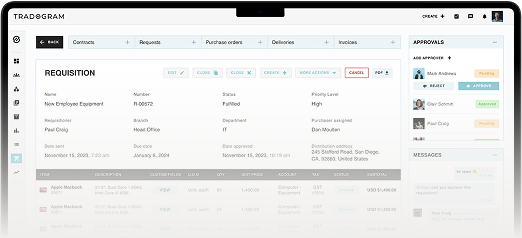
How do you know when things are needed in your business? Emails fly around; nobody knows who is supposed to purchase what, and frustration levels rise. Manual, paper-based systems can be even more tricky, with requests for goods or services getting lost in transit and important purchase activity not happening when needed. You don't need to worry about this today as there are now many purchase order software solution that incorporates a system for creating and approving requisitions internally and digitally.
Requisition is an integral part of procurement and can be implemented by the purchase department of your organization to optimize this process. It is a formal process that documents an internal request to purchase goods for an organization before you create purchase orders.
The purchase requisition workflow standardizes how your team requests purchase items and allows procurement centralization. Without it, team members can often end up contacting vendors independently, confusing the process even more with multiple contact points for your supplier. This article reviews six reasons why your business should use requisitions when purchasing office supplies, raw materials or any other business needs:
- Streamline and Centralize Purchase
- Reduce the Risk of Fraud in Purchase Requisition
- Act as a Control
- Prevent Miscommunication During the Procurement Process
- Manage Purchase Approvals
- Use a Purchase Requisition to Measure Performance
DOWNLOAD THE FULL GUIDE TO SET A PURCHASE REQUISITION PROCESS
1- Streamline and Centralize Purchase
Without a formal purchase requisition system or a team responsible for handling requisition, a business could potentially have multiple people contacting suppliers for the same thing. This could lead to errors, miscommunication, potentially incorrect pricing and a complicated audit trail.
With a requisition process implemented within your purchase requisition system, you can centralize all purchasing requests to one person or department. This also helps you to set rules for who can purchase goods or services and how a purchase order is sent on behalf of your company. With requisition, every purchase get done by a single point of contact within your business. They will help simplify the buying process and allow meaningful and profitable supplier relationships to form between your business and your vendors.
To streamline and centralize purchasing efficiently, make sure to:
- Assign a Team. Ensure one department or individual is responsible for all purchase requests to avoid duplicate orders or errors.
- Set Clear Rules. Define who can approve purchase orders and under what conditions.
- Establish Communication Protocols. Centralize communication with suppliers to simplify negotiations and prevent confusion.
.png)
2- Reduce the risk of Fraud in Purchase Requisitions
Centralizing procurement has many benefits, including reducing fraud. The requisitions within the purchase requisition system act as evidence of a procurement request and is the single source of truth to ensure that all procurement is recorded with a legally binding internal document.
Keeping procurement to an individual or a single team will keep rogue purchasing at bay. This individual or group will become specialized in procurement and be able to perform the function more efficiently and effectively than in a non-centralized structure where anyone can purchase goods or services.
Another critical area to remember when reducing fraud risk in your company's procurement process is to separate who does the buying and who pays the invoices. The separation of duties by business function is called the segregation of duties, which means that specific processes are divided by departments to reduce overall business risk. In man organizations, the purchase department is in charge of buying the goods and services needed while the finance department takes charge of paying invoices.
A few tips on how you can reduce the risk of fraud are:
- Incorporate a software to increase transparency within the company.
- Document all requests to create a traceable audit trail.
- Segregate Duties. Separate purchasing from invoice payments to minimize fraud risks.
3- Act as a Control
Purchase requisition systems are crucial to reducing errors. Avoiding duplicate purchase orders is vital, and a requisition will be where you go to confirm what was ordered and when. Standardizing the process can also help with financial audits and purchase order analysis, making your team question if something is genuinely needed or could wait. The purpose of a control is not to slow down the process too much but to put an opportunity to reflect on if something is genuinely needed. This will help control spend and work within the allocated budget.
The other way a requisition can be used as a control is through the payment process. The finance team can use the requisition as part of the validation process when reviewing supplier invoices and confirming what needs to be paid. Any variance found between what the supplier invoice says and what was requested can be investigated.
In order to enhance control, make sure to:
- Implement Approval Checkpoints. Make sure to assign appropriate personnel to review and approve requests before proceeding with a purchase.
- Avoid Duplicates. Regularly check requisitions against existing orders to avoid duplicates or assign a team member to do it.
- Support Financial Audits. Use requisition data during audits to validate purchasing decisions and ensure compliance.
4- Prevent Miscommunication During the Procurement Process
One of the most significant parts of a requisition is the standardization of the request both internally and in terms of what is sent to the vendor. It contains the information of who is requesting the purchase, what they require, the requisition number, when they need it, and any other information you include in the requisition that is important to your business. Reducing back-and-forth communication will be a gold mine in terms of getting back wasted time of back and forth between team members.
Another great benefit to reducing miscommunication is minimizing the team’s stress levels. A requisition will clearly outline what is required to request procurement and will train the end user to provide all the relevant information at once. The reduction of uncertainty is key to keeping the process running smoothly and in line with the business need.
Before moving forward, let’s overview a few tips to prevent miscommunication:
- Standardize Requisition Forms. Include key details like item description, requester, and deadline to minimize back-and-forth.
- Train Employees. Educate your team on how to fill out requisition forms accurately to reduce errors.
- Reduce Response Time with the right purchase requisition system. With standardized requests, you can significantly cut down on time wasted clarifying details with vendors.
.png)
5-Manage Purchase Order Approvals
A requisition form can be used within the approvals process even if you are using a manual purchasing process. Approvals are essential as it allows you to control your spending and ensure you have visibility into the process. Having a manager sign off as requisition is approved is a great way to implement an approval process.
Approval structures can be built to customize what is needed in your business. All purchases could require approval, or simply purchase requests of a specific dollar amount, purchase category, or certain quantity requested are some examples. Finding a balance between approvals and process speed is critical.
A purchase order software solution optimizes the process between requisition and approval and makes the steps between them seamless. End users would make a purchase request within the system, and it would flow automatically through to the correct approvers instantly for review.
To manage PO approvals easily, make sure to leverage the power of the purchase requisition system and do the following:
- Customize Approval Workflows. Tailor the approval process to match your organization’s needs.
- Monitor Approval Thresholds. Set thresholds for automatic approval or escalation based on the value or nature of the purchase.
6-Use the Purchase Requisition to Measure Performance
Purchase requisitions are a great starting point to measure the performance of your procurement process overall. Requisitions are where you go to find out what people requested initially. Walking through the process tells you if you were able to procure the desired goods in the time frame requested.
Reviewing your purchase requisitions regularly will tell you where you may have potential issues within your procurement and also help with purchase order management.
Are your suppliers able to fulfill orders? Is procurement activity occurring promptly? Are team members mindful of order frequency when requesting procurement? Can we consolidate shipments to potentially save on freight? How has the spend management been since the process was initiated?
Essential measures, such as how much cash is tied up in inventory and the fill rate your suppliers are giving you, are just some of the ways you can track the performance of a good purchase order in your business with requisitions as the source. The great thing about using an order management software for this is that it automates the workflow.
Before moving on to the conclusion, let’s also overview a few quick recommendations of how to use purchase requisition to measure performance:
- Track Procurement Efficiency. Regularly review requisitions to evaluate how quickly goods are procured.
- Analyze Supplier Performance. Use requisition data to assess whether suppliers are fulfilling orders on time and as requested.
- Optimize Inventory Management. Review requisition frequency to identify opportunities to consolidate orders and reduce costs.
Final thoughts
Requisition is the first step in ensuring a streamlined purchasing process and growing your businesses. Between acting as controls and helping document the process, requisitions are the basis of a robust procurement process.
Ensuring that requisition is integrated in a purchase software is a significant step which provides your company with an all-encompassing purchase management solution. Tradogram is the best purchase order software solution that does a fantastic job of giving you complete visibility of your procurement.