
Published
December 28, 2022
| Updated
August 1, 2026

3 reasons why you need to use procurement software

3 Reasons Why You Shouldn't Delay a Decision About Procurement Software

Procurement software usually gets postponed for the same three reasons: timing, budget, and the belief that the current process is good enough for now. Here is what each delay costs a growing purchasing team, and the signs it is time to move off email and spreadsheets.

Majdi Sleimen, COO of Tradogram
3 Reasons Why You Shouldn't Delay a Decision About Procurement Software
Take control of your procurement
Book A Demo

Does any of the following sound familiar?

"Sorry for the delay in my response, I was involved with another project and couldn't check my phone, email, or nearby smoke signals. However, I have reviewed your procurement software. We use email and spreadsheets right now, so tell me again why we should implement this? Even if we were to incorporate this kind of system, it wouldn't be for another 6 months as we're currently busy with a minor auditing situation. We prefer to continue using manual processes because, to be honest, that's all we know." - Message sent via fax.

It gets worse...

"Widgets Unlimited Co. would like to thank you for the 4 hours you spent with us on the phone three times in the past week. We absolutely love the software and will be able to move forward once we convince Jerome (and not Anita) to present the information package to HQ in Montreal. Management likes Jerome. They almost fired Anita last year (just between us). The software is more likely to be viewed as economical and intelligent if it comes from the 'right' person. So we'll let you know ASAP if Jerome has agreed. I should also mention that here at WUC our understanding of 'ASAP' is quite unique - just like our brand identity. Perhaps we could schedule a fourth demo in the interim? Thanks again, we'll send you a basket of nuts on every statutory holiday."

Although exaggerated, this type of correspondence isn't entirely fictitious. Companies of all sizes face numerous roadblocks before they're able to begin implementing new procurement software. Best intentions are forgotten in the face of interdepartmental miscommunication, an infinite hierarchy of decision-makers, and internal software policies that must be adhered to with increasing rigidity.At a time when technology is designed to ease communication challenges (rather than make them worse), why are these problems still so prevalent, and what can be done to minimize the effects of red tape? When the decision-making process is delayed with no end in sight, the consequences begin to accumulate. This table reviews the top three reasons to make a decision sooner, rather than later.‍

One: YOU'LL SAVE MONEY & IMPROVE REVENUE

Every minute that passes without a system in place to streamline your purchasing results in lost revenue. A lack of control over procurement can quickly cause overspending. When it's possible to gain immediate insight into corporate spending, why not take advantage of this and determine what costs can be eliminated?

‍Two: YOU'LL SAVE TIME & INCREASE EFFICIENCY

‍The earlier your company can make a decision about procurement software, the earlier the technology can be implemented to increase purchasing efficiency. All manual processes are replaced with automation to heighten control over company spend and reduce the amount of time employees are tied up with mindless tasks. As a safety precaution, seek an easy-to-implement solution that can grow with the demands of your organization.

‍Three: YOU'LL ENHANCE COMPETITIVENESS

‍Once you select the best procurement software for your organization you can immediately begin negotiating better deals with suppliers and gain visibility into your entire process end-to-end. This results in savings that can be transferred over to your customers, generating a competitive advantage that will secure industry dominance.

In summary, a limitless amount of time to make a decision generally means a decision will never be made. It's more likely that too many options will enter the equation, features will be reviewed in extreme detail, and management will be paralyzed by an excess of choice. This results in a return to your outdated, manual processes.

Keep this in mind when beginning the procurement software selection process if you want to avoid hearing the endless hum of a fax machine: it doesn't pay to delay.

Frequently Asked Questions

What are the signs a business has outgrown spreadsheets for purchasing?
The reliable signals are operational rather than volume-based: duplicate or missing purchase order numbers, invoices arriving for purchases nobody can locate, approvals that cannot be evidenced when finance asks, and departments maintaining private trackers because the shared one is never current. Another is the monthly reconciliation that grows a little longer each period. Multiple locations or departments raising orders independently accelerates all of these, because spreadsheets do not merge across sites without someone doing it by hand. When the same manual correction work recurs every month, the process has outgrown the tool.
What does delaying a procurement software decision actually cost?

The costs accumulate quietly. Staff hours go into rekeying, chasing approvals and reconciling records that a connected process would produce automatically. Spend continues outside any negotiated agreement because nobody can see it in time. Duplicate and overpaid invoices go uncaught without matching against orders and receipts. Audit preparation takes weeks rather than days. None of these produce an invoice, which is precisely why they are easy to defer. The practical exercise is estimating hours spent per month on work the process creates rather than work that creates value, then comparing that against implementation effort.

How long does procurement software take to implement?

For a mid-sized organization, a straightforward implementation covering requests, approvals, purchase orders and supplier records is usually measured in weeks rather than months. The variables that extend it are the state of your supplier data, how many approval rules need configuring, and whether integration with an accounting or ERP platform is in scope. The work that most often gets underestimated is cleaning supplier records, since duplicates and inconsistent naming carried over from spreadsheets undermine reporting from day one. Starting that cleanup before the project begins tends to shorten the whole timeline.

How do you build a business case for procurement software?

Build it on time recovered and risk reduced, then add negotiated savings as the upside rather than the headline. Time is the most defensible component because it can be estimated from current practice: hours spent creating orders manually, chasing approvals, reconciling invoices and preparing audit documentation. Risk covers duplicate payments, off-contract buying and gaps in approval evidence. Savings claims are harder to defend before you have the spend data, which is itself an argument for the system. Presenting the case with a measurable baseline makes it easier to demonstrate the result afterwards.

Written by:

Majdi Sleimen, COO of Tradogram
Co-Founder & COO, Tradogram

Majdi Sleimen is the Co-Founder of Tradogram and a procurement expert with deep experience in source-to-pay processes and procurement optimization. He focuses on helping organizations streamline purchasing workflows, improve control over spend, and adopt more efficient procurement systems through technology-driven solutions.

Take control of your procurement with Tradogram

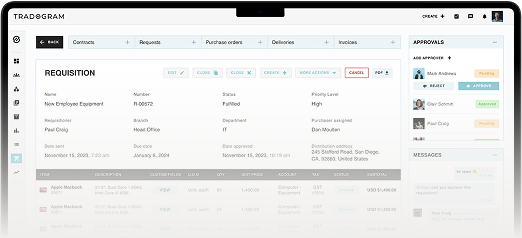
Tradogram requisition dashboard showing an approval workflow Book A Demo