Published
February 27, 2023
| Updated
September 2, 2026

5 ways to free yourself from purchasing chains

5 Ways to Free Yourself from Purchasing Chains

Supplier negotiation goes better when you are not negotiating from a corner. This article looks at five habits that limit purchasing leverage, from late involvement to vague contract terms, and what to change so procurement enters the conversation with room to move.

Majdi Sleimen, COO of Tradogram
5 Ways to Free Yourself from Purchasing Chains
Take control of your procurement
Book A Demo

Procurement's three-way relationship with Negotiations and Contracts can use these words as its mantra:

"Only free men can negotiate. A prisoner cannot enter into contracts."

Does purchasing really want to disagree with Nelson Mandela?

5 Ways To Free Yourself From Purchasing Chains

Avoid being a captive of contract leakage, or even worse, pre-contract maverick spending. Let Tradogram demonstrate how negotiated savings can become realized savings through the strategic use of contracts. In keeping with Mandela's style, here are 5 revolutionary benefits of optimal Contract Lifecycle Management (CLM) - otherwise known as freedom:

  1. The terms and conditions of an order can be established in advance. The time required to complete single or multiple transactions will be greatly reduced, therefore increasing day-to-day business efficiency (time is money!). As an added bonus, non-purchasing employees are in the clear to focus on their core competencies without having to hunt down a manager in procurement.
  2. Preferred suppliers are easier to identify. The ability to access all your previous contracted data and measure vendor performance can only lead to noticeable frontrunners. These are the suppliers that will continue to secure contracts, while you gain the advantage of their proven reliability. The systematic negotiations that result from higher supplier capability mean faster and better quality shipments and a greater likelihood that the desired terms will be achieved. Additionally, these negotiations typically come with a lower price, which leads us to....
  3. Purchasing power can be consolidated. Any company leveraging the power of volume orders will experience savings, and contracts facilitate this process. How? Ordering items in bulk is a more organized process internally that happens to create a domino-effect of financial advantages from external sources: vendors have more incentive for offering the best possible price when they receive a healthy portion of your business. Use contracts as a tool to set these savings in motion.
  4. Real-time snapshots and graphics provide visual data. Changes made to a contract are immediate - no delay while you wait days for your supplier to receive the document. If this isn't useful enough, Tradogram also provides all necessary contract details in a "snapshot" within the application: creation and expiration dates, currency, buyer & supplier info, and more are all instantaneously visible. Effortless and unrestricted purchasing, savings included.
  5. Automation helps you manage. This is short and sweet: automatically create POs from contracts and send them to suppliers in no time at all! With Tradogram, once a contract expiration date has been set, the system will automatically remind you to renew it with just a click. Your freedom, that is. ;)

Frequently Asked Questions

Looking for purchase approval workflow automation tools that are easy to use and enforce compliance without IT hassle, any recommendations for mid-sized organizations?
The automation tools that work best for mid-sized organizations without a dedicated IT team are usually ones you can configure yourself through a settings screen, defining approval rules by department, amount, or location, rather than ones that require custom development or vendor consulting to set up. Look for tools that enforce compliance automatically, blocking a purchase from moving forward without the required approval, rather than just flagging non-compliance after the fact. Ease of use matters as much as functionality here, since a tool your team avoids because it's clunky defeats the purpose; a workflow that's simple enough for non-technical staff to use consistently is often more valuable than one with more features nobody uses.
What are the signs that a manual purchasing process is holding a business back?

The clearest signs are approvals that stall because the approver is unavailable, invoices arriving for purchases nobody remembers authorizing, and finance being unable to answer how much has been committed this month without assembling it by hand. Others include buyers rekeying the same order details into several systems, departments keeping private spreadsheets because the official process is too slow, and suppliers calling to chase orders that were approved but never issued. Individually each looks like a minor inefficiency. Together they indicate the process depends on people remembering steps rather than the system enforcing them, which stops scaling once purchasing volume grows.

How can a company reduce the time spent chasing purchase approvals?

Reduce approval chasing by replacing email with routing rules that send each request to the right approver automatically and show the requester where it currently sits. Most delay is not deliberation but requests sitting unread in an inbox, so visibility into queue position removes much of the follow-up. Adding delegate approvers for planned absences and setting thresholds so low-value routine purchases skip senior sign-off removes more. The aim is not to approve faster by loosening controls but to stop requests waiting on someone who does not know they are waiting, which is a different problem with a different fix.

Which purchasing tasks are worth automating first?

Start with approval routing and purchase order creation, because they are high-frequency, rule-based and the source of most delay. Routing rules remove the manual decision about who should review a request, and generating the purchase order from the approved request removes a rekeying step and the errors that come with it. Invoice matching is usually the next candidate, since it is repetitive and its exceptions are exactly what finance needs to see. Leave sourcing, negotiation and supplier selection until the transactional layer is stable, because automating those before the underlying data is consistent tends to produce confident output from unreliable inputs.

Written by:

Majdi Sleimen, COO of Tradogram
Co-Founder & COO, Tradogram

Majdi Sleimen is the Co-Founder of Tradogram and a procurement expert with deep experience in source-to-pay processes and procurement optimization. He focuses on helping organizations streamline purchasing workflows, improve control over spend, and adopt more efficient procurement systems through technology-driven solutions.

Take control of your procurement with Tradogram

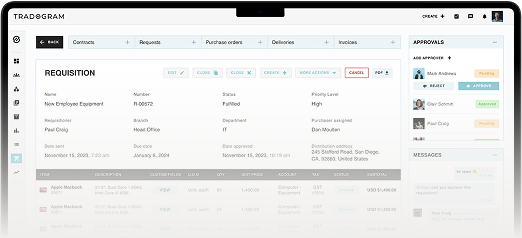
Tradogram requisition dashboard showing an approval workflow Book A Demo