Published
March 15, 2023
| Updated
September 3, 2026

6 tips to take your procurement team from average to world-class

6 Tips To Take Your Procurement Team From Average to World-Class

World-class procurement teams are built the same way strong sports teams are: clear roles, honest performance review, and practice on the fundamentals. Here are six tips for moving a purchasing team from reactive order processing to work that shapes what the organization buys.

Majdi Sleimen, COO of Tradogram
6 Tips To Take Your Procurement Team From Average to World-Class
Take control of your procurement
Book A Demo

Do you ever find yourself staring off into space in a procurement department meeting wondering how Cristiano Ronaldo, Lionel Messi, or Marta would conduct themselves in a similar situation? Although it may seem like corporate purchasing and professional soccer are fields apart (perhaps one with greener grass), world-class players - aka, footballers - might actually have a lot to teach MNEs. For example, determination, patience, leadership, relationship-building, and a commitment to at least 10,000 hours of work are some points of commonality.

Don't worry, this blog won't be a guilt trip if your team isn't currently sprinting towards 10,000 hours of work.

According to a study conducted by The Hackett Group, world-class procurement departments are able to operate with 20% less costs than the average company, and they're doing this with 27% fewer employees. So what kind of strategies are these organizations implementing that set them up to be the award winners of corporate spend?

1) TRAIN WITH MANAGEMENT
An entire company relies on the goods/services obtained by a procurement team, so all members must have effective communication with management. This ensures that objectives are aligned, budgets are realistic, and the purchasing workflow is as smooth and transparent as possible. The organization is free to play offense at full capacity when a procurement team is in sync with the management.
2) CHEER FOR SUPPLIER INNOVATION
If optimal, a buyer-supplier relationship will be mutually beneficial. So rally your procurement team to support supplier innovation! This means reduced costs for goods/services, improved shipping options, and high-quality suppliers with greater drive to remain loyal. A desire to continuously improve fuels both the buyer and the supplier in this arrangement.
3) MAKE DATA YOUR BEST COACH
Analytics can be easily accessed and used to identify maverick spending while informing future purchasing decisions. A supplier's performance can be tracked and rated, POs can be viewed over a given time period, latest purchases can be updated in real-time, and more. In 2016, failing to take advantage of data may result in a penalty on par with ignoring the advice of a coach.
4) DEVELOP AGILE TALENT
The best procurement teams are able to see beyond their own movements and anticipate the effects of external forces. In the next few decades a high number of retiring baby boomers have to potential to create a deficit of knowledgeable professionals. Procurement departments deemed to be 'world-class' are proactively monitoring market trends and scouting employees to fill the widening gap.
5) DON'T SWEAT TECH
Technology options can feel overwhelming, especially when many procurement teams approach the challenge from the wrong end. Organizations functioning at an optimal level begin the process by identifying those systems that need improvement, and then proceed to select the technology that best suits their needs. Avoid being sidelined by tech pressure when you should be thinking 5 moves ahead.
6) COMMIT TO GREEN
Best-in-class procurement teams that are interested in scoring the game-winning goal must guarantee that their purchasing is environmentally-friendly and sustainable in the long-term. Both buyers and consumers are now considering these factors when selecting suppliers, so companies that don't make a green commitment will quickly lose their competitive edge.


Frequently Asked Questions

Why do cloud-based features matter for small business procurement software?

Cloud-based procurement software matters for small businesses mainly because it removes the IT overhead of maintaining servers or software installations, which a lean team with limited IT capacity usually can't take on anyway. It also means approvals and purchasing can happen from anywhere, which matters when staff are working across multiple locations or aren't always at a desk. Real-time visibility is another practical benefit: everyone involved in a purchase, from the requester to the approver to accounting, sees the same up-to-date information instead of waiting on a periodic export or email update. For a small business, cloud deployment is usually less about a specific feature and more about keeping the software itself out of the way.

What's the difference between policy enforcement and policy monitoring in procurement?

Policy enforcement stops a purchase that violates policy from happening in the first place, usually through approval rules that require sign-off before spend is committed, while policy monitoring reviews purchases after the fact to see whether policy was followed. Enforcement is generally more effective for a small team, since catching a problem before money is spent avoids the harder work of unwinding an already-completed purchase. Real-time monitoring still has value as a backstop, flagging unusual spending patterns that predefined approval rules might not catch. Most small teams get the best results by combining both: automated approval enforcement for known rules, and periodic monitoring for everything else.

How can a finance team get more control over spending with automation?

Automation gives finance control by putting a checkpoint in front of every purchase instead of catching spending after the fact in the accounting system. Automated routing sends requests to the right approver based on amount or department, and budget checks at the point of request show whether funds are actually available before a purchase is approved. This shifts finance from reviewing spending after it's happened to seeing and shaping it before it's committed. The bigger the gap between committed spend and what shows up on a monthly report, the more automation tends to help.

How do you connect purchasing systems across multiple subsidiaries to one accounting system?

Connecting purchasing across multiple subsidiaries to one accounting system usually requires procurement software with integration or API access to the accounting platform, so purchase orders, receiving records, and invoices from each subsidiary sync back to a single ledger without manual re-entry. Without that connection, each subsidiary's finance team often re-keys purchasing data separately, which increases the chance of errors and slows month-end close. The integration matters most when subsidiaries share a chart of accounts or need consolidated financial reporting at the parent level. Look for software that supports this kind of connectivity natively rather than through manual file exports and imports.

Is Tradogram good software for reducing manual procurement work on a small team?

Tradogram is built for organizations that have outgrown manual purchasing but don't need a full enterprise system, which fits many small teams handling growing purchase volume. It automates purchase requests, approval routing, and purchase order creation, and its TradoScan feature can pull data from invoices automatically instead of requiring manual entry. Father Joe's Villages, for instance, saw PO processing drop from 2 to 3 business days down to a few minutes after switching from a manual process. Whether it's the right fit depends on how many people are involved in buying and how much approval complexity your team actually needs.

How does centralized purchasing software change what a procurement department does day to day?

Centralized purchasing software shifts a procurement department's day-to-day work away from manually collecting requests and chasing approvals, and toward reviewing spend patterns, managing supplier relationships, and handling exceptions that actually need judgment. When routine requests route themselves through predefined approval rules, the team spends less time as a processing bottleneck and more time on work that requires expertise, such as negotiating with suppliers or analyzing where spend is going. This shift matters most in departments that were previously centralized in name only, with requests still coming through scattered emails and spreadsheets. The department's role becomes oversight and strategy rather than administration.

Written by:

Majdi Sleimen, COO of Tradogram
Co-Founder & COO, Tradogram

Majdi Sleimen is the Co-Founder of Tradogram and a procurement expert with deep experience in source-to-pay processes and procurement optimization. He focuses on helping organizations streamline purchasing workflows, improve control over spend, and adopt more efficient procurement systems through technology-driven solutions.

Take control of your procurement with Tradogram

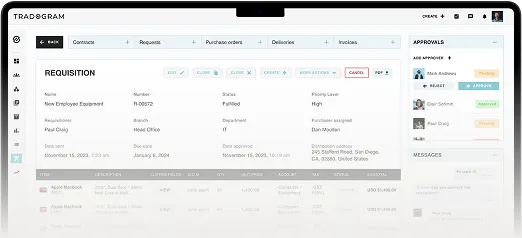
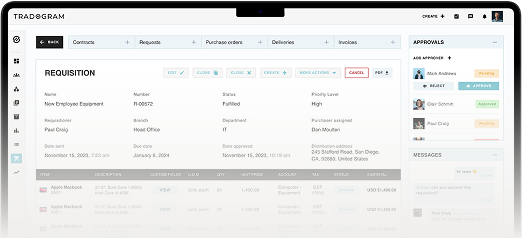
Tradogram requisition dashboard showing an approval workflow Book A Demo