
Published
April 17, 2023
| Updated
August 4, 2026

How cloud software changed what buyers expect from enterprise procurement

A Millennial and Enterprise Software Walk into a Cloud

Enterprise software once meant a server room and a long implementation. This article looks at how cloud procurement changed expectations for setup time, cost, and usability, and what that shift means for teams evaluating a purchasing system today.

Majdi Sleimen, COO of Tradogram
A Millennial and Enterprise Software Walk into a Cloud
Take control of your procurement
Book A Demo

Have you ever gone an entire day without looking at yourself in a mirror? Not even catching an accidental glimpse? Unlikely, and vanity doesn't enter the equation. We've designed mirrors to be imbedded in the human experience: they're on/in bathrooms, hallways, foyers, compact cases, ceilings, cars, and endless other locations. We reflect (pun intended), monitor, and interpret what we see, an act that is native to our very existence.

Technology has become our new "mirror" and millennials are the first generation of digital natives, casting their decentralized gaze on enterprise software (programs used by businesses). The effects of tech are everywhere and taken for granted by those who were born between 1980 - 2000, although there's some debate about the exact date range.

This millennial generation grew up in a time of rapid globalization and economic disruption. They have been politely described as constantly connected, tech-savvy, socially-aware, collaborative….and they're posed to reinvent the corporate status-quo. According to 2015 internet trends, 46% of B2B decision makers are millennials. The generation that lives online buys online, both at home and at work.

In 2014 the top enterprise software companies by revenue included Microsoft, oracle, IBM, and SAP. However, companies like Slack, Checkr, and Gainsight have been competing with these heavyweights by proving that workplace tools can be fun and interactive while still maintaining optimal functionality. Online communication has shifted its tone: value is placed on personalization and emotion. Due to this shift in perspective, previous generations are struggling to keep pace with the speed at which millennials utilize data and make connections. For example, social media has become a major component of software branding - studies have demonstrated that 34% of 18-35 year-olds like a product more when it leverages a social media platform. Ease of doing business is prioritized over industry expertise (for better or for worse) when millennials browse B2B vendors; instant access to price comparisons, product information, and peer reviews is expected by default.

Another millennial philosophy that has infiltrated, or corrupted, enterprise software is the concept of a "sharing economy". This is the preference of access over ownership - people would rather lease than own software, as ownership is considered to be a burden. Cloud-based applications that inspire agility and interoperability are appearing across all industry sectors. It would be logical to think that so much sharing could be risky, especially in terms of data security, but millennials have grown up understanding the intricacies of transparency. Generally speaking, they know what is and isn't safe to share. If a millennial happens to be your employer, this is good news!

‘Tap' and ‘share' have become part of our vocabulary while ‘save' and ‘click' fade to antiquity. This evolving language is causing millennials to ask questions about the future of technology, something that prior generations have always done. However now the question isn't how do we make existing technologies better, but instead, what is the next big thing people will want to use? Since mirrors have already been invented, maybe we need crystal balls. With Wi-Fi connectivity, of course.

Frequently Asked Questions

How has cloud software changed procurement technology?
Cloud delivery changed the economics and the timeline. Procurement systems once required server infrastructure, specialist administration and implementations measured in quarters, which put them out of reach for organizations below enterprise scale. Cloud deployment removed the infrastructure cost, shortened setup to weeks, shifted pricing to subscriptions that scale with use, and made updates continuous rather than disruptive projects. The practical consequence is that mid-sized organizations can now run purchasing processes that were previously available only to companies with dedicated IT teams and capital budgets for software.
Why did enterprise procurement software move to the cloud?

It moved because both sides benefited. Buyers avoided infrastructure investment, lengthy implementations and the burden of maintaining and upgrading systems themselves, while gaining access from any location, which mattered increasingly as teams distributed. Vendors gained predictable subscription revenue and the ability to improve a single hosted version rather than supporting many customer-specific installations. The result was a substantially lower barrier to entry, which is the main reason procurement software is now a realistic consideration for organizations that would never have contemplated an on-premises deployment.

Why do modern buyers expect business software to be easy to use?

Because the people evaluating and using business software now spend their personal lives with consumer applications that require no training, and they apply the same standard at work. That expectation has practical consequences for procurement systems specifically, since the users are not procurement specialists but employees across the business raising occasional requests. A system those people find confusing simply gets bypassed, and purchases return to email. Usability is therefore not a preference in this category, it is what determines whether the process is followed at all.

What should you look for when evaluating cloud procurement software?

Look at how quickly your own team could be working in it, since implementation time and training burden are where cloud advantages are either realized or lost. Check how supplier data and approved invoices move to and from your accounting platform, because a disconnected system relocates manual work. Confirm what configuration you can change yourself versus what requires vendor involvement, as that determines how the system adapts as you grow. Ask about data ownership and export as well, so you know what leaving would involve before you commit.

Written by:

Majdi Sleimen, COO of Tradogram
Co-Founder & COO, Tradogram

Majdi Sleimen is the Co-Founder of Tradogram and a procurement expert with deep experience in source-to-pay processes and procurement optimization. He focuses on helping organizations streamline purchasing workflows, improve control over spend, and adopt more efficient procurement systems through technology-driven solutions.

Take control of your procurement with Tradogram

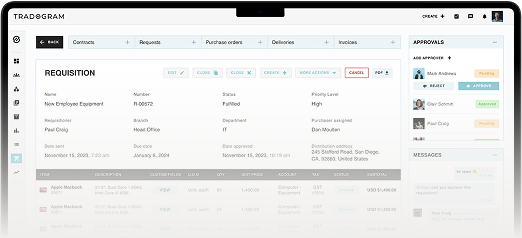
Tradogram requisition dashboard showing an approval workflow Book A Demo