
Published
May 17, 2023
| Updated
August 5, 2026

Deciding on a procurement solution?

At a Crossroads Trying to Decide on a Procurement Solution?

Choosing a procurement solution is difficult when the days are already full and every option promises the same result. This article covers how to judge what your process actually needs, which problems software solves first, and how to compare options without a six-month evaluation.

Majdi Sleimen, COO of Tradogram
At a Crossroads Trying to Decide on a Procurement Solution?
Take control of your procurement
Book A Demo

You're up against unrealistic deadlines, you can't seem to complete a single task before new ones pile up, and the entire office is sluggish & uncooperative. Does your workplace reality leave you lost? Now imagine you're also responsible for selecting the company's latest procurement management software. If this was a Choose Your Own Adventure the very first choice you make could spark a lightbulb moment:

To choose your procurement management software based on criteria such as price, ease of navigation, and reliability, please proceed to tradogram.com/features. Here you'll be able to explore a multitude of options and contemplate which procurement features are most suitable to your needs. Select this option and you'll be amazed by the purchasing functions at your fingertips. The 'Learn More' button will lead you to a PDF that describes these features in more detail.

Please proceed to tradogram.com/company/contact-us if you want your procurement decision to be almost effortless - complete the Send a Message form and request the eProcurement Comparison Document. We'll send you an Excel document that will allow you to objectively compare features of various eProcurement solutions. The best choice will become obvious.

Either option will take you to the same user-friendly "map". This is because Tradogram wants to make your route to eProcurement as intuitive and painless as possible, especially if/when you feel lost in the unknown world of procurement software.

To further help readers understand the importance of making a wise eProcurement decision, we've created a checklist that answers the question "what do you want your eProcurement solution to do for you?" The more boxes you tick off the better...be economical with your spending, not eProcurement benefits.

Enhance supplier relations and regularly evaluate their performance.

Increase the adoption rate of requisitioners using the system, allowing orders to be sent to the right person automatically.

Improve contract compliance by minimizing off-contract maverick spending.

Automate and improve processes such as creating POs and send them through the proper approval routes with zero effort.

Maximize savings and secure better deals by negotiating effectively with suppliers.

Establish and maintain an auditable process by archiving reports that can be easily retrieved.

Track budgets and analyze spend at all company levels for exemplary purchasing habits.

Streamline the sourcing process through the creation of standardized Requests (RFPs and RFQs).

Frequently Asked Questions

How do you work out which procurement features you actually need?

Start from the problems you currently have rather than from a feature list, because vendor comparisons tend to reward breadth over fit. Document where your process breaks down: approvals that stall, orders created manually, invoices that cannot be matched, spend nobody can see. Each of those maps to a capability, and the mapping tells you what is essential rather than desirable. Features solving problems you do not have add cost and complexity while contributing nothing. The exercise takes a few hours and is the difference between evaluating options and being presented to.

What should you compare when evaluating procurement solutions?

Compare on how the system handles your actual process rather than on feature counts. The questions that differentiate are how approval rules are configured and whether you can change them yourself, how the system connects to your accounting platform, what implementation involves and how long it takes, how supplier records are structured, and what reporting is available without custom work. Pricing structure matters too, specifically what scales with users, transactions or modules. Requesting a demonstration using a purchase resembling your own is more informative than a standard product walkthrough.

Who should be involved in choosing a procurement solution?

Include the people who will use it daily, the finance stakeholder who owns the control requirements, and at least one representative from a department that raises requests but does not work in procurement. That last group is usually excluded and is precisely who determines whether the system gets adopted or bypassed. IT should assess integration and security without owning the decision. Keeping the group small enough to move is important, but excluding the everyday users is the most common cause of a system that satisfies procurement and nobody else.

What is the most common mistake when selecting procurement software?

Choosing on feature breadth rather than on whether the system fits how the organization actually buys. The broadest option looks like the safest choice, but capability that goes unused still carries configuration effort, training burden and cost, and it frequently comes with complexity that discourages the occasional users whose adoption the process depends on. The second most common mistake is not checking the accounting integration closely enough, since a purchasing system that cannot pass approved invoices through cleanly relocates manual work instead of removing it.

Written by:

Majdi Sleimen, COO of Tradogram
Co-Founder & COO, Tradogram

Majdi Sleimen is the Co-Founder of Tradogram and a procurement expert with deep experience in source-to-pay processes and procurement optimization. He focuses on helping organizations streamline purchasing workflows, improve control over spend, and adopt more efficient procurement systems through technology-driven solutions.

Take control of your procurement with Tradogram

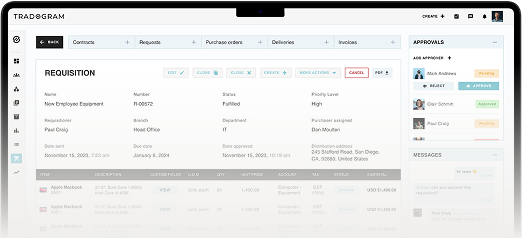
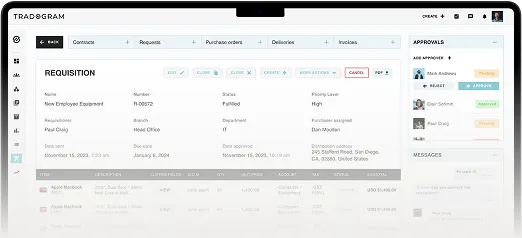
Tradogram requisition dashboard showing an approval workflow Book A Demo