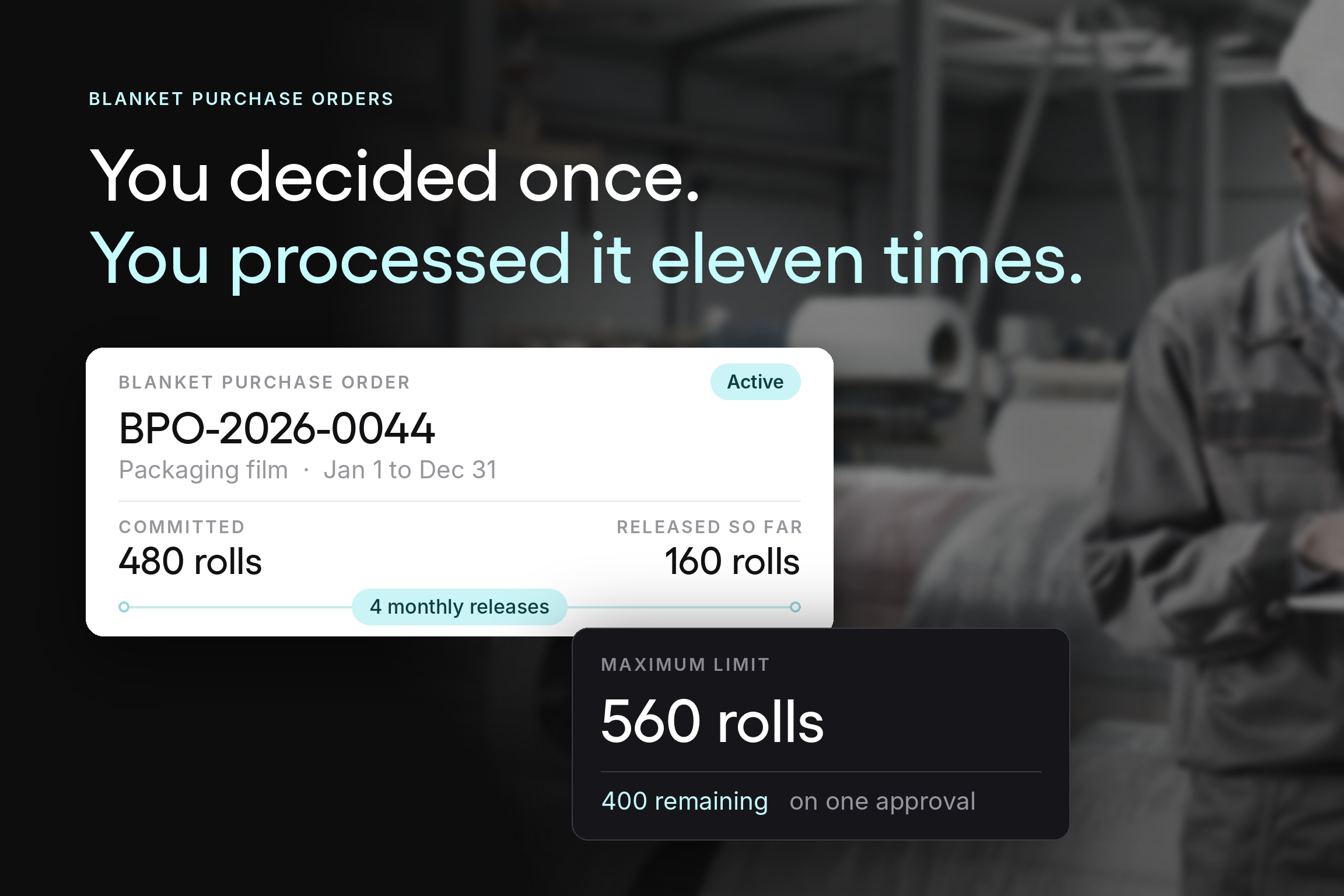


If your team raises the same purchase order to the same supplier for the same item eleven times a year, you are paying eleven times for the paperwork on one commercial decision.
With blanket purchase orders, instead of a separate order for every delivery, you agree to the terms once for a defined period, then draw against that agreement as needed. The negotiation happens once. The approval happens once. The individual deliveries become releases rather than new purchases.
The savings are easier to quantify than most procurement improvements. APQC benchmarking puts the cost of processing a single purchase order anywhere from roughly $14 to more than $54, depending mostly on how much manual handling sits between the steps. Multiply the difference by the number of repeat orders you place, and the math takes care of the rest.
This guide covers what a blanket purchase order is, exactly what goes into one, how the process works, three worked examples, the benefits and the genuine risks, and how to manage blanket POs so they do not quietly drift away from the terms you agreed.
Key Takeaways
- A blanket purchase order is one agreement covering multiple deliveries over a set period at pre-negotiated terms. It replaces a series of individual POs for recurring purchases, which removes the repeat approval cycle.
- The administrative savings are real, and the pricing savings are usually larger. Committing to volume gives you leverage you do not have when buying the same quantity in eleven separate transactions, and consistent pricing removes the mid-year cost surprises that come with spot buying.
- Blanket POs work on predictable demand and fail on unpredictable demand. If you cannot forecast the quantity within a reasonable range, a fixed-price commitment transfers risk to you rather than removing it.
- The main risk is drift, not price. Blanket POs left unmonitored accumulate off-agreement releases, expire without anyone noticing, and lock in pricing that the market has moved past. Quarterly review is what prevents all three.
What is a blanket purchase order?
A blanket purchase order, often called a blanket PO, blanket purchase agreement, standing purchase order, or blanket agreement, is a long-term agreement with a single supplier covering multiple deliveries of specified goods or services over a defined period at agreed-upon prices.
Rather than issuing a new purchase order each time you need something, the blanket agreement sets the commercial terms once, and each subsequent delivery draws against it.
Those draws are usually called releases, release orders, or call-off orders, and they do not require the full approval cycle a new purchase order would trigger. Larger organizations sometimes structure this as a master blanket PO with subordinate agreements per site.
This arrangement simplifies recurring purchases and suits businesses with predictable, repeating demand and established supplier relationships. It is most common for office supplies, raw materials, consumables, packaging, and recurring maintenance services, though it works for anything where you know roughly what you will need and from whom.
What is specified in a blanket purchase order?
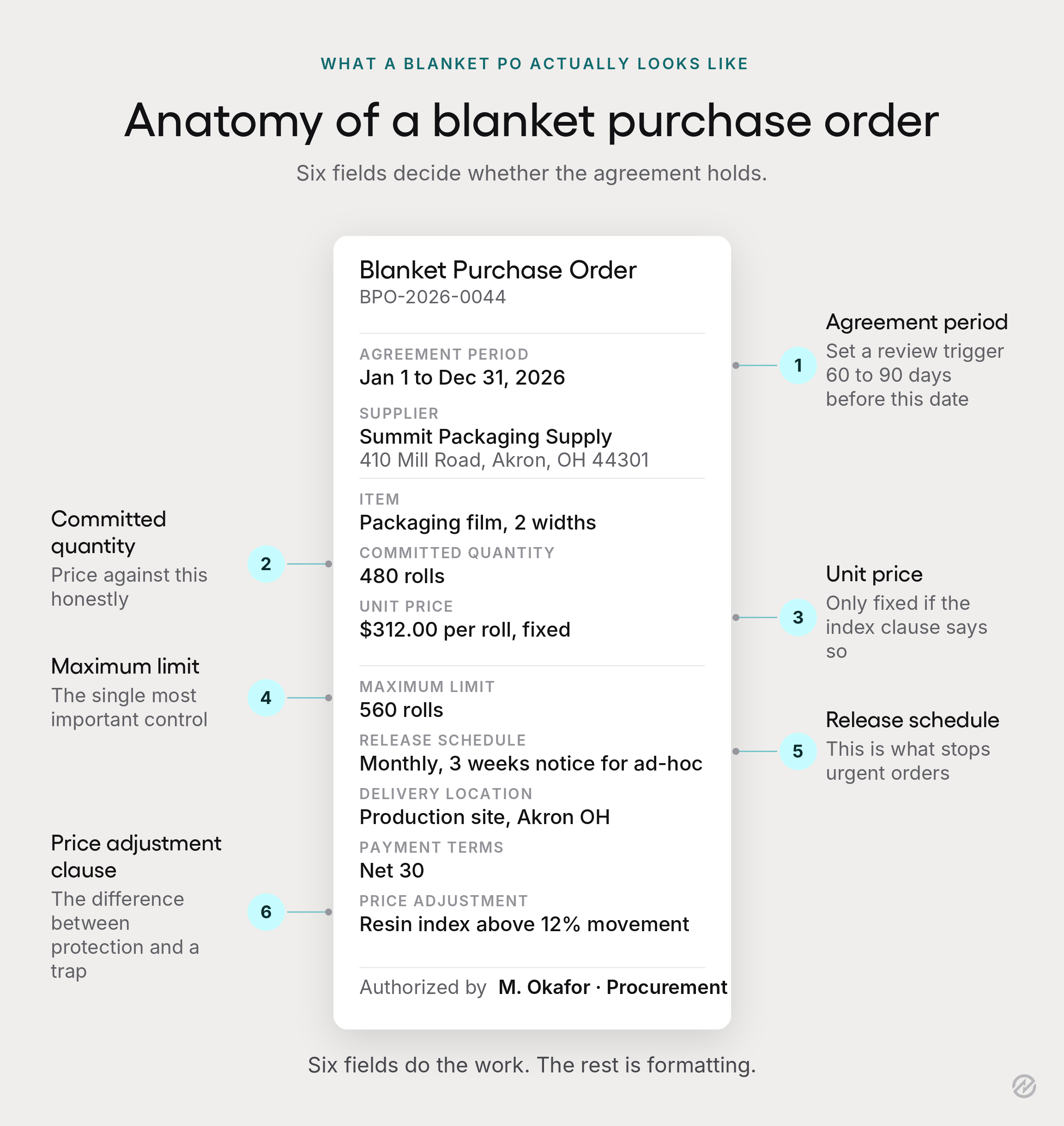
A well-constructed blanket PO defines six things. Getting any of them wrong is where the problems start.
Pricing and contract terms. Fixed unit prices, or an agreed indexation mechanism if you expect market prices to move. Payment terms, delivery terms, and any volume discount tiers.
Items and exact quantities, or an estimated range. The items or services covered, with either committed quantities or a forecast range. Be clear with the supplier about which one it is, because a supplier pricing against a firm commitment will price differently than one pricing against an estimate.
Delivery schedules and locations. How often, to where, and with what notice period for a release. This is where you coordinate multiple deliveries in advance.
A maximum limit. Either a total value cap or a maximum quantity, or both. This is the single most important control on a blanket PO, because it is what stops the arrangement from becoming an open-ended commitment.
The agreement period. Start and end dates, usually 6 to 12 months, occasionally longer for stable categories. Expiration dates should be visible to whoever manages the relationship, not buried in a document.
Cancellation and change clauses. What happens if demand disappears, if quality slips, or if either party needs to exit. Termination rights that require a dispute to exercise are not much use.
Blanket purchase order versus standard purchase order
The distinction is simple and worth stating precisely, because it determines which one you should use.
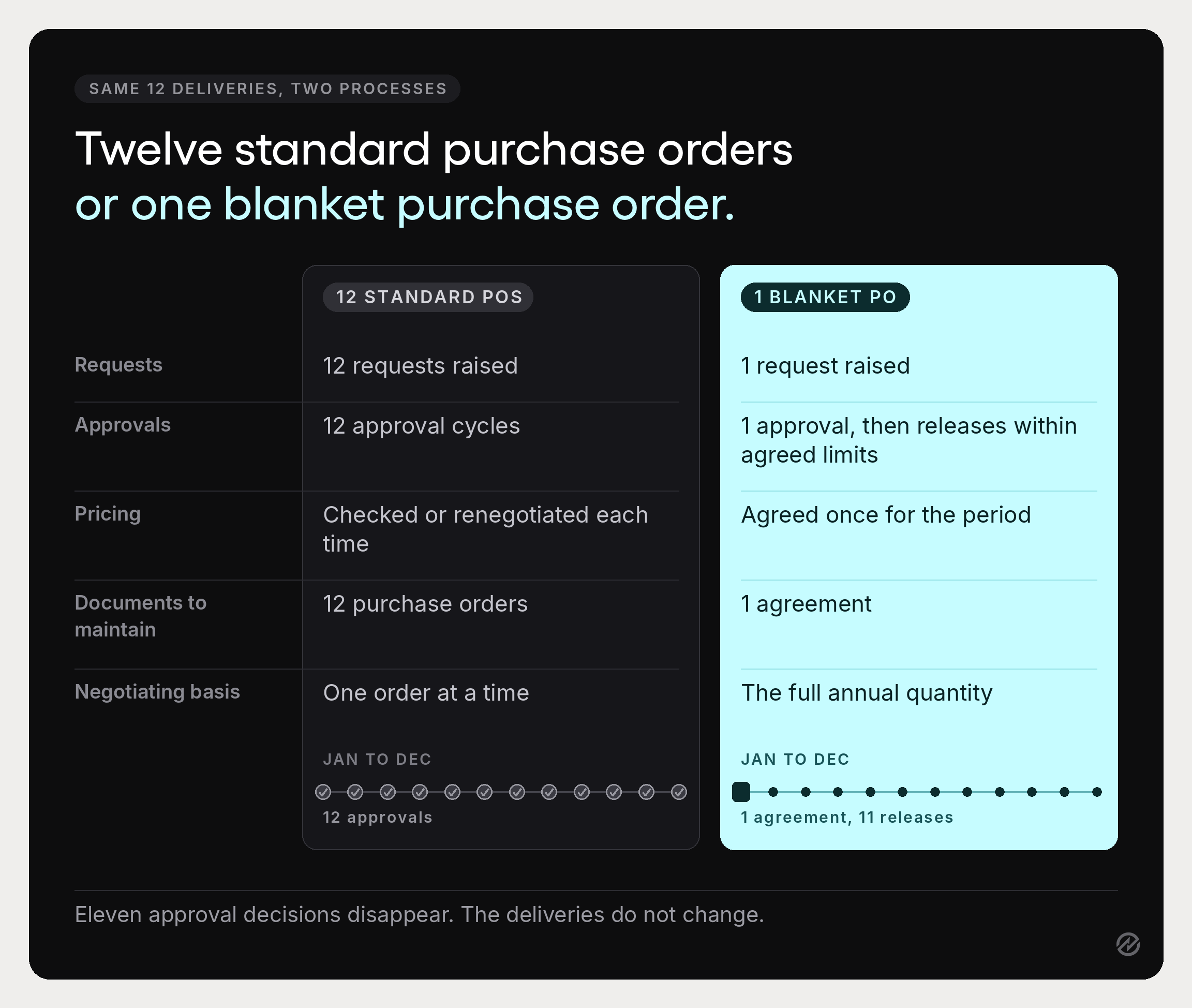
A standard purchase order covers one transaction: specific items, a specific quantity, one delivery, one approval. It suits one-time purchases and anything where the requirements are particular to that occasion.
A blanket purchase order covers recurring purchases over a specified period: agreed terms, multiple deliveries, one approval at the outset and lightweight releases thereafter. It suits repeat purchases from the same vendor where the requirement is consistent.
The practical difference shows up in the approval process. Standard POs require new approvals for each purchase. Blanket POs require one approval at setup, after which releases run against the agreed limit. That is the entire source of the administrative savings, and it is also the reason the maximum limit matters so much: the approval control moves from the individual purchase to the agreement.
How blanket purchase orders work
The blanket PO process runs in five stages.
1. Identify the opportunity. The procurement team reviews purchase history to find items bought repeatedly from the same supplier, the first step in deciding which recurring procurement needs are worth consolidating. This is a spend analysis exercise, and it is where most organizations discover they place far more repeat orders than they realize.
2. Agree terms with the supplier. Negotiate unit pricing, the agreement period, delivery expectations, the maximum limit, and any volume discounts, ideally through proper supplier management records, not a name in an inbox. Suppliers generally price better here because committed volume and a longer horizon reduce their uncertainty.
3. Approve internally. The blanket PO goes through the approval process once, typically at a higher level than a routine order because the committed value is larger. Communicating the spending limit at this stage prevents charges beyond the approved amount later.
4. Release against the agreement. When stock runs low or a service is needed, someone raises a release rather than a new purchase order. The release references the blanket PO, draws down the remaining quantity or value, and goes to the supplier without a fresh negotiation.
5. Receive, match, and pay. Receive deliveries against the release, match invoices to the release and receiving record through three-way matching, and pay per the agreed terms. The blanket PO’s remaining balance updates automatically in any system worth using.
Stage four is where blanket POs succeed or fail operationally. If releases are easy, people use the agreement. If the ordering process for a release is as much work as raising a new purchase order, they will do the latter, and the agreement will sit unused while spend leaks around it. Blanket orders only streamline recurring purchases when the release itself is genuinely lighter than the alternative.
Blanket purchase order examples
Abstract definitions only get you so far. Here are three worked examples across different categories, with the numbers filled in. The figures are illustrative, but each agreement follows the structure of a working one.
Example 1: Office supplies and indirect spend
A 180-person professional services firm buys paper, toner, and general office supplies from one vendor. Last year it placed 34 separate purchase orders averaging $840 each, for roughly $28,600 in total.
The blanket agreement:
| Field | Value |
|---|---|
| Supplier | Contracted office supplies vendor |
| Agreement period | 12 months, January 1 to December 31 |
| Items covered | 62 catalog SKUs at agreed unit prices |
| Estimated annual volume | $30,000 |
| Maximum limit | $34,000 |
| Release method | Department administrators order from the catalog, with no approval under $500 |
| Delivery | Next day, to two office locations |
| Price protection | Fixed for 12 months, one review point at month 6 |
What changes: 34 approval cycles become one. Administrators order from a catalog instead of raising requisitions. Because the vendor prices against $30,000 of committed volume, the firm negotiates roughly 8% off list on the catalog SKUs, or about $2,400 before any administrative savings.
The control that matters: the $34,000 cap. Without it, catalog ordering with no approval under $500 is an open tap.
Example 2: Raw materials and direct spend with scheduled releases
A food manufacturer buys a packaging film it uses across three product lines. Demand is predictable within about 10%, and the material has a 3-week lead time.
The blanket agreement:
| Field | Value |
|---|---|
| Supplier | Primary packaging supplier |
| Agreement period | 12 months |
| Item | One film specification, 2 widths |
| Committed quantity | 480 rolls, roughly 40 per month |
| Unit price | $312 per roll, fixed |
| Maximum limit | 560 rolls, to allow for demand upside |
| Release method | Scheduled monthly release, plus ad-hoc releases with 3 weeks' notice |
| Delivery | Monthly to the production site |
| Price protection | Fixed, with a resin index clause allowing adjustment above a 12% movement |
What changes: the production team stops raising urgent purchase orders when stock runs low, because the monthly release is already scheduled. The committed 480-roll volume earns a price roughly 6% below the spot rate the manufacturer had been paying, worth about $9,500 across the year.
The control that matters: the resin index clause. On a direct material with real commodity exposure, a flat 12-month fixed price protects you if prices rise and traps you if they fall. The index clause caps the downside on both sides.
Example 3: Maintenance services, recurring but variable
A multi-site retailer contracts HVAC maintenance across 14 stores. Scheduled servicing is predictable. Callouts are not.
The blanket agreement:
| Field | Value |
|---|---|
| Supplier | Regional HVAC maintenance contractor |
| Agreement period | 24 months |
| Services covered | Quarterly scheduled service at 14 sites, plus reactive callouts |
| Rates | $340 per scheduled service visit; $145 per hour for callouts; parts at cost plus 12% |
| Estimated annual value | $41,000 |
| Maximum limit | $52,000 per year |
| Release method | Scheduled services auto-release; callouts released by the store manager up to $800, above that by the facilities manager |
| Price protection | Rates fixed for 24 months |
What changes: store managers stop calling whoever is available at whatever rate. Every visit runs at contracted rates against one agreement, and the facilities manager can see cumulative spend across all 14 sites in one place.
The control that matters: the two-tier release authority. Services agreements are where blanket POs most often drift, because the work is variable and nobody wants to block an urgent repair. Setting a release ceiling per site preserves the control without slowing the callout.
The five benefits of blanket purchase orders
The case for blanket POs usually rests on paperwork, the smallest of the five benefits below. The pricing and predictability gains are larger and slower to appear.
1. Lower administrative costs
This is the benefit people buy for. Consolidating recurring purchases into a single agreement removes repeat approvals, repeat negotiations, and repeat data entry, cutting administrative overhead across the purchasing process.
Given the APQC range of roughly $14 to more than $54 per purchase order, an organization replacing 34 standard POs with one blanket PO and 34 lightweight releases removes most processing cost from 33 of them.
The cost savings scale with how many repeat orders you place and how manual your procurement process is. Organizations already running automated purchasing see smaller gains in administrative work because their per-order cost is already low. They usually see a larger pricing gain instead.
2. Better pricing through volume
Committing to an annual quantity gives you leverage that thirty-four separate transactions do not. Volume discounts, tiered pricing, and simply being a customer worth retaining all follow from the commitment rather than from the negotiation skill applied on any single order. The result is pricing that is both better and more consistent.
Consistent pricing is worth something on its own. Knowing your unit cost for the next twelve months makes it far easier to manage budgets and removes the mid-year cost increases that come with buying at spot. For categories with steady demand, this is one of the more reliable forms of cost control available.
3. Operational efficiency and fewer stockouts
Scheduled releases mean the reorder decision happens on a calendar, not when someone notices the shelf is empty. That single change removes most emergency purchasing, and emergency purchasing is where premium pricing, expedited freight, and substituted specifications all creep in.
Procurement teams spend less time on administrative tasks and more on the sourcing work that moves costs. For businesses carrying stock, predictable delivery schedules make it easier to hold appropriate inventory without swinging between overstock and shortage, and the agreed lead time becomes something you can plan production around.
4. Stronger supplier relationships
A supplier with a twelve-month commitment behaves differently than one filling ad-hoc orders. You get better responsiveness, earlier warning of supply problems, consistent product quality from a team that knows your specification, and priority when allocation gets tight.
Improved supplier relationships are a real benefit here, not a soft one, and they show up when something goes wrong. A supplier allocating constrained stock works down a list, and committed customers with clean payment records sit near the top. That is worth more in a shortage than the few percent the agreement saved you in a normal quarter.
The commitment also changes the conversation on the supplier’s side. Account managers can justify investment in your relationship when they can forecast the revenue, which is how you end up with dedicated contacts and proactive notice instead of a shared inbox.
5. Clearer cash flow visibility
Because the agreement defines expected volumes and delivery dates, you can forecast when the invoices will arrive and roughly what they will say. For recurring operational expenses, this makes cash flow planning materially more accurate than trying to predict a stream of individual purchases.
It also makes budgeting simpler at the start of the year. A category covered by a blanket PO at fixed pricing is a known number in the plan. Finance can build a forecast around it without revising the estimate every quarter.
The challenges and risks of blanket purchase orders
Blanket POs carry real risks, and the biggest ones come from how the agreement is managed.
Forecasting risk. The whole arrangement rests on predicting demand within a reasonable range. Get it badly wrong, and you either fall short of a committed volume or hold material you no longer need. This is the reason blanket POs should not be used where quantities cannot be forecast.
Price lock-in cuts both ways. Fixed pricing protects you when market prices rise and prevents you from benefiting when they fall. On volatile categories, an index clause or a shorter agreement period is usually better than a flat twelve-month fixed price.
Dependency on a single supplier. Consolidating volume with one vendor improves your pricing and concentrates your risk. If that supplier has a capacity problem, a quality failure, or a financial one, you have fewer alternatives, less recent experience with anyone else, and long-term commitments that make it harder to switch suppliers quickly.
Over-ordering and over-commitment. Easy releases are the point, and they are also the danger. Without a maximum limit and release authority set deliberately, blanket POs become a way to spend without scrutiny.
Drift from the original terms. Over time, releases start including items outside the agreement, prices creep above the contracted schedule, and nobody notices because each individual release looks small. This is the most common failure and the least dramatic, and it is what makes it hard to maintain compliance with your own agreement.
Committed funds. A blanket PO ties up budget longer than a series of individual purchases, which matters more for businesses managing tight working capital.
When not to use a blanket purchase order
Avoid them for one-time purchases, highly customized items, categories where prices move unpredictably and you cannot agree on an index, situations where exact pricing is unknown at the outset, and anything where you cannot forecast quantity with reasonable confidence.
Two cases deserve a specific warning. The first is a new supplier whose quality you have not yet validated, where a twelve-month commitment is a bet placed before you have the evidence to place it. Run standard POs for a quarter first. The second is a category undergoing genuine change, whether a specification is being redesigned or a market is restructuring, where locking terms now means locking them to a requirement that will not exist in six months.
When should a business use a blanket purchase order?
The conditions that make a blanket PO worthwhile are specific enough to check against.
- You buy the same goods or services repeatedly from the same vendor.
- Demand is predictable within roughly 10 to 15% over the agreement period.
- Unit costs are clearly definable in advance.
- A single supplier can fulfill the requirement throughout the contract period.
- Staggered deliveries suit you better than one bulk purchase, either for storage or cash flow reasons.
- Bulk ordering qualifies for meaningful volume discounts.
- A long-term supplier relationship is strategically favorable, instead of something you want to keep flexible.
If five or more of those hold, a blanket agreement will almost certainly pay for itself. If fewer than three do, individual POs are probably the right call.
Managing blanket purchase orders
Setting one up is the easy part. Keeping blanket purchase orders delivering requires discipline.
Set clear parameters at the outset. The maximum limit, the release authority, the items covered, and who can raise a release. Ambiguity in any of these is where misuse starts.
Implement release approval workflows based on order value. Releases should not require the full approval cycle, but they should not be unlimited either. A tiered threshold, such as no approval below a set value and a manager above it, keeps the speed without losing the control.
Track spending against the agreement continuously. You need to see the remaining balance, not just the total spent. Any system worth using shows the drawdown in real time; if you are running blanket POs on spreadsheets, this is the number that gets stale first.
Review performance quarterly. Check spend against forecast, pricing against the agreed schedule, delivery performance against the terms, and whether releases are staying inside the items covered. Quarterly is frequent enough to catch drift and infrequent enough that people actually do it.
Document every release. Each release should trace back to the agreement, with its own receiving record and invoice match, so both parties stay aligned on what has been drawn and what remains. This is what makes the audit trail hold and what keeps invoice matching straightforward.
Start renewal evaluation 60 to 90 days before expiration. Expiration dates that arrive unnoticed produce one of two bad outcomes: purchasing continues with no agreement in place, or the agreement rolls over on terms nobody reviewed. Both are avoidable with a calendar trigger.
Reassess whether the agreement still fits. Business needs change. A blanket PO that made sense when you had one production line may not when you have three, and a supplier that was the obvious choice two years ago may not be now.
How procurement software helps
Blanket POs are manageable on spreadsheets in the way that most things are manageable on spreadsheets, which is to say up to a point and then not.
Procurement software handles the specific mechanics that make blanket agreements work:
- Creating the agreement with its maximum limit
- Letting authorized users raise releases that draw against it automatically
- Showing the remaining balance without anyone calculating it
- Applying approval workflows by release value
- Surfacing expiration dates before they arrive
- Matching invoices to individual releases, not just to the agreement as a whole.
The reporting matters as much as the mechanics. Seeing spend by agreement, releases by department, and pricing variance against the contracted schedule turns a blanket PO from a commitment into a managed arrangement.
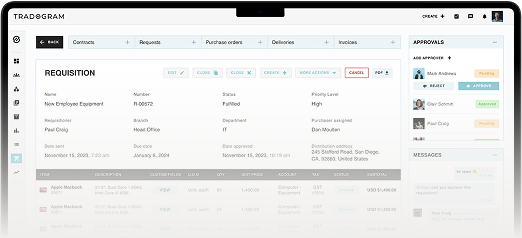
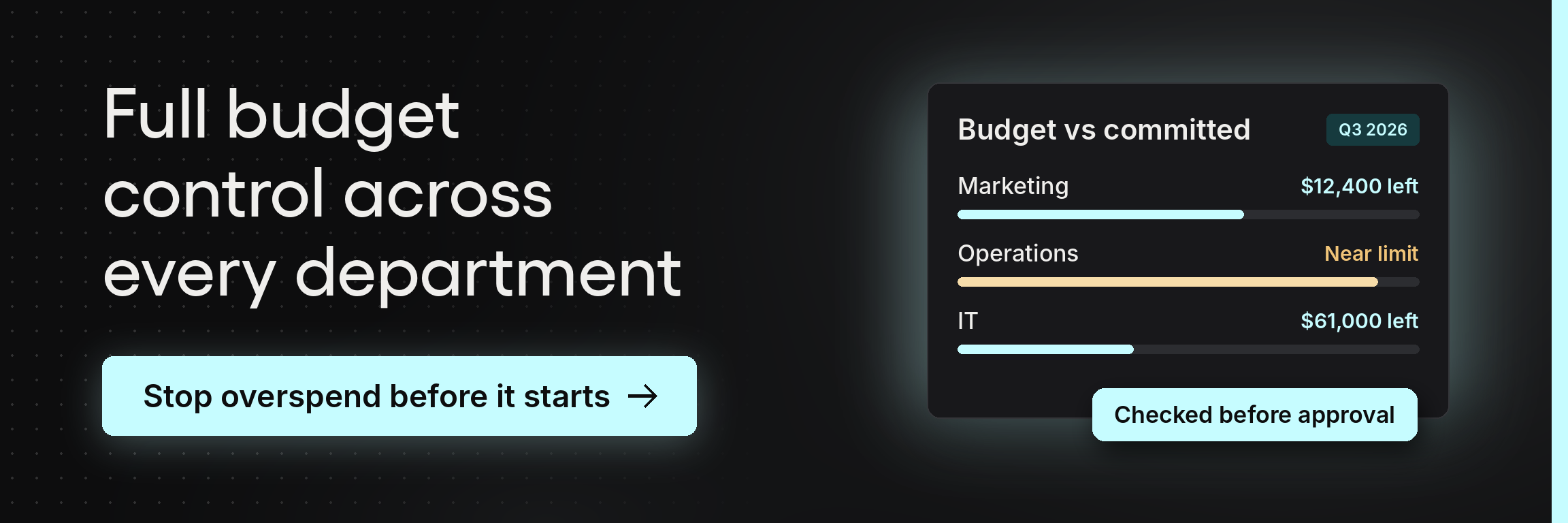
How that looks varies by platform. In Tradogram, a blanket purchase order is created the same way as any other purchase order, so there's no separate process to learn.
The difference is what happens after approval: a single Tradogram purchase order can carry multiple deliveries and multiple invoices, so each delivery is received and invoiced against the same PO instead of starting a new one.
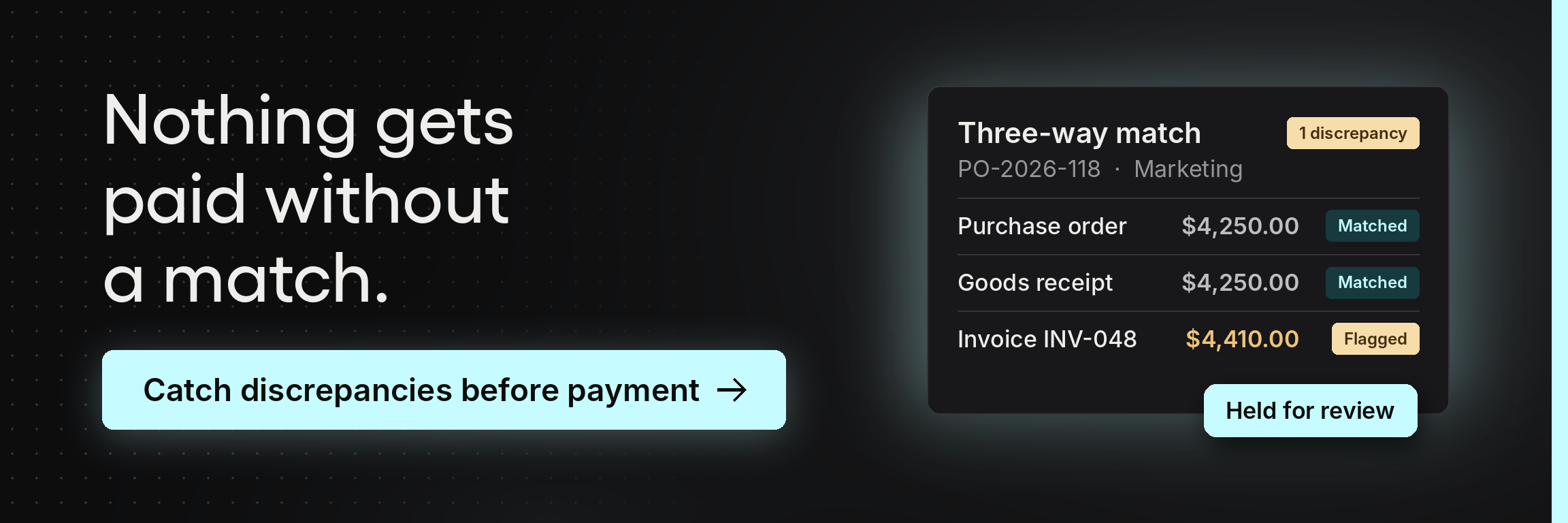
The agreement is approved once, each delivery is recorded as it arrives, and each invoice is matched against the purchase order and receiving records before payment.
Are blanket purchase orders contracts?
Largely, yes, and the distinction is worth understanding.
A purchase order is a commercial document representing the buyer’s offer to a supplier. When the vendor accepts it, it typically becomes a binding agreement. A blanket purchase order works the same way: once accepted, both parties are bound to the terms it sets out for the period it covers.
That said, not all contracts are purchase orders. A contract typically encompasses more complex terms, including specific deliverables, quality standards, service levels, liability provisions, and conditions particular to the arrangement. Many organizations run a master services agreement or supply contract alongside a blanket PO, with the contract management system holding the legal terms and the blanket PO holding the commercial and operational ones.
For lower-value, straightforward categories, a well-constructed blanket purchase order is usually sufficient on its own.
For higher-value or higher-risk arrangements, pair it with a contract and make sure the two don't contradict each other, which they often do when different people write them at different times.
Choosing the right purchase order type
Blanket POs are one of four common purchase order types, and picking the right one is often half the battle.
Standard purchase orders cover one-off or occasional purchases with specific, detailed requirements. The most common type and the right default.
Planned purchase orders specify item, quantity, and price up front but leave delivery details open, with delivery released once timing becomes clear. Useful when you know what you need but not exactly when.
Blanket purchase orders, also called standing orders, arrange regular supplies of consistent items over a defined period. Typically 6 to 12 months with specified intervals and delivery arrangements.
Contract purchase orders exclude item lists entirely and establish legally binding reference terms that other purchase orders follow. They set the foundation for subsequent orders.
The different types of purchase orders guide covers each in more detail, including where the boundaries between them get blurry in practice.
Whichever type fits, the process around it still needs approvals that move, budgets checked before money is committed, and invoices matched before they're paid. To see how Tradogram handles that across your purchasing, book a demo.