

Most companies can produce a purchase order. Far fewer can point to the purchasing procedures that govern it.
That gap matters because a purchase order is the only purchasing document that keeps going after you finish it. A purchase request gets approved and stops. An invoice gets paid and stops. A purchase order stays open. Goods arrive against it, sometimes in parts. Invoices reference it. Quantities get amended, dates slip, and somebody agrees to a change over the phone that never makes it into the document.
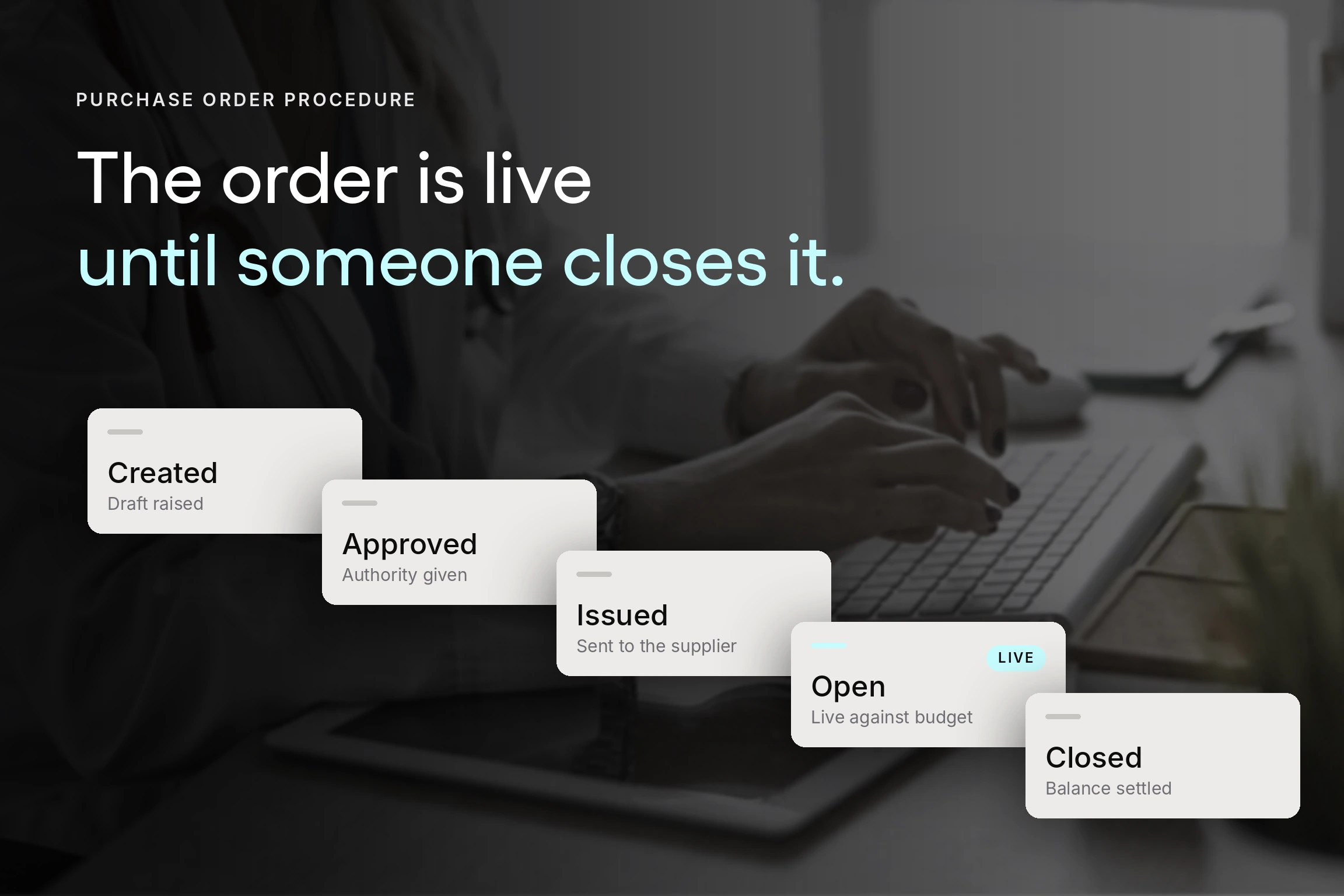
Until it closes, that order is a live commitment against your budget whether anyone is watching or not. Which is why most purchase order trouble is open-order trouble rather than creation trouble: orders partially received and forgotten, orders closed because most of the shipment turned up, orders still open for goods that arrived last year. Purchase orders record commitments, not just expenses, and that is what separates the PO process from every other step in the purchasing cycle.
A purchase order procedure answers the questions that arise across that lifecycle. This guide walks through the purchase order process step by step, from creation to close, then lays out the best practices worth writing down.
What a purchase order procedure must answer
A procedure is a set of answers to questions people currently resolve by asking a colleague. Test any draft against these seven. Answer all of them, and you have a formalized purchasing process. Answer three, and you have an explainer.
- Who may raise a purchase order, and for which categories?
- What information must be present before an order can be issued?
- Who approves at each value, and who approves when that person is unavailable?
- Which purchases require an order, and which are exempt?
- Who may amend an issued order, and what triggers re-approval?
- What happens when a delivery is short, late, or wrong?
- Who closes an order, and on what evidence?
This guide covers the purchase order specifically. The entire procurement process around it, from identifying a need through supplier evaluation, sits in our guide to the procurement cycle, alongside the procurement strategies that decide what gets bought.
The purchase order creation process
The purchasing process begins with a need, not a purchase order. In a functioning process, the order is created from an approved purchase requisition, and creation is largely a transfer: the specification, correct quantity, and appropriate budget code carry forward, joined by the supplier, agreed price, and terms settled during strategic sourcing and contract negotiation.
Orders created from scratch aren't traceable to an authorization, so nobody can show who approved the spend, and payment details get retyped, introducing errors that surface at invoice matching long after the context has faded.
State plainly what an order may be created from. "Every purchase order for goods or services must reference an approved purchase requisition" is a strong default, with named exceptions rather than case-by-case judgment.
The seven things every purchase order needs
A purchase order (PO) is a commercial instruction, and the supplier's acceptance often turns it into a legally binding contract. Whether a given order becomes a legally binding agreement, and on whose terms, depends on your jurisdiction and what is attached, so confirm that with your own advisors. What is not in dispute is that gaps in this legally binding document become disputes later.
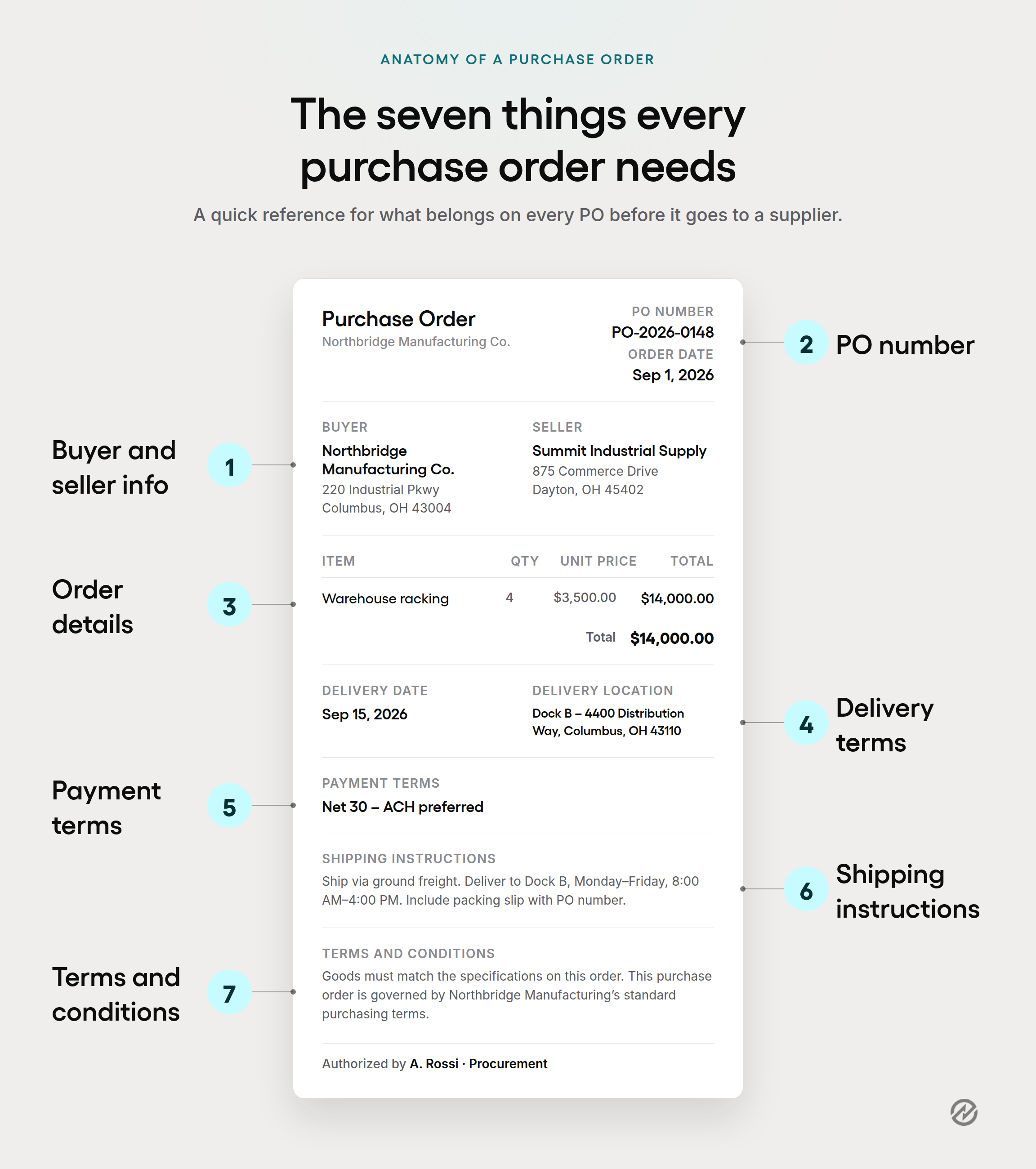
Seven things belong on every purchase order before it goes out.
Unit of measure is the field most often skipped and the most expensive to get wrong: ordering twelve when the supplier prices by the case is a different commitment from ordering twelve units. Two more things belong at the foot of the document. An approval record, showing the order cleared the approval process, and a budget or cost center code, so the commitment is visible to the right owner without a lookup.
Order types change the procedure, not the fields
Those fields apply to a standard order. Each other type needs a line in your procedure naming when it is used and who may raise it, because the risk differs. A blanket purchase order suits routine buying from a preferred vendor, but it lets someone commit spend repeatedly without fresh approval, which is efficient when the ceiling is set correctly and a control gap when it is not. Give every blanket order a value ceiling and an expiry date, and treat raising one as a higher-authority act. The full types of purchase orders are covered separately.
Approval: the stage everyone documents and most get wrong
Nearly every procedure includes an approval section. Most describe a hierarchy and stop, leaving the two questions that actually cause delays unanswered.
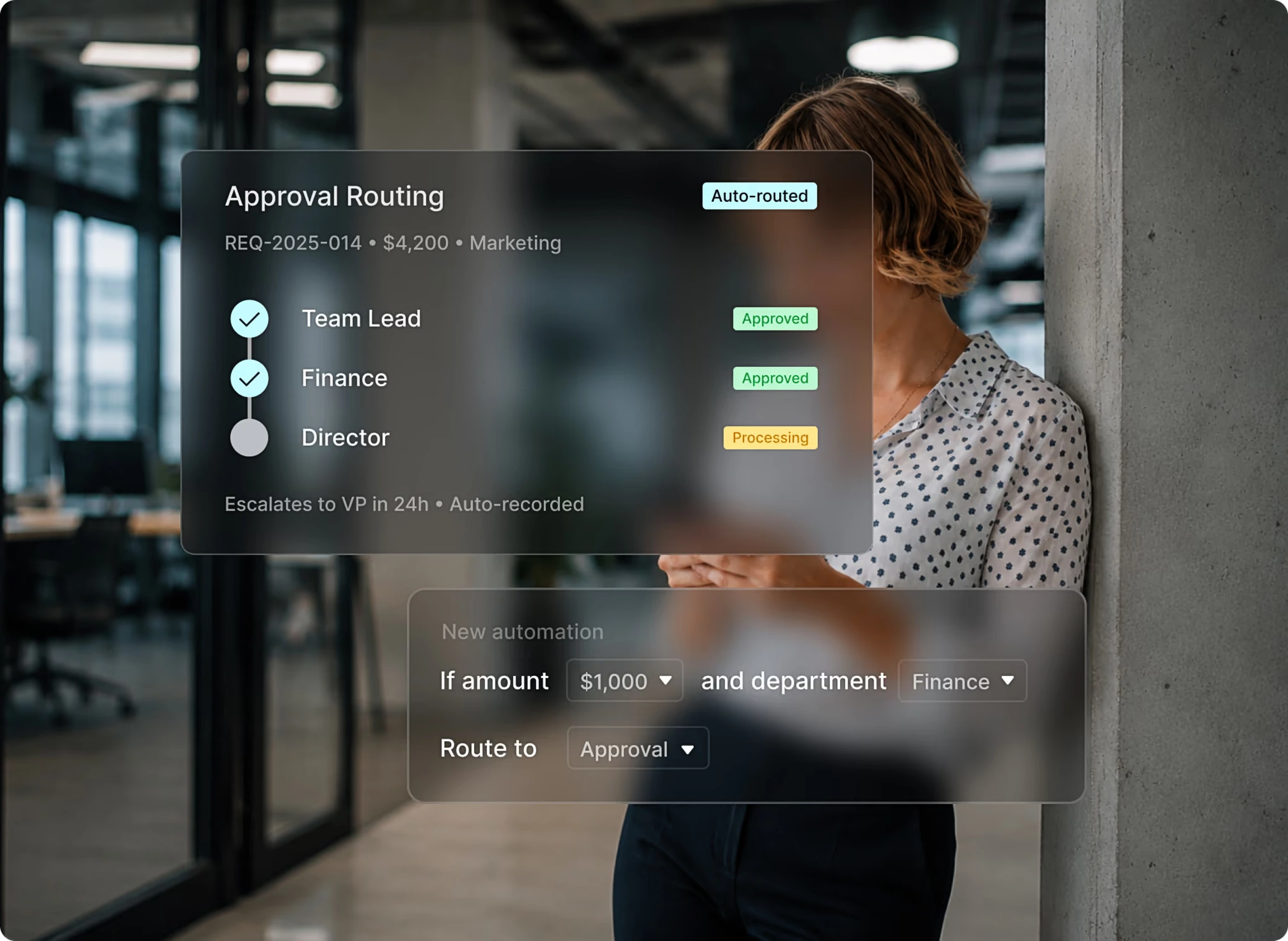
What can each role clear alone? Set thresholds so routine purchases never reach management, and significant commitments always get read. If most orders need more than two approvals, the thresholds are too low, and the cost shows up as cycle time.
Who approves when the approver is unavailable? This omission accounts for a large share of stalled orders. An approval workflow with no named deputy at each level stops working during holidays. Write deputies into the procedure, not into somebody's out-of-office.
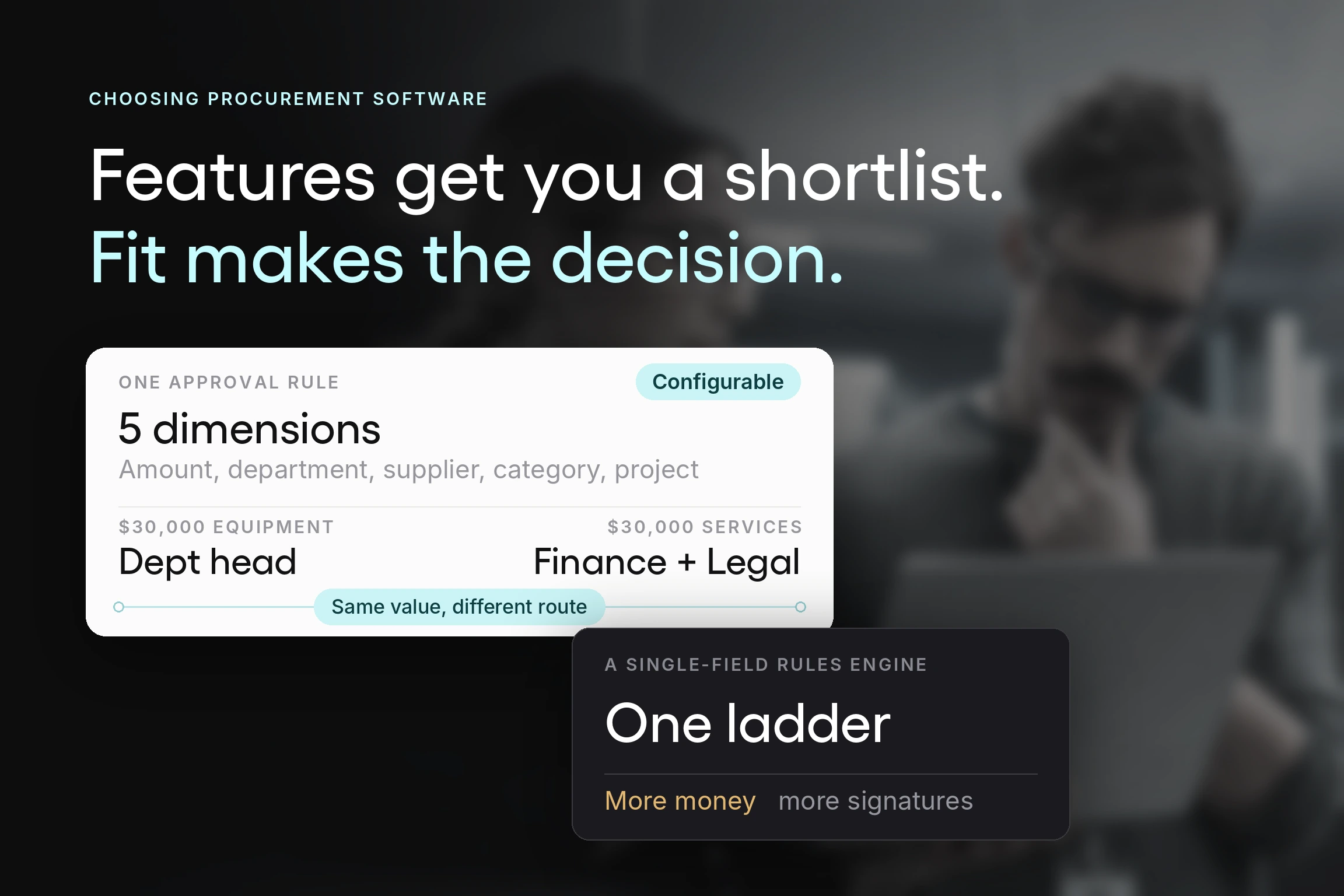
Beyond value, route by category, because a software subscription and a piece of machinery warrant different scrutiny at the same price, and by department or site, since department heads may clear things a central procurement department should not have to see.
Each additional level adds waiting time and diffuses accountability. Add one only when you can name the risk it catches.
Issue: the point of commitment
Issuing means sending the approved order to the supplier. It deserves three explicit rules.
Only approved orders may be sent. Worth stating, because the pressure to send an urgent order ahead of its approval is real and normalizes fast.
Orders go to the agreed channel. A named contact, a supplier portal, or a system-to-system connection. An order emailed to whoever answered last time may never be actioned.
Acknowledgment is expected and recorded. An order you sent is not an order the supplier accepted. Requesting confirmation turns a document you issued into a mutually satisfactory arrangement both sides are working from. For made-to-order goods it matters more, because the real point of no return is when the supplier begins work, on their schedule and without telling you.
The open period: where the procedure earns its keep
An issued order stays open until someone closes it. Three kinds of events land against it during that window, and each needs a rule.
Receipts
Goods and services arrive and are recorded against the order. The rules worth writing down cover the awkward cases, not the clean ones.
Partial receipts. When six of twelve items arrive, the order stays open with six outstanding. Skipping that record is how a genuine shortage becomes an accounts payable mystery a month later.
Over-receipts. Set a tolerance and an owner. Below a stated percentage, accept and record. Above it, refer to whoever raised the order.
Rejections. State who may reject, what evidence is required, and who tells the supplier. Rights of rejection expire on a deadline set in the terms, so speed here is a procedural requirement.
Amendments
This is the quiet failure point in most purchase order procedures.
At Tradogram, we have helped thousands of organizations move purchasing into a system, and undocumented amendments are the single most common reason a three-way match fails during implementation.
A supplier calls to say the price has moved or delivery will be two weeks later. Somebody agrees. The order doesn't change, and weeks later an invoice arrives matching an agreement nobody documented and contradicting the order everyone can see.
Three rules resolve it. Amendments are made on the document, not in an email thread. Amendments above a stated threshold trigger re-approval, because otherwise the authority that cleared the original order has been reassigned to whoever took the call. And the amendment history is retained, so the order shows what changed, when, and who agreed it. Set that threshold as a percentage of order value with a floor: too low and a two-dollar movement generates an approval cycle, too high and material changes bypass control.
Invoices
Invoices reference the order and get matched against it and the delivery receipts. That verification process is three-way matching, and its accuracy depends on the receipts and amendments above having been recorded properly. State the variance tolerance that clears automatically and what happens to an invoice arriving with no order behind it.
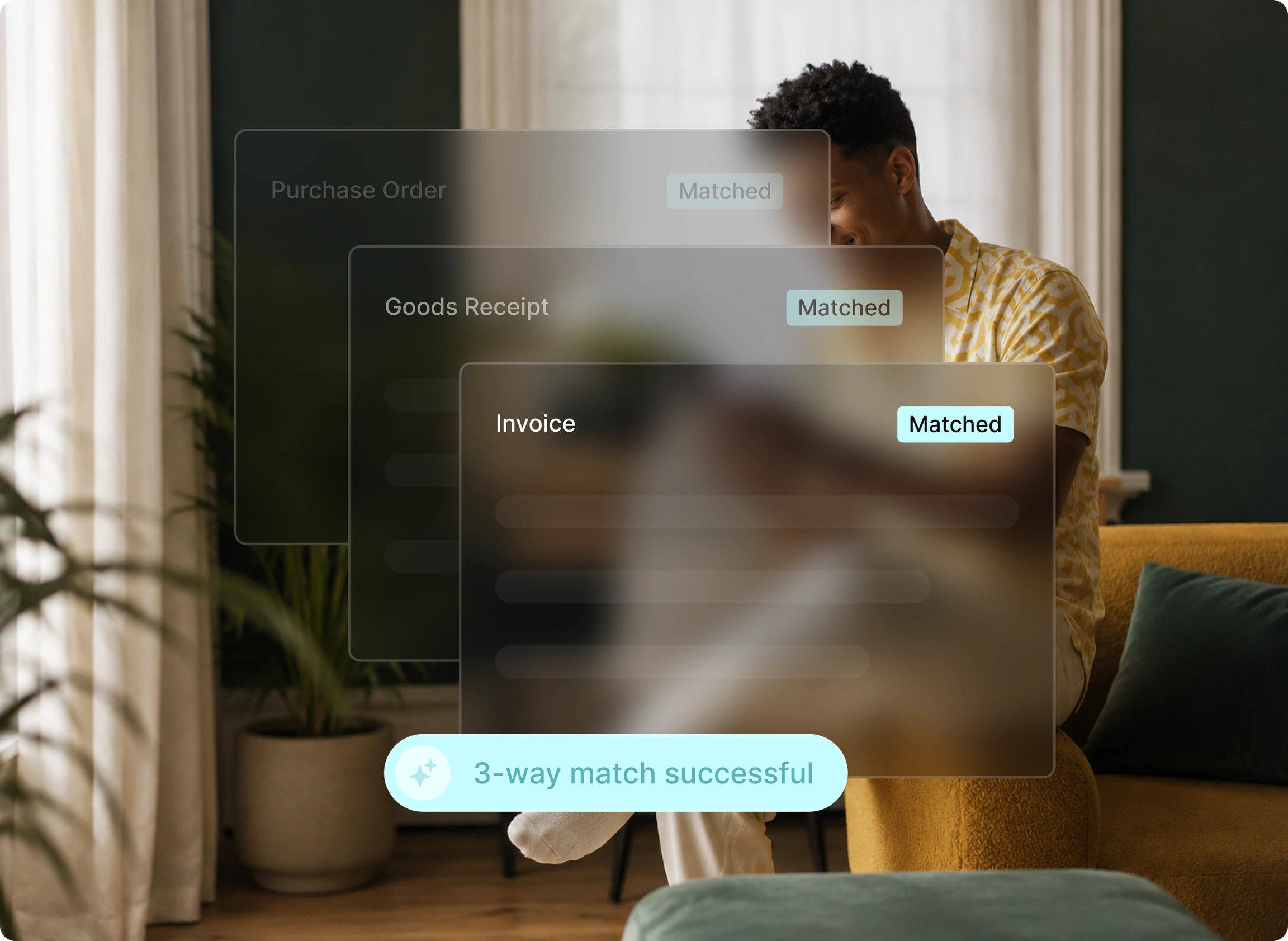
Invoice approval is where invoice processing starts paying you back. Clearing invoices in days rather than weeks puts early payment discounts within reach, and capturing them across a year of routine spend produces cost savings no single negotiation matches. A fast payment process also helps you avoid late payment fees and the erosion of supplier relationships that comes from paying later than you said you would. Suppliers remember who settles on time, and that is what long-term supplier relationships are built on.
Closing the order
Closure is the most neglected step in the purchase order process, because nothing is waiting on it. Nobody chases a close. So it happens inconsistently, and both failure modes cost money.
Closed too early. An order marked complete because most of the delivery arrived. The outstanding balance is now invisible, and nobody notices until someone needs the missing items.
Never closed. An order for goods that arrived last year, still counted as committed spend. Every stale order overstates what the organization has promised, and a budget owner working from that figure is told there is less available than there is.
Three rules cover it. An order closes when it is fully received and fully invoiced, or when it is formally canceled with a reason recorded. Closure has a named owner, usually the purchasing manager rather than the requester. And open orders are reviewed monthly, with anything past a stated age progressed or canceled.
That last rule makes the difference. A monthly list of orders open longer than sixty days, each with an owner attached, surfaces problems no other spend management control catches. Add a line on cancellation too, because one the supplier never hears about produces a delivery against an order your system says is dead.
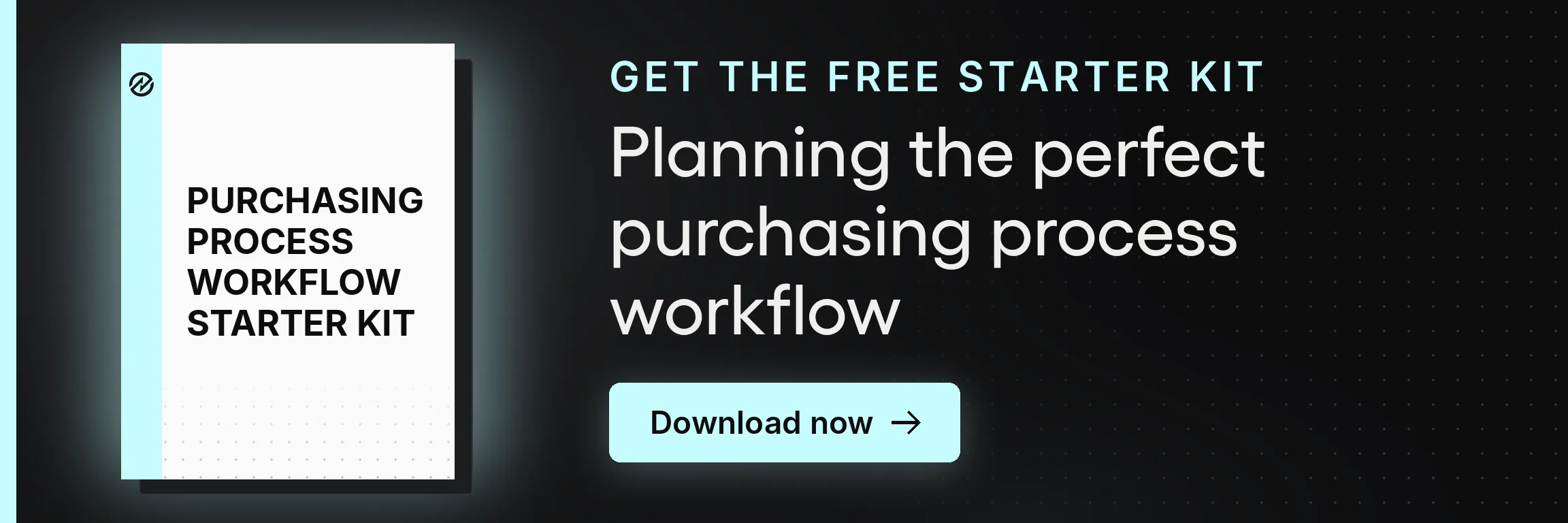
The rules worth writing down
Beyond the stage-by-stage mechanics, a few best practices belong in the procedure document itself.
When an order is required. Every purchase, or everything above a stated value. Both are defensible. No rule is not, because accounts payable then cannot tell whether a matching order should exist. Set any threshold against the cost of processing an order rather than a round number: many organizations require orders for raw materials and capital items while letting low-value office supplies run on a card.
No-PO-no-pay, and its exceptions. The organization will not pay an invoice with no order behind it. It is an effective control against unsolicited invoices, a real form of fraud. It only works if the exceptions are named in advance: utilities, rent, statutory payments, some professional fees, and card transactions under a limit. Write down how such payments are handled, or the rule gets renegotiated invoice by invoice.
Who may raise, amend, and close. Three separate permissions, often collapsed into one. Having raise and close sit with one person on high-value orders removes a useful check. Tier the separation by value.
Buying from pre-approved suppliers. Repeat orders to the same supplier shouldn't require evaluating potential suppliers from scratch every time. Maintain a list of preferred suppliers with agreed pricing and state what it takes to add one. This rule removes the most friction, and friction is what sends people around the process.
Retention and audit. State how long orders and their records are kept for future reference, where, and who can retrieve them. An audit trail assembled after the fact is a project, while proper documentation created as a byproduct of the procedure is a retrieval.
Rolling it out. Involve the people who will use it, receiving staff above all, since they get consulted last and know most about where records break. Then make the compliant path the fast path, because when following the procedure is slower than working around it, people work around it.
Where a purchase order system changes the procedure
Everything above works on paper, and procurement teams that define the procedure first get far more from procurement software afterward, because applying a system to an undefined process only makes the ambiguity faster. An effective purchasing process comes first; the procurement system makes it repeatable. What it changes is specific.
Orders inherit their data. Created from an approved requisition, the order carries the specification and codes forward. Purchasing process automation removes the manual tasks that introduce errors.
Approval routing applies your rules automatically. Approval workflow automation sends each order to the right approver by value, category, department, or project, with deputies handling absences. Control and speed come from the same mechanism, which is why most organizations see the biggest improvement here.
The open period becomes visible. Purchase order management holds receipts, amendments, and invoices against the order itself, so partial receipts stay visible, and order age is reportable. This is the part that is genuinely hard on paper.
Committed spend appears when the order is issued. Budget and spend control shows what has been promised alongside what has been paid, which stops orders from going out against budget that isn't there.
Connect that to your ledger, whether QuickBooks, Xero, Sage, or NetSuite, and the commitment and the eventual invoice reconcile without rekeying. That is the procure-to-pay process working end to end, and it lets purchasing teams streamline operations and run purchasing at an efficiency the paper version can't match.
After digitizing this part of the process, Ashesi University moved purchase order processing from two to three business days to under two hours, reporting a 15% cost reduction. The change was not people working faster. It was orders no longer waiting. Read their case study.
If your procedure is sound and running it consistently has become the constraint, see how the core features connect requisitions, approvals, orders, receiving, and invoices, or book a demo, and we will walk through your own approval structure.