

Many organizations track procurement performance, but few leverage the full potential of spend under management. This metric plays a critical role in optimizing costs and driving strategic value.
By understanding what spend under management truly means and how to increase it, businesses can gain better visibility, improve supplier relationships, and make data-driven decisions that support long-term growth.
What is Spend Under Management
Spend under management refers to the portion of an organization’s total spend that is actively managed by the procurement team using formal processes, tools, or systems. This includes spend that is tracked, analyzed, and strategically sourced to align with company goals.
It’s a key performance indicator that reflects procurement’s influence over purchasing decisions. The higher the spend under management, the more control a company has over costs, compliance, and supplier performance.
Importance of Spend Under Management
Understanding and increasing spend under management is crucial for any organization aiming to improve procurement performance. It reflects how effectively your company is leveraging its purchasing power and managing supplier relationships.
- Cost control and savings
When spend is properly managed, companies can negotiate better pricing, reduce maverick spending, and uncover opportunities for cost reduction. - Improved compliance and risk management
Managed spend ensures purchases align with internal policies and contracts, reducing the risk of fraud, errors, and non-compliance. - Stronger supplier performance and insights
With more spend under management, procurement teams gain better visibility into supplier activity, enabling performance tracking and strategic partnerships.
How to Calculate Spend Under Management
Calculating spend under management helps organizations understand how much of their total spending is strategically controlled. The formula is simple:
Spend Under Management (%) = (Managed Spend / Total Spend) × 100
- Managed Spend includes all purchases made through approved procurement processes, contracts, or systems.
- Total Spend refers to all organizational spending within a given period, including unmanaged or ad hoc purchases.
For example, if your organization has $8 million in managed spend out of a total of $10 million, your spend under management would be:
(8,000,000 / 10,000,000) × 100 = 80%
A higher percentage indicates greater procurement efficiency and control.
How to Increase Spending Under Management
Boosting spend under management requires a strategic and consistent approach across people, processes, and technology. The goal is to bring more of your organization’s spending under structured procurement control, improving efficiency, compliance, and cost savings along the way.
Assess Your Current Processes
Start by identifying which parts of your spending are currently unmanaged or bypassing procurement workflows. A clear baseline helps you pinpoint areas for improvement.
- Map out all purchasing workflows to see where spend is being tracked and where it isn't
- Identify departments or teams that frequently make off-contract or manual purchases.
- Review approval chains to ensure they support efficient and controlled spending.
Improve Visibility and Transparency

Better visibility allows procurement teams to track, monitor, and optimize how money is spent across the organization.
- Consolidate data from different departments into a single source of truth
- Use spend analysis reports to identify trends, gaps, and non-compliant purchases
- Share clear dashboards with stakeholders to promote accountability
Enhance Supplier Relationships
Collaborating more closely with suppliers can improve contract adherence and bring more spend under control.
- Develop long-term agreements with preferred vendors to drive consistency
- Include performance metrics and reporting expectations in contracts
- Communicate procurement goals clearly to suppliers to build alignment
Incorporate New Technology
Digital tools streamline procurement and make it easier to track and manage spend organization-wide.
- Implement cloud-based procurement software to centralize purchasing activities
- Use spend analysis tools to monitor trends and identify unmanaged spend
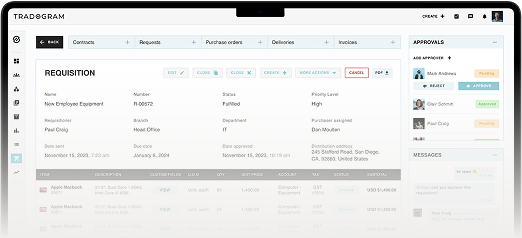
- Leverage solutions like Tradogram to automate processes, enforce policies, and gain actionable insights
Onboard Employees
Employees play a crucial role in ensuring purchases go through the right channels. Training and engagement can significantly boost managed spend.
- Educate staff on procurement policies and the importance of compliance
- Provide simple, user-friendly tools for purchase requests and approvals
- Encourage feedback to continuously improve the procurement experience
Improving Spend Under Management with the Right Tools
Spend under management isn't just a procurement metric; it reflects how strategically your organization controls its purchasing decisions. By increasing this figure, companies can unlock savings, reduce risk, and enhance operational efficiency.
Tools like Tradogram make tracking and boosting spend under management easier through intuitive spend analysis features, real-time insights, and streamlined workflows. With the right platform in place, turning procurement into a strategic powerhouse is within reach.