.png)


Purchasing can be done in a variety of ways in your business. Some companies will have everyone who buys products contact the suppliers directly. Others will consolidate procurement activity to a single person or department.
What is an Online Purchasing System?
An online purchasing system is a digital platform that streamlines and automates the procurement process, allowing businesses to manage their purchasing activities efficiently and effectively. Unlike traditional paper-based methods, an online purchasing system enables organizations to electronically create, track, and manage purchase orders, supplier information, and transactions in real-time. By leveraging technology, businesses can gain greater visibility into their procurement processes, improve collaboration with suppliers, and enhance overall operational efficiency.
What is an Online Purchase Order System?
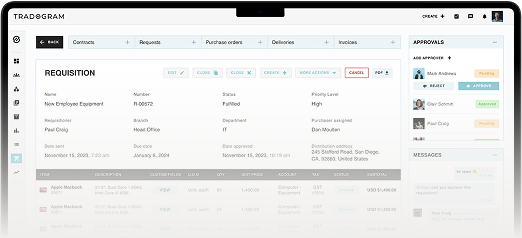
An online purchase order system, also known as an online PO system, is a digital solution designed to facilitate the creation, approval, and management of purchase orders within an organization. This software enables businesses to generate purchase orders electronically, streamline approval workflows, and track order statuses in real-time. With an online purchase order system, organizations can automate repetitive tasks, reduce errors, and improve compliance with procurement policies and procedures. Additionally, these systems often integrate with other procurement tools and systems, providing seamless communication and data exchange throughout the procurement process.
As your business grows, keeping track of your purchases becomes more critical than ever. This article will explore if you should move your business to an online purchasing system. This article will discuss five reasons to move to an online purchase to pay system.
1- Greater visibility
2- Streamlined Process
3- Spend Control
4- Error Reduction
5- Improved Decision Making
DOWNLOAD PLANNING THE PERFECT PURCHASING PROCESS WORKFLOW GUIDE
1- Greater Visibility
Understanding the detail of your procurement processes is a significant first step to having visibility into the process. A paper-based system may work for a small business; however, as your business grows, it becomes more important than ever to have this visibility into the process.
Visibility can look like a lot of things in procurement. For example, seeing a list of supplier purchase orders can give insight into how frequently you buy from a given vendor. Seeing the buying pattern of a given item can show you if there is an opportunity to consolidate buys and get better pricing.
Managing a process virtually, in a purchase-to-pay system allows you to understand how your business functions and helps other team members gain that insight. Collectively, your team will increase their knowledge of the process and, in return, make better decisions.

2- Streamlined Process
From purchase requisition to supplier invoicing, many areas streamline the procurement workflow. Instead of multiple people reaching out to a given supplier to purchase, a purchase requisition is a critical process to document what people are for and when they ask for it. A purchase requisition can confirm what people require and when they need it.
Standardized processes in your business are the easiest way to make work easier for your team and improve engagement and productivity. When processes are the same for everyone, they can get done faster and more accurately. Even a tremendous paper-based process won’t be as easy to manage as one managed digitally.
3- Spend Control
A great purchase-to-pay system will give you back control within your business. If you already have some of your business online, a purchase-to-pay system should integrate with your existing system to ensure that your transactions are adequately captured.
Another great way that a purchase-to-pay system can give you back control is to use it to implement an approval workflow. Based on your business need, you could have a process in which Purchase Orders over a certain amount require approval.
A great control is also the ability to easily match purchase orders with supplier invoices to create a reconciliation. This ensures that you are only getting invoiced for the product you ordered.
A purchase-to-pay system will also allow you to go back in time and audit your activity. This is an easy way to ensure that your business workflows are being adhered to and that the standards of the processes you have built are met.
As your business grows, you may evolve your financial reporting requirements. Depending on the business size, these reporting requirements may vary and require specific record-keeping standards. A purchase-to-pay system will do a fantastic job of documenting the entire process for this purpose.

4- Error Reduction
When processes are manual, there are so many opportunities for error. Purchase Orders are an area where mistakes can easily cost your business money.
A purchase-to-pay system can manage the creation of purchase orders and implement workflows to optimize them. For example, having a unique purchase order for each order gives you and your vendor a common reference to discuss when confirming the detail of your order. This also reduces the instance of double ordering and the errors when reconciling what was ordered versus what was received.
Another way an online system far outperforms a paper process is by avoiding ordering mistakes. Many systems can either limit or put a warning on POs over a specific period.
Another area of error reduction that comes with an online purchase-to-pay platform is pricing. An excellent online platform will show a history of what you paid for a given item and capture any contractual pricing you may have for an item. This will let you handle supplier pricing and ensure you get appropriately billed. Understanding your contract pricing allows you to negotiate with your vendors.
5- Improved Decision Making
With increased visibility and more control, you will have the tools available for improved decision-making within your business.
Most online purchase-to-pay systems have analytics that put your procurement process on display for review and analysis. With the correct information at your fingertips, you will be informed with accurate information to understand the impact on your business.
Some analytics may be around purchase volume, while others relate to profitability. A purchase-to-pay system will keep all your purchasing activity in one place so you can monitor it and adjust your strategy if needed.
The other main advantage of an online purchase-to-pay platform is timely access to data that helps infom your decision making. No paper-based process will ever be able to offer up-to-the-minute statistics on your company’s buying patterns or overall spending. This easily accessible information within an online purchase-to-pay system will improve your decision-making.
Final Thoughts
While you may start your business with manual, paper-based processes, as you scale, it becomes critical to structure your operations in a way that makes sense. A robust, an online purchase-to-pay system can be the best next step in digital transformation to get more control over your business and have the insight to fuel your growth.
Your business may have evolving needs as it grows, and an online purchase-to-pay platform will scale with you. The risk to your business will be reduced by having your procurement processes well-documented and quickly tracked. The process will move from someone’s head to a process your entire team understands.
If you want to learn more about digital procurement’s extensive benefits, schedule a free demo of Tradogram’s procurement management system today.