

A robust, agile procurement process matters more to a growing business than most owners expect. With rising costs and supply chain issues that haven't fully settled, how your company requests, approves, orders, receives, and pays for things stops being an administrative detail and becomes a financial control. The trouble is that the process grows one workaround at a time. A request comes in by email. Someone approves it in a chat message.
Someone types a purchase order into a spreadsheet, and the invoice shows up three weeks later with a number nobody recognizes.
Procure-to-pay technology replaces that chain of workarounds with a single connected record. It automates order management, vendor management, contract lifecycle, and accounts payable work, and keeps the information in one place instead of five. This article covers what changes at each stage, what your finance department can see afterward that it could not see before, and what to expect when you put a new system in front of people used to doing it the old way.
Key Takeaways
- Procure-to-pay technology connects the purchase request, approval, order, receipt, and invoice into one record instead of five disconnected ones. The value is not any single feature. It is that finance stops reconstructing what happened after the money is already committed.
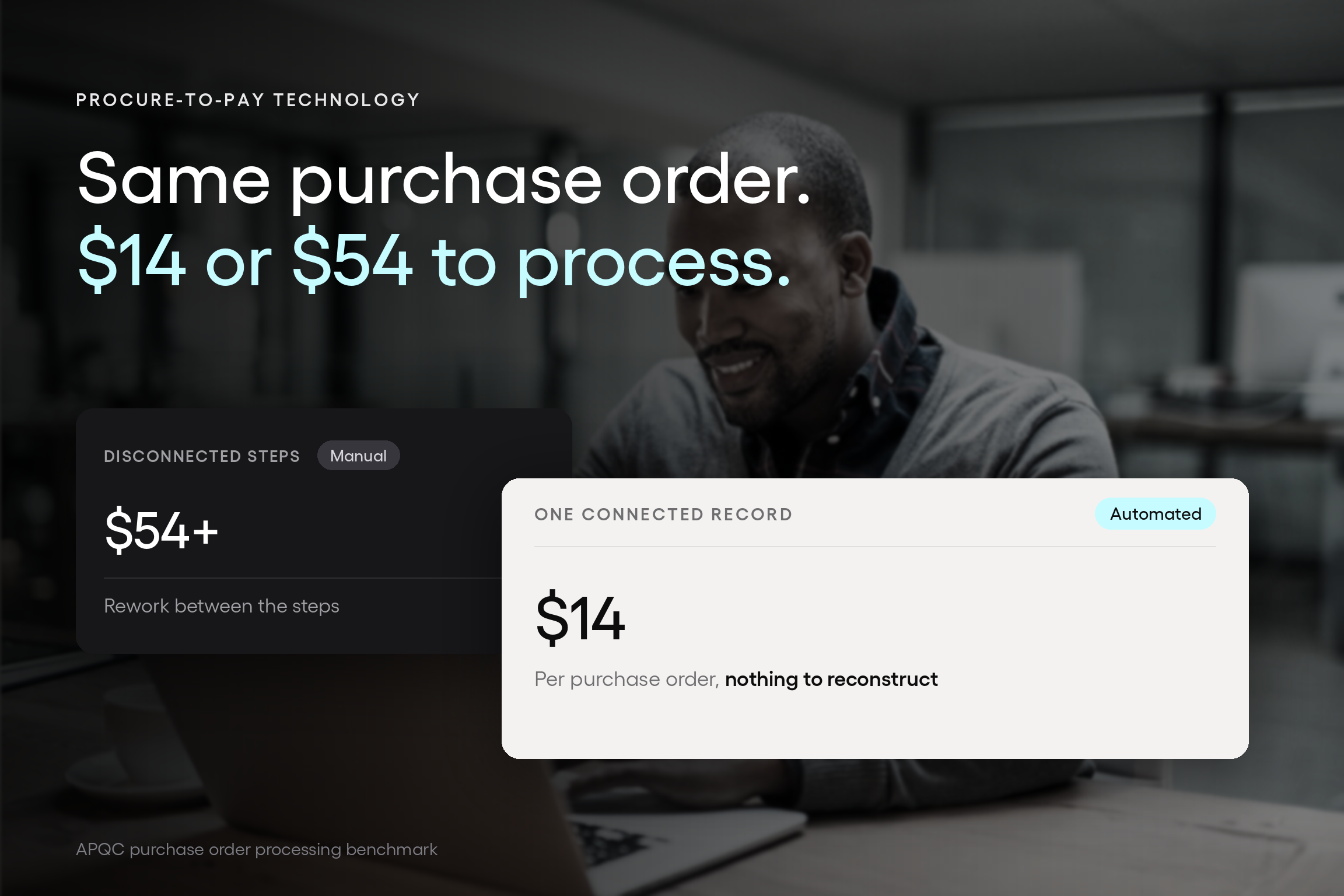
- The highest cost of a manual p2p process is rework, not headcount. APQC benchmarking finds organizations spend anywhere from about $14 to more than $54 to process a single purchase order, and the gap is driven largely by how much correction and chasing sits between the steps.
- Automated matching changes what your accounts payable team does all day. When invoice, purchase order, and receiving records line up automatically, staff stop verifying the routine invoices and start investigating only the ones with a variance.
- Adoption is the part most businesses underestimate. Procure-to-pay technology only produces accurate financial reporting if people actually submit requests through it, which makes standardized procedures and a short learning curve more important than feature count.
What procure-to-pay technology actually does
Procure-to-pay (P2P) technology is software that manages the full purchase-to-pay cycle, from the moment someone requests goods or services to the moment a supplier’s invoice is approved for payment.
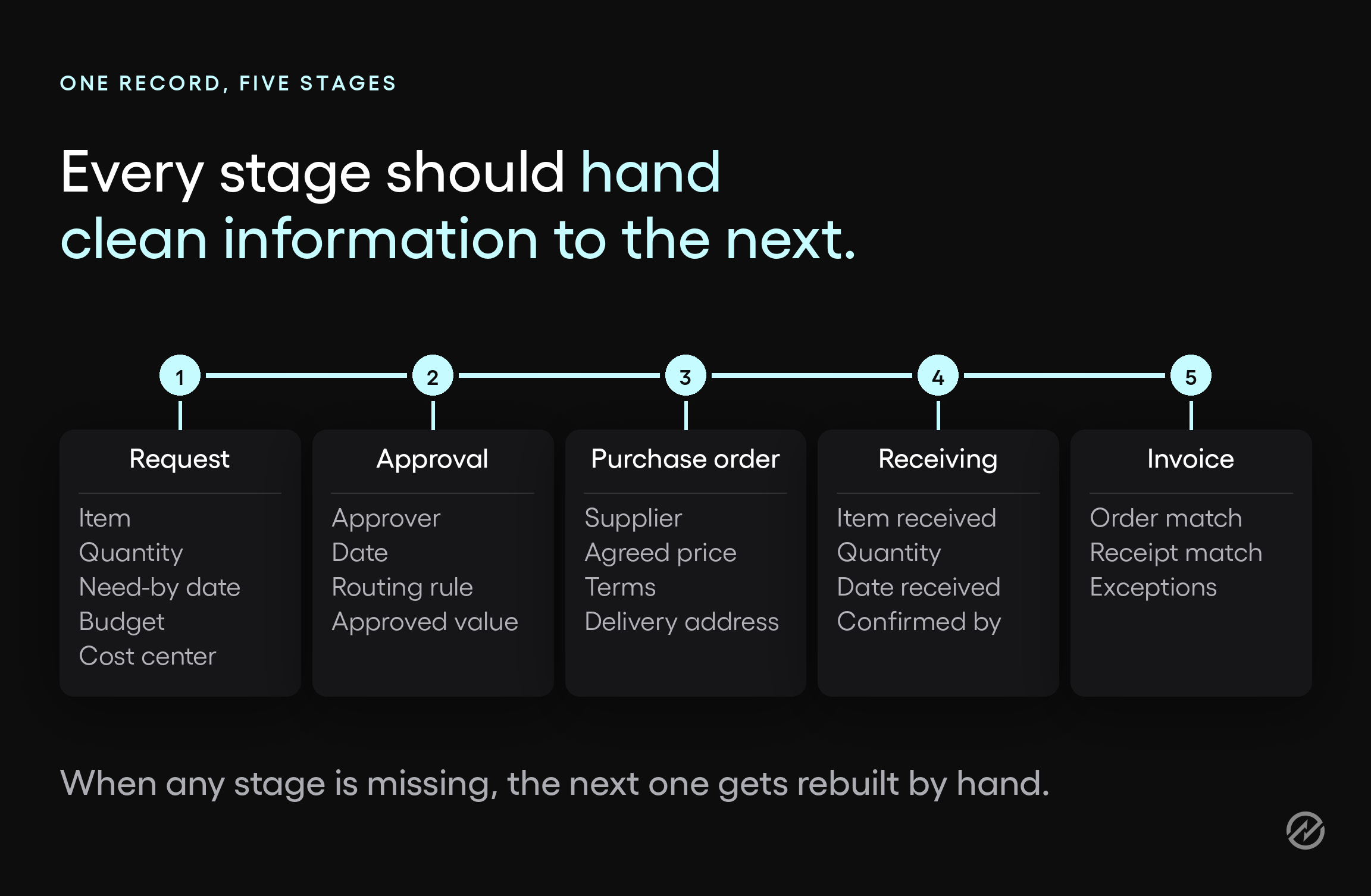
The P2P process itself is not new. Every business has one, even when it exists only in people’s heads. Technology changes whether each step passes clean information to the next.
In a manual P2P process, people retype information at every handoff. A requester describes what they need in an email. A buyer retypes it into a purchase order. Accounts payable retypes the details again to check the supplier’s invoice. Each retyping creates a chance for human error, and manual processes like this rarely produce a record anyone can search later.
A procure-to-pay system removes the retyping. The approved request becomes the purchase order, the purchase order becomes the reference for receiving, and the receiving record becomes half of the invoice check. That single thread connects procurement and finance teams to the same set of facts, which is why the entire procurement process becomes easier to report on, not just faster.
It helps to be precise about scope. Procure-to-pay solutions cover the transactional half of purchasing. Source-to-pay adds the sourcing and supplier selection work that happens before a supplier is chosen.
If you want the step-by-step version of the P2P process itself rather than the technology that runs it, the procure-to-pay process guide covers each stage in order.
Where the P2P process breaks without technology
The failure points are predictable, and they show up in the same order in most growing businesses.
Purchases happen before anyone approves them. Someone needs a part, the supplier is on the phone, and the order goes out with a promise to sort out the paperwork later. That is maverick spend, and it stays invisible until the invoice arrives.
Approvals stall because nobody knows whose turn it is. A purchase requisition sits in an inbox while the requester assumes it is moving and the approver assumes someone else handled it.
Budgets look healthy right up until they do not, because a department checks its remaining budget against what has been invoiced rather than what has been ordered.
Invoices arrive that nobody can match. There is no purchase order, the quantities don't match, or nobody recorded whether the goods arrived. Accounts payable spends its week on email archaeology.
Supplier information lives in four places: contact details in someone’s phone, contracts in a shared drive, pricing in a spreadsheet, and performance notes nowhere at all.
Each of these also creates manual tasks that shouldn't exist, which is how a two-person purchasing job quietly becomes a three-person one. None of it is a failure of effort. They are failures of connection, which is exactly what procure-to-pay technology is designed to fix.
Purchase requisitions and approvals
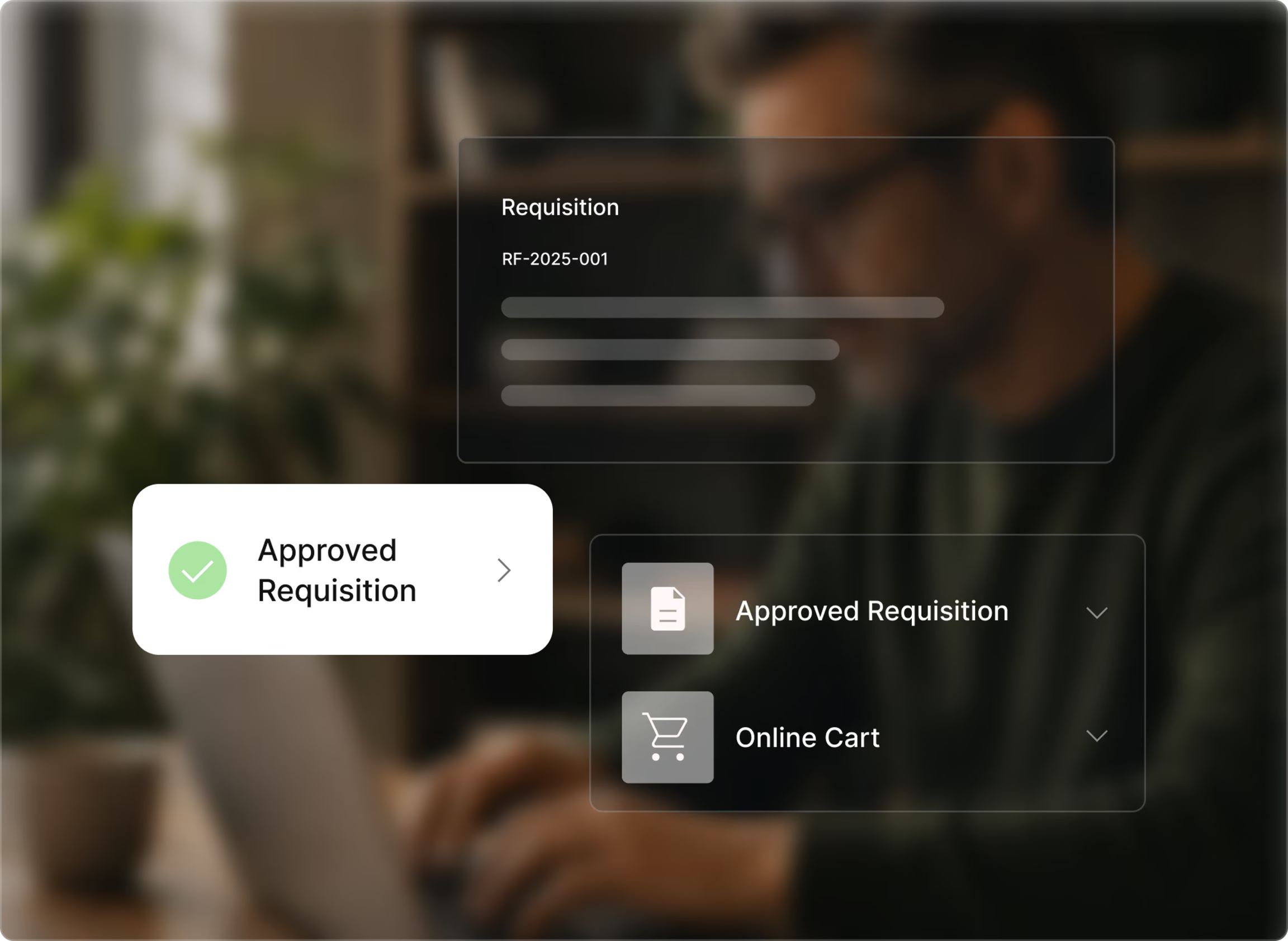
Adding a purchase requisition process to your business gives you visibility at the very beginning, before any money is committed. A purchase requisition is a formal request created by the person who needs something. They indicate what they want to purchase, when they need it, how many, and which budget it belongs to.
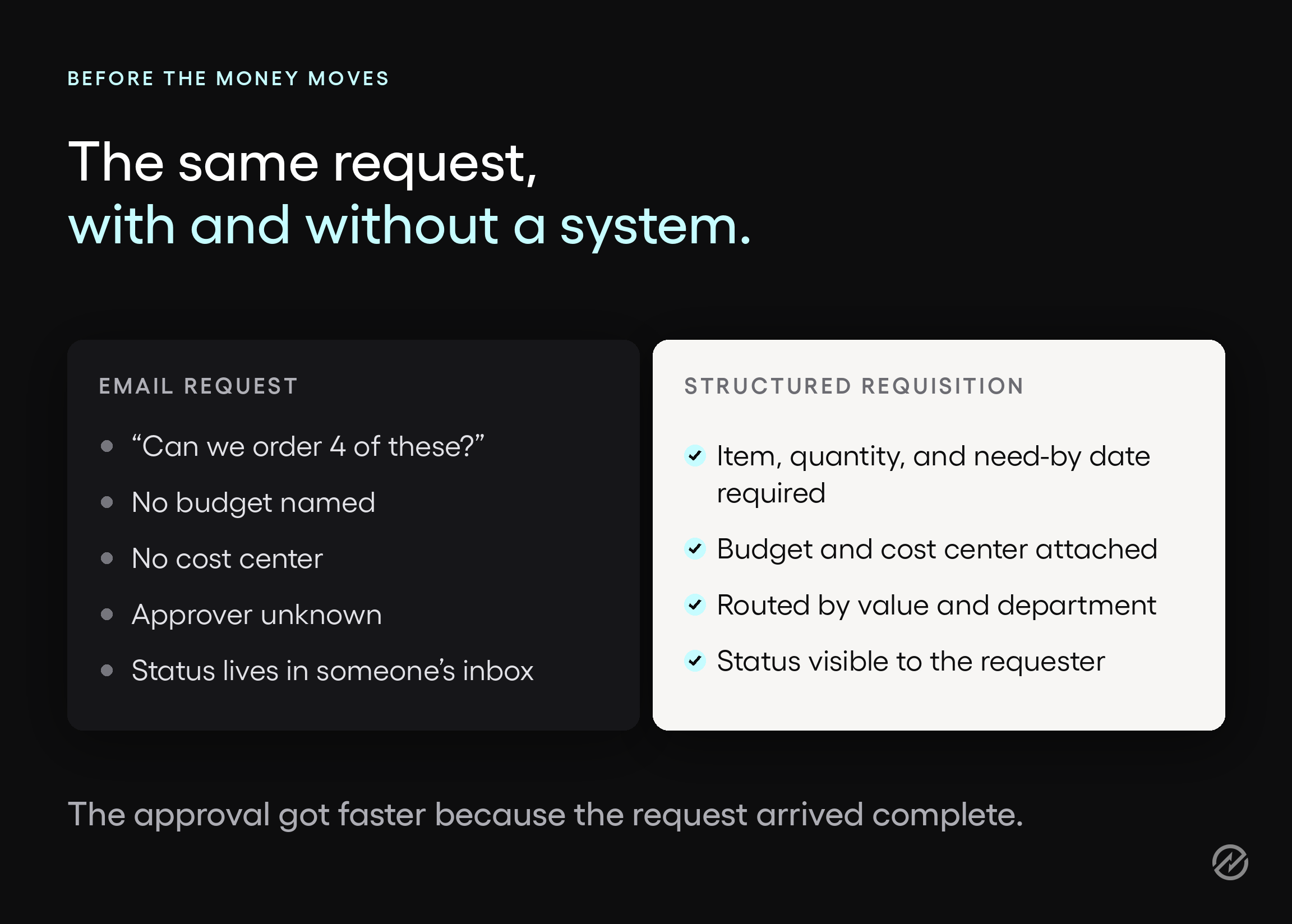
The difference a system makes at requisition creation is structure. A form with required fields means the approver is not chasing the requester for a quantity or a cost center. Requests that used to arrive as a sentence in an email arrive complete, which is the fastest way to shorten an approval cycle.
From there, the purchase requisition approval routing takes over. Approvals can apply to all purchase requests over a certain amount, or by department, project, supplier, or category. Once it crosses a threshold, a request may go to a department manager, a project lead, or finance. The business rules decide, not the requester’s judgment about who to copy on the email.
That is also how company policies stop depending on memory. When your internal policies say that anything over $5,000 needs a second approver and anything involving a new supplier needs procurement review, a system applies those procurement policies to every request without anyone having to remember. It is a quieter way to ensure compliance than a policy document nobody reads, and it drives better compliance because the rule applies before the purchase rather than being audited after.
Self-service portals matter more than they sound like they should. When employees can submit a request, see where it sits, and check what was approved without asking anyone, the volume of status questions that land on procurement teams drops sharply. The people who benefit most are usually the ones who had no idea how to buy anything in the first place.
Procurement budget management
Building and managing budgets in a procure-to-pay system changes when you discover a problem. You can build budgets by function, such as accounting, sales, or marketing, or by project, depending on how your business is organized.
Creating budgets by function helps you control costs where they concentrate, which is useful if one department consistently accounts for a large share of purchasing activities. Project budgets give you a benchmark for spending by project and let you hold to a threshold you set deliberately rather than discover afterward.
For businesses that earn revenue by project, recording and tracking project work against budget is the easiest way to see whether you are charging enough for your services. A project that consistently comes in over budget points to something specific: material prices moved, the scope was underestimated, or the job was poorly administered. All three are fixable, but only if you can see them while the project is still running.
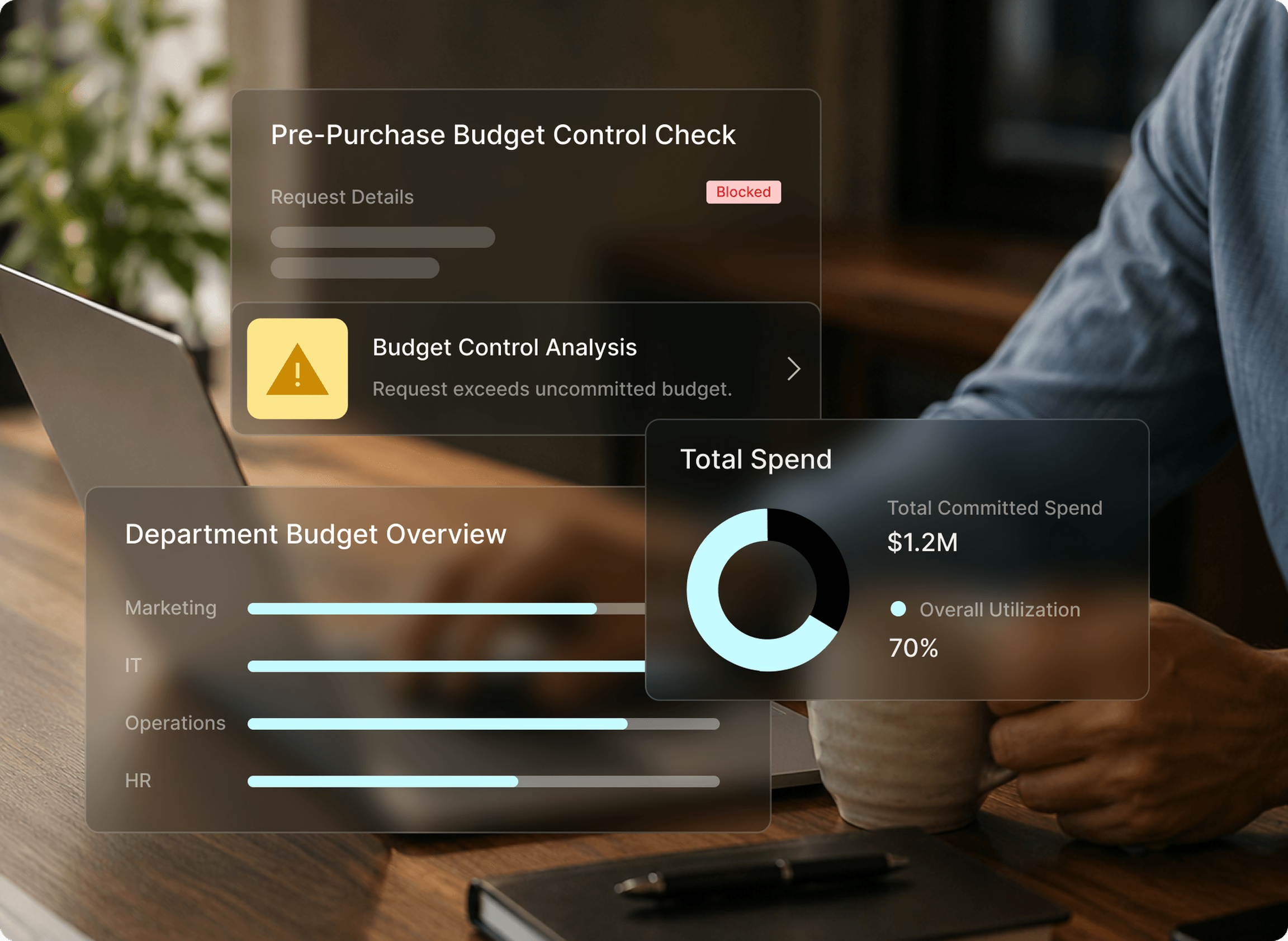
The mechanism that makes this work is checking requests against the budget before approval rather than after invoicing. Checking before approval is the most reliable form of cost control available to a growing business, and it gives you real-time visibility into committed spend, meaning money that is promised but not yet billed. It is the number most spreadsheets cannot produce and the one most likely to explain why a department that looked fine on the fifteenth is over by the thirtieth.
Greater visibility here also does something for cash flow management. When you can see what has been ordered and roughly when the invoices will land, cash flow planning stops being a guess. Splitting the view between direct and indirect spend is worth the setup time, because indirect spend is usually where the small uncontrolled purchases accumulate, and it is rarely anyone’s explicit job to watch it. This is also where purchasing information becomes useful for financial management, not just procurement.
Vendor contract management
With commodity prices moving and supply chains still unpredictable, a reliable record of your vendor contracts, preferred suppliers, and their end dates is more valuable than ever. Being proactive ahead of a renegotiation keeps you in a stronger position. You are more likely to hold your current negotiated prices for longer, and in some cases to secure a reduction.
Good contract management tools perform three vendor management functions at once.
- They surface contract terms and renewal dates before they expire, which is one of the few places procurement and supply chain management genuinely overlap for a mid-market business.
- They capture supplier interactions so negotiation history is documented instead of remembered.
- They keep supporting documents, such as insurance certificates and tax forms, attached to the supplier record where anyone reviewing a purchase can find them.
Being organized is not just administratively tidy. It is how you become a customer suppliers want to keep. A supplier who gets clean purchase orders, accurate receiving confirmations, and on-schedule payments treats you differently than one who has to chase you. Stronger supplier relationships come from being easy to do business with, and most of what makes a company easy to do business with is process. Better supplier relationships are a byproduct of better internal habits, not of more meetings.
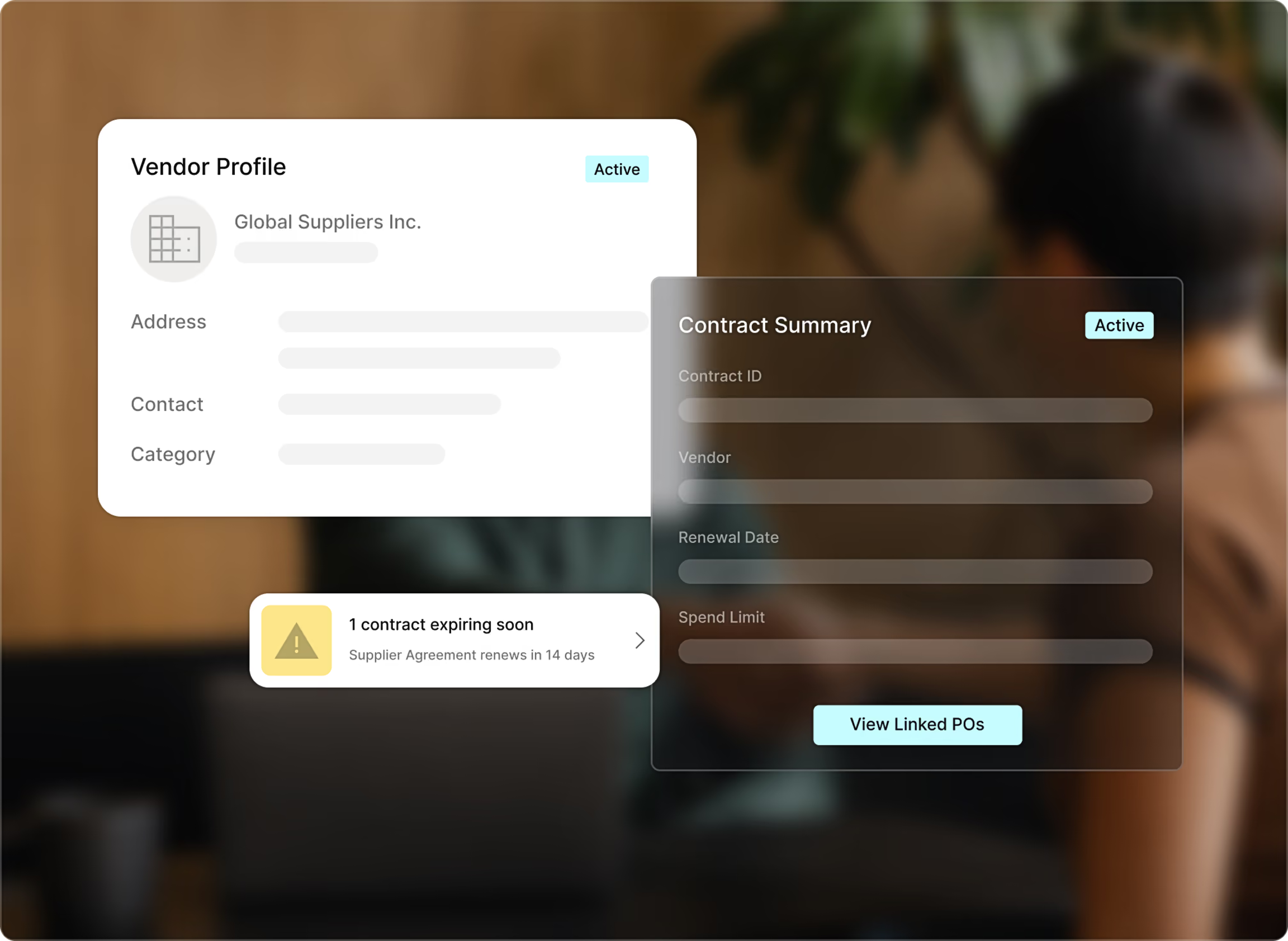
Vendor contract management also lets you watch items you buy from multiple suppliers. If you order the same item from three vendors at three prices, consolidating to one supplier immediately improves your leverage. That kind of consolidation is a standard move in strategic sourcing, and it is usually the first real saving a business finds after it can finally see its own purchase history.
Supplier management goes further than contracts. A shared supplier management software record keeps supplier information, supplier data, documents, and performance notes in one place, which matters for two reasons.
First, supplier selection gets easier when you can compare candidates against multiple criteria rather than a general impression.
Second, supplier onboarding becomes a repeatable process rather than a scramble. A structured supplier onboarding process that collects banking details, documents proving the supplier meets your compliance standards, and any regulatory requirements up front is both a risk management step and a practical risk-mitigation tool, because it creates a verified record to check later changes against.
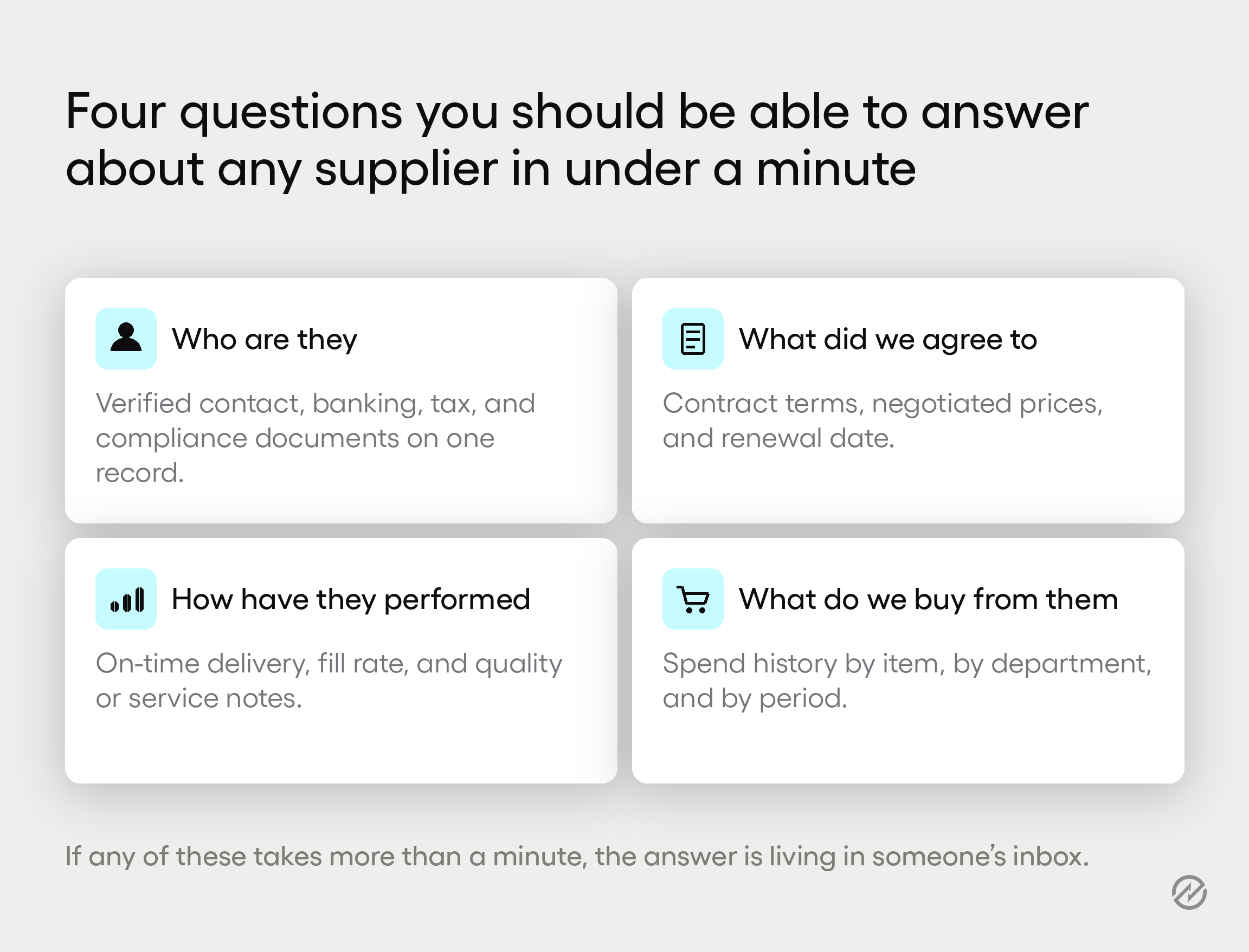
Supplier relationship management, in practice, is mostly this: knowing who you buy from, what you agreed to, how they have performed, and when the agreement ends.
Accounts payable reconciliation
Your accounts payable team spends most of its week reconciling purchase orders against invoicing to make sure the right invoices get paid on time. It is slow work that involves both suppliers and internal purchasers, chasing down variances and confirming what actually arrived.
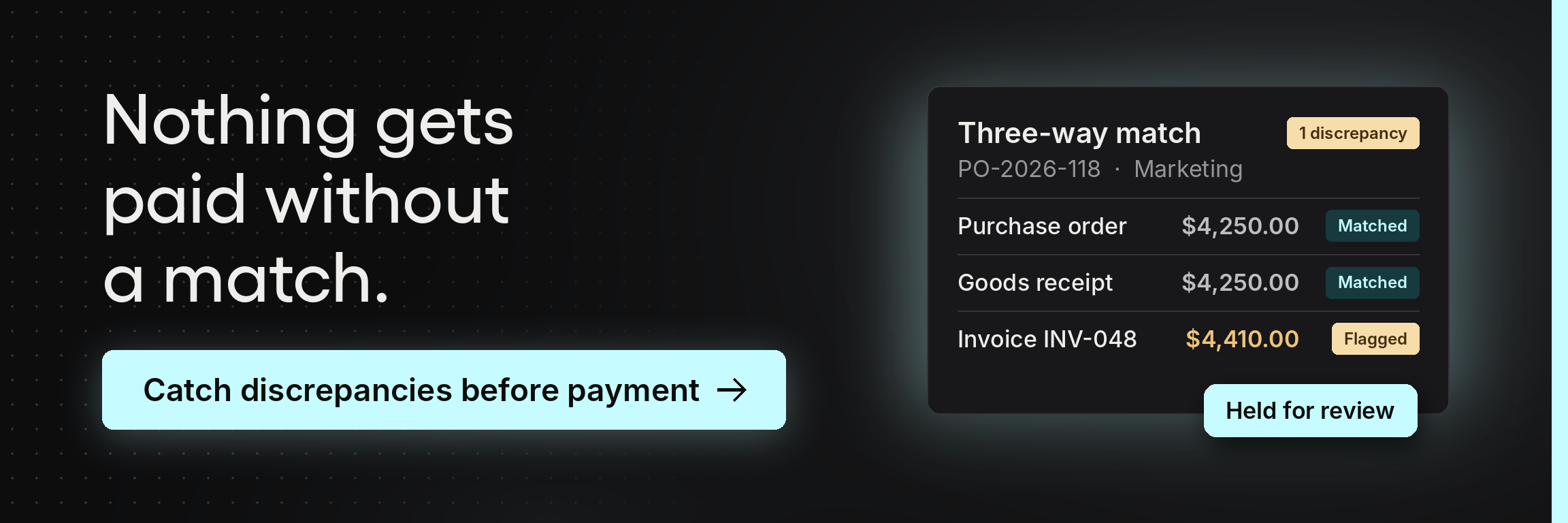
A procure-to-pay system should automatically match the supplier’s invoice against the purchase order and the receiving record. That is three-way matching, and when it runs cleanly, the invoices that agree on price, quantity, and delivery move to invoice approval without anyone reading them line by line.
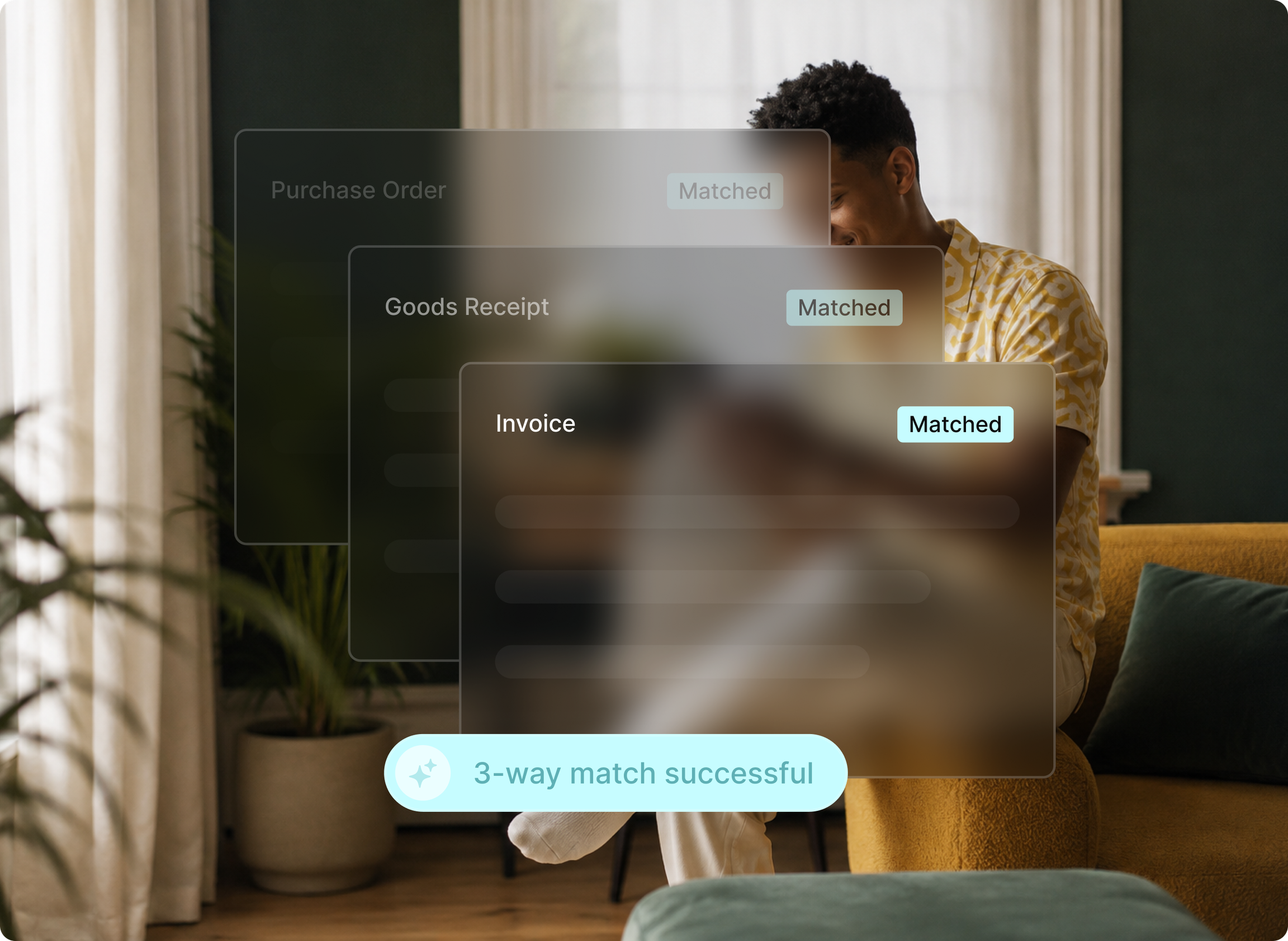
Your team stops handling every invoice and starts handling only the exceptions. This is commonly called AP automation, and its effect on payment processing is straightforward. It speeds up processing for invoices that are already correct so people can focus on the ones that aren't, and predictable processing helps supplier payments arrive when suppliers expect them.
The size of that shift is measurable. Ardent Partners' State of ePayables 2025 puts the average cost to process a single invoice at $9.84, taking an average of 8.2 days, with an 18.4% exception rate. The same research found 57% of suppliers can now send invoices electronically, so the technology question is less about the invoices that arrive clean and more about what happens to the rest.
The gap between those numbers is almost entirely a question of whether the purchase order and receiving data exist in a usable form before the invoice arrives.
Faster invoice processing is not only about labor. Processing invoices on a predictable schedule is what lets you take early payment discounts and avoid late payment penalties, and both show up in real money rather than on efficiency slides. Invoice cycle time is worth tracking on its own, because it tends to move before anything else does when a process improves.
Invoice automation also improves the quality of what finance receives. When invoice management connects to purchasing rather than sitting downstream of it, accruals are based on what was actually ordered and received. That is the difference between accurate financial reporting and a month-end close spent asking departments what they bought.
One caution worth stating. Automated matching does not remove judgment from the process, and it should not. It removes routine verification so the finance department can focus on invoices where something is genuinely wrong. Payment execution and final payment approval still belong to people.
Procurement trend visibility
Access to your own purchasing data over time is where a procure-to-pay system stops being an efficiency tool and starts being a decision tool. A good one produces procurement reporting across items, vendors, and overall spend, and lets you compare one quarter to the next or to the same period last year, depending on whether your business is seasonal.
Items. Understanding which items get purchased most often lets you consolidate purchases where it makes sense and see how pricing has moved over time. It also feeds catalog management and inventory management. Once you know your top fifty recurring items, putting them in a catalog with agreed pricing removes both the sourcing step and the pricing argument from routine purchases. For businesses carrying stock, purchase history lets you optimize inventory levels rather than reorder by habit.
Vendors. Supplier reporting shows how a vendor actually performs: whether purchase orders get filled completely, how long deliveries take, and how often something has to be returned or reordered. Supplier performance data changes renewal conversations, because you are no longer negotiating on impression.
Spend. With budgets in place, it matters whether they perform. Do you have budgets that consistently run over or under? Spending patterns across departments, categories, and procurement activities are usually where cost-saving opportunities hide, and they are rarely where people assume. A proper spend analysis frequently helps you identify cost-saving opportunities in indirect spend that nobody was watching, simply because no single purchase was large enough to notice. Cost savings are rarely dramatic in any one category, but they add up.
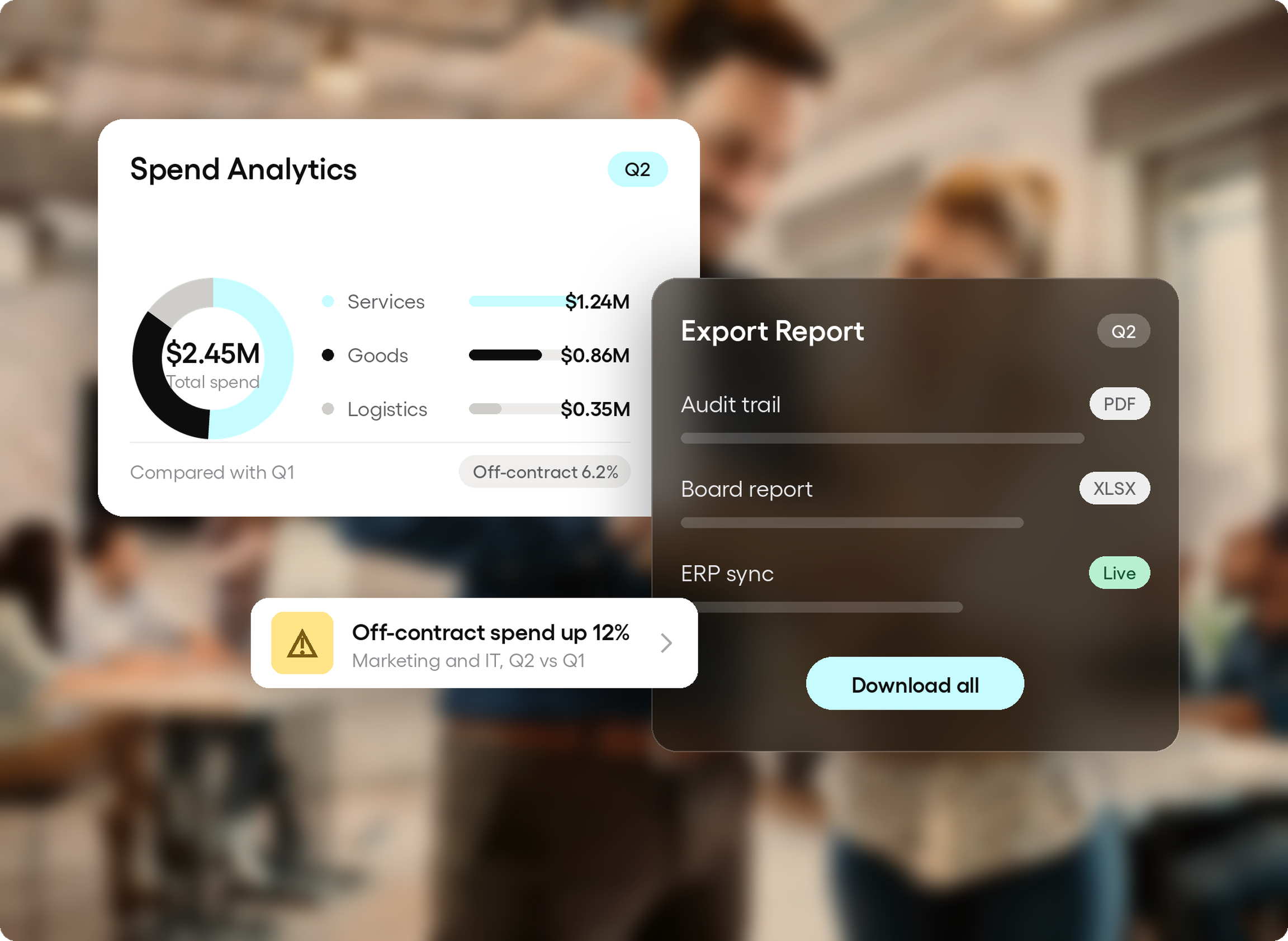
An easy-to-use procure-to-pay platform makes these reports easy to access and read. Some present valuable insights in a dashboard; others provide transactional detail, and what you need depends on who is asking. A department manager wants to know whether they are on track.
A CFO wants to know where the money went and what is committed. Better decision-making depends on both getting an answer without asking procurement to build a spreadsheet.
Strategic decision-making sits on top of all of it. Data-driven decisions about consolidation, supplier mix, and budget allocation are only possible when the procurement cycle produces clean data as a byproduct of running normally, rather than as a special project.
What AI has changed about procure-to-pay technology
The honest answer is that artificial intelligence has changed the input end of the process far more than the decision end, and that is where the useful gains are.
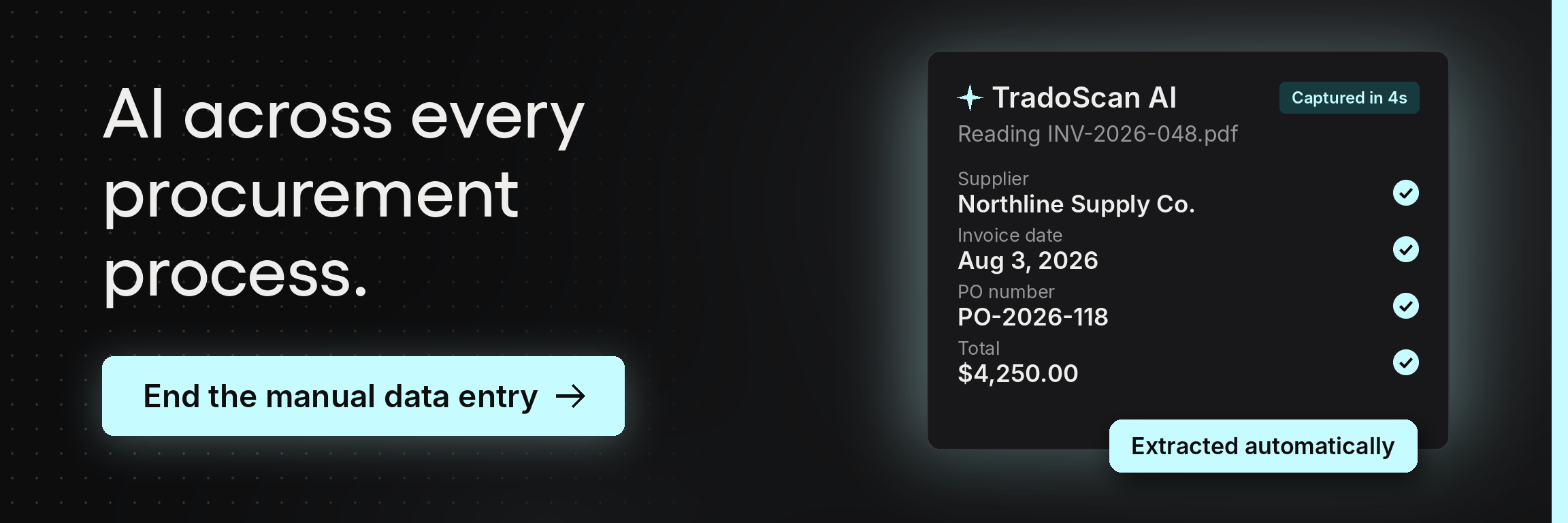
Document capture is the clearest example. Optical character recognition has existed for decades, but older systems needed a fixed template for every supplier, which meant someone had to maintain the templates.
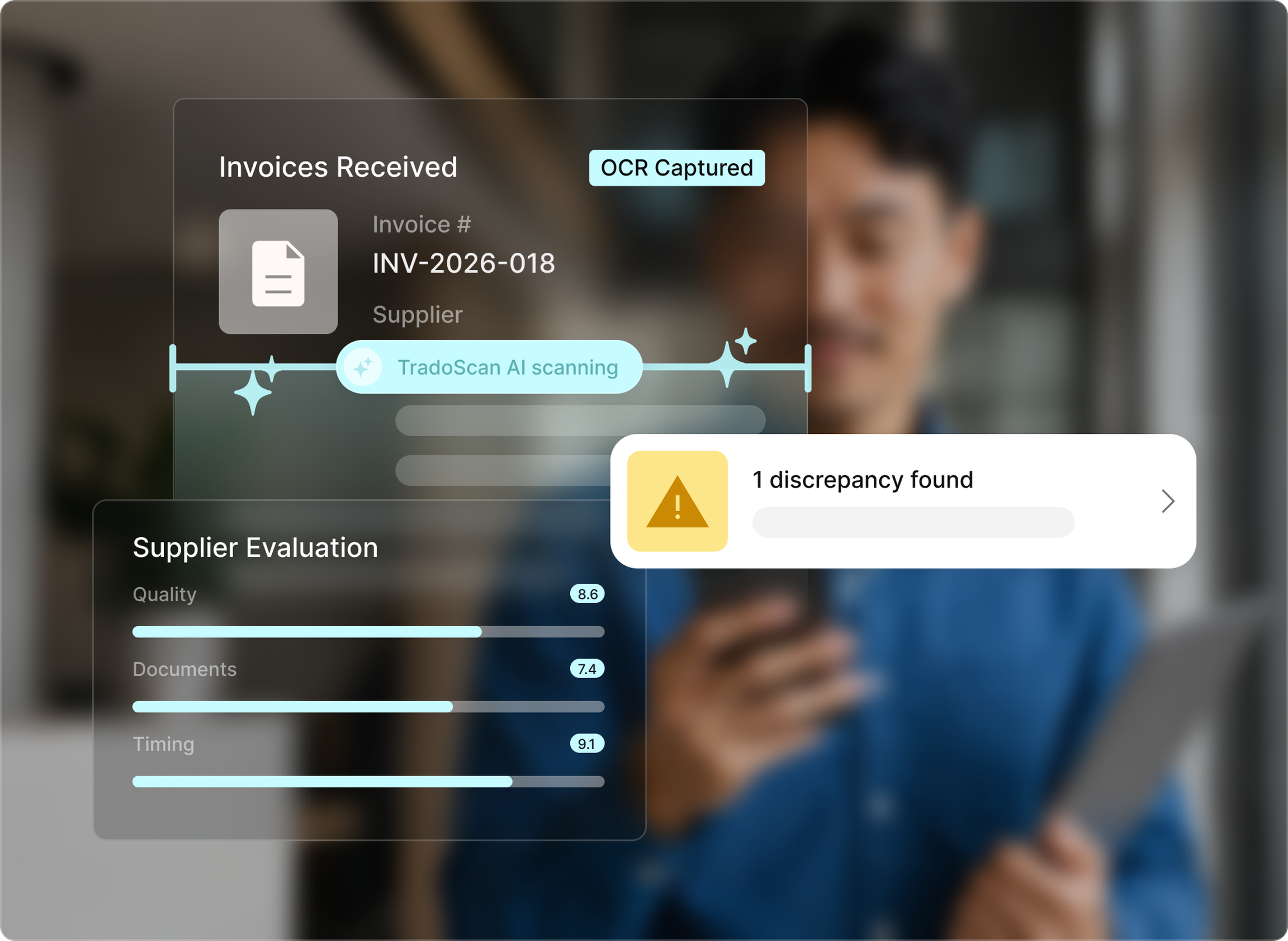
Machine learning models read a supplier’s invoice without a template, pull the vendor, invoice number, dates, line items, and totals, and improve as corrections are made. That removes the largest single block of manual data entry in accounts payable. Ardent Partners reported that roughly three-quarters of AP teams were using AI in some capacity by 2025, and capture is where most of them started.
Fraud detection is the second area where AI-driven automation earns its place. Systems that have learned normal patterns from past behaviors can flag a supplier bank detail change, a duplicate invoice number, or an amount well outside a vendor’s history.
None of these are conclusions, and none should be treated as an approval or a rejection. They prompt a person to look.
Applied to routine tasks across the P2P process, these advanced technologies reduce errors and deliver measurable efficiency gains: fewer keystrokes, fewer transposition errors, shorter queues.
Improving efficiency at the input end of the process is unglamorous work, and it is where most real-time savings live.
Workflow automation handles the movement between steps, automated workflows apply the rules, and P2P automation covers the stretch from approved request to matched invoice. None of it decides whether a purchase is a good idea. That remains a human judgment, and a well-designed system protects the moment when a person makes it.
Be skeptical of any claim that pay automation removes people from the process entirely. Reducing manual effort so your team spends its time on exceptions, supplier conversations, and sourcing is a real outcome.
Removing oversight is not, and the businesses that get the most out of digital transformation in procurement are the ones that were clear about the difference before they bought anything.
How procure-to-pay technology fits with your existing systems
A procure-to-pay platform is not a replacement for your accounting system and should not try to be. It sits in front of it. Requests, purchase order creation, approvals, and receiving happen in the P2P system, and the approved, matched result flows into your accounting or enterprise resource planning system as a bill ready to pay.
That division of labor is what makes effective integration possible for smaller finance teams. Full ERP systems do have procurement modules, but those modules are built for large organizations with dedicated administrators, and the configuration effort is proportional.
A connected procure-to-pay layer gives you the purchasing controls without rebuilding the accounting stack.
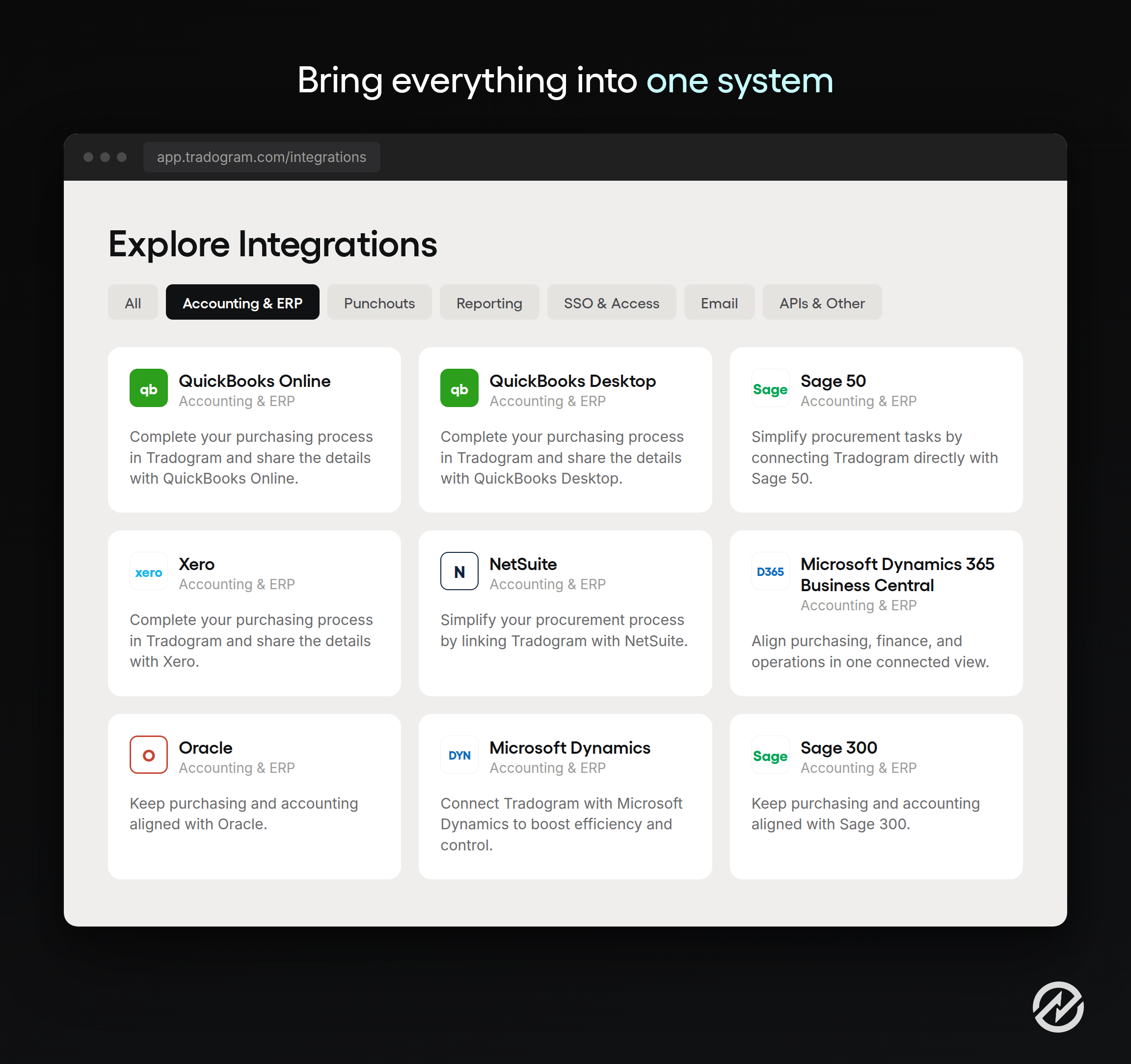
The practical questions to ask about any integration are narrow and answerable.
- Does it sync suppliers in both directions or only one?
- Does it push approved invoices, purchase orders, or both?
- How are chart of accounts and cost centers mapped?
- What happens when someone edits a record on the accounting side?
Software platforms that answer those questions specifically are usually the ones whose procurement integrations actually work in production. If you already run an ERP, it is worth reading how procurement software integrates with an existing ERP system before you shortlist anything.
The same logic applies to e-procurement more broadly. If your business runs multiple business units, entities, or locations, the value of a connected system and centralized procurement data rises quickly because spreadsheets cannot enforce consistency across units.
Organizations in the public sector and in regulated industries feel this first, since they have to produce an audit trail on demand rather than assemble one on request.
What to expect when you roll it out
This is the part that gets skipped in most software conversations, and it is the part that decides whether any of the above actually happens.
A new system changes people’s habits, not just their tools, which makes this a procurement change management exercise as much as a software one. The employee who used to email a request now fills in a form. The manager who used to reply “fine, go ahead” now clicks an approval that gets recorded. Neither is harder, but both are different, and different is what people resist.
Three things make user adoption go well.
Standardize before you configure. If two departments follow different purchasing rules for no particular reason, a system will faithfully reproduce both. Process standardization is easier to do while you are mapping workflows than six months later. Agree on standardized procedures for request fields, approval thresholds, and who owns which budget, then build procurement workflows to match.
Keep the first version simple. The most common implementation mistake is encoding every exception the business has ever made into the approval rules. Start with the rules that cover most purchases, and add complexity only when a real case demands it. A user-friendly first version that people use beats a complete one they work around.
Name an owner. Someone has to answer questions in the first eight weeks, and it should be a person, not a mailbox. The learning curve for requesters is usually one session, and shorter for approvers. For whoever administers the system, it is genuinely a few weeks of work, and pretending otherwise is how projects lose credibility.
The payoff is worth being specific about. Improved compliance is not an abstraction. It means requests follow the rules by default, so the exceptions are visible instead of hidden.
Procurement teams get their week back from chasing approvals and rekeying data, which lets procurement professionals apply their procurement expertise to sourcing, supplier development, and cost work rather than administration. Those are the strategic priorities most procurement functions are asked about, and usually the strategic needs the business has least capacity to meet.
Many organizations underestimate how much of effective procurement is simply consistency. The significant benefits of a P2P platform come from the same process running the same way every time, which is what makes the data trustworthy enough to act on.
How to tell whether your business is ready
You do not need a procurement department to justify procure-to-pay technology. You need enough purchasing complexity that the manual process is costing you more than the software would.
A few signals that the threshold has been crossed:
- Invoices regularly arrive that nobody can immediately match to an order.
- More than one person is authorized to commit money, and there is no consistent record of who approved what.
- Your budget owners find out about overspending after the fact rather than before.
- You buy the same items from more than one supplier at more than one price.
- Preparing for an audit or a year-end review means reconstructing purchase history from email.
- Someone on your team spends more than a day a week on purchasing administration.
If three or more of those are true, the manual process has stopped being cheaper, and the effort you spend trying to control spending by hand is already costing more than a system would.
Start small. Pick the one stage that is causing the most rework, usually either approvals or invoice matching, and fix that first. A P2P platform can run the whole cycle, but you don't have to turn it all on in week one, and businesses that phase it in tend to get further than those that try to do everything at once.
Procure-to-pay technology will not fix an unclear policy or decide what your business should buy. What it will do is make sure that every purchase follows the process you chose, that the information reaches finance while it is still useful, and that you and your team spend less time on repetitive tasks and more time managing the business. That is a modest description of the benefit, and it is also an accurate one.