

Procurement plays a pivotal role in the success of any business, greatly impacting the company’s bottom line. Thus, it’s crucial to achieve efficiency in procurement activities and ensure they are aligned with organizational goals.
In this article, we’ll explore the importance of procurement metrics and key ones every business should monitor to continuously drive operational excellence and achieve strategic objectives. So, let’s dive into it.
What are Procurement KPIs?
Procurement KPIs are key performance indicators that are measurable values used to assess the efficiency of procurement activities within an organization.
Importance of Tracking Procurement KPIs
Procurement KPIs are important to track for several reasons, including:
- Improve efficiency and cost management by identifying bottlenecks and optimizing processes.
- Strengthen supplier relationships through performance monitoring and better communication.
- Ensure alignment with organizational goals by tracking compliance, quality, and strategic objectives.
Top Procurement KPIs to Track
The main procurement KPIs to track range from spending under management to PO cycle times. So, let’s take a look at each of them in more detail.
Spend Under Management
Achieving Spend Under Management (SUM) ensures that procurement processes are streamlined, costs are controlled, and savings are maximized. The definition of spending under management in more technical terminology would be the percentage of total procurement spend managed by the procurement team through strategic contracts and agreements.
How to calculate: SUM (%) = (Procurement-Managed Spend / Total Spend) * 100
Supplier Diversity
The percentage of spending allocated to diverse suppliers (e.g., small businesses, minority-owned, or women-owned businesses). This metric is crucial in enhancing supplier diversity overall, driving innovation, and supporting community engagement.
How to calculate: Supplier Diversity (%) = (Spend on Diverse Suppliers / Total Spend) * 100
Compliance Rate
Tracking compliance rate is crucial as it reduces risks associated with maverick spend and strengthens supply relationships. The compliance rate is the percentage of procurement transactions that adhere to organizational policies and contract terms.
How to calculate: Compliance Rate (%) = (Compliant Transactions / Total Transactions) * 100
Supplier Defect Rate
Supplier defect rate is the percentage of defective goods or services suppliers provide. By tracking this metric, you can efficiently monitor supplier performance, reduce quality issues, and improve customer satisfaction.
How to calculate: Supplier Defect Rate (%) = (Defective Deliveries / Total Deliveries) * 100
PO Accuracy
PO accuracy refers to the percentage of POs processed without errors such as incorrect quantities, prices, or supplier details. Purchase order accuracy helps ensure efficient procurement processes, reduce delays, and minimize return costs by reducing the required returns.
How to calculate: PO Accuracy (%) = (Error-Free POs / Total POs) * 100
PO Cycle Time
Purchase order cycle time is the average time taken to complete the PO process from initiation to supplier acknowledgment. Shorter cycle times improve efficiency and speed up procurement overall. This contributes to the timely delivery of goods and services.
How to calculate: PO Cycle Time = Total PO Processing Time / Number of POs
Emergency Purchase Ratio
The emergency purchase ratio is the percentage of purchases made on an emergency or unplanned basis. A lower ratio indicates better planning, reduced costs, and fewer disruptions in operations.
How to calculate: Emergency Purchase Ratio (%) = (Emergency Purchases / Total Purchases) * 100
Supplier Lead Time
Supplier lead time is the average time taken by a supplier to deliver goods or services after receiving an order. Shorter lead times allow for better inventory management. Thus, they also reduce the risk of stockouts.
How to calculate: Supplier Lead Time = Total Delivery Time (Days) / Number of Orders
Inventory Aging
Inventory aging is the amount of time inventory remains in stock without being used or sold. It helps identify slow-moving inventory and optimize stock levels.
How to calculate: Inventory Aging (Days) = Current Date - Date Inventory Was Received.
Inventory Turnover Ratio
Inventory turnover ratio refers to the number of times inventory is sold and replaced over a specific period. Higher turnover ratios mean faster turnover and reduced holding costs.
How to calculate: Inventory Turnover Ratio = Cost of Goods Sold (COGS) / Average Inventory Value

How to Efficiently Achieve Procurement KPIs
There are a few things to get in order to effectively achieve procurement KPIs.
Learn to Prioritize
To efficiently achieve set procurement metrics, learn to prioritize and focus on achieving higher-priority ones first.
- Assess which KPIs have the most significant impact on cost savings, efficiency, and compliance.
- Focus on high-value items or categories to drive the most substantial improvements.
- Regularly review priorities to adjust based on changing business needs and market conditions.
Distribute Responsibilities Among the Team Members
An uncoordinated team equals an unorganized workflow, thus decreasing productivity and causing inefficiency in setting goals.
- Assign specific KPIs to team members based on their expertise and roles.
- Set clear expectations and deadlines for each team member responsible for different aspects of the KPIs.
- Promote collaboration and cross-functional communication to ensure everyone is aligned and working towards common goals.
Incorporate the Right Technology
Start incorporating the right technology to track progress and measure against set benchmarks.
- Invest in procurement software that allows for real-time tracking and reporting of KPIs.
- Use automation to reduce human errors and improve the accuracy of data collected for KPIs.
- Continuously evaluate and integrate new technologies that offer advanced features like predictive analytics or AI for better decision-making.
Enhance Procurement Performance with Tradogram
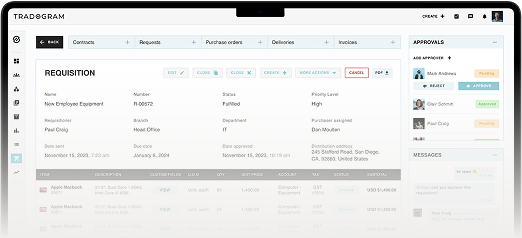
If you are looking for a reliable procurement solution, then you are in the right place. Tradogram is an all-in-one procurement solution that comes in handy with advanced features for procurement optimization.
The platform’s features range from tracking and monitoring tools to supplier management and inventory management tools. Contact us to learn more about what we have to offer and how we can help you improve procurement efficiency and achieve higher ROI.