

The instinct to buy local has long been framed as a consumer virtue or a CSR checkbox. That framing is now outdated, and more to the point, it was always the wrong argument to make to the people who actually decide where things get bought.
Notice what the framing did. It did not just mislabel local sourcing. It decided who owns it. When buying local lives in the sustainability report, the sustainability team defends it in values language to an audience that has already allocated it a fixed budget. It is a line item with a constituency, and the first cost review of a difficult quarter is where it goes to die.
Twenty years of support-your-local-business campaigning has produced almost no change in enterprise sourcing behavior. That is not because procurement leaders are cynical people. It is because nobody ever gave them a number.
I should say where I am standing. Tradogram is an Ottawa company, and most of the organizations we work with are in the United States.
We have spent the last two years watching mid-market procurement teams on both sides of a border that used to be an administrative detail and is now a variable in the sourcing decision.
That is not a neutral vantage point, and I am not going to pretend otherwise. It is also why I think the buy-local argument has been made badly, by people who agree with me.
Distance is a proxy. Jurisdiction is the variable.
Here is the reframe that makes the argument survive a cost review.
In the context of modern procurement, a local supplier is not necessarily one down the street. It is one operating inside the same regulatory and geopolitical boundary as you. A supplier in Ontario and a supplier in Texas may both qualify for a company in either place. A supplier in a jurisdiction subject to export controls or retaliatory tariffs does not, no matter what the unit price says.
Procurement already prices distance, but it does it badly, by folding it into lead time. Lead time is an excellent measure of the ordinary case and a useless one for the discontinuous case. A supplier 400 kilometers away across a hardening border and a supplier 3,000 kilometers away inside your own regulatory perimeter carry opposite risk profiles.
A lead-time field records them as roughly the same.
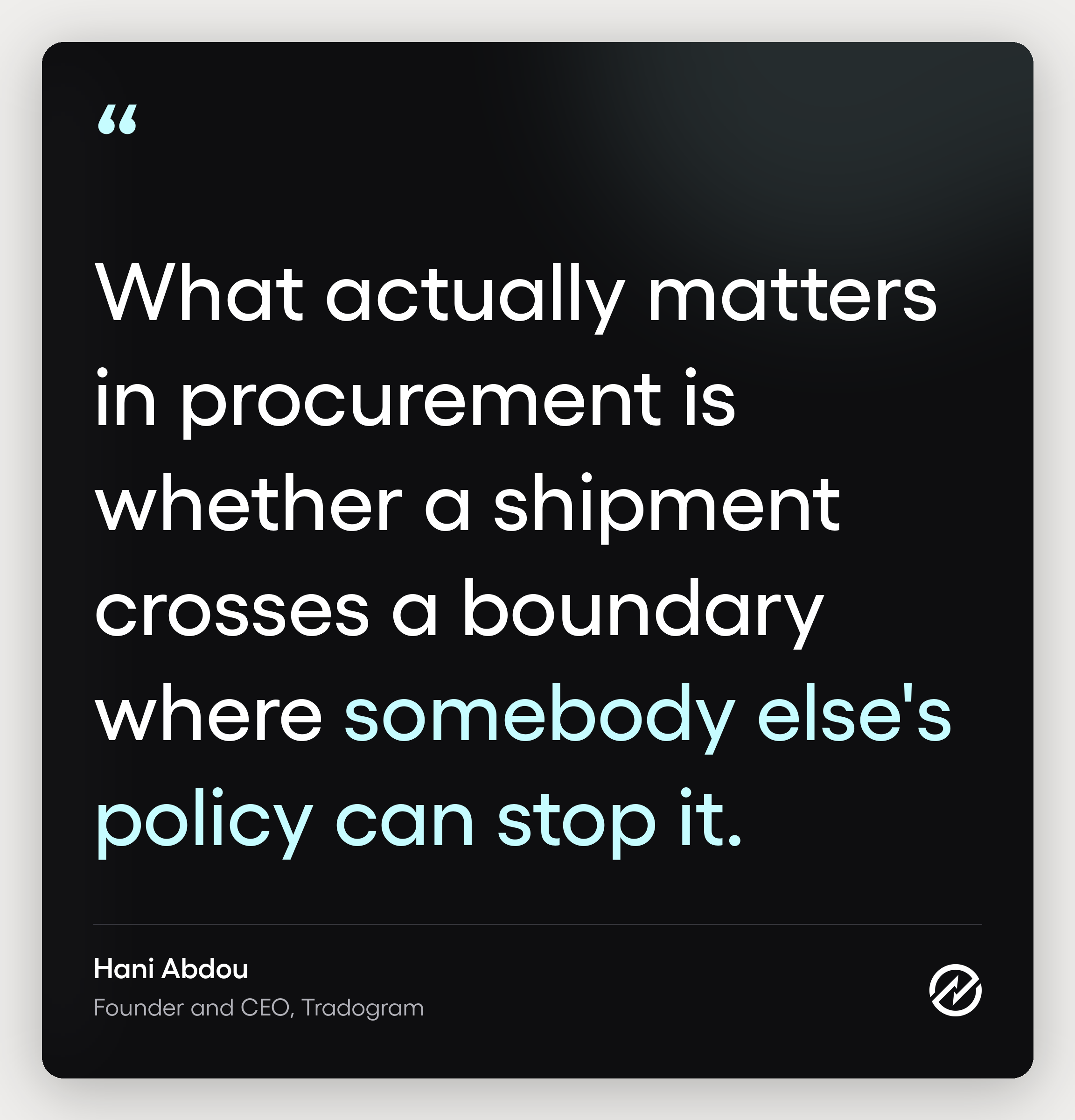
What actually matters in procurement is whether a shipment crosses a boundary where somebody else's policy can stop it. That is jurisdiction, not kilometers. Distance only mattered because it correlated with jurisdiction, and over the last few years that correlation has broken down enough to be worth calling out.
BCG's analysis in Acting Decisively as Global Sourcing Shifts describes the shape of it: export regulations restricting sourcing options for specific technologies, and tariffs on critical imports redirecting decisions made on cost a few years ago. None of that shows up in a unit price comparison until it shows up all at once.
The reason it stays invisible
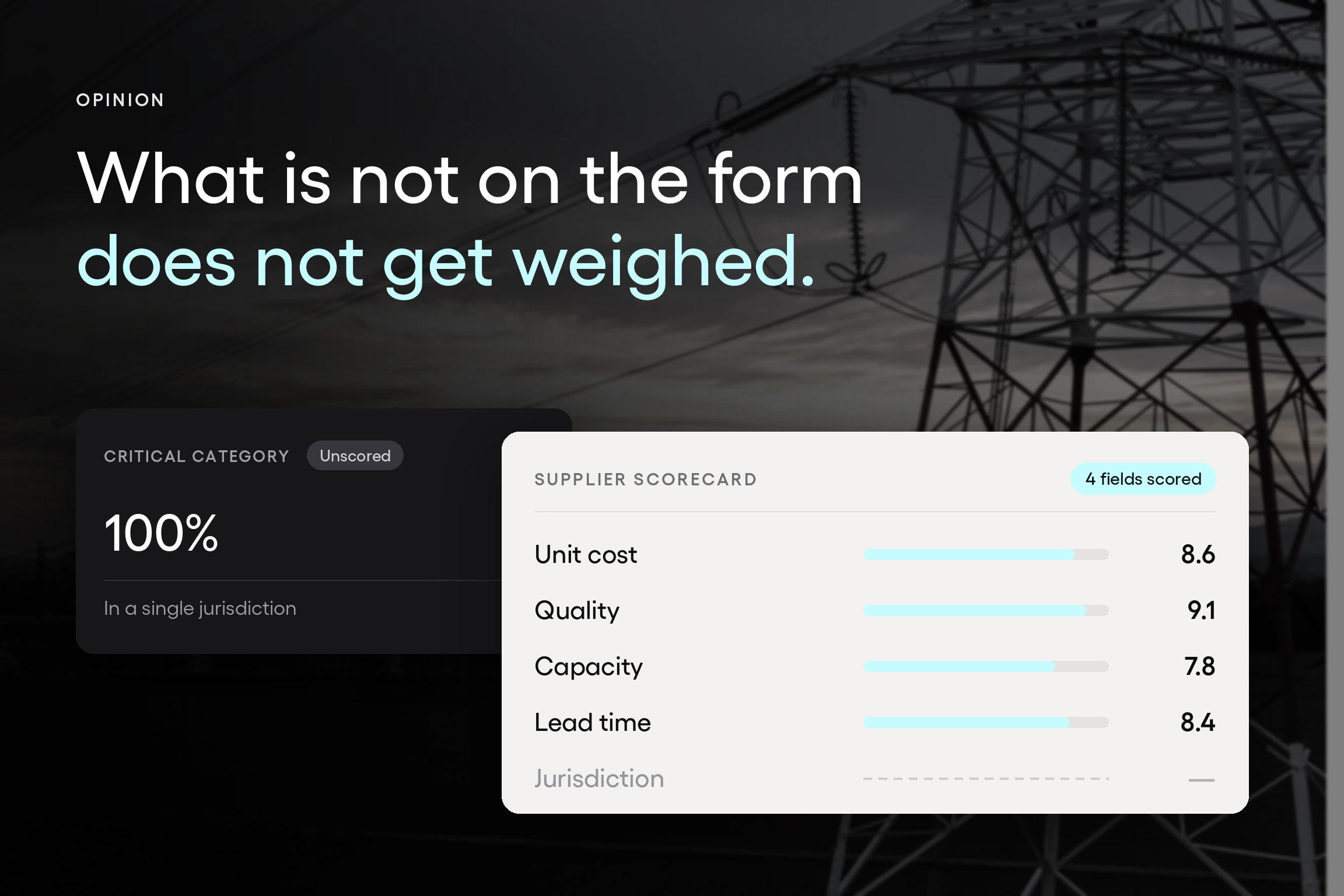
A sourcing scorecard prices unit cost, quality, capacity, and lead time. Some price supplier financial health, and the good ones price capacity concentration.
None of them have a field for jurisdictional concentration.
What is not on the form does not get weighed. So geography enters the sourcing decision in one of two ways: as a tiebreaker when everything else is equal, which is rare, or as a crisis, when a policy change makes a category unavailable, and somebody has to find an alternative in four days. Neither is a decision process, and both simply happen in the absence of one.
The sharper version of the problem is that even teams who want to weigh it often cannot, because Tier 1 visibility is not jurisdiction visibility. Most organizations have reasonable insight into their direct suppliers. Tier 2 and Tier 3 are a blind spot. A domestic vendor that sources its critical inputs from a single offshore sub-supplier gives you the paperwork of a local supply base with none of the protection. You pass the audit and keep the exposure.
The aerospace and defense sector worked this out earlier than the rest of us, because the consequences arrive faster there. The Aerospace Industries Association's analysis of strategic localization treats supplier proximity as a technology sovereignty question and a single-point-of-failure question rather than a cost question. That is the right frame, and it is not specific to defense. It is just that defense cannot defer the consequences the way the rest of us can.
What this costs, honestly
Localization usually costs more per unit. Often permanently. Anyone telling you otherwise is selling something, and probably selling it to your CFO, who will find out.
It is also worth being honest about the last round. A lot of reshoring in 2021 and 2022 went badly. It went badly for a reason worth naming: it was executed as panic reallocation during a disruption, not as a change to how sourcing decisions get made.
Companies moved categories under pressure, at bad prices, on short timelines, and then discovered that the domestic supplier they had rushed to qualify had its own concentration problem one tier down. That experience is now being used as evidence that localization does not work. It is evidence that doing it in a hurry does not work.
So here is the reframe that makes the cost defensible. You are not buying cheaper inputs. You are buying optionality, and optionality has a price.
Procurement already understands this instrument perfectly well. It is why you carry safety stock you hope never to use. It is why you dual-source categories where single-sourcing would be cheaper, and why nobody calls that decision wasteful. Jurisdictional diversification is the same instrument applied to a variable that has not been on the form.
One objection deserves a direct answer, because it will be the first one raised in the room. This is not protectionism with a spreadsheet. Protectionism is a policy position about trade, and I am not making one. This is portfolio construction. It is an argument against holding one hundred percent of a critical category in any single jurisdiction, and that includes your own. A Canadian company wholly dependent on Canadian suppliers has concentrated its risk exactly as much as one wholly dependent on suppliers anywhere else. The principle is diversification across boundaries, not preference for the boundary you happen to live inside.
The question worth asking
The question is not whether to buy local. Framed that way, it will keep losing to unit price, and it will keep losing for the same reason it has lost for twenty years: it is being argued as a virtue against an argument made in numbers.

The question is whether your sourcing decisions have a field for the thing that has been quietly determining your risk all along. If jurisdictional concentration is not scored, it is not managed, and you will find out where your exposure sits at the same time as everybody else, which is the worst possible moment to find out.
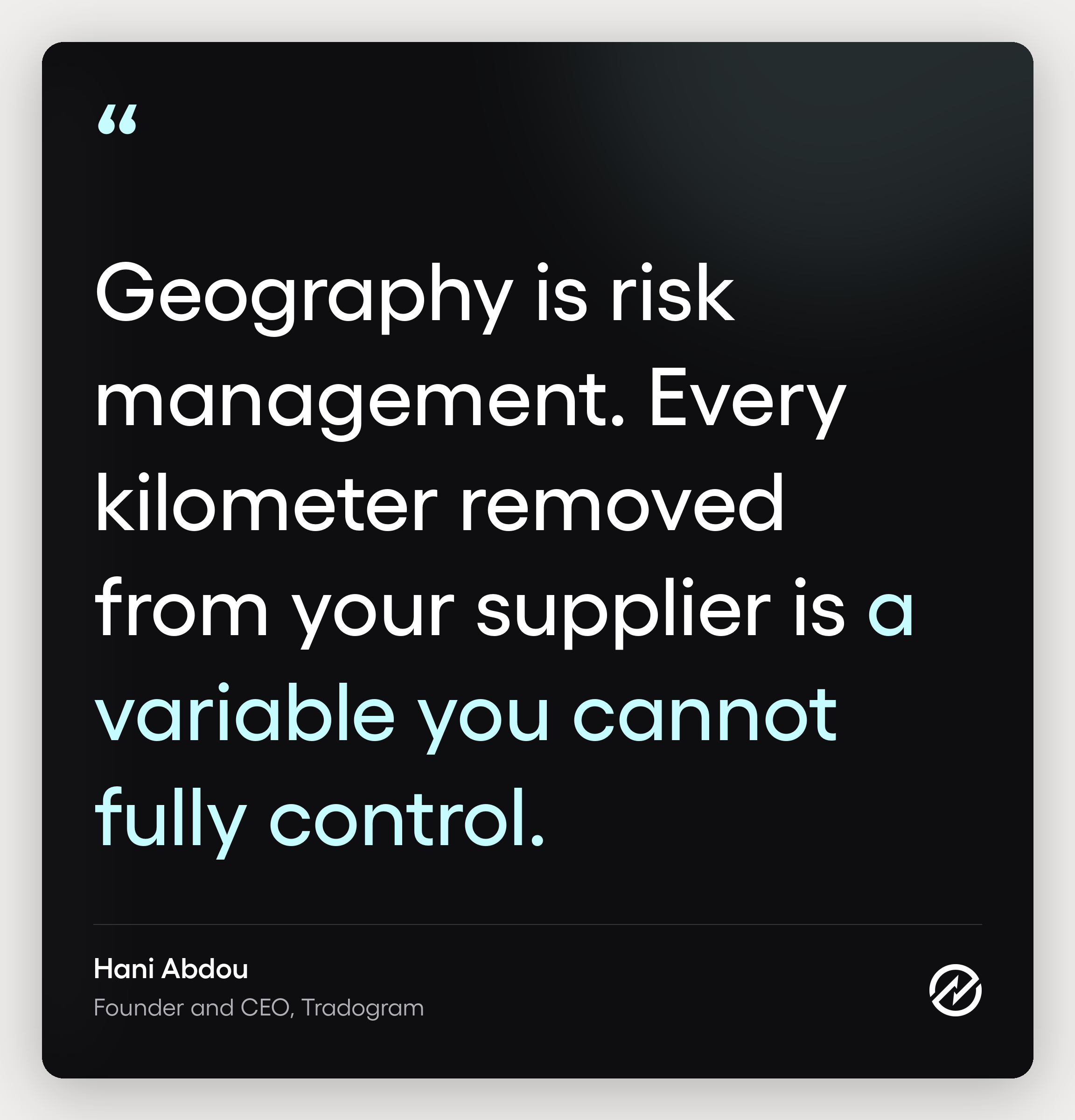
Geography is risk management. Every kilometer removed from your supplier is a variable you cannot fully control.
If you want the method rather than the argument, the companion piece covers how to build a supply chain map from purchase orders you already hold, and how to score it across four dimensions, jurisdiction among them.