

The High Cost of Silence: Why Compliance Monitoring is a Financial Imperative
Every dollar your organization spends outside a negotiated contract is effectively working against you. In most procurement operations, these dollars accumulate faster than anyone cares to admit.
Compliance monitoring — the ongoing, real-time scrutiny of purchasing behaviour against approved policies, contracts, and vendor agreements — is not a luxury reserved only for large enterprises. It acts as the financial immune system for any procurement function. Yet many teams still view compliance as a retrospective task: conduct an audit, find gaps, patch them up, and repeat.
This reactive cycle is costly. According to research cited by Ardent Partners, organizations lose an average of 12% to 18% in savings leakage for every dollar spent off-contract. When scaled across a mid-sized company's annual procurement budget, this becomes a figure that is hard to overlook.
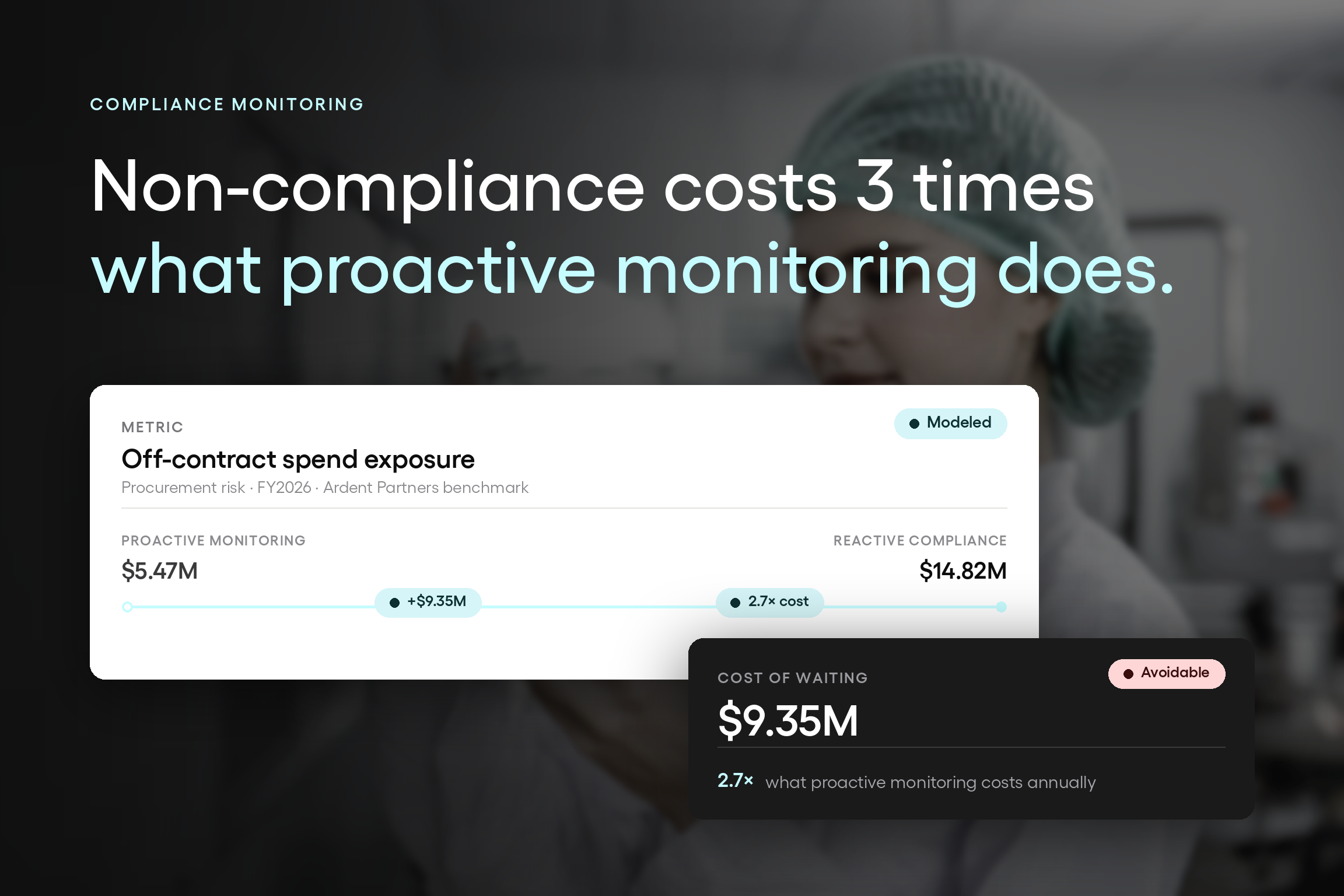
The cost of silence is even greater. The Ponemon Institute found the average total cost of non-compliance reaches $14.82 million — nearly three times the $5.47 million cost of proactively maintaining compliance.
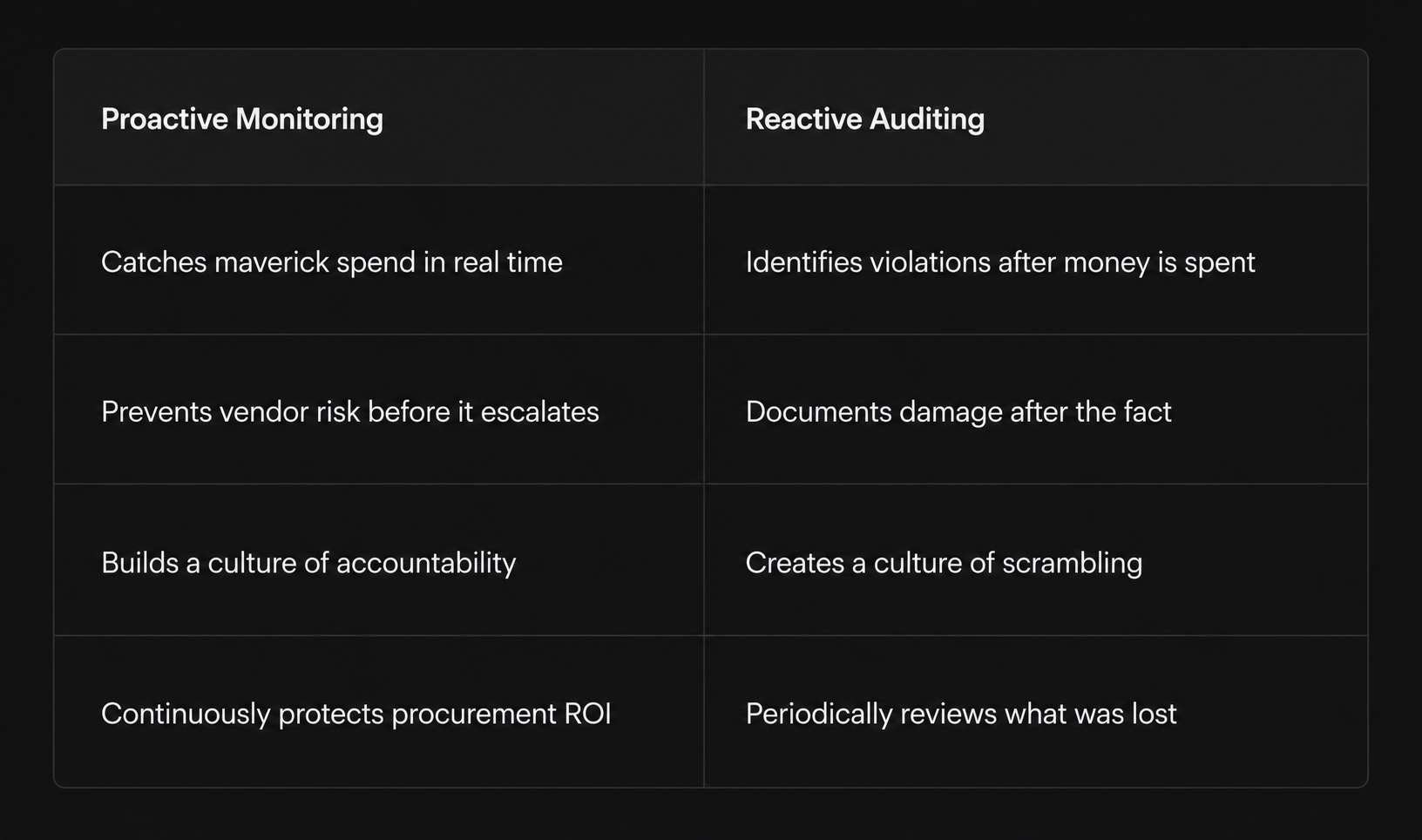
Compliance monitoring serves as the vigilant eyes and ears of your procurement department — constantly observing, continually comparing purchase activity against the rules you've set, and flagging discrepancies before they snowball into six or seven-figure problems.
Why Real-Time Monitoring Beats Periodic Audits
Traditional compliance checks happen on a schedule: quarterly, annually, or whenever a stakeholder raises a red flag. By the time an audit surfaces an issue, the maverick spend has already occurred, the budget has already been affected, and the only remaining option is damage control.
Real-time monitoring changes this dynamic entirely. Instead of discovering non-compliance after the fact, procurement teams using integrated procure-to-pay platforms can catch policy violations at the moment of requisition — before a purchase order is even issued.
This shift from reactive to proactive compliance delivers measurable ROI in several ways:
- Reduced maverick spend. When every purchase request is automatically checked against approval workflows and preferred vendor lists, off-contract buying drops significantly.
- Faster issue resolution. Flagging a policy exception in real time means it can be corrected in minutes rather than discovered months later during a painful reconciliation.
- Stronger contract compliance. Automated contract management tools ensure purchases are matched against negotiated terms, capturing rebates and volume discounts that would otherwise be missed.
- Improved audit readiness. A continuous, documented trail of compliance checks means your team is always prepared for an external audit, rather than scrambling to reconstruct records.
Building a Business Case for Compliance Technology
For procurement leaders trying to secure budget for compliance technology, the ROI argument is straightforward: the cost of the software is almost always dwarfed by the savings leakage it prevents. A platform that reduces off-contract spend by even a few percentage points can pay for itself many times over within the first year.
Beyond the direct financial case, real-time monitoring also strengthens spend analysis and budget control capabilities, giving finance and procurement leaders a clearer, more current picture of where money is actually going — not just where it was supposed to go according to last quarter's budget.
Moving From Checkbox Compliance to Continuous Protection
Checkbox compliance treats policy adherence as a box to tick once a year. Real-time monitoring treats it as an ongoing discipline woven into every transaction. The difference shows up directly on the bottom line: fewer leaks, faster corrections, and a procurement function that can prove its value with data rather than assumptions.
Ready to Strengthen Your Procurement Compliance?
Tradogram gives procurement teams the real-time visibility and automated controls needed to catch compliance issues before they become costly problems. Contact our team today to see how continuous monitoring can protect your organization's bottom line.