

Most organizations know exactly where their largest purchases go. Ask a finance lead which suppliers take the biggest share of annual expenditures and the answer comes quickly, with contracts and negotiated terms behind it.
Ask the same question about the other end of the spend portfolio and the room goes quiet.
That quiet is expensive. The purchases nobody watches are not small in number. They are small in value, individually, and there are thousands of them, spread across hundreds of vendors that no single person is accountable for managing. That is tail spend, and for most mid-market organizations it is the largest untouched cost reduction opportunity on the books.
The reason it stays untouched is not indifference. It is arithmetic. A procurement team that rigorously manages 50 strategic suppliers cannot apply the same rigor to 500 transactional ones, and most tail spend management advice assumes a team size and a toolset that mid-market procurement teams do not have.
This article takes a different approach. It defines tail spend precisely, quantifies what unmanaged tail spend actually costs, and sets out how to run a tail spend analysis and consolidate suppliers without adding headcount. The work is real, but it is finite, and the return is immediate in a way that most procurement initiatives are not.
What is tail spend?
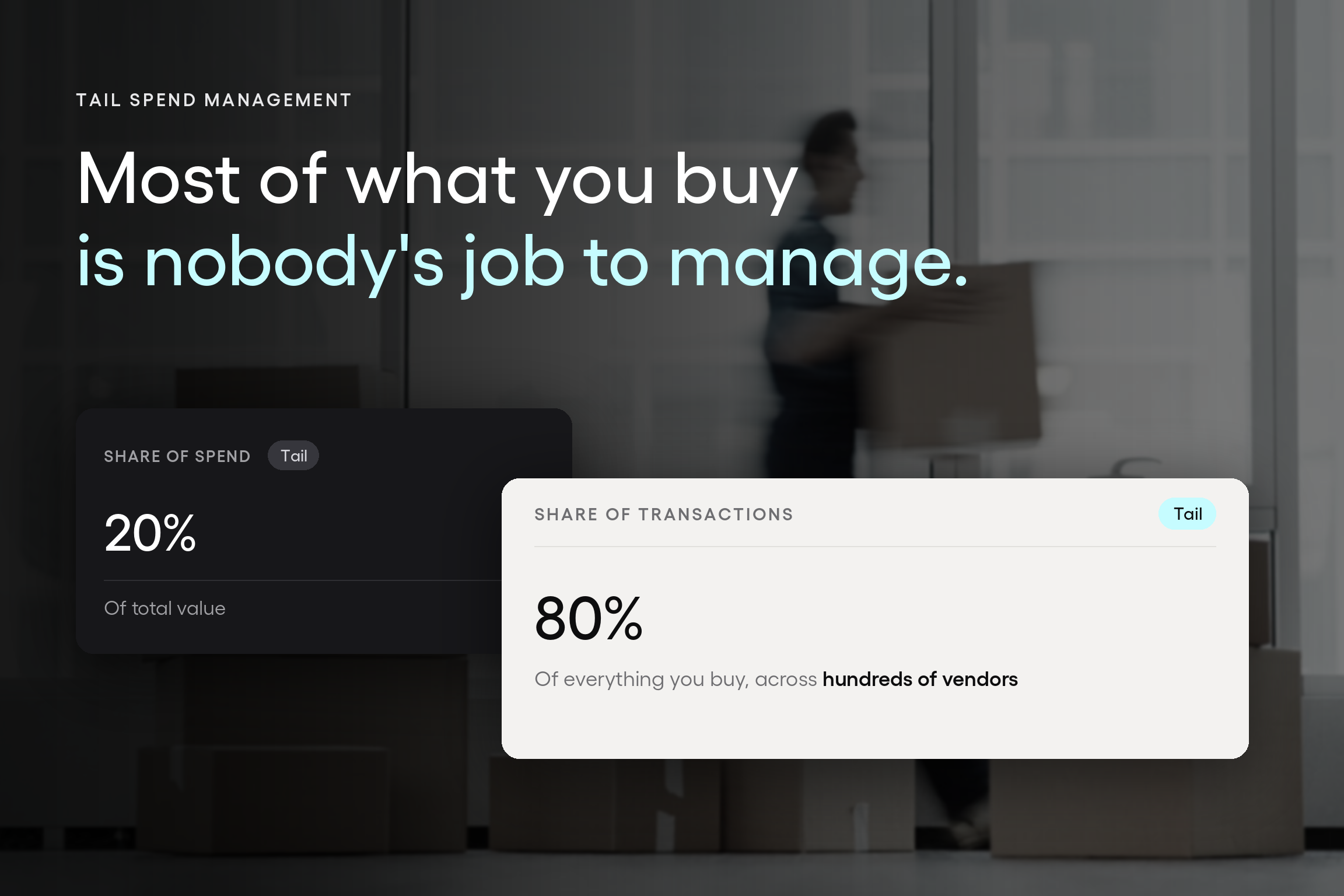
Tail spend refers to the low-value, high-volume purchases that sit outside actively managed procurement. It typically accounts for about 20% of total spend while representing roughly 80% of all procurement transactions, spread across the large majority of an organization's suppliers.
The numbers vary by source and by organization. McKinsey's analysis in "Long tail, big savings" puts tail spend at 80 to 90% of the items a company buys while accounting for only the bottom 10 to 20% of spend, and identifies savings potential of 5 to 15% in that category for companies that have not managed it before. Whichever end of those ranges your organization sits at, the shape is the same: a small share of money, an overwhelming share of activity.
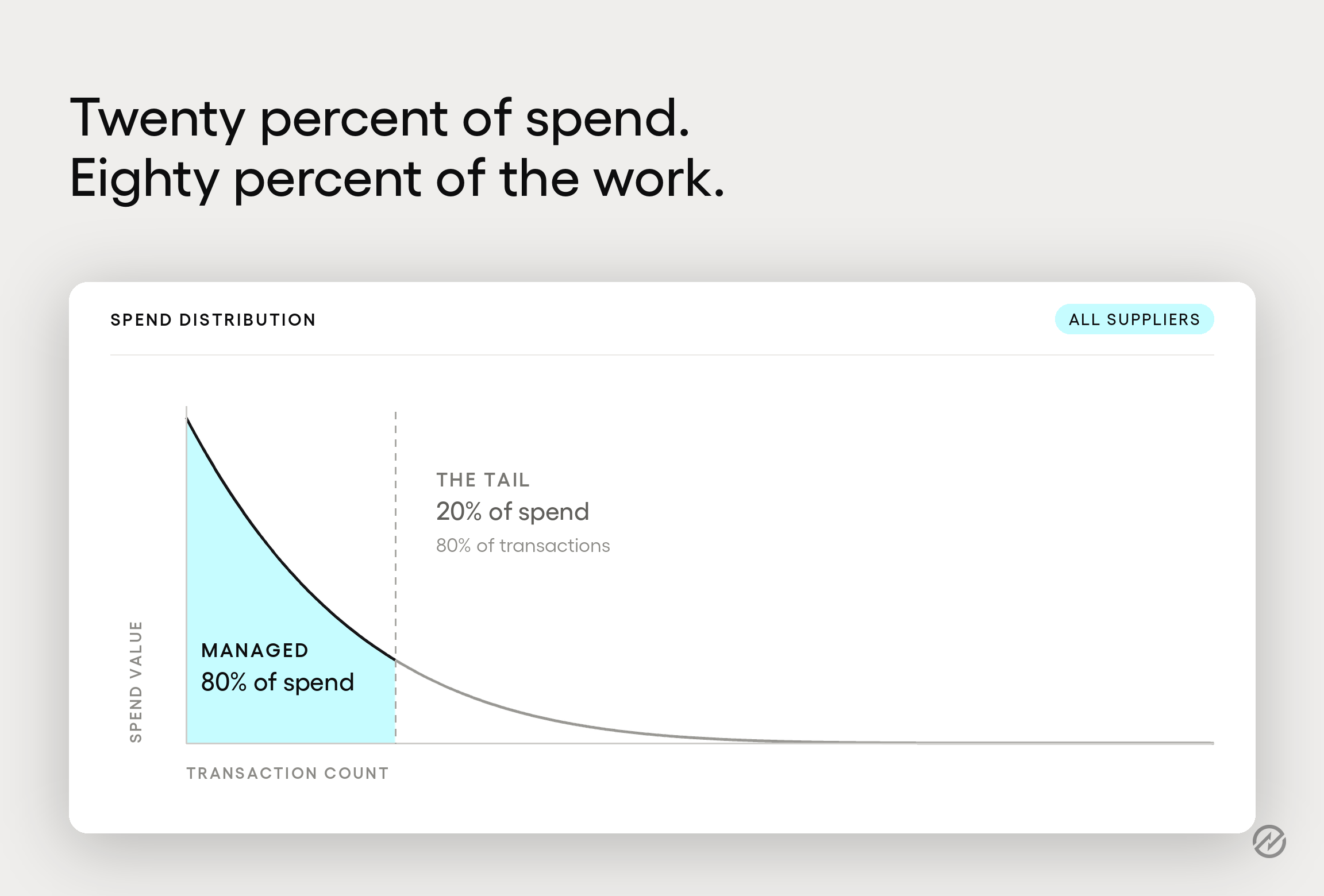
To define tail spend in practical terms, it is the tail end of your spend portfolio: what remains after you remove the suppliers and categories your team negotiates, contracts, and reviews. In most mid-market organizations that leftover includes:
- Office supplies, break room, and facilities purchases
- One-off service contracts and professional fees
- Emergency and expedited orders placed outside the approved list
- Small software subscriptions bought by individual teams, from a design app to a project management tool
- Replacement parts, tools, and consumables ordered as needed
- Travel and event costs booked independently
None of that is exciting, and that’s the point. Tail spend is the ordinary purchasing that happens in the gaps between managed categories, and understanding it starts with accepting that its defining feature is fragmentation rather than any particular category.
Two distinctions are worth drawing early.
- Tail spend is not the same as indirect spend. Indirect spend describes what is being bought, meaning goods and services that do not go into the finished product, and plenty of indirect spend is strategic and well managed. Tail spend describes how it is being bought, meaning without oversight. Direct spend can develop a tail too, particularly in organizations with multiple sites ordering the same materials independently.
- Tail spend is also not the same as maverick spend, though the two feed each other. We have covered maverick spend in depth separately, and the relationship matters here: an unmanaged tail creates the conditions for off-contract buying, and off-contract buying grows the tail. One is the structure, the other is the behavior.
Tail spend typically fails in two directions
Tail spend creates two problems that sound like opposites. Both are real, and most organizations have both at the same time.
Failure #1 - Some of it runs through your full purchasing process. A $180 order for replacement parts gets a requisition, an approval chain, a purchase order, a receipt, and a three-way match, because your process cannot tell the difference between $180 and $180,000. That spend is visible, controlled, and wildly expensive to handle relative to its value.
Failure #2 - The rest never enters the process at all. It goes on a corporate card, through a supplier's website, or over the phone, and arrives as an invoice nobody approved. That spend is cheap to transact and completely invisible.
The two are connected, and the direction matters.
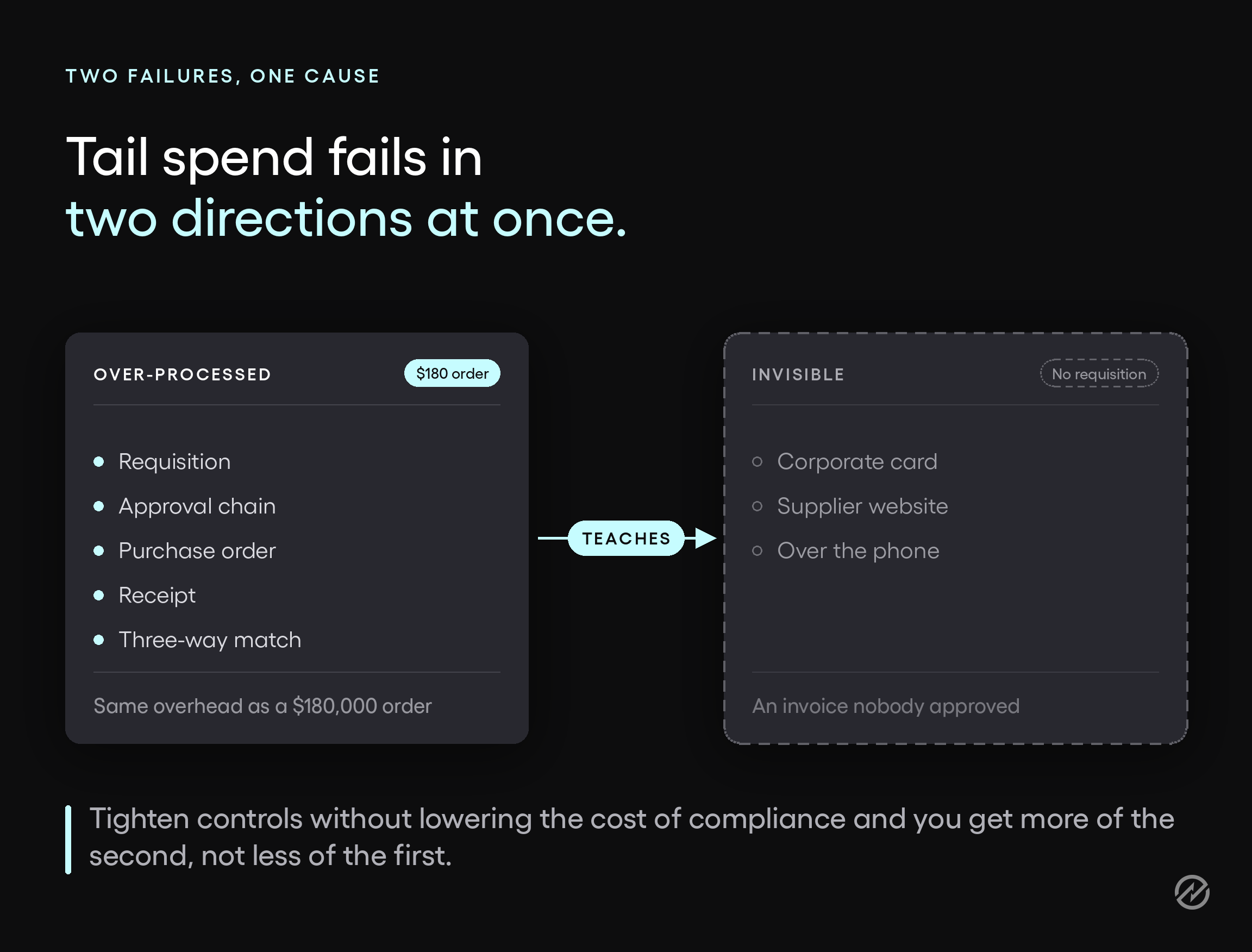
Every hour someone spends waiting on an approval for a box of cables teaches them to buy the next box on a card. Organizations that tighten controls without lowering compliance costs reliably end up with more of the second problem rather than just less of the first.
Why low-value purchases cost more than they seem
Let’s start with the half that runs through your process. The purchase price of a tail spend transaction is rarely the problem. The processing cost is.
Every purchase, regardless of value, moves through the same procure-to-pay process. It needs a requisition, an approval, a purchase order, a receipt, an invoice matched against both, and a payment.
A $200 order for office supplies takes nearly the same administrative effort as a $200,000 order for production materials, because the steps don't scale down with the amount.
That is the arithmetic that makes unmanaged tail spend expensive. When 80% of your transactions carry 20% of your value, your procurement processes are spending the overwhelming majority of their capacity on the smallest share of the money.
Three mechanisms drive the cost, and they compound.
- Manual data entry across disconnected systems. In fragmented environments, procurement staff re-key the same information repeatedly. An invoice arrives, gets matched by hand to a purchase order, cross-referenced against a contract stored elsewhere, and routed for approval through a separate tool. Each step adds labor cost and error points, and errors create downstream work.
- Touchpoint multiplication. Every additional vendor brings its own onboarding, compliance checks, payment terms, invoicing format, and relationship overhead. Managing vendor relationships across hundreds of fringe suppliers consumes procurement capacity out of all proportion to what those suppliers deliver. The number of suppliers, not the amount spent with them, is what sets the workload.
- Reconciliation that compounds at month-end. When spend data lives in separate systems, reconciliation becomes a forensic exercise rather than routine. Teams chase mismatched invoices, duplicate payments, and vendors nobody recognizes. None of that work adds value, and all of it scales with transaction count.
The practical consequence is that your procurement team's most experienced people spend their time on administration rather than on strategic sourcing, category management, or negotiation.
That is the real cost of an unmanaged tail, and it does not appear on any invoice.
The visibility problem: you cannot analyze what you cannot see
Now the half that never enters the process. Limited visibility is the defining constraint in tail spend management, and it is structural rather than accidental.
Tail spend is, by construction, the spend that never enters a system designed to capture it. Purchases get made on corporate cards, through supplier websites, over email, or by phone. They arrive as invoices rather than as purchase requests. By the time finance sees them, the buying decision is months old, and the money is gone.
That creates three specific failures, each expensive in its own way.
- Compliance and contract risk. Without centralized contract tracking, renewal deadlines pass unnoticed, and auto-renewals trigger on unfavorable terms. Audit exposure grows quietly. Decentralized purchasing also means suppliers enter the organization without vetting, creating compliance risks nobody has assessed.
- Missed savings from split volume. When spend on similar goods is split across fifteen or twenty vendors, no single supplier sees enough volume to justify a discount. The consolidation that would earn better pricing never happens, because no one holds the full picture. These cost-saving opportunities stay invisible because the data is fragmented.
- Broken forecasting. Siloed procurement data makes demand planning unreliable. Teams over-order, under-order, or duplicate purchases across departments, and each outcome has a cost.
Underneath it all is data quality.
Even organizations that capture tail spend often cannot analyze it, because supplier names are inconsistent, categories are missing, and the same vendor appears four times under four spellings.
Poor data quality defeats spend analysis before it begins, which is why the first step in any credible tail spend management program is a data cleanup rather than a sourcing exercise.
The problem compounds quietly. An organization with 3,000 supplier records accumulated over a decade and no supplier management system usually has a few hundred that are duplicates, a few hundred more that are inactive, and no reliable way to tell which is which without opening each one.
The scalability wall
At a certain point, manual tail spend management stops working, and most mid-market organizations hit that breaking point without noticing.
A procurement team can rigorously manage 50 strategic suppliers. The same team cannot manage 500, many of them transactional, low-touch vendors that each require onboarding, invoice handling, and occasional chasing. The administrative overhead of managing that long tail grows faster than the value those vendors deliver.
That is the scalability wall. Past it, fragmentation stops being an inconvenience and becomes a structural drag on the procurement function. The symptoms are recognizable: month-end takes longer every quarter, the team is perpetually firefighting rather than planning, and nobody can answer a simple question about what the organization spent on a given category last year without a week of spreadsheet work.
The wall is also why hiring rarely solves tail spend. Adding a person to manage 500 vendors manually buys capacity, not control, and the tail keeps growing. The equation changes when you reduce the number of vendors that need managing and automate the transactions that remain.
What fragmentation costs beyond the transaction
The financial cost is the easiest part to measure. The operational cost runs deeper.
When a procurement team is spread across hundreds of supplier relationships, no single relationship gets the attention it deserves. Depth matters in vendor management. Preferred buyers earn priority production slots, faster issue resolution, and early access to new products.
Spread too thin, your organization becomes another account number, and your ability to enforce quality standards erodes with it.
Consistency suffers most visibly at the item level. When three vendors supply the same component, you are rarely getting identical quality, even when the specifications match. Tolerances drift, and materials vary, creating downstream quality control problems that cost time and credibility to resolve.
Then there is opportunity cost, which procurement leaders should care about most. A team consumed by supplier disputes, late shipments, and onboarding replacements is not building category expertise or negotiating better long-term agreements. Fragmentation strains internal processes. It consumes the capacity that should be driving procurement strategy.
How to run a tail spend analysis
Before you can reduce tail spend, you have to see it. A tail spend analysis is a structured pass through your procurement data, and you can do it in a few days rather than a few months.
Pull twelve months of spend data from every system that holds it. That means your accounting system, card statements, expense platform, and any locally held purchasing records. Completeness matters more than precision at this stage.
Normalize the supplier list. Merge duplicate vendors, standardize naming, and flag one-time suppliers. This is the least interesting step and the one that determines whether everything after it works. AI-driven spend classification tools can do much of this automatically, matching variant supplier names and assigning categories, which is worth considering if your list runs to thousands of rows.
Rank suppliers by annual spend and count the transactions behind each. Two columns tell you most of what you need: what you spent, and how many times you had to process something to spend it. Suppliers with low spend and high transaction counts are your most expensive relationships per dollar.
Assign spend categories. Grouping the tail by category is what reveals consolidation candidates. Fifteen vendors supplying the same category is an opportunity. Fifteen vendors supplying fifteen categories is a different problem.
Identify the overlap. Flag every case where more than one supplier serves an identical need, and every case where the same item is being bought at different prices across departments or sites.
Analyzing spend data this way surfaces spending patterns no individual department can see on its own, because each one only sees its share of the procurement budget. The overlap between departments is where the savings opportunities concentrate.
The output is a short list of consolidation candidates ranked by how much administrative burden they remove, not by how much they spend. That ranking is the part most organizations get backward, and it is why spend analytics that only look at dollars miss the tail entirely.
Five steps to reduce tail spend and consolidate suppliers
Supplier rationalization is the practical response to everything above. Here is the sequence that works.
1. Audit and categorize your spend. Start with the tail spend analysis described above. Map every active supplier, categorize by spend volume and transaction count, and flag redundant vendors serving identical needs. You cannot make decisions about a supplier base you have not measured.
2. Centralize your procurement data. Pull spend records, contracts, and supplier performance into a single source of truth. Fragmented data produces fragmented decisions, and a vendor consolidation strategy built on partial information will consolidate the wrong suppliers. Centralizing spend data also makes financial forecasting and budgeting possible in a way that scattered records never will.
3. Consolidate and renegotiate. With volume data in hand, approach preferred suppliers with the full picture of what you actually buy. Supplier consolidation works in two directions: it reduces the number of relationships to manage, and it concentrates enough volume with the remaining suppliers to justify better terms. Both effects matter, and the second one funds the project.
4. Make the compliant path the easy path. Consolidation fails when buying from an approved supplier is harder than buying elsewhere. Catalogs, punchout access to vendors your team already uses, and simple purchase requests do more to reduce rogue purchases than any policy memo. Fewer rogue purchases mean fewer new suppliers entering the tail.
5. Monitor continuously. Tail spend rebuilds itself the moment controls relax. Ongoing spend monitoring with alerts for off-contract purchases is what keeps a consolidated supplier base consolidated. Track key metrics that reflect the real goal: supplier count, transaction count per supplier, percentage of spend under management, and contract coverage. Cost savings alone will not tell you whether the tail is growing back.
Effective tail spend management is not an attempt to manage every purchase. It is a decision about which purchases deserve active management and which should be made cheap to process and left alone.
Organizations that succeed at managing tail spend effectively focus on strategic spend, then remove as much friction as possible from everything else. An effective tail spend strategy is measured by how little attention the tail requires, not by how much it receives.
What tail spend automation actually changes
Manual effort does not scale to the tail. That is the whole problem, and it is why tail spend management solutions are ultimately a technology question rather than a policy one.
Automation changes four things specifically.
- It removes the per-transaction cost that makes low-value purchases uneconomic to process. When requisitions, approvals, purchase orders, receiving, and invoice matching run in one connected procurement platform, the administrative cost of a small purchase falls to something proportionate to its value.
- Automating low-dollar transactions is what makes managing the tail affordable, and it is also what stops people from routing around the process, because a request that takes ninety seconds does not send anyone to a corporate card.
- It creates the spend visibility that analysis depends on. When every purchase request enters the same system, spend data is captured at the moment of the decision rather than reconstructed afterward. That gives finance and procurement teams live spend analytics instead of a quarterly archaeology project, and it produces greater spend awareness across the organization rather than in procurement alone.
- It holds the line on compliance. Approval rules, budget controls, and preferred supplier catalogs enforce policy automatically, which is what prevents a consolidated supplier base from fragmenting again.
Those four changes drive operational efficiency. Streamlined processes reduce hidden administrative costs; the same controls that help you control costs also reduce risk by keeping unvetted suppliers out; and the capacity you recover goes back into strategic sourcing rather than processing.
For finance and procurement leaders, that is the argument that lands: long-tail spend management delivers significant savings, but the more durable return is a procurement budget you can forecast and a team that is no longer the bottleneck.
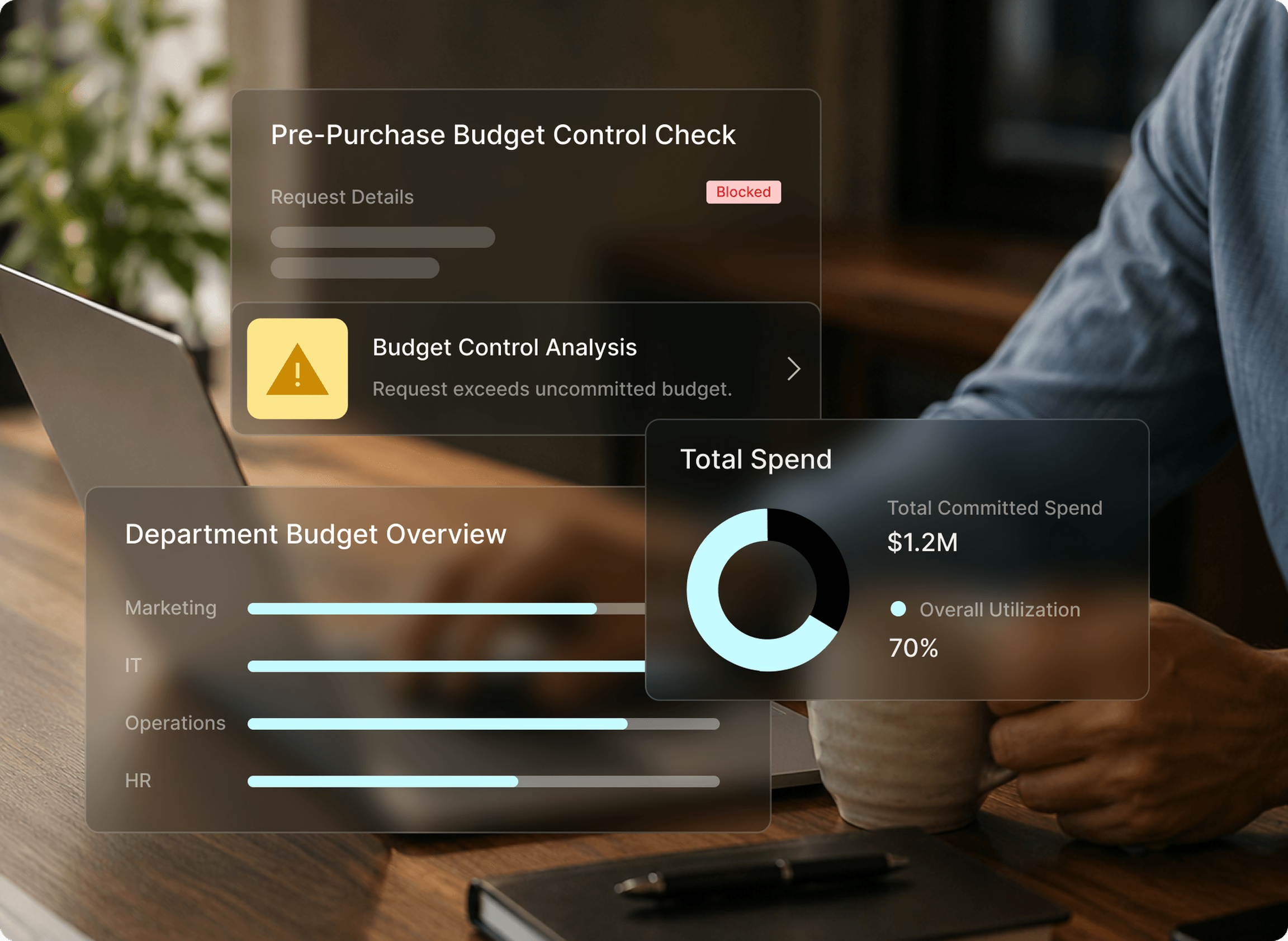
For organizations building this capability, tail spend solutions tend to come down to two connected capabilities.
Procurement spend management software handles the budget and control side, and supplier management software consolidates vendor records, documents, and performance in one place, letting procurement and finance teams work from one set of numbers.
Tradogram's own customer figures show 75% less time spent on manual approval workflows and 4x faster invoice processing when those steps are connected rather than handled separately. Your results depend on your starting point, but the direction is consistent: the savings come from removing steps, not from buying harder.
A note on expectations. No procurement management solution eliminates the tail, and any tool promising to is describing something other than procurement. The realistic goal is to shrink it, make what remains visible, and lower the cost of processing it. That is achievable in a quarter.
Where to start
Pull twelve months of supplier data and sort it by transaction count rather than by spend. The suppliers at the top of that list, the ones you buy from constantly and spend almost nothing with, are your tail. Most procurement leaders are surprised by how short the list of consolidation candidates turns out to be, and how much administrative drag the top ten remove.
Streamline internal processes around that list and the rest follows. That single view is usually enough to justify these tail spend management strategies internally, because it reframes tail spend from a savings argument, which finance has heard before, into a capacity argument, which procurement can prove.