

For most companies, the highest controllable cost on the income statement is what they pay other companies. Not payroll, which leadership guards carefully and reviews every year, but the total cost of everything the organization buys to operate.
That number is usually managed one purchase at a time, by people who were never asked to think about it as a portfolio.
Ask a leadership team to name their ten largest suppliers, and most can. Ask why those ten were chosen, when the decision was last tested against the market, or what it would cost to replace any one of them inside a quarter, and the room goes quiet. That silence has a price, and strategic sourcing is what closes it.
At Tradogram, we have helped thousands of organizations digitize their procurement processes, and the pattern we see most often is a procurement function doing strategic work in flashes, usually when a contract is about to expire or a supplier has just failed, rather than as a repeatable cycle. The cost of working that way rarely shows up as a line item, which is exactly why it persists for years.
This strategic sourcing guide covers what strategic sourcing is, how it differs from traditional procurement, the seven steps of the strategic sourcing process, and how to measure whether any of it produced measurable cost savings.
Key Takeaways
- Strategic sourcing is a cycle, not a project, and the difference shows up in the accounts. The seven steps end with benchmarking results and return to profiling the category, because market dynamics change and a supplier decision that was right two years ago may not be right now. Organizations that run the process once and treat it as finished book one round of savings, then quietly give them back over the following three years.
- The most valuable work happens before anyone contacts a supplier. Spend analysis and supply market analysis, steps one and two, determine the quality of every decision that follows. Teams that skip to requesting quotes are negotiating without knowing what leverage they have.
- Total cost of ownership beats unit price, and the gap between them is where margin goes. Price is the most visible number and rarely the largest one. Delivery reliability, quality failures, payment terms, switching costs, and administrative overhead routinely outweigh the difference between two quotes, which is why the cheapest supplier and the least expensive supplier are often not the same company.
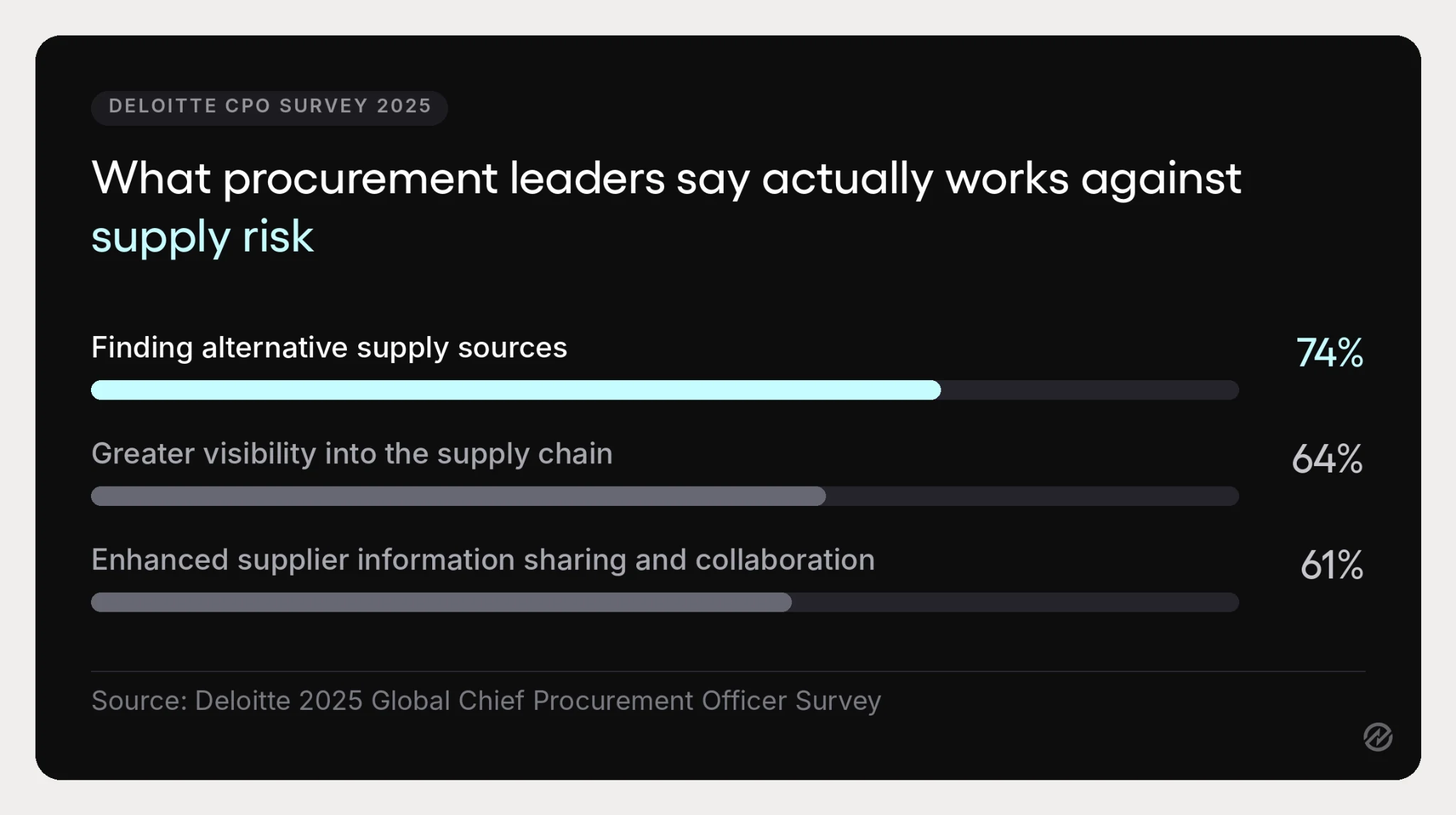
- Supplier diversification is now the most widely used risk control. In Deloitte’s 2025 Global Chief Procurement Officer Survey, 74% of respondents identified finding alternative supply sources as their most effective risk mitigation strategy, ahead of greater supply chain visibility at 64%.
- Strategic sourcing and strategic procurement describe the same discipline at different scopes. Sourcing is the supplier-selection engine. Strategic procurement is the wider function that includes it, along with category management, contract management, and supplier relationship management. Leadership teams that treat either as administrative overhead manage their second-largest cost base by exception.
What is strategic sourcing?
Strategic sourcing is the structured, data-driven process of analyzing what an organization buys, understanding the markets it buys from, and selecting suppliers on long-term value rather than the lowest quoted price. Strategic sourcing involves supply market research, supplier evaluation, and negotiation as a repeatable cycle rather than a one-time event, which is why it sits inside supply chain management rather than alongside it. It treats supplier selection as a recurring, evidence-based business decision rather than a transaction triggered by a purchase request.
The discipline has a specific origin. Roughly two decades ago, the consultancy A.T. Kearney, now Kearney, formalized the seven-step strategic sourcing process that remains the standard framework today. The steps below follow that structure.
Strategic sourcing focuses on a few things that transactional purchasing does not:
- Total cost rather than unit price. What the relationship costs across its life, not what appears on the quote.
- Spend categories rather than individual orders. Grouping similar purchases to create leverage that single requisitions never have.
- The supply market, not just the supplier list. Understanding cost drivers, capacity, and competition in the market you are buying from.
- Long-term value creation. Supplier decisions that hold up across years, including how easily you could change your mind.
How strategic sourcing differs from traditional procurement
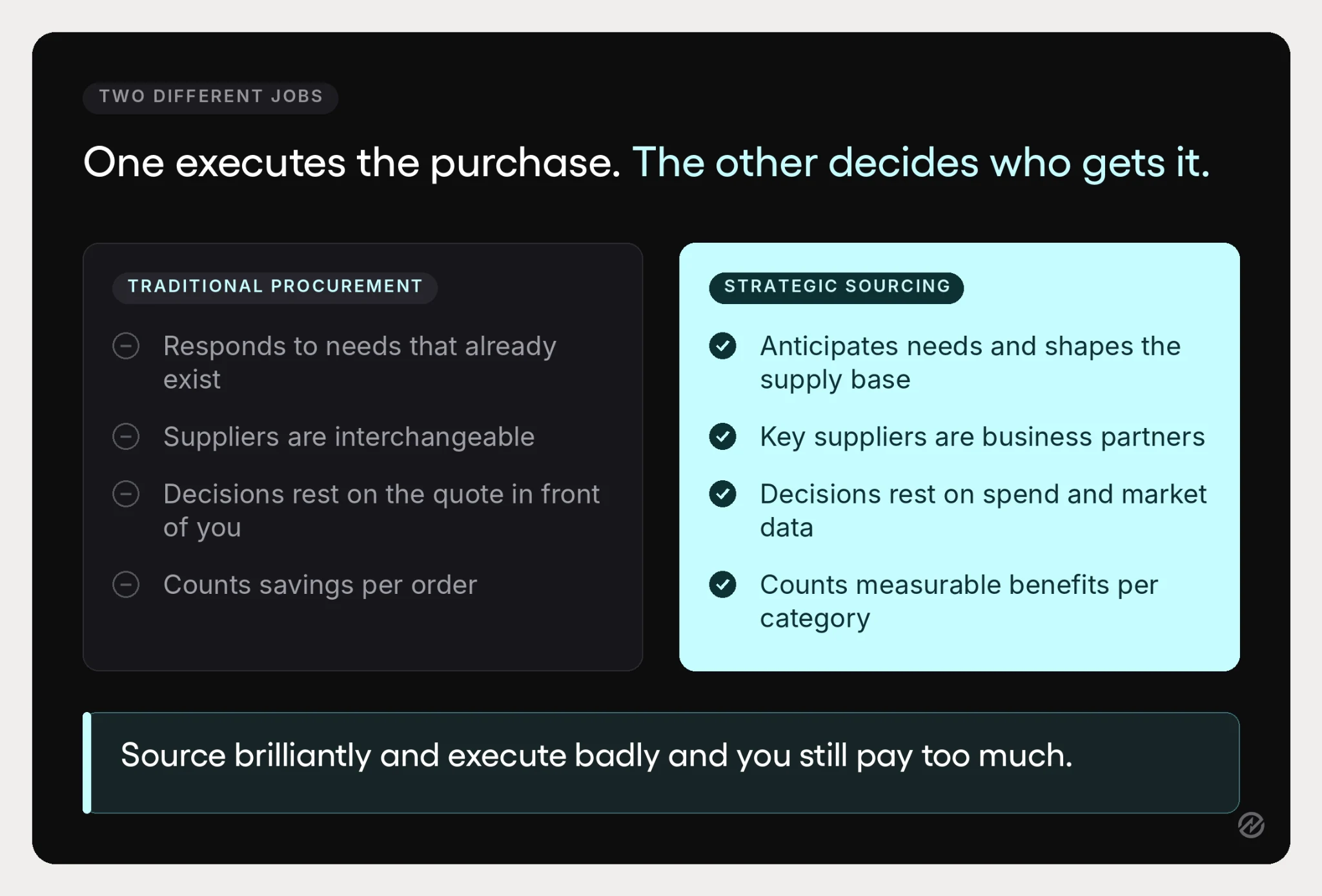
Traditional procurement focuses on executing purchases correctly: the right item, the right price, the right paperwork. That work still has to happen. Strategic sourcing sits above it and decides which suppliers should be receiving those purchases in the first place.
The practical differences show up in four places.
Time horizon. Transactional purchasing responds to an existing need. Strategic sourcing anticipates needs and positions the supply base ahead of them.
Supplier posture. Traditional procurement treats suppliers as interchangeable and switches on price. Strategic sourcing treats key suppliers as business partners, which changes what you can ask for and what they will offer.
Evidence base. Purchasing decisions in a transactional model rest on the quote in front of you. Strategic sourcing rests on spend analysis, supply market analysis, and supplier performance data.
Definition of success. Traditional procurement counts savings per order. Strategic sourcing counts measurable benefits across a category over time, including risk reduction and supply continuity that never appear as a line-item saving.
Neither replaces the other. An organization that sources brilliantly but executes poorly still pays too much because the negotiated terms never make it into the purchase orders.
Strategic sourcing and strategic procurement
These two terms get used interchangeably, and the distinction is one of scope rather than substance.
Strategic sourcing is the process of selecting and managing suppliers: analyze spend, study the market, define a strategy, run the competitive process, select, implement, measure.
Strategic procurement, sometimes called strategic procurement management, is the broader function that contains sourcing alongside category management, contract management, supplier relationship management, and the operational buying that follows. The strategic procurement process aligns all of those procurement activities with business objectives, and strategic sourcing and procurement are best understood as the same effort viewed at two altitudes.
If you are choosing between suppliers for a category, that is sourcing. If you are deciding how the whole purchasing function connects to company strategy, that is strategic procurement. The seven-step procurement sourcing process below serves both.
The benefits of strategic sourcing
Before the mechanics, it is worth being specific about what the process is supposed to produce, because “cost savings” on its own is too vague for a board to act on and too vague for a procurement team to be measured against.
Start from first principles. What is the organization trying to accomplish, where is the money actually going, and what would leadership need to know to make a better decision than the one being made today? Every benefit below is an answer to one of those three questions.
Competitive advantage. The one that belongs first, though it is usually listed last. Strategic sourcing enables organizations to secure capacity, pricing, or supplier innovation that competitors cannot easily match. A company with a dependable supply of something scarce is in a different market position than one paying spot prices for it, and that is a strategic outcome rather than a purchasing one.
Measurable cost savings and cost reduction that reach the income statement. Not just a better unit price. Consolidating suppliers in a fragmented category, eliminating off-contract buying, and renegotiating from an evidence base all produce savings that survive audit, which is the only kind finance will credit.
Lower supply risk. A supply base you have deliberately shaped is more resilient than one you inherited. Knowing which categories depend on a single source is the prerequisite for risk management that anticipates supply disruptions rather than reacting to them.
Stronger supplier relationships. Suppliers who understand your volumes, forecasts, and standards perform differently from suppliers who receive unpredictable orders. Strong supplier relationships are an operational asset, not a courtesy.
Better quality and supply continuity. Selecting on total cost rather than price tends to surface the suppliers who fail less often, which is usually where the real money is.
Operational efficiency. Fewer suppliers, clearer contract terms, and preferred suppliers with agreed pricing reduce the administrative load on procurement teams and on everyone who submits a purchase request.
A basis for fostering innovation. Strategic sourcing encourages collaborative relationships with key suppliers, which surface product and process improvements that a purely price-driven relationship never will. Over a long enough horizon, this is worth more than the negotiated savings, and it is invisible on any quarterly report.
The strategic sourcing process: 7 steps
The seven steps run as a cycle. Step seven feeds back into step one, because market dynamics, internal demand, and supplier performance all move.
Step 1: Profile the category
Start with what you actually buy. Category profiling means assembling a clear picture of spend in the category before forming any view about suppliers.
Analyze:
- Historical spend and volume
- Spend broken out by product and sub-product
- Spend by department or user
- Spend by supplier
- Demand forecast for the period ahead
The questions this answers are deliberately basic, and most organizations cannot answer all of them from memory: what are we buying, how much are we paying, who are our suppliers, and who inside the business is doing the buying.
Spend analysis at this stage frequently surfaces the finding that justifies the whole exercise. Fragmented spending patterns across multiple suppliers for the same category, maverick buying outside agreed contracts, or a supplier receiving far more volume than anyone realized. Our deeper guide to profiling the sourcing category covers this step in detail.
Step 2: Understand the supply market
With internal demand understood, turn outward. Supply market analysis identifies who else could supply this category, what drives their costs, and where the leverage sits.
Examine the cost drivers underneath the product or service: raw material costs, labor, transportation, and whether the supplier market is growing or contracting. A category where supply is tightening calls for a different strategy than one where new suppliers are entering.
This is also where global sourcing enters the picture, if the category supports it. Sources include published market reports and industry statistics, trade fairs, and direct conversations with suppliers outside your current roster. The more you understand the supplier landscape, the better positioned you are to negotiate. Our guide to understanding the supply market goes further on the analysis itself.
Step 3: Grow a sourcing strategy
You are not selecting a supplier yet. You are defining what a qualified supplier looks like and narrowing the field.
An effective sourcing strategy starts with an honest picture of business needs and internal capability, then sets qualification criteria and minimum requirements. Common criteria include:
- Cost and value for money
- Quality and consistency
- Reliability and delivery performance
- Responsiveness and communication
- Flexibility as volumes change
- Financial stability, which a credit check will tell you more about than a sales conversation
Assess both existing suppliers and potential suppliers against the same criteria. Current suppliers should not get a pass on history, and if an incumbent is holding the business back, that needs naming rather than managing around.
Keep the shortlist to four or five candidates. Approaching a supplier who has little chance of qualifying wastes their time and yours.
Do this with a cross-functional team rather than procurement alone. Sourcing objectives set without input from the people who use the goods or services tend to optimize for the wrong thing.
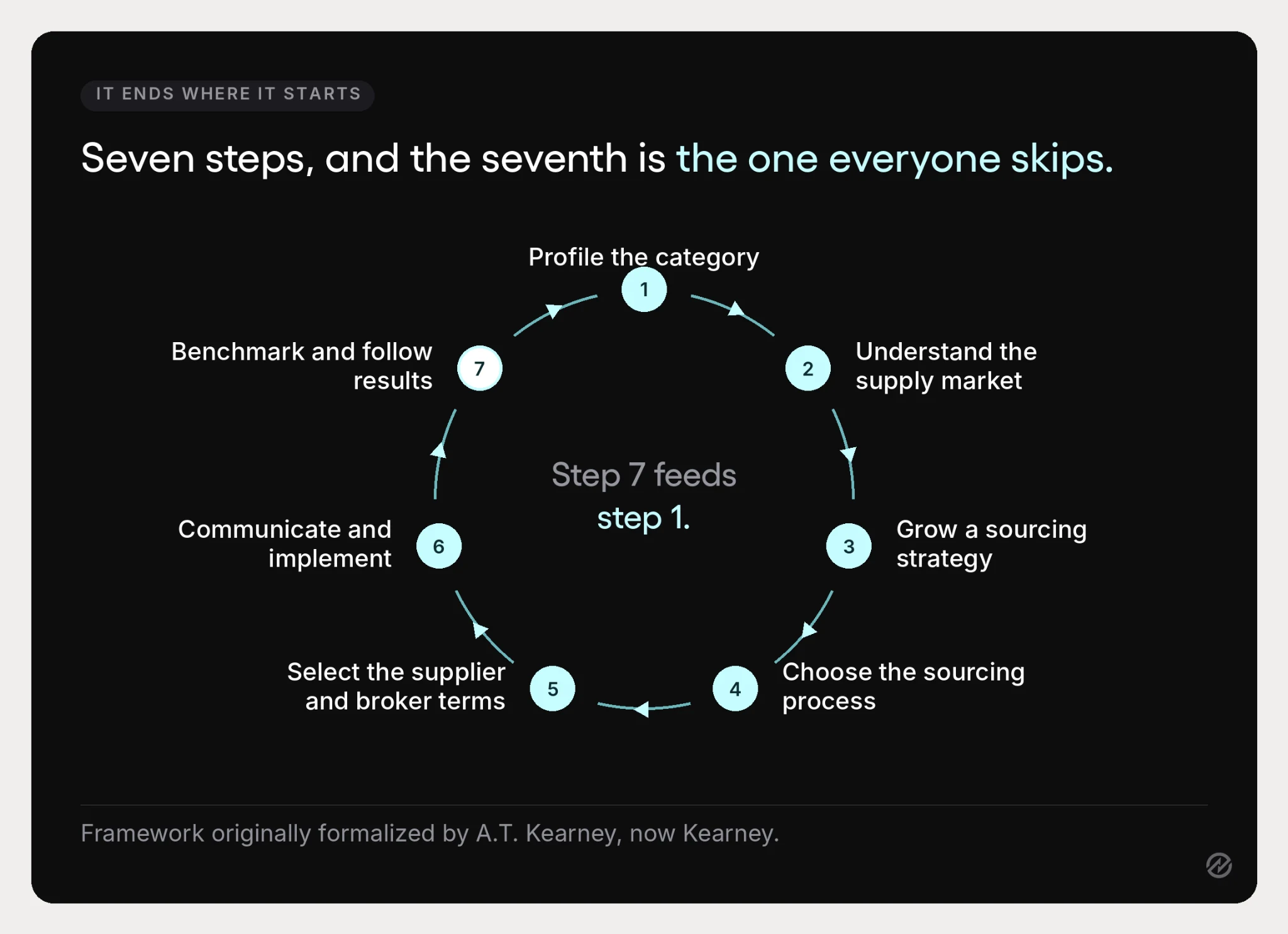
Step 4: Choose the sourcing process
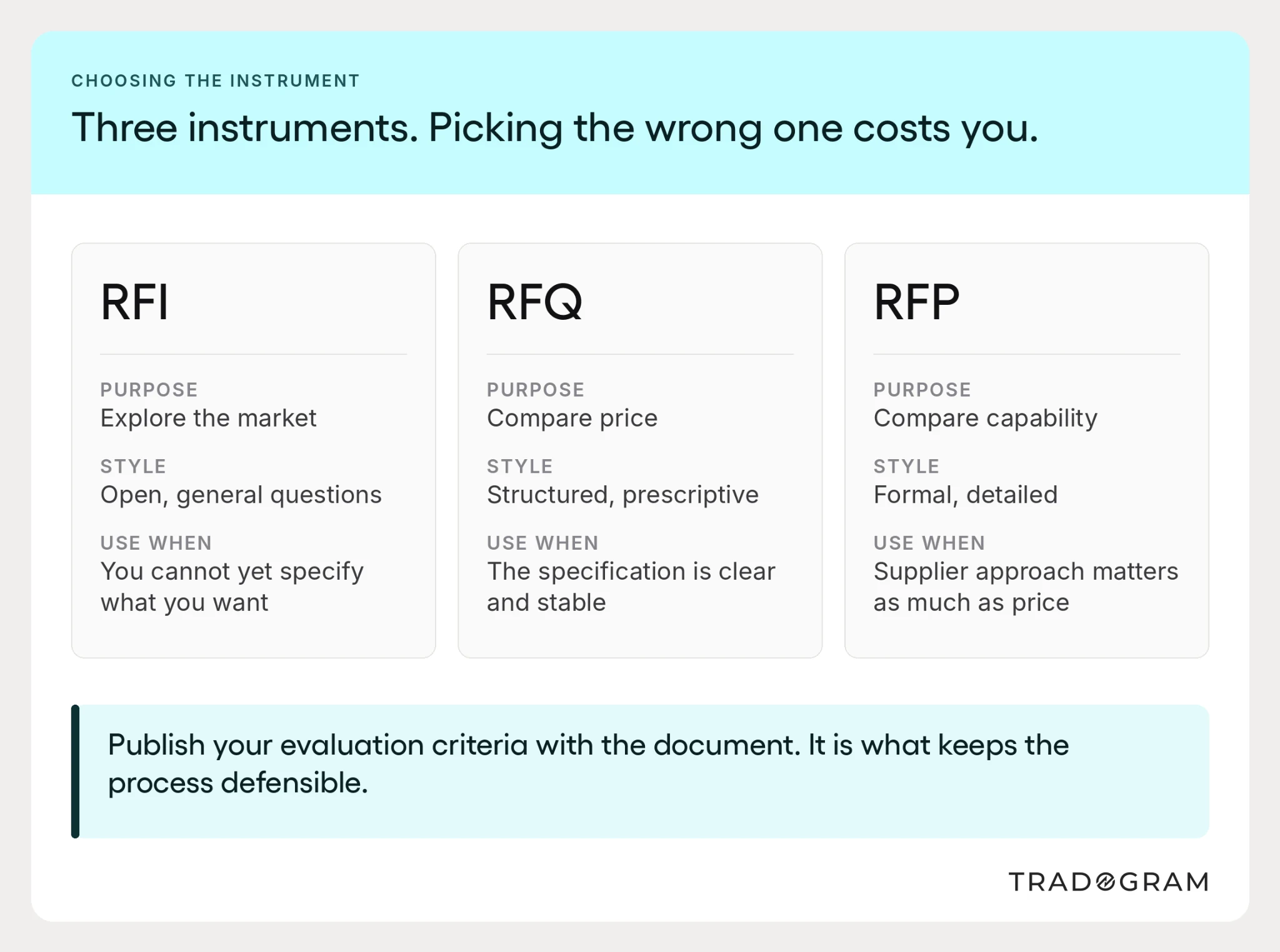
Now select the competitive mechanism. Three instruments cover most situations, and choosing the wrong one is a common, costly mistake.
RFI, a request for information. Exploratory. Written in a relatively open style with general questions, used as a market research tool when you do not yet know enough about the supplier landscape to specify what you want.
RFQ, a request for quotation. Structured and prescriptive, focused on price. Appropriate when the specification is clear and stable, and you are genuinely comparing like with like.
RFP, a request for proposal. Formal and detailed, asking specific questions to draw out as much as possible about a supplier’s product, service, and business. Appropriate when the solution is not fully specified, and supplier approach matters as much as price.
Whichever you use, the document should set out specifications, requirements, pricing breakdowns, communication expectations, legal and financial terms, and the evaluation criteria you will actually apply. Publishing the evaluation criteria is what keeps a competitive process defensible.
Competitive bidding benefits both sides. Buyers reach qualified suppliers at lower search cost and secure better terms. Sellers get a clear view of what the market expects and where they stand against it.
Step 5: Select the supplier and broker the terms
Apply the criteria from step three to the responses from step four. This is where evaluation discipline pays off, because the temptation at this stage is to revisit the criteria to fit a preferred answer.
Expect to go beyond the written response. Interviews, site visits, and reference checks surface what a proposal document will not. The team running this step needs enough category knowledge to ask the right questions, which is another argument for cross-functional involvement.
Negotiate on the full set of terms, not just price. Payment terms, delivery commitments, service levels, price-review mechanisms, and exit provisions all carry value, and contract management tools are where those terms need to end up, and some are easier to win than a discount.
Step 6: Communicate and implement
Tell the successful suppliers, tell the unsuccessful ones, then do the unglamorous work that determines whether any of the negotiated value is realized.
Implementation is where sourcing projects quietly fail. Negotiated pricing has to reach the systems people buy through, preferred suppliers have to be visible to requesters, and stakeholders who were buying elsewhere need to know the arrangement exists. Bring suppliers into those discussions so they hear about changes directly, rather than through a purchase order that doesn't match expectations.
Step 7: Benchmark and follow the results
The step most often skipped, and the one that turns a project into a process.
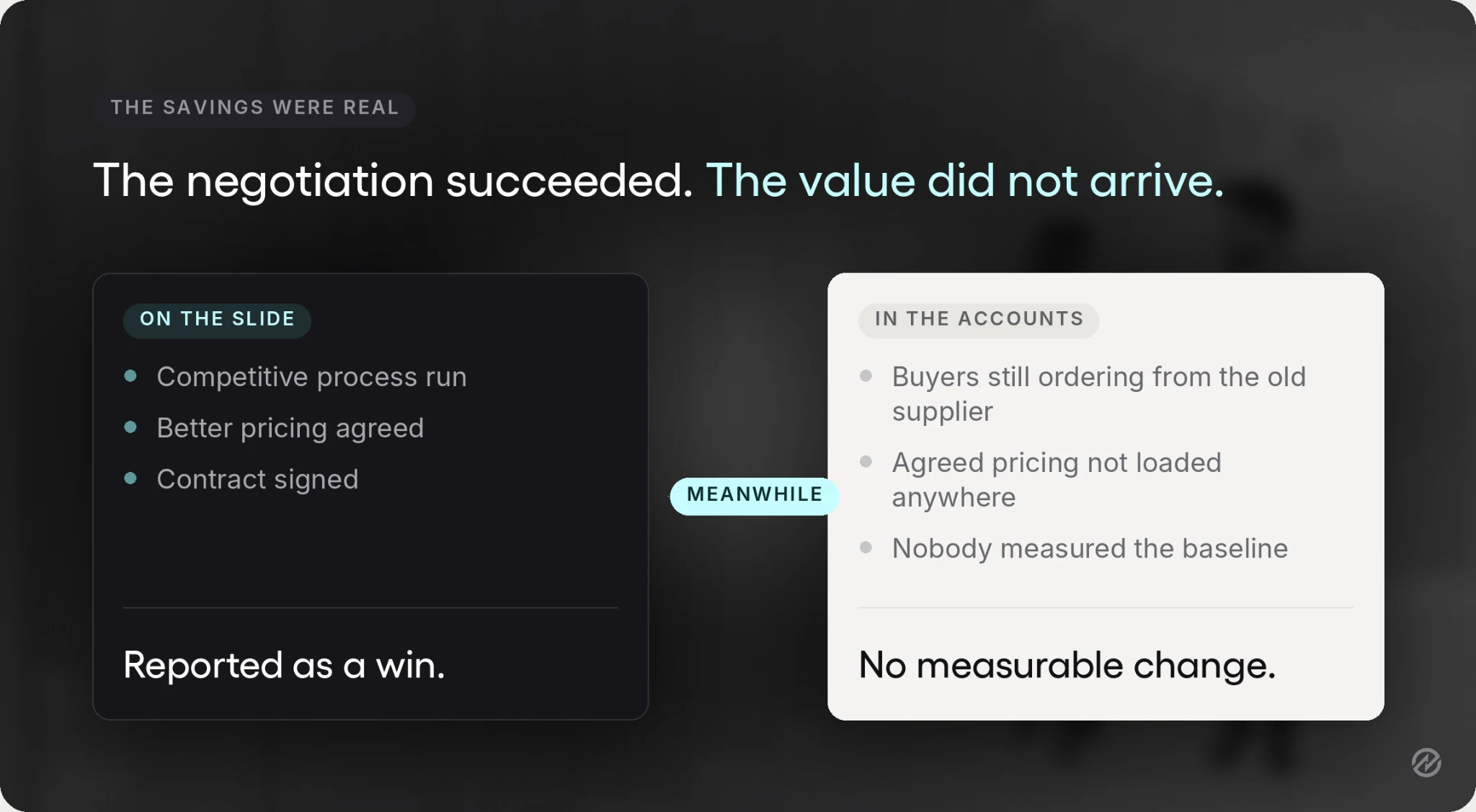
Benchmark the starting position, then track supplier performance against it: delivery reliability, quality, price against agreed terms, and responsiveness. Measure whether the savings the business case promised actually appeared in the accounts rather than on a slide.
When performance drifts, raise it early and specifically, while it is still a conversation rather than an escalation. Then return to step one. Treating strategic sourcing as a cycle keeps it aligned with market conditions, rather than a snapshot that ages.
Category management and where sourcing fits
Category management is how strategic sourcing gets organized at scale, and it is where supply chain management and procurement stop being separate conversations. Rather than sourcing item by item, you group related purchases into spend categories and manage each as its own portfolio with an owner, a strategy, and a review cycle.
The relationship is straightforward: category management strategic sourcing means running the seven-step process per category rather than per purchase. Office supplies, IT hardware, freight, professional services, and raw materials each face different supply markets and deserve different strategies.
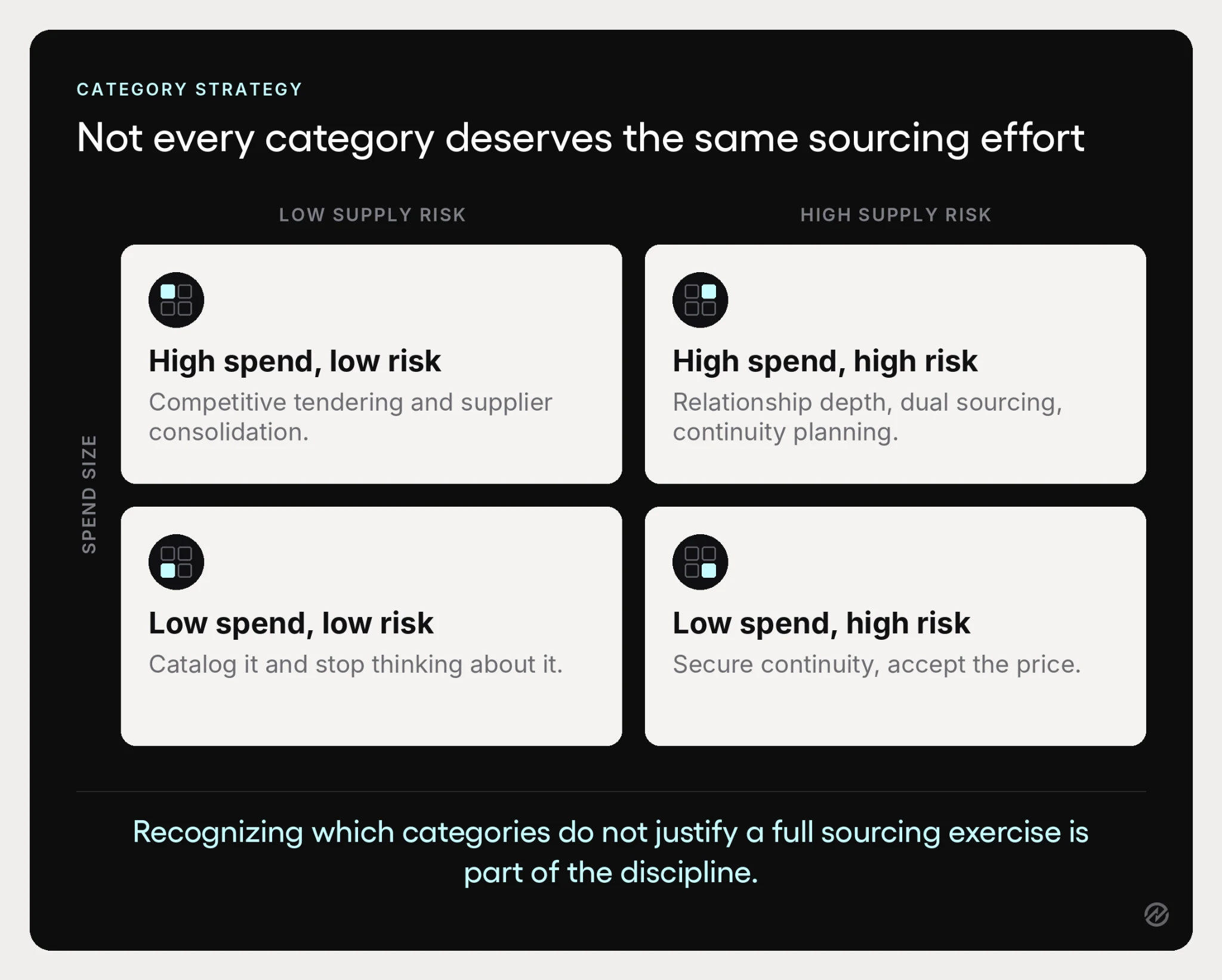
Categories are usually worth treating differently along two dimensions:
- Spend size. How much the category represents in annual value.
- Supply risk. How difficult the category would be to replace if a supplier failed.
High-spend, low-risk categories reward competitive tendering and supplier consolidation. Low-spend, high-risk categories reward relationship depth and continuity planning, even where the dollar value looks trivial. A category that is small and easily replaced rarely justifies a full sourcing exercise at all, and recognizing that is part of the discipline.
This is also where data analysis earns its place. Spending patterns across categories reveal consolidation opportunities that no single requisition would ever expose: the same category bought from eleven suppliers across four departments, or a tail of low-value suppliers that costs more to administer than the spend justifies.
Supplier relationship management and supply risk
Selection is the beginning of the relationship, not the end of the work. Managing supplier relationships after the contract is signed determines whether the agreement's value is realized.
Evaluate suppliers continuously, not at renewal
Supplier evaluation should run on a schedule rather than being triggered by a problem or a contract expiry. The measures that matter are consistent across most categories: on-time delivery, quality acceptance rate, price adherence to agreed terms, responsiveness, and documentation accuracy.
The practical value of tracking these continuously is that renewal conversations start from evidence. A supplier whose delivery performance has slipped for two quarters is a different negotiation from a supplier you feel vaguely dissatisfied with.
Build the supply base deliberately
Supplier consolidation and diversification pull in opposite directions, and both are right in different places.
Consolidating suppliers in a category concentrates volume, improving pricing and reducing administrative overhead. It also increases supplier risk and concentrates exposure if that supplier fails. The judgment is category-specific: consolidate where supply is plentiful and switching is easy, diversify where it is not.
That trade-off has moved up the agenda. In Deloitte’s 2025 Global Chief Procurement Officer Survey, 74% of respondents named finding alternative supply sources as their most effective risk mitigation strategy, ahead of greater supply chain visibility at 64% and enhanced supplier information sharing at 61%. Maintaining multiple suppliers in exposed categories is now mainstream practice rather than a hedge, and shaping the supplier base deliberately is the work that makes it possible.
Treat key suppliers as business partners
A small number of suppliers usually account for a large share of category value and nearly all of the risk. Those relationships justify different handling: shared forecasts, joint performance reviews, and early visibility of changes on both sides.
Collaborative relationships like this are also where innovation happens. Suppliers who understand where your business is going will bring you ideas. Suppliers who only see purchase orders will send you purchase orders.
Connect sourcing to contract management
The negotiated agreement is the bridge between a sourcing decision and daily buying. Contract terms, renewal dates, price-review mechanisms, and service levels need to live somewhere people can find them, connected to the supplier record rather than in a folder.
When contract management is disconnected from purchasing, two failures follow. Agreements auto-renew without review, and buyers pay list price against a contract nobody knew existed.
Where sourcing hands off to execution
Strategic sourcing decides who you buy from. The rest of the procurement process decides whether those decisions actually govern what gets bought, and this handoff is where most sourcing value is won or lost.
Three connection points matter.
Requisitions. When someone raises a request, the sourcing decision should already be visible to them. A purchase requisition process that surfaces preferred suppliers and contracted pricing at the point of request converts a sourcing decision into default behavior. Without it, every requester has to make their own supplier choice.
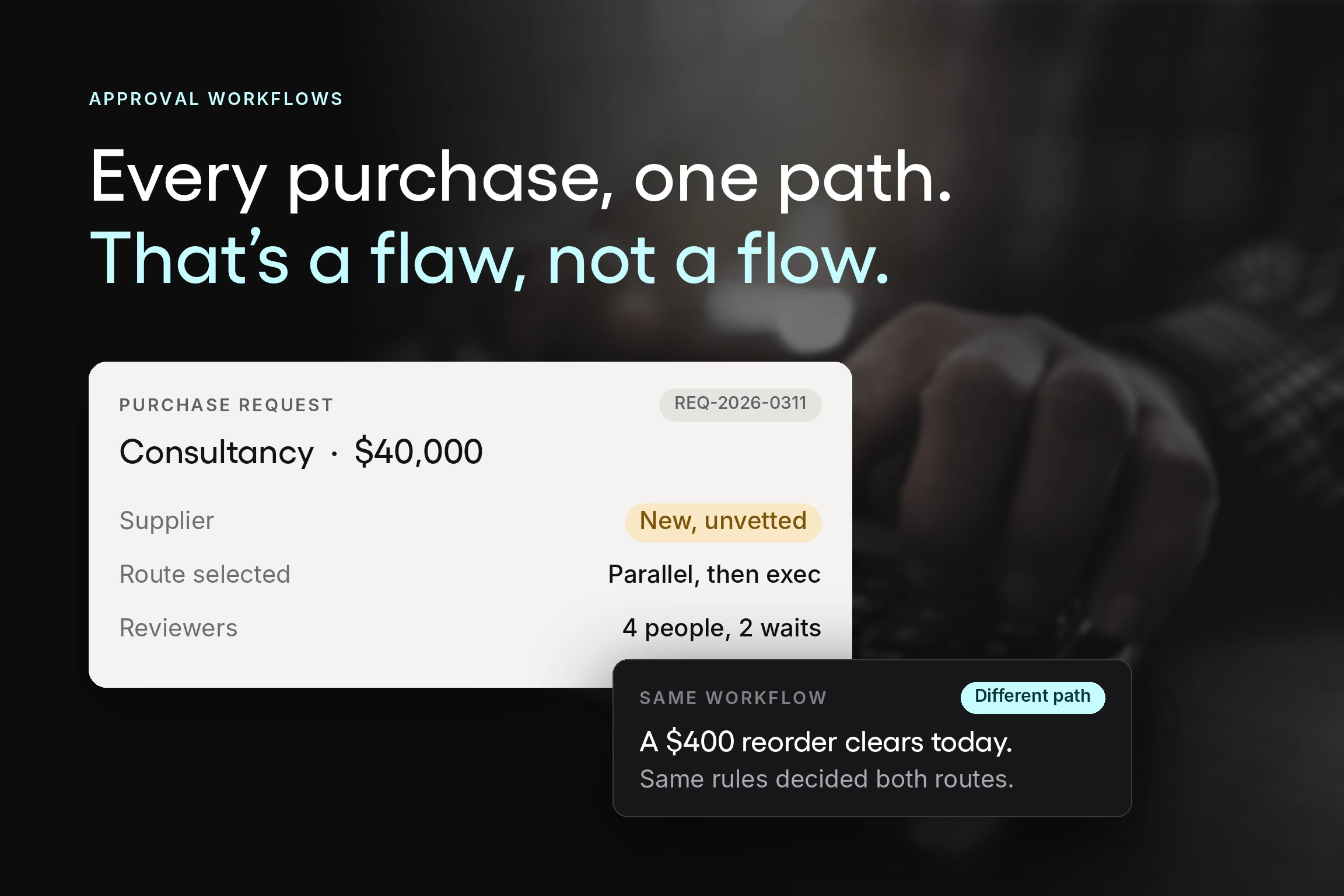
Approvals. Approval rules are where off-contract buying gets caught. A request naming a supplier outside the agreed arrangement can route to procurement for review rather than proceeding on value alone, a design decision within the procurement approval workflow.
The purchase-to-pay cycle. Contracted pricing only holds if the procure-to-pay process checks invoices against the negotiated terms. Without that check, price creep goes unnoticed until someone runs a variance analysis months later.
Sourcing that is disconnected from these three produces agreements nobody uses. That is why spend under contract is a more honest measure of sourcing success than negotiated savings.
Five ways strategic sourcing programs fail
After enough of these, the failures become predictable. None are about negotiation skill, which most organizations assume they need to improve.
Sourcing without a baseline. If nobody documented what the category cost before, any savings claim is an assertion. Finance will treat it as one, and the next sourcing exercise will be harder to fund.
Optimizing for the quote. Selecting on unit price while ignoring delivery reliability, quality failures, and payment terms produces a cheaper contract and a more expensive year. This is the most common failure and the easiest to prevent, because it only requires calculating total cost before deciding, not after.
Stopping at signature. Negotiated terms that never reach the purchasing process are theoretical. If buyers cannot see the preferred supplier and agreed price when they raise a request, they will use whoever they used last time.
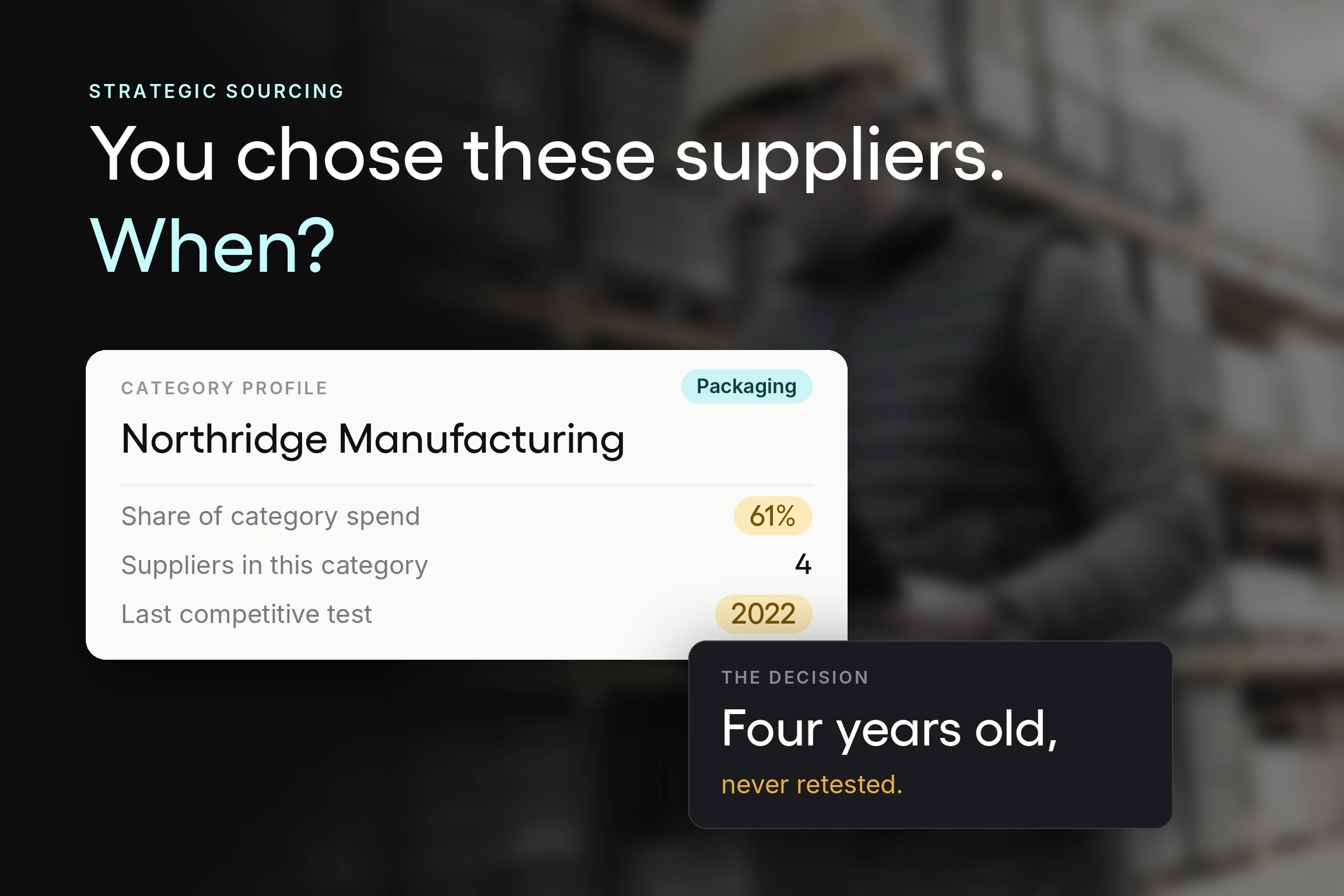
Running it once. A sourcing decision has a shelf life, and nobody writes the expiry date on it. Markets move, volumes change, and suppliers that performed well in year one don't always perform well in year three. A category sourced once and never reviewed is running on assumptions that expired without anyone noticing, which is how a company ends up defending a supplier relationship on the grounds that it has always been there.
Excluding the people who use the goods. Procurement teams that set criteria without end-user input optimize for the wrong attributes, then spend the contract period managing complaints about a supplier that meets every written criterion.
Measuring strategic sourcing
Strategic sourcing produces measurable benefits or it does not, and the difference is usually in whether anyone defined the baseline before starting.
Realized savings against a documented baseline. Not projected savings. What the category cost before, what it costs now, adjusted for volume. Savings claimed without a baseline rarely survive contact with finance.
Total cost of ownership, not unit price. Include delivery, quality failures, payment terms, administrative effort, and switching costs. TCO is harder to calculate and reflects reality.
Spend under contract. The share of category spend flowing through negotiated agreements, visible through procurement spend management software. This is the clearest measure of whether sourcing decisions are reaching daily purchasing decisions, and it is where most negotiated value leaks away.
Supplier performance against agreed terms. Delivery, quality, and price adherence, tracked over time rather than sampled when something goes wrong.
Supply risk exposure. How many categories depend on a single source, and how long replacement would take. This rarely appears in a savings report and is often the most valuable thing sourcing produces.
Sourcing cycle time. How long a full sourcing exercise takes from category profiling to implemented contract. A process that takes nine months will be run less often than the market changes.
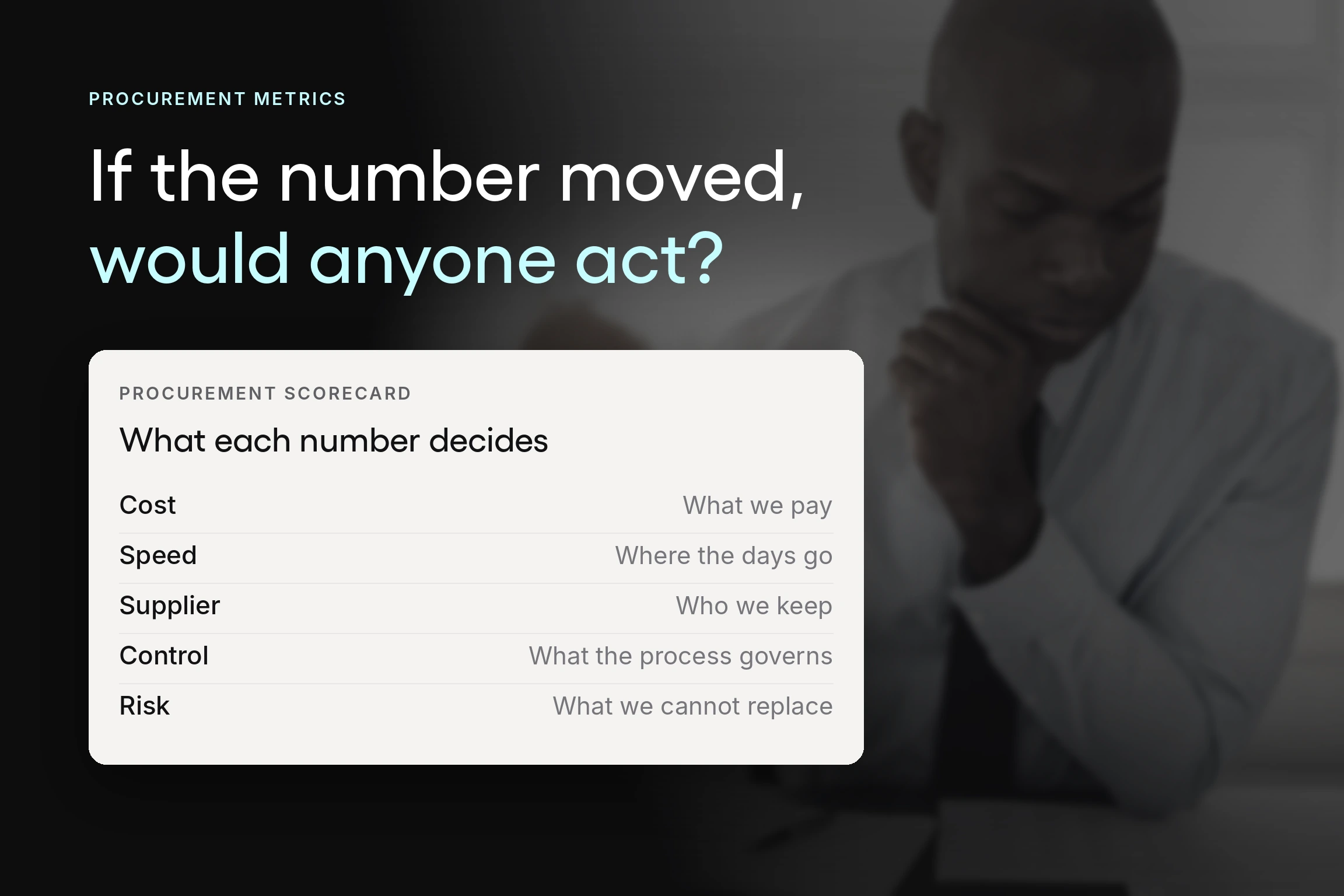
Our guide to procurement KPIs covers the wider measurement set. Continuous improvement depends on reviewing these on a cadence rather than assembling them for an annual presentation.
How software supports the strategic sourcing process
Strategic sourcing is analytical work, and most of the analysis depends on data that manual processes scatter across spreadsheets, inboxes, and accounting exports.
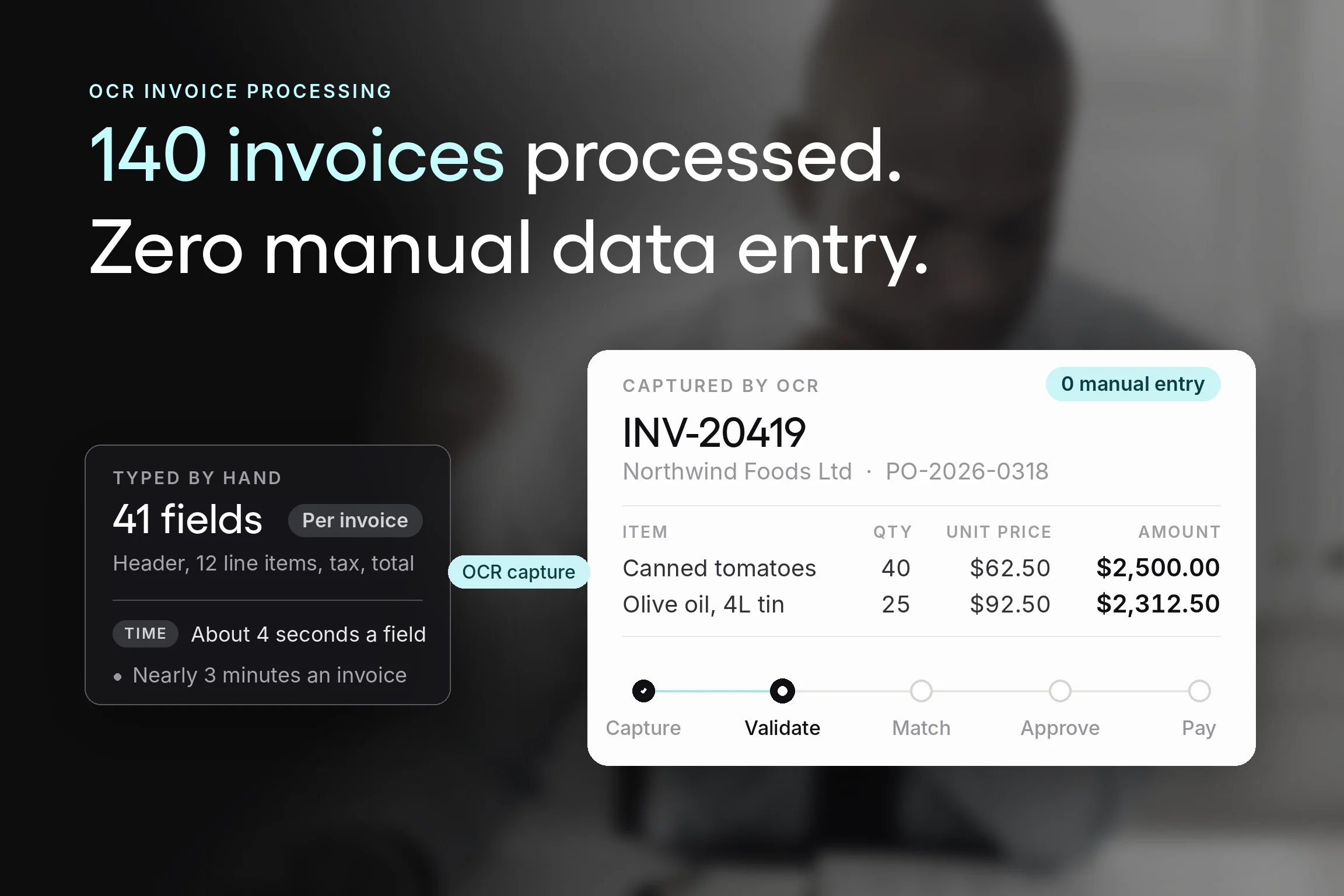
Spend analysis becomes possible. Step one requires spend broken out by category, department, and supplier. When purchasing runs through one system, that view exists already rather than being reconstructed each time someone asks.
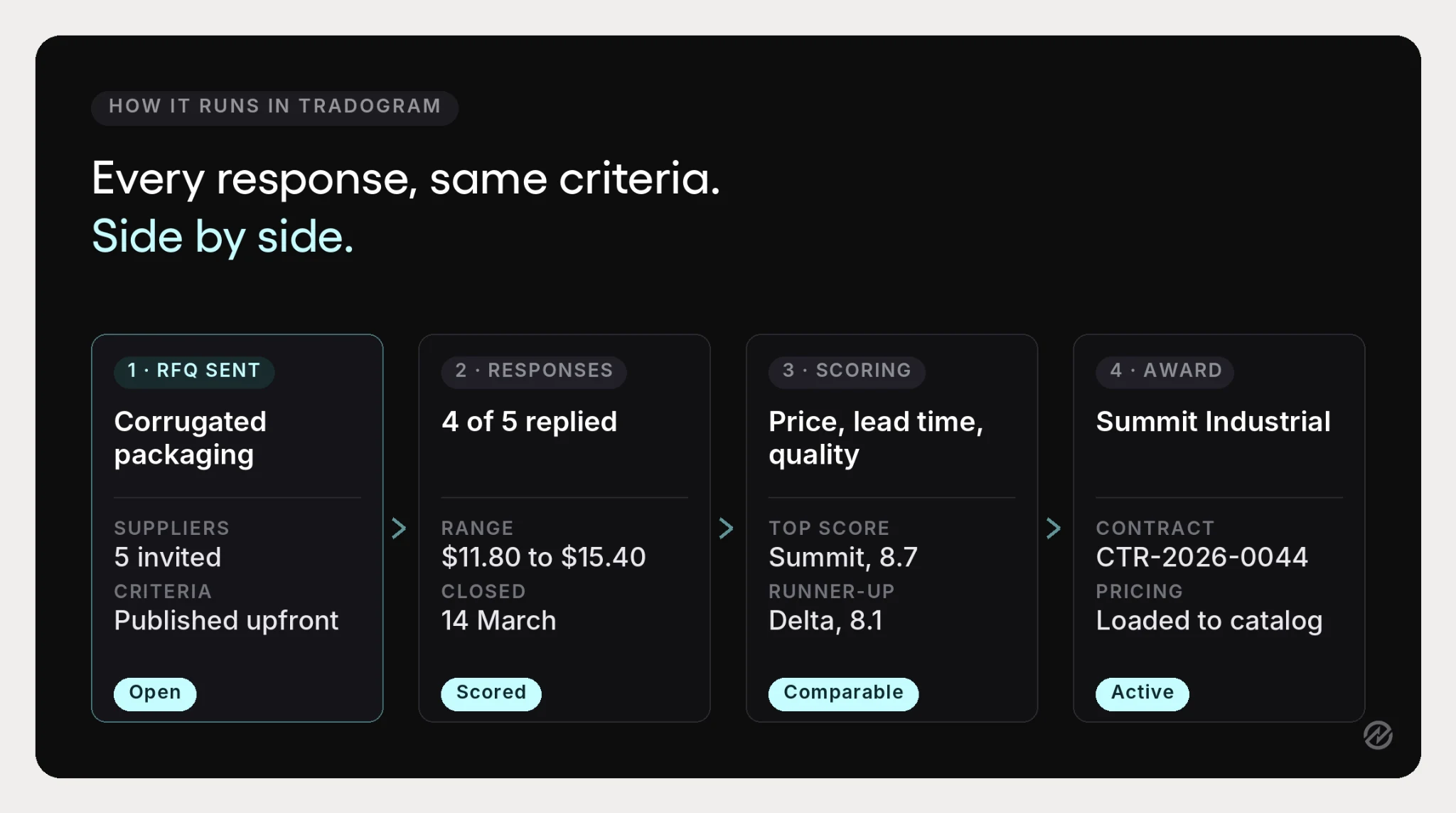
Sourcing events stay comparable. Sourcing management software keeps requests for quotation and supplier responses side by side, scored against the criteria you published, rather than spread across email threads where like-for-like comparison quietly stops happening.
Supplier records hold the evidence. Performance history, documents, certifications, and contract terms attached to the supplier record are what make supplier evaluation a review rather than a search. Supplier management software is where that history accumulates.
Negotiated terms reach the point of purchase. This is the one that decides whether supplier value survives contact with daily buying. When preferred suppliers and agreed pricing are visible inside the purchasing process, they align purchasing decisions with the sourcing strategy by default. Without them, the contract is theoretical.
Results are trackable. Procurement reporting against a documented baseline is what closes step seven and feeds the next cycle.
Tradogram connects sourcing, supplier records, contracts, purchase requests, approvals, and purchase orders in one system, which lets a sourcing decision made in step five still govern behavior six months later.
How to get a strategic sourcing process off the ground
Running the full seven steps across every category at once is how strategic sourcing programs stall, and it is usually a symptom of trying to justify the function rather than improve it. A narrower start works better and proves more.
Pick one category. Choose one that is large enough to matter and fragmented enough to improve, which usually means a category bought from several suppliers by several departments without a clear owner. That combination is common, and it is where the evidence will be most persuasive.
Profile it properly before doing anything else. Most of the argument for change is already sitting in the spend data, and you will need it, because cross-functional attention is not granted on the strength of a proposal. It is granted on the strength of a number nobody can dispute.
Run the full cycle on that category, including step seven. One completed cycle with a measured result is worth more than three half-finished ones, both for the savings themselves and for the credibility that funds the next category. This is the part leadership should insist on, because an organization that never finishes a sourcing cycle will never know whether the function is working.
Then pick the second category, and set a review cadence for the first.
Procurement strategy is built this way, one category at a time, rather than announced. The companies that end up with genuine leverage over their cost base are rarely the ones that ran a transformation program. They are the ones that finished the first category and kept going. If you want to see how sourcing, supplier records, and purchasing connect in practice, book a demo and we will walk through it with a category of your own.