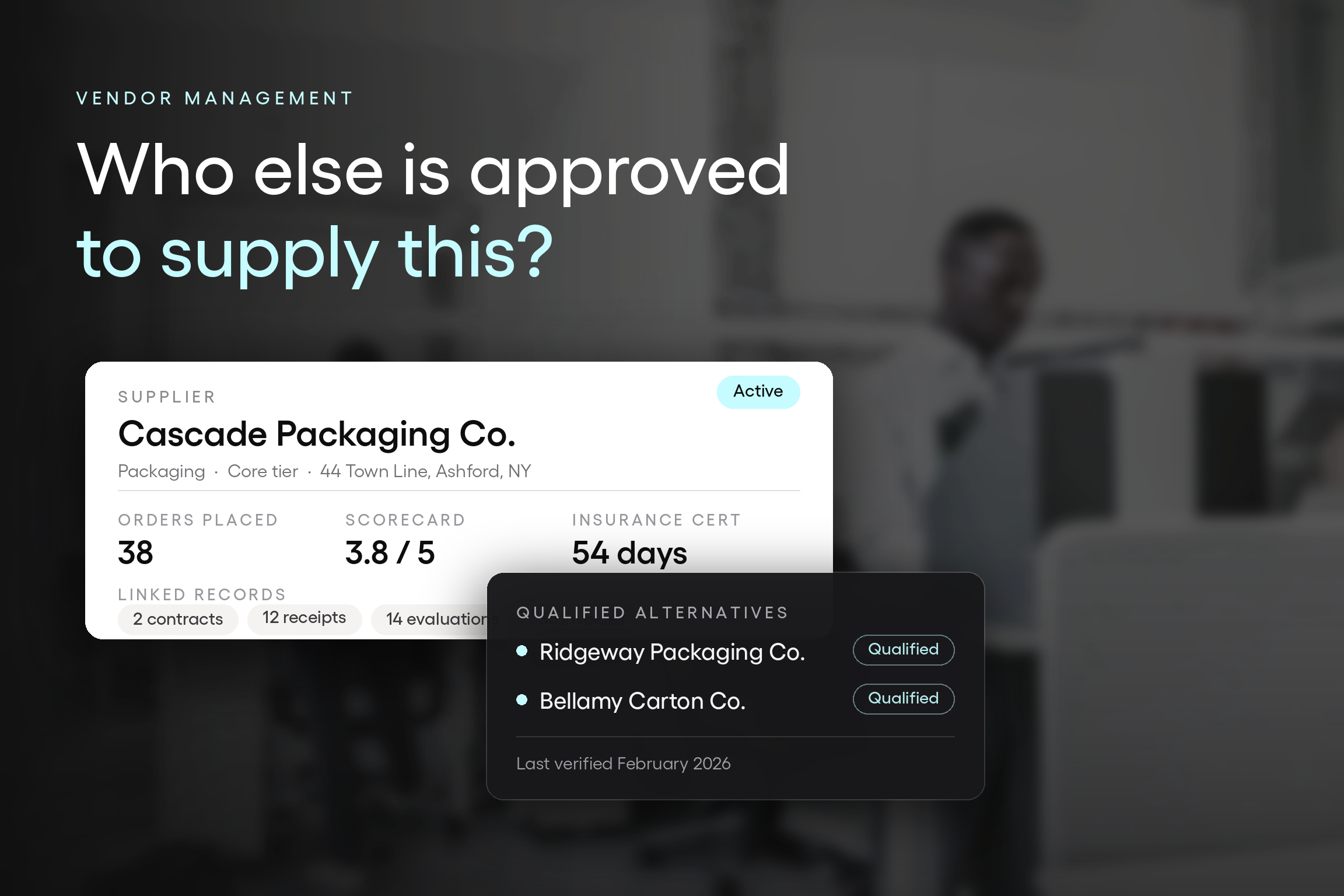


A supplier you've used for three years goes quiet in the middle of a project. Someone asks who else is approved to supply the same item, and the answer depends entirely on which person you ask and which spreadsheet they happen to keep.
Vendor management is the process by which an organization qualifies, onboards, monitors, and maintains the suppliers it buys from. It covers everything from the point a supplier is under consideration through to the end of the relationship: the records you keep, the terms you agreed to, the performance you track, and the decision to renew, renegotiate, or move on.
Most teams already do parts of this. Someone collects the tax forms. Someone remembers which supplier missed the last two deliveries. The trouble is that the parts live in different places and different heads, so every purchase starts a small search, and nobody can answer a straightforward question about a vendor without asking two other people first.
The rest of this guide works through each of those: the full vendor management process stage by stage, the practices that hold up during a busy week, the KPIs worth putting on a scorecard, the challenges that arise as your vendor list grows, and how to tell when a vendor management system earns its cost.
What is vendor management?
Vendor management is the ongoing work of maintaining accurate, current information about the companies you buy from and using it to make better purchasing decisions. In practice, it comes down to five activities that repeat for every vendor you keep: collecting and verifying their information, agreeing terms, buying against those terms, measuring what you actually received, and deciding what happens at renewal.
Two boundaries are worth setting, because the term gets stretched in both directions.
The first is where the work starts. Some teams count the search, bid comparison, and award decision as vendor management. This guide treats vendor selection as sourcing work and starts the clock at qualification, the first point at which you're building a record you'll keep. Either convention is workable.
What matters is that the second half, meaning onboarding, oversight, and performance, is the part most likely to end up unowned, and it's the part this guide concentrates on. If you need the wider distinction spelled out, we cover the difference between procurement and vendor management separately.
The second boundary is the vocabulary. Most organizations use "vendor" and "supplier" interchangeably, and vendor relationship management and supplier relationship management refer to the same discipline. Some teams do draw a line, reserving "supplier" for goods and "vendor" for services or resale. Either is fine as long as you apply it consistently in your records, because mixed labels are what make vendor data hard to search two years later.
None of this requires software to begin. It requires deciding who owns the vendor record and agreeing on what it must contain.
Why vendor management matters to business success as your supplier list grows
At fifteen vendors, none of this feels necessary. The person who set up each relationship still remembers it, and the gaps in your records get filled in by conversations. Somewhere between fifty and a few hundred vendors, that stops working, usually without any single moment where it announces itself. What changes isn't the number of suppliers. It's that the people who hold the knowledge are no longer in every conversation where it's needed.
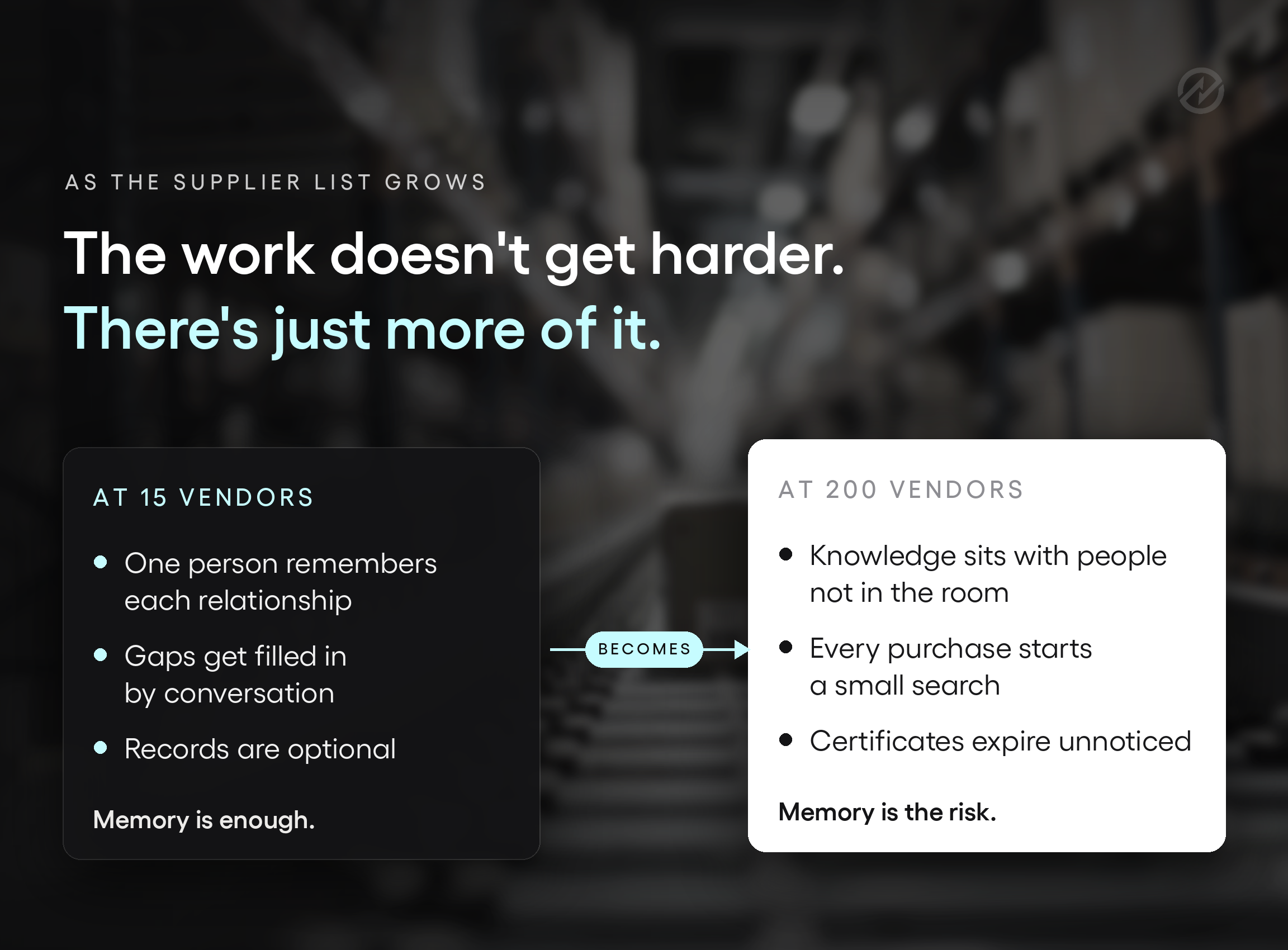
Three things go wrong first, and each one costs money in a different way.
Continuity. Go back to the supplier who went quiet mid-project. If you have a current record for that category, you know who else has been qualified, what they quoted last time, and whether their insurance certificate is still valid. You make a call and lose a day. Without it, you run a fresh search, take whatever price is available at short notice, and buy from a company nobody has vetted. The purchase still happens either way. The difference is what you paid and what you took on.
Cost control. Buying the same category from six vendors instead of two usually means paying six different prices for it, none of them negotiated from a position of volume. Price drift is the quieter version of the same problem. Rates increase by a few percentage points each renewal cycle, and nothing flags it because there's no record of what you agreed to last time. Most cost reduction in purchasing starts with being able to see what you're currently spending with whom.
Risk. A vendor's financial stability, insurance coverage, certifications, and regulatory compliance are all true on the day you check them and not necessarily a year later. Vendor oversight is mostly the practice of rechecking things you already verified once on a schedule for the vendors where it matters. Organizations with global supply chains carry more of this risk, but a single-site company relying on a single specialist supplier can be more exposed than a multinational with three qualified alternatives.
None of this is an argument for treating all vendors the same way. It's an argument for knowing which ones you'd struggle to replace, which is what the tiering section covers.
The vendor management lifecycle, stage by stage
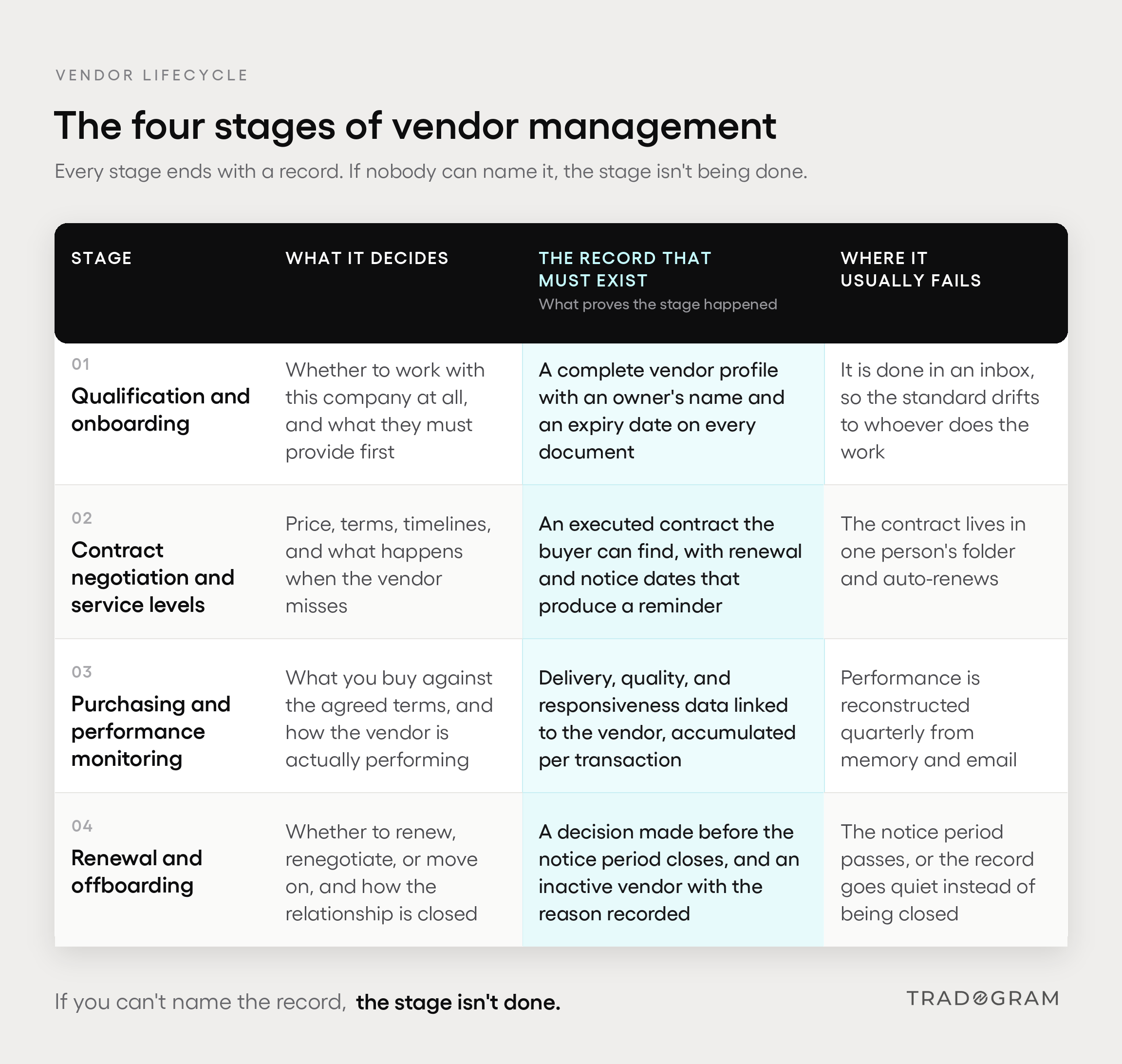
Every vendor moves through the same seven steps, whether or not anyone is tracking them: qualification, onboarding, contract negotiation, purchasing, performance monitoring, renewal, and offboarding. They group into four stages of work, which is how the sections below are organized.
A useful test for each stage: what record has to exist when this stage ends? If nobody can name it, the stage isn't really being done.
1. Vendor qualification and onboarding
Qualification asks whether this company should be doing business with you at all. Depending on the category, this means checking financial stability, insurance coverage, certifications, references, capacity, and any regulatory compliance required by your industry. For a low-value office supplier, it's a five-minute check. For a sole-source supplier of something you can't run without, it deserves considerably more.
Onboarding is the administrative half, and it's the step most often done in an inbox. Collecting tax forms, banking details, compliance documents, insurance certificates, contact information, and payment terms. Assigning a vendor ID. Filing the vendor into categories so it can be found later by someone who wasn't part of the conversation.
The record that has to exist at the end: a complete vendor profile with an owner's name on it and a date on every document that expires.
Two habits make the difference here. Set the qualification requirements for each category before you start onboarding anyone, so the standard doesn't drift based on whoever is doing the work. And put an expiry date on every document that has one, because an insurance certificate collected in good faith becomes a compliance gap on a specific, predictable day.
2. Contract negotiation and service level agreements
Contract negotiation sets what you've agreed to buy, at what price, on what timeline, and what happens when the vendor misses. Pricing gets the attention. The terms that matter most in the months afterward are usually the unglamorous ones: payment terms, delivery windows, price adjustment clauses, renewal and notice periods, and service-level agreements that define acceptable performance in measurable terms.
Service level agreements only help if the measure is something you can actually observe. "Timely delivery" isn't a service level. "Delivered within three business days of order acknowledgment, 95 percent of the time, measured quarterly" is one, and it tells both sides what a conversation about underperformance will be based on.
The record that has to exist: an executed contract stored where the buyer can find it, with the renewal and notice dates entered somewhere that produces a reminder. Contracts that live in one person's folder tend to auto-renew. Contract management tools address exactly this, but a shared calendar entry is better than nothing.
3. Purchasing and ongoing performance monitoring
This is the longest stage and the one that generates the data everything else depends on. Every purchase order, delivery, and invoice against a vendor is a performance observation, whether or not anyone records it as one.
The practical question is when to capture the assessment. Monitoring vendor performance as a quarterly exercise means reconstructing six months of vendor engagements from memory and email, which is why it so often gets skipped. Capturing a short rating at the point of receiving, while the person who took delivery still remembers whether it arrived complete and on time, turns performance monitoring into a byproduct of work already happening.
The record that has to exist: delivery, quality, and responsiveness data linked to the vendor, accumulated per transaction rather than assembled at the time of review.
4. Renewal and offboarding
Renewal is a decision, but only if someone makes it before the notice period closes. Otherwise it's an automatic event that a calendar performs on your behalf. Come to it with the performance data, the current pricing relative to the current market, and a clear view of whether alternatives exist.
Offboarding is the step almost nobody documents, and it causes disproportionate trouble. When you stop using a vendor, close the record rather than letting it go quiet: settle outstanding invoices and open purchase orders, revoke system and portal access, retrieve or return any assets, retain the documents your industry requires you to keep, and mark the vendor inactive with a note explaining why. An inactive vendor with no reason recorded gets re-onboarded by a new buyer in eighteen months, sometimes the same vendor you dropped for cause.
How to tier your vendors so effort matches risk
Most vendor management strategies fail for a dull reason: the team designs a process good enough for the vendors that matter, then can't apply it to the other four hundred, so it gets applied to none. Tiering fixes that by deciding in advance how much attention each relationship earns.
The common approach is to rank by annual spend and treat the top of the list as your key vendors. That's half right. Spend tells you what a relationship costs. It doesn't tell you what happens if the vendor disappears on a Tuesday. The second question is replaceability, and it's the one that catches the vendors people miss: the small shop supplying a component nobody else machines to spec, the consultant whose specialized expertise the last three projects depended on, the software provider your finance teams have built a month-end routine around. Low spend, high consequence. Sorted by invoice value, they sit near the bottom of the list.
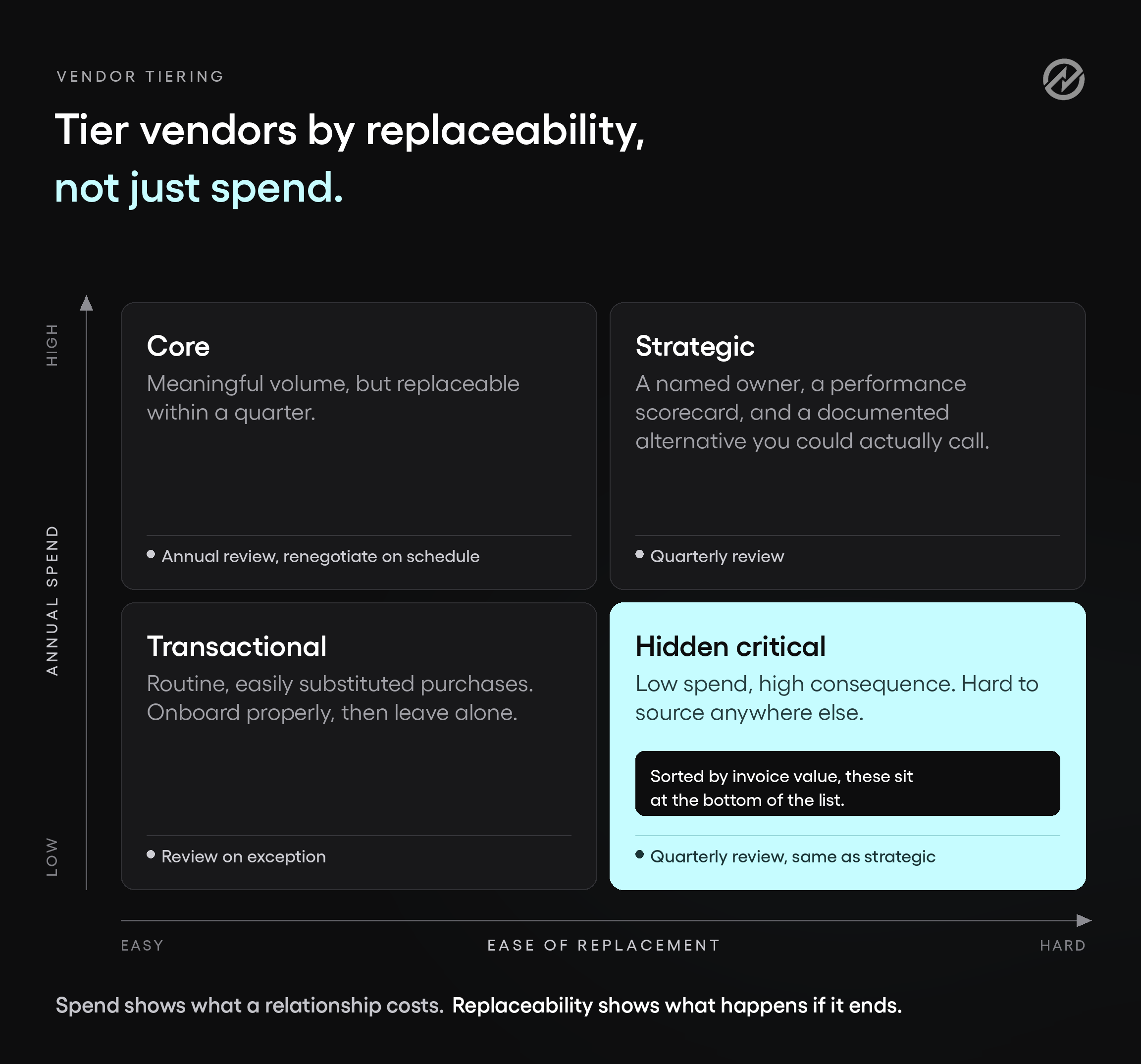
Score both axes and four tiers fall out naturally.
Strategic vendors are high-spend, hard-to-replace, or both. They get a named owner, a performance scorecard, quarterly reviews, and a documented alternative you could actually call. This is where relationship development pays off, because joint planning that lowers costs or improves service delivery only happens with vendors who see the relationship as worth investing in, too.
Core vendors carry meaningful volume but could be replaced within a quarter. Track their performance, review them annually, and renegotiate on schedule rather than by drift.
Transactional vendors cover routine, easily substituted purchases. Onboard them properly, then leave them alone until an exception says otherwise. One-time purchases sit here too and need a compliance record and nothing more. Managing them like core vendors is how the process becomes something people route around.
Hidden critical vendors are the low-spend, hard-to-replace relationships described above. Their spend argues for transactional treatment, and their replaceability argues for strategic treatment, and replaceability should win. Give them a named owner, a current record, and a documented alternative, even if you only place two orders a year. This is the quadrant the exercise exists to find, and the one a spend-ranked list will never surface.
Two practical notes. Tier by category rather than by legal entity when a vendor supplies several unrelated things, because one relationship can be strategic in one category and transactional in another. And revisit the tiering once a year. Vendors move between tiers as business needs change, and a tier assigned three years ago is describing an organization you no longer are.
5 best practices for effective vendor management
The practices below are ordered by what fails first. None of them require software, and all of them survive a week when three other things are on fire, which is the only real test of an effective vendor management process. A practice that only works during a quiet month isn't a practice. It's a plan.
1. Give every vendor a named owner
Most vendor problems are ownership problems wearing a different costume. When nobody owns a relationship, the tax form gets collected by whoever needed the vendor first, the performance complaint goes to whoever answered the phone, and the renewal is handled by nobody at all.
Assign a person to each vendor, or at minimum to each category, and write the name in the record. For strategic vendors this is a real responsibility that includes the review cadence and the renewal decision. For transactional vendors it just means somebody's name appears when a question comes up. Vendor managers in large organizations do this formally. In a lean team it's usually a column in a spreadsheet, and it works nearly as well.
2. Centralize vendor data where the whole team can reach it
Vendor information kept in one person's inbox is functionally the same as vendor information nobody has. The test isn't whether the data exists. It's whether a colleague can answer a question about a vendor at 4 pm on a Friday without calling anyone.
What belongs in a shared vendor record: contact details, tax and banking information, insurance and certification documents with expiry dates, agreed contract terms and pricing, the category and tier, the owner, and the performance history. Structure it with consistent categories from the start. Retrofitting categories onto four hundred inconsistently named records is a project nobody volunteers for twice.
3. Turn compliance tracking into a scheduled task
Maintaining compliance fails through expiry, not neglect. Somebody collects a valid insurance certificate, files it correctly, and does everything right. Fourteen months later, the certificate has lapsed, and the file still looks complete.
The fix is unglamorous. Record an expiry date on every document that has one, set a reminder 60 days ahead, and decide in advance what happens when a vendor doesn't respond, because the answer at that point is either "we buy from them anyway" or "we stop," and it's better to have chosen. Match the depth of checking to the tier. Applying strategic-vendor diligence to a one-time supplier is how compliance tracking becomes theater.
4. Treat negotiating contracts as preparation for the next renewal
Contract negotiation is usually treated as a discrete event, which is why so many organizations arrive at renewal with no idea whether the deal is still competitive. Negotiate with the renewal in mind. Write in the price adjustment mechanism rather than leaving it open, set the notice period long enough to run a real alternative, and define performance in terms you'll be able to evidence later.
Preparation is where the leverage is, and most of it is internal. Know your actual volume across all departments before you sit down, because organizations that buy the same category through multiple vendors routinely discover their real spend is several times what any single line suggested. Industry research and published benchmarks help calibrate, but your own purchase history is the stronger card. Cost savings at renewal usually come from consolidation and better information rather than harder bargaining.
5. Build a vendor management program from what you already have
You don't need a formal program to start, and the version built in one push is often the one no one maintains. Start with the vendors that would hurt to lose, which is a much shorter list than your total vendor count.
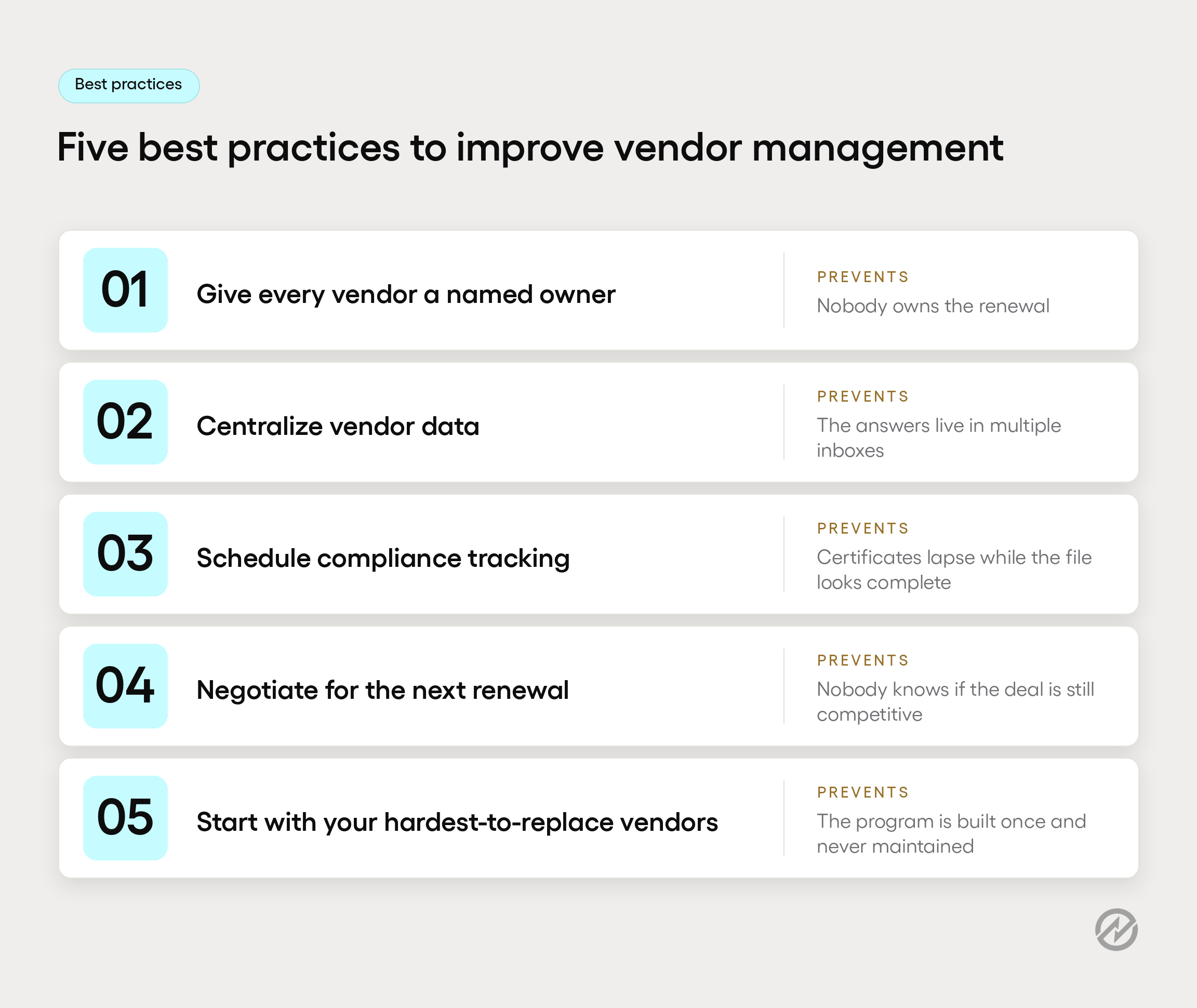
A workable sequence: export the vendor list from your accounting system, sort by spend, add the replaceability judgment from the tiering section, and assign owners to the top tier. Then standardize what a new vendor must provide before the first purchase order, since fixing intake prevents the problem from growing while you clean up the backlog. Then bring the rest of the records up to standard as each vendor comes up for renewal, rather than as a separate cleanup project. Documenting this as part of your procurement process helps keep it in place when the person who built it moves on.
Vendor management KPIs and how to build a scorecard people trust
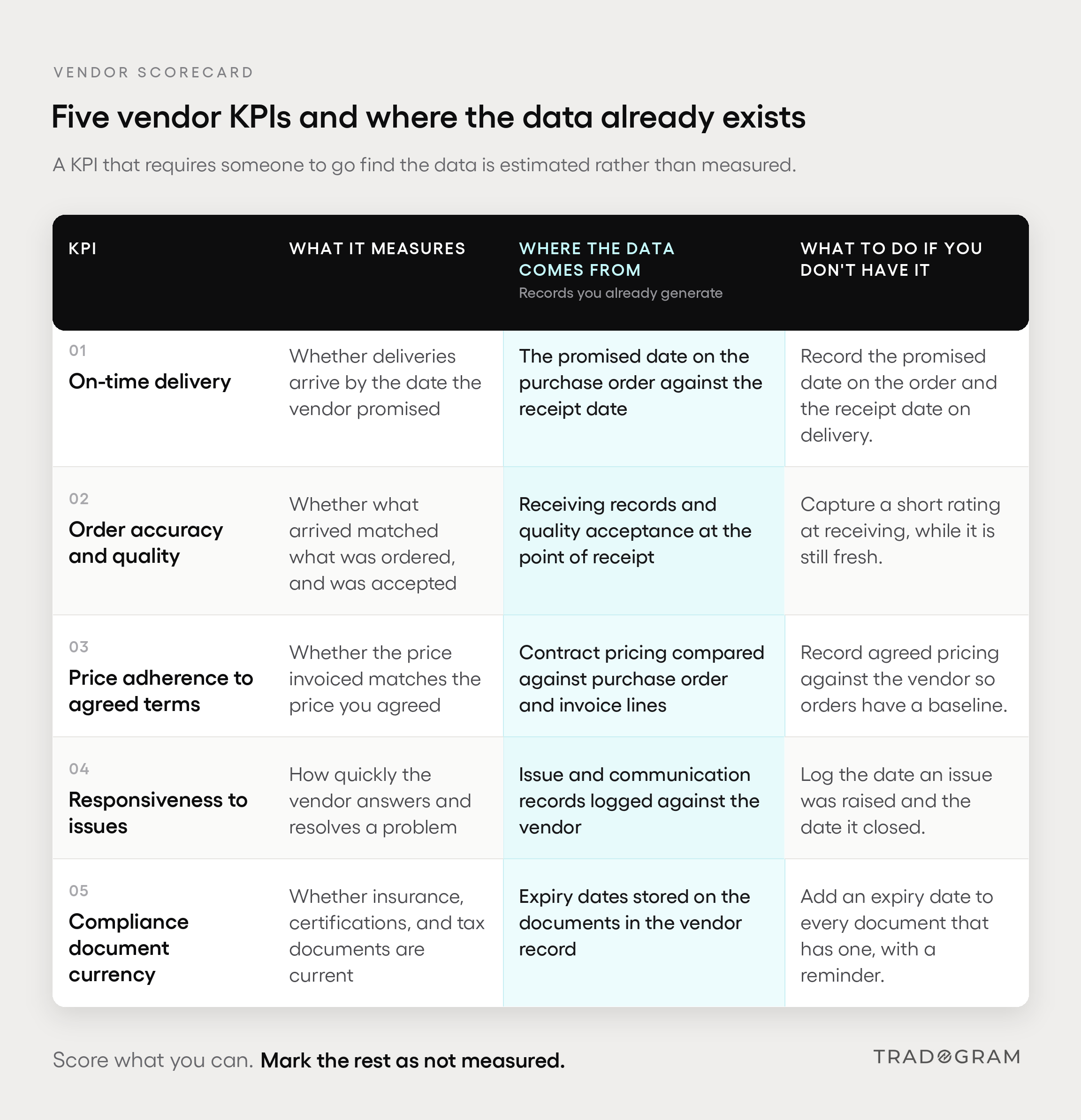
Start with the smallest set of key performance indicators (KPIs) that would change a decision. Five is usually enough, and the discipline is worth it, because a scorecard with twelve measures gets built once and never updated.
The measures that earn their place in most organizations are on-time delivery, order accuracy or quality acceptance, responsiveness, adherence to agreed-upon pricing terms, and currency of compliance documents. Each one is observable from records you already generate. That matters more than sophistication. A KPI that requires someone to find the data is an estimated KPI, and an estimated number is worse than no number because it looks authoritative.
Weight the measures rather than averaging them, because the measures aren't equally important and pretending otherwise hides the thing you actually care about. Here's a scorecard for a packaging supplier, scored out of 5 on each measure over a quarter.
A 3.8 out of 5 reads as a solid supplier, and a straight average would have said 3.6, which is close enough that neither number tells you anything useful on its own. The value is in the rows. This vendor's quality is excellent, and its delivery reliability is not, which is a specific conversation with a specific ask. The compliance score of 2 is the more urgent item, and it would have been invisible inside a single blended figure.
That's the point of the exercise. A vendor scorecard isn't a grade. It's a way to identify improvement opportunities precisely enough to give the review meeting an agenda.
What to do when the data is incomplete
Most teams stall here, because on-time delivery requires a promised date recorded against an actual receipt date, and plenty of organizations have one but not the other.
Score what you can and mark the rest as not measured. A three-measure scorecard that's accurate beats a five-measure scorecard where two rows are guesses, and the gaps tell you what to start capturing. If you can't measure delivery reliability today, the fix is recording the promised date on the purchase order and the receipt date on delivery, which takes one quarter to produce usable data.
Two rules keep a scorecard credible. Show vendors their scores and the basis for them, because a measure a supplier disputes is either wrong or badly defined, and both are worth knowing. And compare vendors only within the same category. Ranking a stationery supplier against a specialist fabricator produces a number that no one should act on.
Reporting tools make this cheaper by pulling performance metrics from transaction records instead of asking someone to compile them, and procurement reporting that runs off live purchasing data is the difference between quarterly scorecards that happen and quarterly scorecards that were meant to.
Common vendor management challenges and what causes them
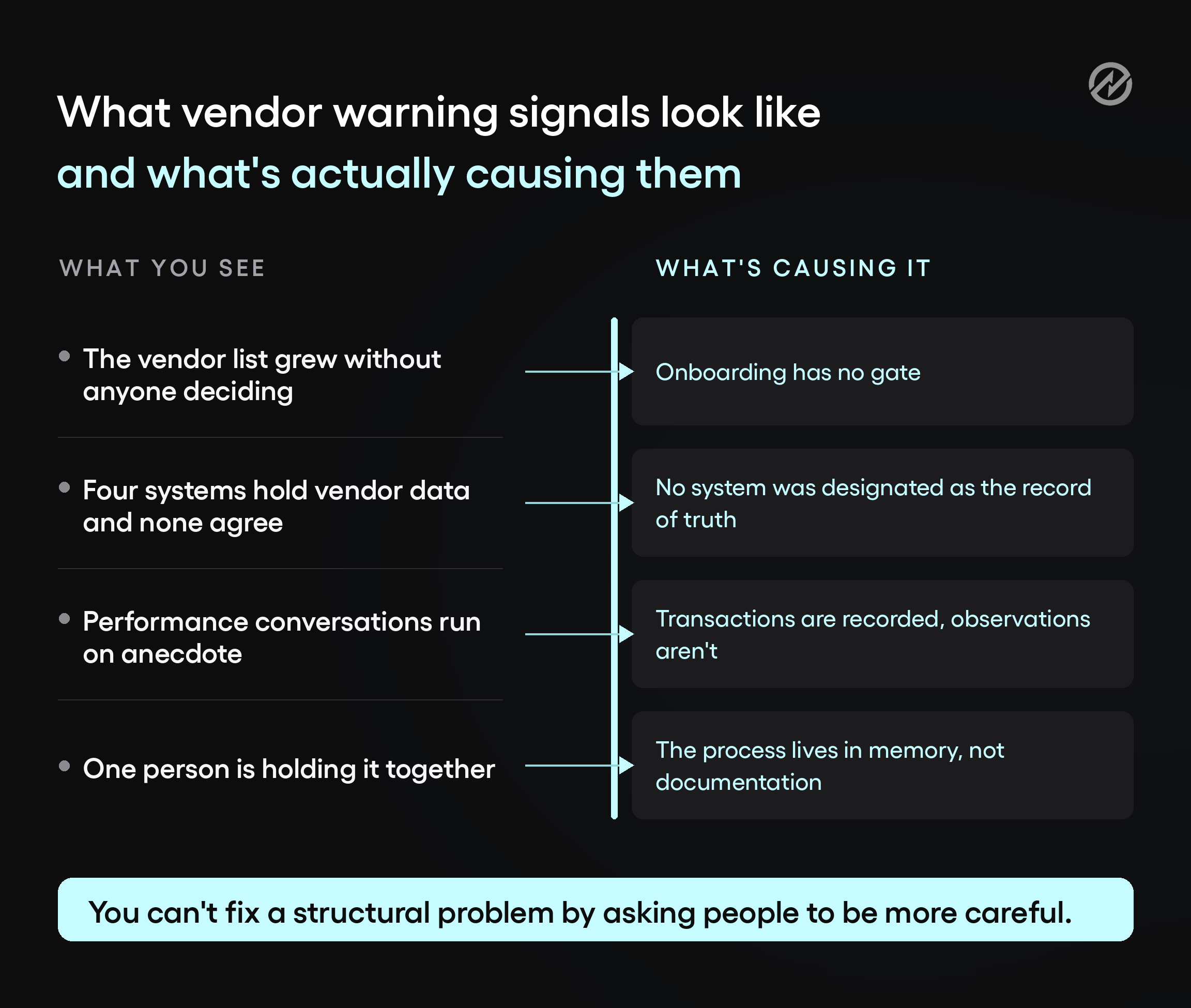
The challenges below are what teams describe when they say the process isn't working. Almost all of them have a structural cause rather than a performance one, which is useful to know, because you can't fix a structural problem by asking people to be more careful.
1 - Vendors get added without anyone approving it
A department needs something urgently, finds a supplier, and the vendor exists from that moment on. Nobody chose to work with multiple vendors in the same category. It accumulated. The cause is an onboarding process with no gate, and the symptom shows up as duplicate vendors, inconsistent naming, and a list where a third of the entries haven't been used in two years.
2 - Vendor data lives in four places and agrees in none
Contact details in the accounting system, contracts in a shared drive, insurance certificates in an inbox, performance opinions in people's heads. Each source is maintained by someone doing their job properly. The cause is that no system was ever designated as the record of truth, so all four became partial ones.
3 - Performance conversations run on anecdote
Everyone knows a vendor has been unreliable lately. Nobody can say whether it's three late deliveries or eleven, or whether it started before or after the contract renewed. The cause is that vendor engagements are recorded as transactions rather than as observations, so the data is technically present and practically unusable.
4 - One person is holding it together
This one rarely gets named as a challenge until that person takes a long vacation. If your vendor process depends on institutional memory, you don't have a process yet, and finding out which parts were undocumented is an expensive way to learn.
Vendor risk management gets harder as the supply chain lengthens
Vendor risk is the challenge that scales the worst because the checks that establish it are point-in-time, and the exposure is continuous. Financial stability, regulatory compliance, insurance, and certifications are verified once at onboarding and then assumed indefinitely.
Distance compounds it. Organizations buying through global supply chains carry longer lead times, more intermediaries, and less direct visibility of who is actually producing what. Services procurement carries a version of the same problem in a different shape, since the risk is concentrated in specific people and their availability rather than in inventory you can inspect.
To manage risk seriously, you need three things: a schedule, a tier that specifies which vendors get rechecked and how often, and a documented alternative for the relationships you couldn't afford to lose. That last item is the one most often skipped, and it's the only part that helps when something actually happens. These sit alongside the wider procurement challenges most teams are working through at the same time.
What connects all of these is that each one was manageable when the organization was smaller. The work didn't get harder. There's just more of it, spread across more people, with the same amount of memory holding it together.
What vendor management software does and how to choose one
Software isn't the first answer, and it's worth saying plainly. If you have thirty vendors, one person handling purchasing, and a spreadsheet that's actually current, a vendor management system will mostly formalize something already working. The threshold is usually crossed when more than a few people need the same vendor information, when no one can answer a vendor question without asking a colleague, or when compliance documents have begun to expire unnoticed. That's a volume and continuity problem, and it's the specific problem this category of software exists to solve.
How a vendor management system works
A vendor management system is a centralized platform that stores vendor records and links them to the purchasing activities in which those vendors are involved. That connection is the part that matters. A standalone vendor database is a tidier spreadsheet. A system that links the vendor record to requests, purchase orders, receiving, contracts, and invoices turns vendor management from a maintenance task into something that updates itself as work happens.
In practice, the core functions cover the full vendor lifecycle:
- Vendor onboarding with a structured intake form, required documents, and an approval step, so the vendor onboarding process has a gate instead of a side door
- A single vendor record holding contacts, categories, tax and banking details, financial terms, and documents with expiry dates
- Contract management, with agreements stored against the vendor and renewal dates that produce a reminder rather than a surprise
- Performance tracking, capturing delivery, quality, and responsiveness data per transaction so supplier performance builds from records rather than recollection
- Reporting, turning that history into measurable performance metrics and KPIs you can put in front of a vendor
- Workflow automation for the vendor-related workflows that consume the most time, including approval routing, document requests, and renewal alerts
- Supplier participation, letting external vendors submit their own information, quotes, or invoices instead of emailing them to someone who retypes them
The key benefits follow from the connection rather than any single feature. When purchasing and vendor data sit in the same place, the role vendor management plays shifts from record-keeping to something closer to decision support.
What to look for when choosing vendor management software
Feature lists across this category look nearly identical, so evaluate against how your team actually works rather than against the list.
Does it fit the way you already manage vendors? Categories, approval routes, required onboarding documents, and financial terms differ by organization. Software that can't be configured to your rules will either be worked around or force a process change nobody asked for.
Will occasional users manage it? The person who onboards two vendors a year is the real adoption test, not the administrator. A system only the procurement team can operate leaves the rest of the organization emailing requests as before.
Does vendor data connect to purchasing? Ask to see a vendor record with its purchase orders, contracts, and performance history attached. This is the difference between a database and a system.
Does it integrate with your accounting tools? Vendor and payment information maintained separately in two systems drifts apart, and reconciling it by hand removes most of the time saved elsewhere.
What does the supplier experience require? Vendors who need to create an account and learn a portal often don't. Ask what participation looks like for a supplier who has no interest in learning your software.
What happens at renewal and offboarding? Most demos cover onboarding well and stop there. Ask specifically how the system handles a contract approaching renewal and a vendor being deactivated.
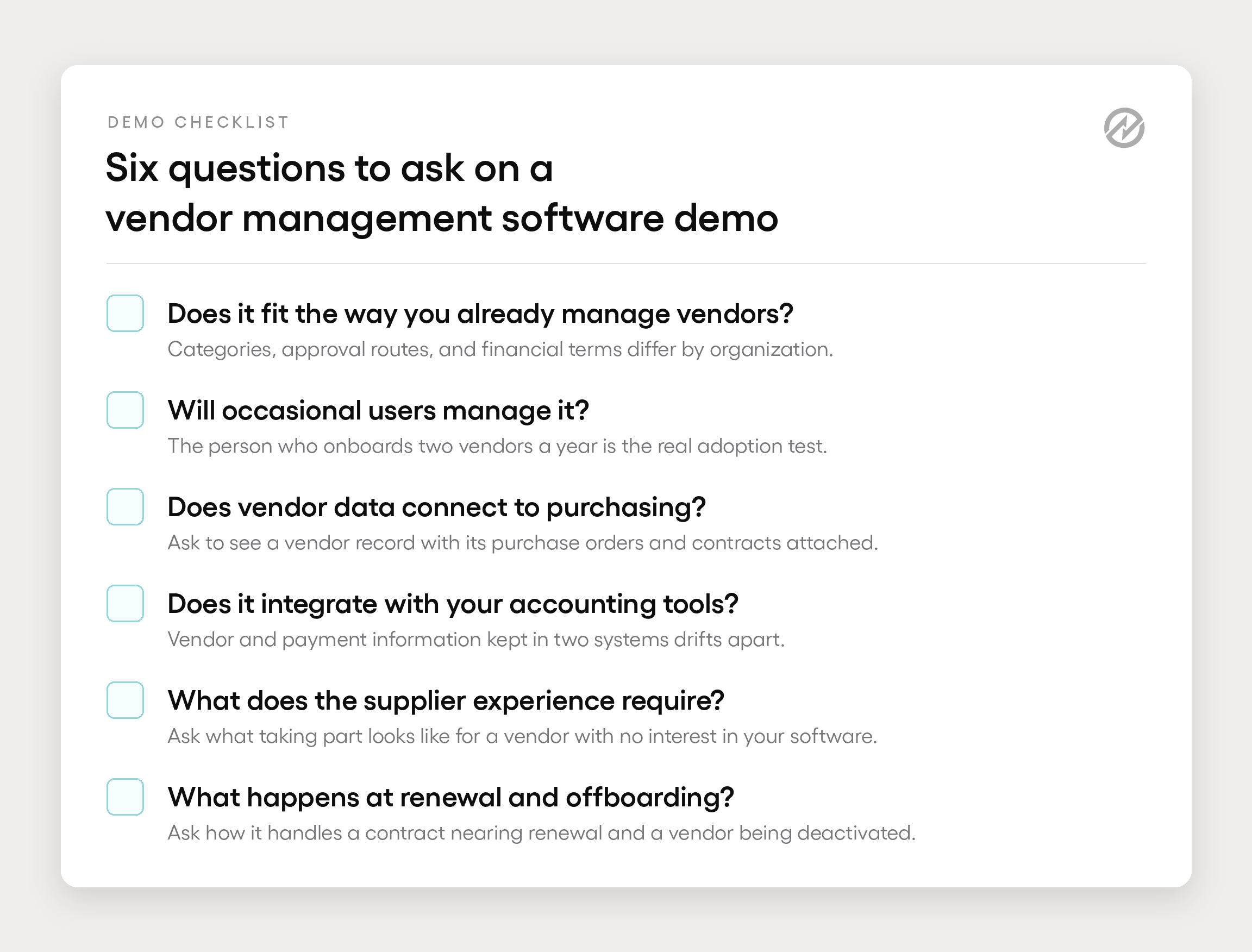
Bringing that list to two or three demos is more useful than a longer feature comparison, and it's the same approach worth taking when comparing procurement software generally.
How Tradogram supports vendor management
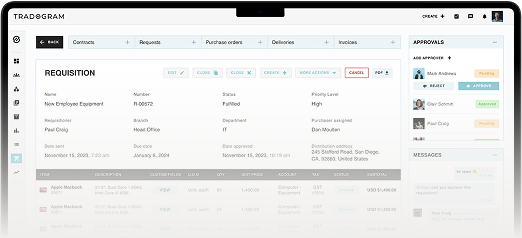
Tradogram is a procurement platform, so vendor records don't sit in a dedicated module. They're attached to the requests, purchase orders, receiving records, and invoices involving those vendors, so the vendor history builds as purchasing occurs rather than as a separate administrative exercise. That connection is what most of the following depends on.
Supplier records with custom categories. Vendor contacts, documents, and details are organized using categories you define, such as type, location, or service. Teams can find the right vendor by considering how their organization actually thinks about suppliers, rather than scrolling through an alphabetical list, and vendor information stays consistent as the list grows.
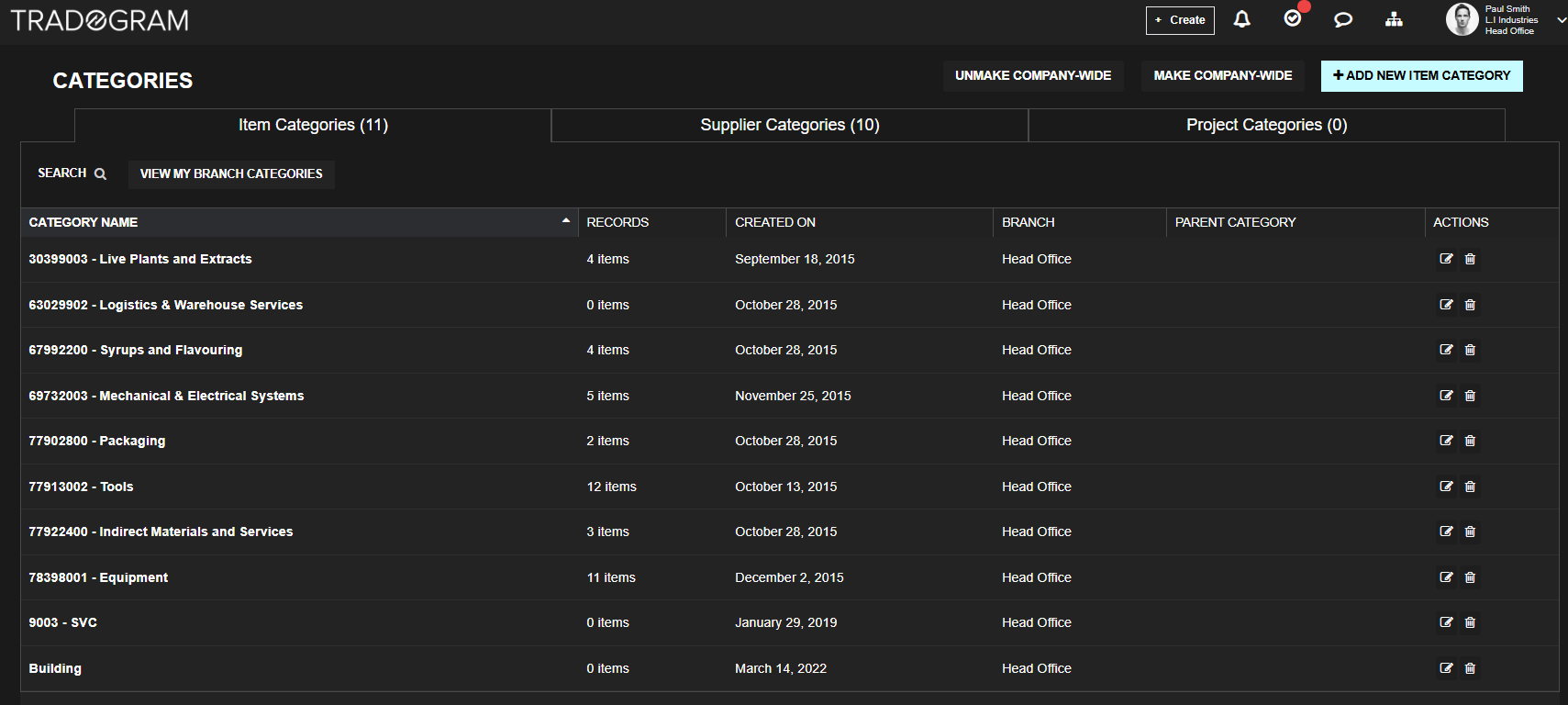
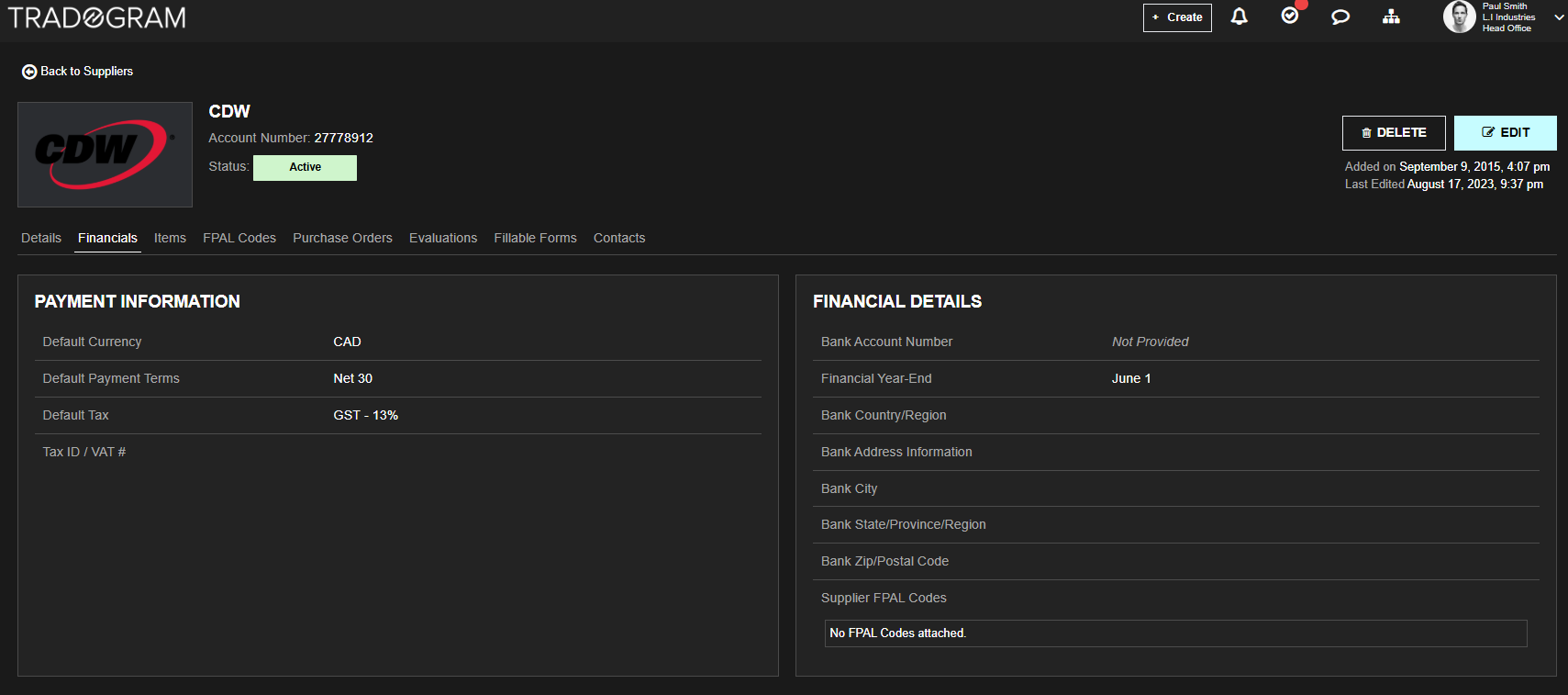
Financial settings per vendor. Payment terms, tax treatment, and currency are applied to the vendor and automatically applied to purchase orders. Buyers stop re-entering terms on every order, which is one of the more common sources of invoice disputes later.
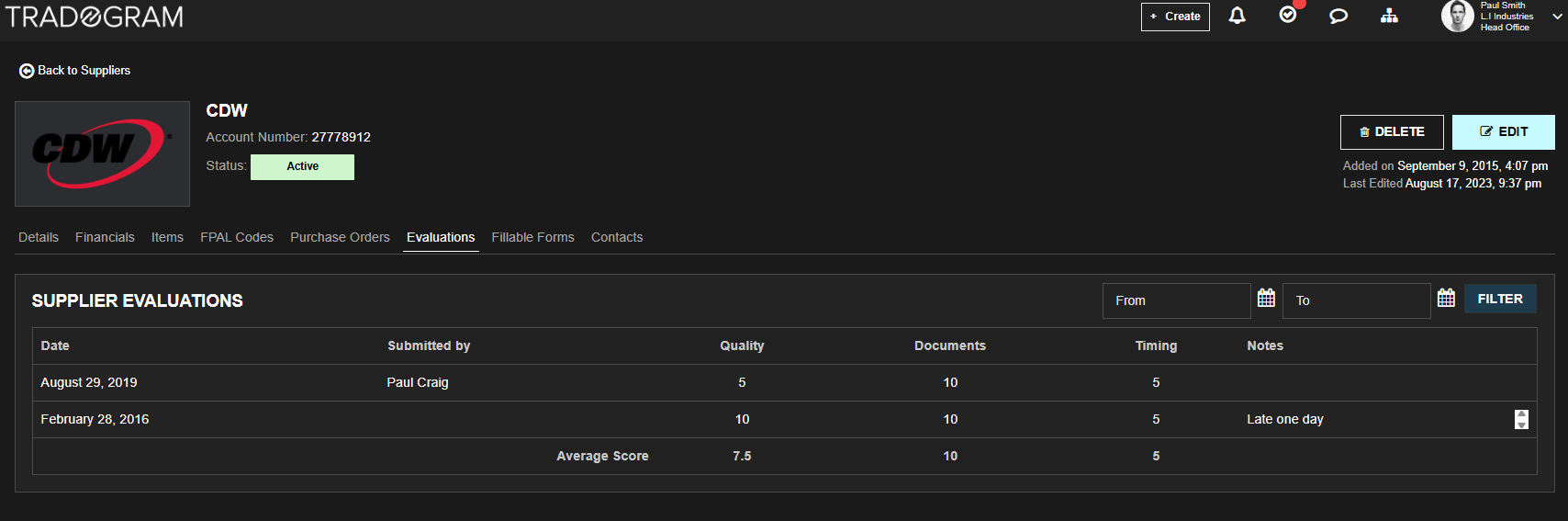
Vendor evaluation on each purchase order. Rather than reconstructing a quarter of the performance at review time, buyers rate the vendor as orders are completed. Over time, that builds a performance database from work already being done, which is what makes a scorecard defensible when a vendor asks where the number came from.
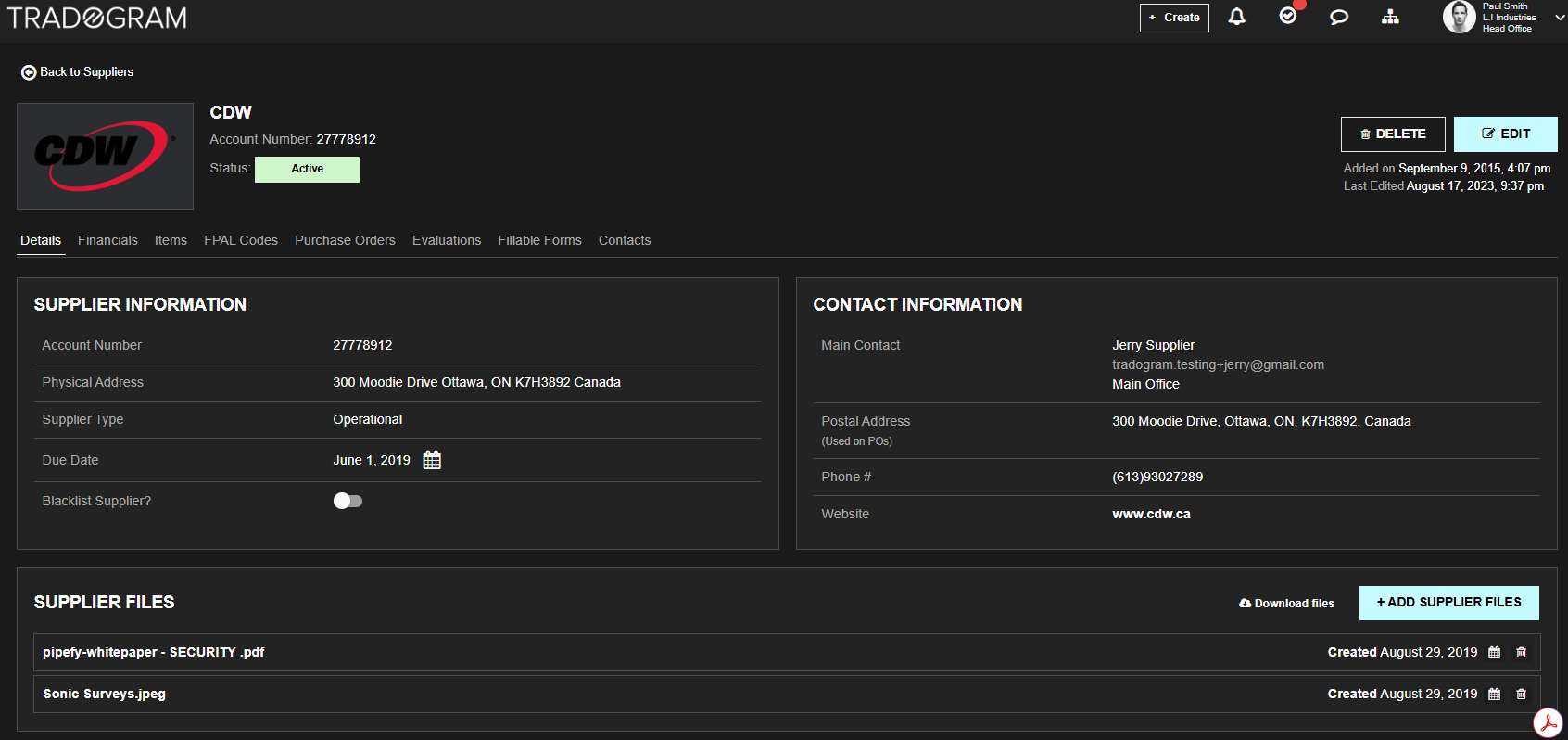
Contract and document storage. Agreements and compliance documents are stored against the vendor record. The renewal conversation starts with the current terms and performance history in the same place, rather than with whichever version of the contract someone can find.
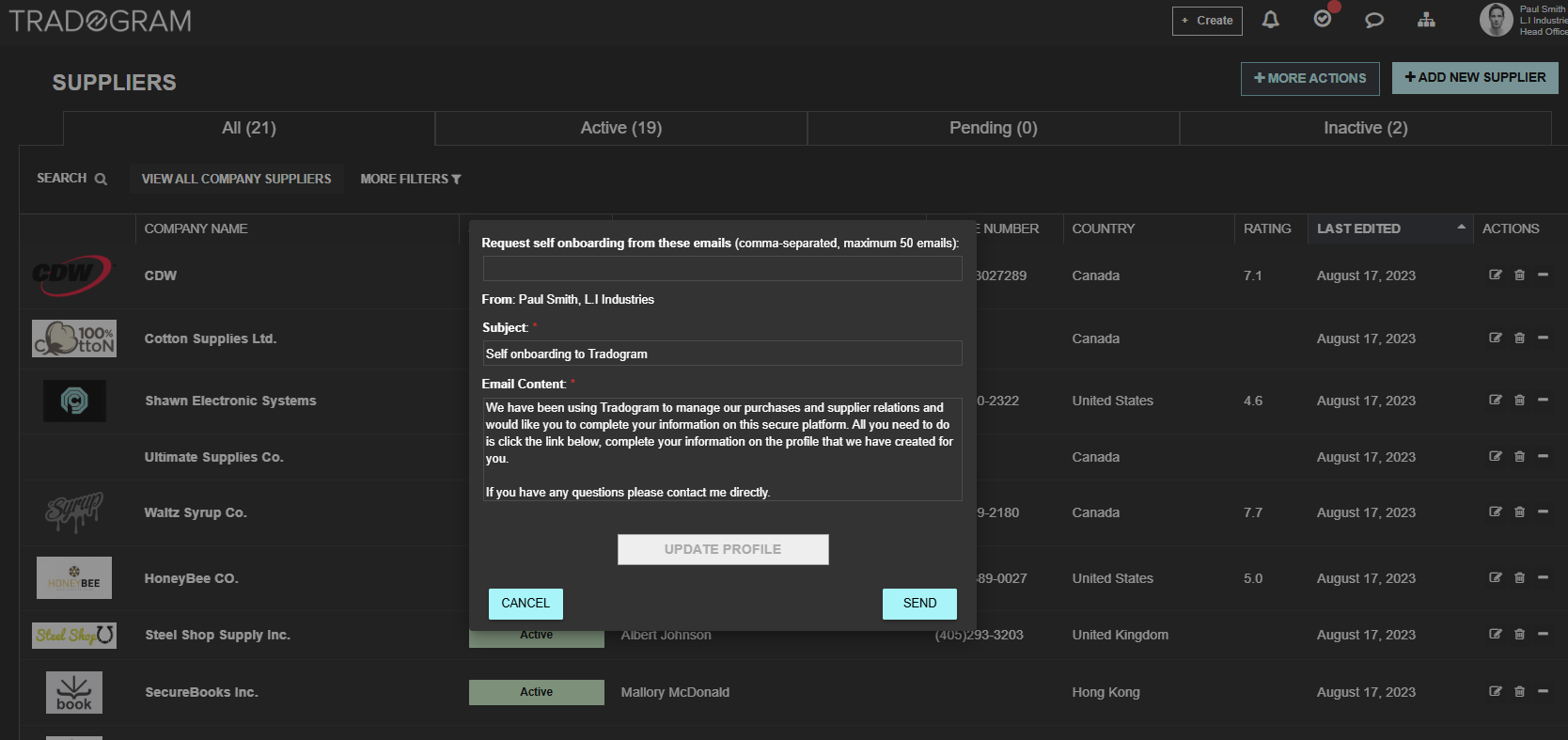
Supplier portal and collaboration. Vendors can be invited to submit quotes, track orders, and create invoices directly. Suppliers can also receive and respond to documents without paying for a Tradogram account, which matters because supplier participation usually fails on the vendor's side rather than yours.
Accounting integration. Vendor and purchasing information synchronizes with accounting systems including QuickBooks, Xero, and NetSuite, so vendor details don't drift between procurement and finance.
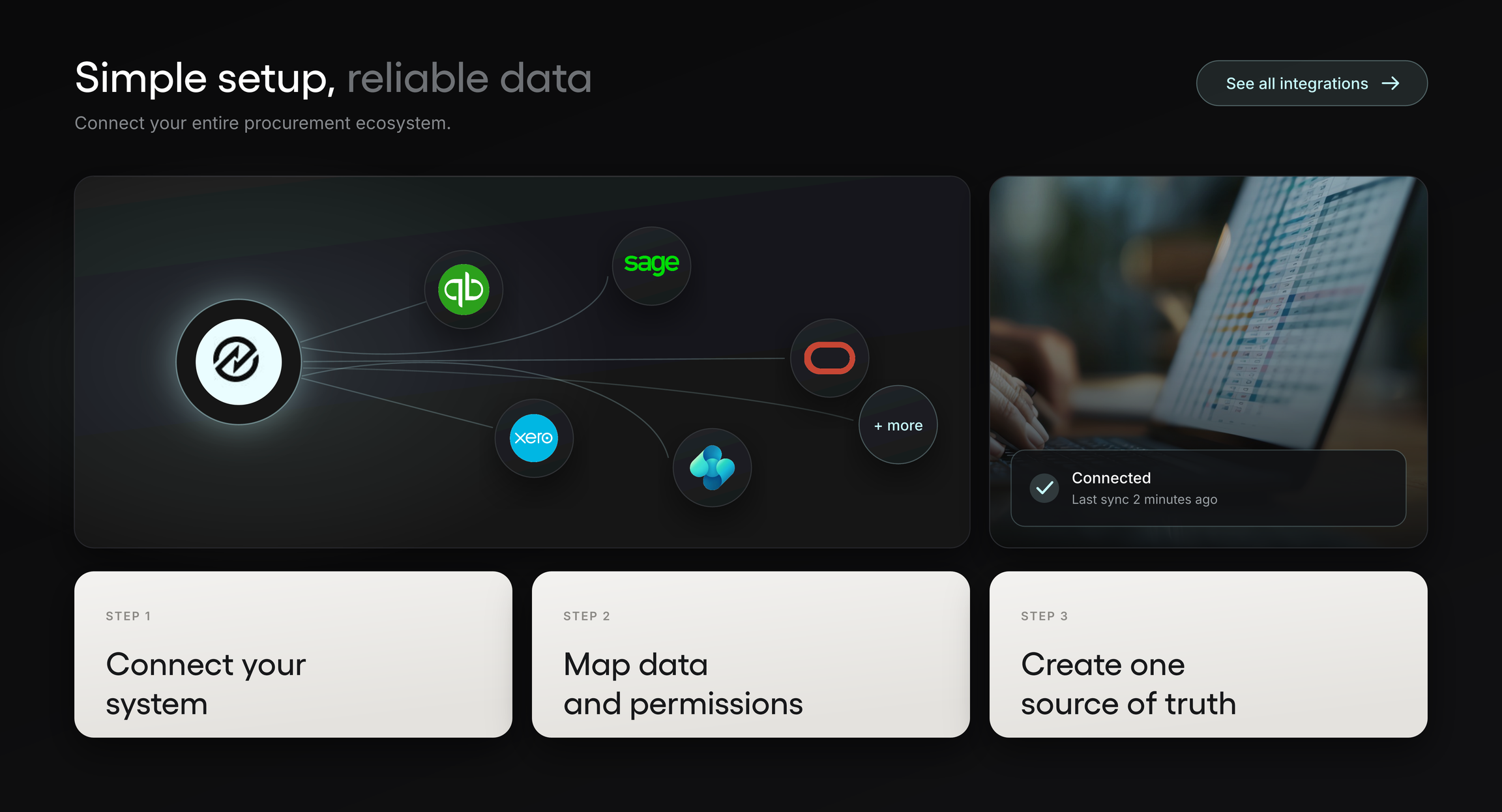
None of this replaces the judgment involved in managing vendor relationships. What it changes is where the effort goes. Instead of maintaining vendor information as its own project, the record maintains itself as purchasing runs through it, leaving time for the conversations that strengthen vendor relationships rather than for locating a certificate. See how supplier management software handles the vendor record and performance history together.
Where to start with vendor management
Vendor management has no incident report. When a budget is blown, or an invoice doesn't match a purchase order, something visibly breaks and someone opens a ticket. When vendor management degrades, nothing happens at all, right up until it surfaces as somebody else's emergency: a stalled project, an audit finding, a renewal that went through at a price nobody reviewed. By then it gets filed under the emergency, not under the thing that caused it.
That's why vendor management is important yet perpetually unfunded. It loses priority arguments because it never produces the kind of evidence those arguments run on.
Here's the practical reason not to wait for one. This is work that can't be done under pressure. A useful vendor record takes a few ordinary months of purchasing to build, and a supplier failure gives you days. Nobody has ever qualified an alternative supplier during the week they needed one.
So name the vendors you couldn't easily replace, assign an owner to each, and review what's actually in those records. That's an afternoon of work. The version of that list you build this month is the version available to you when it matters, and stronger supplier relationships tend to follow that attention rather than precede it.