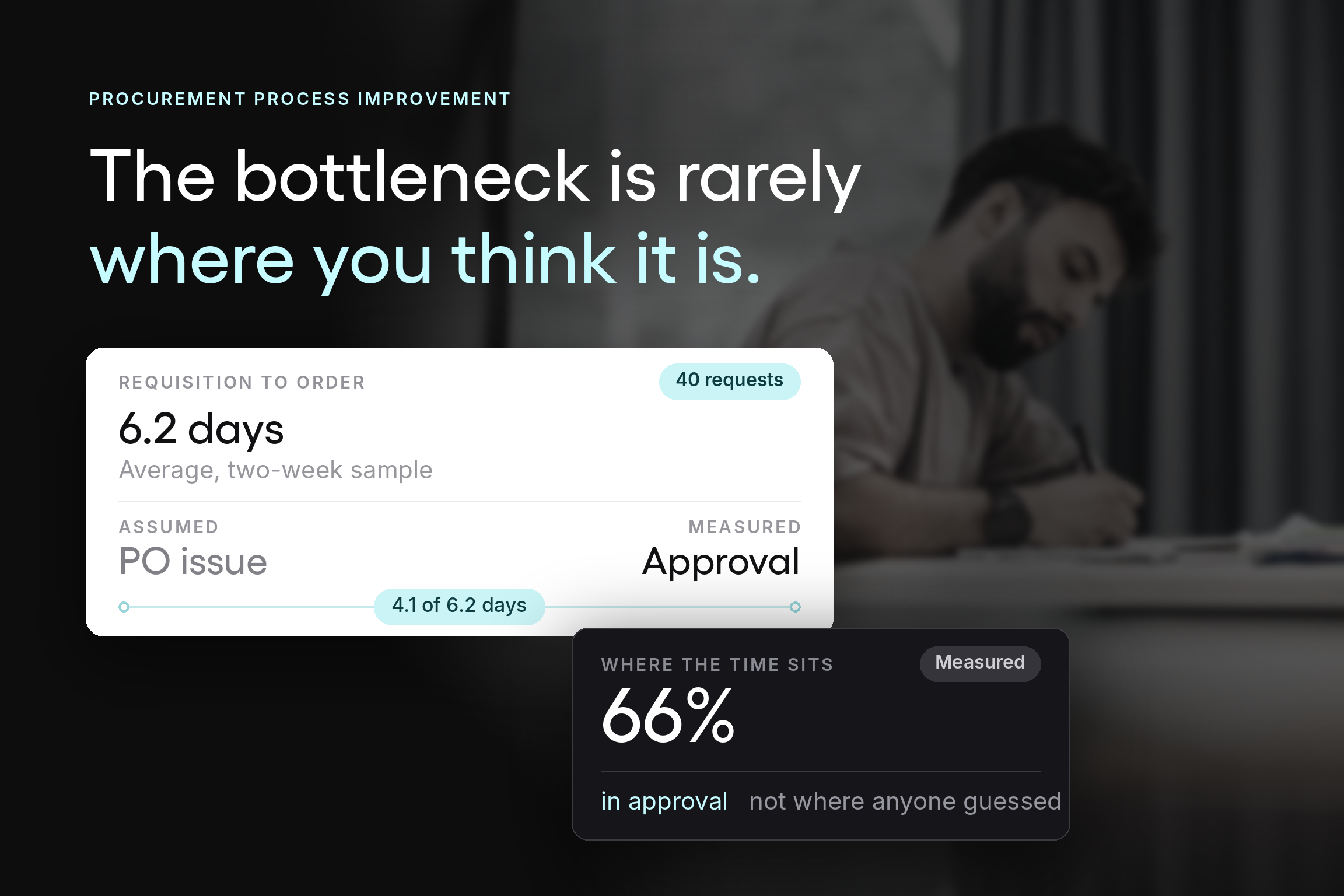


Procurement workload is projected to rise 8% this year. Headcount and operating budgets are both projected to decline.
Those are Hackett Group figures from their 2026 Procurement Key Issues Study, and they describe the constraint every procurement team is actually working under. Not a shortage of ideas about how to improve. A gap between the work arriving and the capacity to do it, widening in both directions at once.
You cannot hire your way out of that arithmetic, because the budget for hiring is the thing that is not growing. The only remaining lever is the amount of work each purchasing decision requires. Procurement process improvement means reducing that work. Inefficient processes create unnecessary costs long before anyone negotiates a price. Controlling costs at that level, and moving to reduce unnecessary costs before they are committed, protects cash flow in a way a single hard-won discount does not.
Most teams already have proven strategies available to them. What they lack is a structured approach for deciding which one to apply to their current procurement process. Efforts to improve efficiency fail when they are aimed at current processes nobody has measured, and procurement practices that worked at a smaller volume are usually the first thing to break.
Here is the thing that makes it tractable: the waste is not evenly distributed.
In every procurement operation we have worked with, the majority of the lost time sits in a small number of identifiable places, and most teams have never measured which ones.
This guide is about finding yours before changing anything, because the most common way procurement improvement programs fail is by fixing the wrong stage very efficiently. A procurement strategy that does not start from measurement is a set of preferences.
Key Takeaways
- Measure before you change anything. Most procurement teams can name their bottleneck, and most are wrong, because the visible delay is rarely where the time is actually spent. Three measurements taken over two weeks will settle it more reliably than any workshop.
- Approval routing is the most common single point of loss. Approvals that depend on a named individual instead of on a rule create queues, and queues produce the workarounds that generate maverick spend. Fixing routing usually returns more time than automating anything else.
- The workload gap cannot be closed by working harder. Hackett Group projects procurement workload rising 8% in 2026 while headcount and operating budgets decline. Efficiency is not an optimization here; it is the only available response.
- Standardization has to precede automation. Automating a process that varies by person, category, or business unit produces faster inconsistency. Agreeing on thresholds, required fields, and category rules first is unglamorous and determines whether the technology returns anything.
- Cycle time is the metric that changes behavior. Cost savings are reported quarterly and argued about. Requisition-to-order cycle time is felt weekly by everyone who requests anything, and improving it is what makes the rest of the business stop routing around procurement.
Start by finding out where the time actually goes
Most procurement process improvement starts with a list of best practices and works backward to find somewhere to apply them. That is why so much of it produces effort without result.
The better sequence is diagnostic. Before deciding what to improve, measure three things across a representative two-week sample.
1. Requisition-to-order cycle time, broken into stages. Not the total. The total tells you there is a problem. The breakdown tells you where. Measure the elapsed time from request raised to request approved, from approved to purchase order issued, and from issued to supplier acknowledgment. In most organizations, one of those three stages accounts for the majority of the elapsed time, and it is usually not the one people assume.
2. The proportion of spend arriving without a purchase order. Count invoices that reference no PO as a share of total invoices, and as a share of total value. This is your maverick spend rate, and it measures whether the process is being followed rather than whether it exists.
3. Touch count on a typical transaction. Follow ten ordinary purchases end to end and count how many times a person handles them, including forwarding an email, re-keying a figure, or chasing a status. Manual processes reveal themselves here in a way they do not in a process diagram.
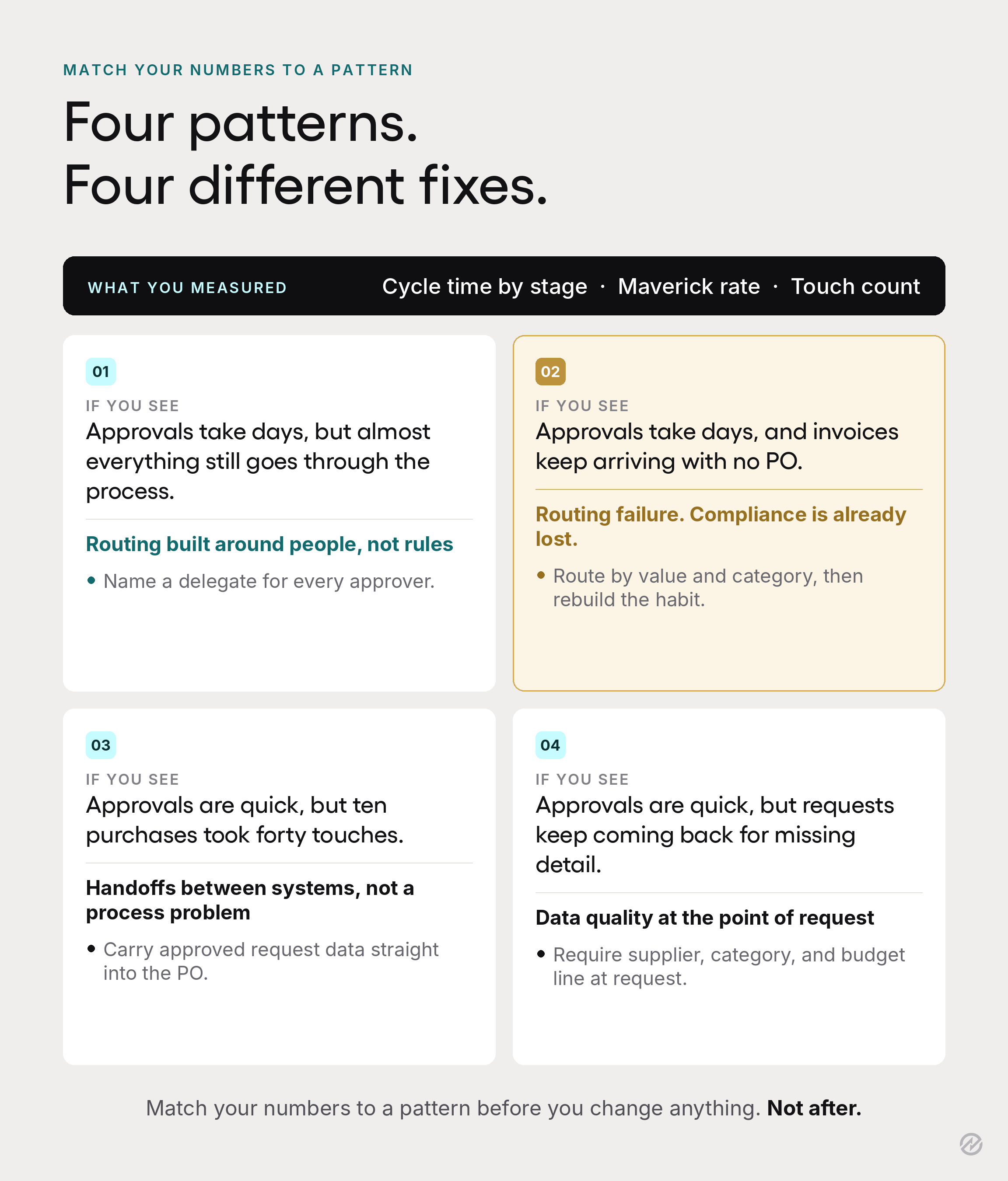
Together, those three numbers will tell you which of the four common failure patterns you have.
| What the numbers show | The actual problem | Where to start |
|---|---|---|
| Long approval stage, low maverick spend | Approval routing, but people are still complying | Route by value and category, add delegates |
| Long approval stage, high maverick spend | Approval routing, and people have stopped complying | Same fix, urgently, before any enforcement |
| Short approval, high touch count | Manual handoffs between systems | Integration and data capture, not workflow |
| Short approval, high exception rate downstream | Data quality at the point of request | Required fields, supplier master, catalogs |
Skipping this step is why procurement teams buy workflow software to solve what turns out to be a master data problem, or clean their supplier data to solve what turns out to be an approval queue.
Fix the approval routing first
Across procurement operations we see, approval is the stage that holds the most recoverable time, and the fix is structural rather than behavioral.
The pattern is consistent. Approval workflows are built around people, because that is how authority is described in an organization chart. Someone requests something, then it goes to their manager, then to a category owner, then to finance above a value.
Each of those is a named individual, and each of them is occasionally in a meeting, on a flight, or on leave.
What happens next is predictable. The request sits. The requester, who needed the item last week, finds another way. Now the purchase has happened without a purchase order, so the invoice will not match, and procurement professionals spend an hour reconstructing what was bought.
The approval delay cost two days. The time lost to the workaround it caused by unauthorized spending is considerably more, and it recurs.
Four changes, in order of return:
Route by value and category rather than by person. A $200 order and a $40,000 order should not travel the same path. Most procurement workflows can be reduced to three or four bands, and the routine band should clear without a human where policy allows.
Give every approver a named delegate. This is a configuration change measured in minutes that permanently removes a category of delay. It is the single highest-return action on this list and the one most often left undone.
Raise the threshold until approval means something. If everything requires sign-off, approvers stop reading. A threshold set high enough that approval is a real decision produces better scrutiny on the purchases that matter, and fewer approval delays on the ones that do not.
Set an escalation clock. A request that has sat for two days escalates automatically. This converts a silent queue into a visible one, which is usually enough to clear it.
Organizations that make these four changes typically see requisition-to-order cycle time fall substantially without touching anything else. The Hackett Group found top-performing procurement organizations run 58% shorter requisition-to-purchase-order cycle times than their peers. That gap is largely a routing gap, not a technology gap.
Standardize before you automate
After diagnosing a problem, the temptation is to buy something. Resist it for one more step.
Automating an inconsistent process produces inconsistency at speed. If three business units define a category differently, require different fields, and apply different thresholds, then automation encodes three processes instead of improving one. Procurement teams that skip standardization generally rebuild their configuration within eighteen months. That is expensive and demoralizing in equal measure.
What actually needs agreeing before any digital procurement tools are configured:
Approval thresholds and who owns each band. Written down, with delegates named.
A category taxonomy the business recognizes. Not a perfect one. A consistent one. Category management is impossible without it, and spend analysis is meaningless without it.
Required fields at the point of request. Supplier, category, budget line, need-by date. Every field you do not require at request becomes a question later, and questions are where the touch count lives.
Preferred suppliers by category. A requester choosing from a list behaves differently from a requester choosing from the internet. This single change does more to enforce compliance than any policy document, because it makes the compliant path the easy one.
What counts as an exception, and who decides? Every process has exceptions. Undefined exceptions become precedents.
This work is unglamorous, and it is the difference between technology that returns value and technology that becomes a second place to type things. Existing processes that are merely habitual should be examined here too, because standardizing a bad practice is still standardizing.
Where automation actually returns time
With routing fixed and the process standardized, automation stops being a gamble. These are the areas where it reliably returns more than it costs, roughly in order.
Requisition to purchase order conversion. Approved request data carrying straight through to the purchase order, with no re-keying. This removes the most common source of manual errors in the purchasing process: someone retyping what someone else already typed. Reducing manual tasks here is the fastest way to reduce errors downstream, because every re-keyed field is a chance to introduce one.
Budget checking at the point of request. The requester sees the budget position before submitting. This moves cost control from a report to a control and prevents requests that were never going to be approved from consuming anyone’s attention.
Approval routing itself. Rules-based routing with escalation, which is what makes the fix in the previous section durable rather than dependent on someone remembering.
Order status and expediting. Automated follow-up on unacknowledged orders and overdue deliveries. Chasing suppliers is pure administrative load, one of the procurement activities that returns nothing to anyone, and it is almost entirely automatable.
Three-way matching and invoice processing. Invoice against purchase order against receipt, with only exceptions reaching a person. Ardent Partners puts invoice processing at $9.84 and 8.2 days on average, with an 18.4% exception rate, and the difference between organizations is almost entirely how many invoices a human has to touch.
Supplier onboarding. A structured intake that collects documents, certifications, and banking details once, with verification built in. Onboarding is where supplier data quality is either established or lost.
What automation does not do is reduce the number of decisions. It reduces the handling around them, cutting the manual effort surrounding each judgment without removing the judgment itself. Leveraging technology at this point means applying digital tools to purchase approvals and matching, and leaving the thinking where it belongs. Procurement teams expecting automation to lighten the judgment load are usually disappointed, while teams expecting it to remove the routine tasks around each judgment are usually not.
The supplier side, where efficiency compounds
Internal process improvement has a ceiling. Past it, the remaining inefficiency sits in how you work with suppliers, and that is where the gains stop being one-time and start compounding.
Consolidate the supply base deliberately. Most organizations carry more suppliers than they need in fragmented spend categories, each one carrying onboarding cost, payment administration, and a relationship nobody owns. Fewer, better-managed key suppliers reduce operational costs and increase leverage at the same time. The caution is concentration risk, so consolidation should be a category-by-category judgment and not a target. Deliberate supplier selection at this stage is what keeps a reliable supply chain from depending on luck.
Make supplier onboarding a process, not an event. Collect documents, insurance, certifications, and banking once, verify them, and store them where both procurement and finance can see them. Poor onboarding drives most supplier master data problems, and supplier master data problems drive most matching exceptions.
Track supplier performance against something specific. On-time delivery, quality rejections, price variance against negotiated agreements, and responsiveness to queries. Supplier performance management turns a subjective view into a record, and a record changes the conversation. Suppliers behave differently when they know what is being measured, and building strong supplier relationships starts from that clarity. Supplier reliability and vendor reliability are the same question asked by two departments, and both are answerable once the data exists.
Build strategic partnerships where the category justifies it. Not every supplier warrants this. For the small number who materially affect your operational performance, supplier collaboration through forecast sharing and joint problem-solving returns more than any negotiation. This is also your best protection against supplier disruptions, because a supplier who considers you a priority customer allocates scarce capacity accordingly.
Give every significant supplier an owner. Supplier relationship management without a named owner degrades to transaction processing, and vendor management becomes a mailbox. Clear vendor communication needs someone whose job it is to maintain it. The owner does not need to be senior. They need to be accountable.
Sourcing, categories, and where cost reduction actually lives
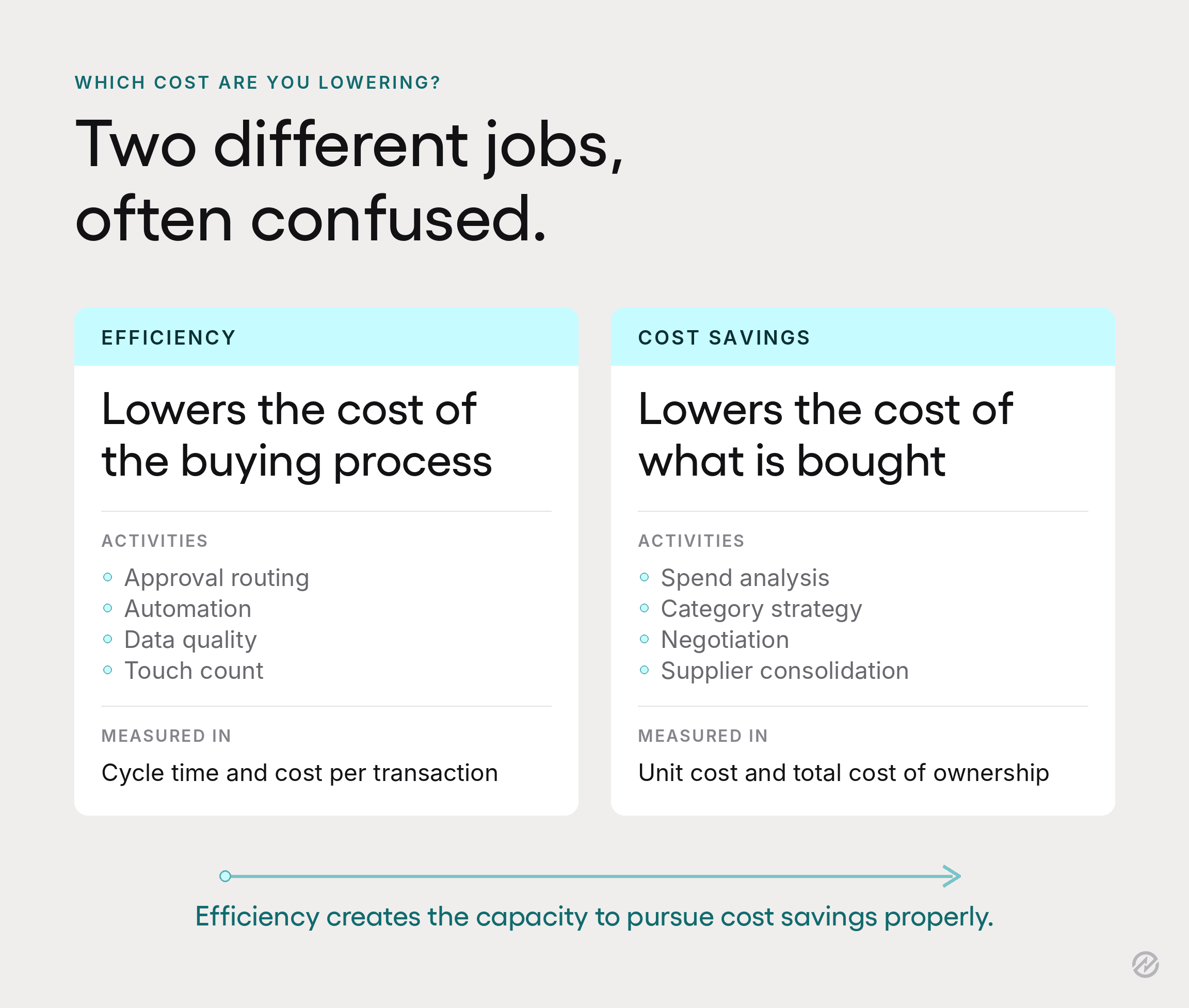
Process efficiency and cost reduction are related, but not the same thing, and conflating them is how procurement ends up measured on the wrong outcome.
Efficiency lowers the cost of buying and raises operational efficiency across every purchase. Sourcing lowers the cost of what is bought. Both matter and they are pursued differently.
Spend analysis first. You cannot identify savings opportunities in spend categories you cannot see. Analyzing spend consistently shows where concentration exists, where fragmentation is costing leverage, and where prices have drifted. Spend analytics of this kind turns purchasing history into a sourcing process you can plan, and data analytics applied to categories surfaces missed opportunities nobody had time to look for. Monitoring patterns over time is what separates a real signal from a single bad month. Bulk purchasing only makes sense once you know which categories genuinely repeat.
Prioritize categories by opportunity, not by size. The largest category is not automatically the best target. The best target is the one with the widest gap between what you pay and what the market offers, which is a different question and one that requires looking outward at market trends rather than inward at history.
Run strategic sourcing on a calendar, not during a crisis. Sourcing strategies built around contract expiry dates give you time to prepare, run a proper process, and negotiate from a position of strength. Renegotiating contracts three weeks before expiry is how organizations discover they have no leverage.
Give category managers real ownership. Category management works when someone owns the outcome for a category across the whole organization, including the market knowledge, the supplier relationships, and the numbers. Split that ownership across business units, and you get category strategies that contradict each other.
Watch for market shifts that change the answer. A category strategy set two years ago against different input costs, lead times, or supply conditions may now be wrong in a way nobody has checked. This is where predictive analytics and advanced analytics earn their place, flagging movement before it becomes a price increase you have to absorb.
The honest framing: process improvement makes procurement cheaper to run. Sourcing makes the organization cheaper to operate. Procurement leaders who deliver only the first tend to be seen as an administrative function. That is a positioning problem as much as a performance one. Contribution to enterprise performance is judged on the second.
Compliance, risk, and the quiet cost of getting it wrong
Inefficient procurement processes create compliance gaps, and compliance gaps are expensive in ways that don't show up in efficiency measures.
Unauthorized spending is a routing symptom. When the compliant path is slow, people take the fast one. Maverick spend is therefore a measure of process usability, not employee discipline, and treating it as the latter produces policies that make the problem worse.
Contract compliance leaks quietly. The gap between negotiated terms and what is actually paid is invisible without analysis and usually material once examined. Contract terms agreed at considerable effort deliver nothing if purchasing happens outside them.
Regulatory compliance and supply chain risks carry financial penalties. Depending on sector and jurisdiction, procurement carries obligations around supplier due diligence, modern slavery reporting, conflict minerals, data protection, and public procurement rules, and organizations buying through global supply chains carry more of them. Documenting due diligence against recognized industry standards is how you mitigate risks that would otherwise surface during an audit. A procurement policy nobody can evidence is not managing risk. Steps that reduce risks here are unglamorous, and supply chain resilience is built on records, not intentions.
Audit readiness is a byproduct or a project. Organizations with an approval trail attached to every transaction answer audit questions in minutes. Organizations without one run a reconstruction exercise annually, which is pure cost.
The efficient version of compliance is not more checking. It is a process where the compliant path is the path of least resistance, so that compliance happens as a consequence of people doing their jobs conveniently rather than as an additional task they must remember.
The procurement KPIs worth tracking, and the ones that mislead
Continuous improvement requires measurement that someone acts on, and that is a narrower set than most dashboards contain. These six key performance indicators cover it. Track progress against your own baseline, tie each one to business goals someone owns, and keep the set small enough that decision makers can hold it in their heads. Cost savings figures are lagging indicators and belong in the annual story. Cycle time and exception rates are what support decision making and data-driven decisions week to week.
| Metric | Why it matters | What it tells you when it moves |
|---|---|---|
| Requisition-to-order cycle time | The measure the rest of the business experiences | Rising almost always means an approval bottleneck, not volume |
| Spend under management | The share of spend the process actually governs | Falling means people are routing around you |
| PO compliance rate | Invoices with a purchase order behind them | The clearest single measure of whether the process is usable |
| Cost per transaction | Efficiency of the purchasing processes themselves | Compare against APQC’s $14 to $54 range per purchase order |
| Invoice exception rate | Data quality upstream | Above the 18.4% average points at requisition data, not at AP |
| Realized versus negotiated savings | Whether sourcing work survives contact with buying | A wide gap means contract compliance, not bad negotiation |
Two cautions on performance metrics.
Savings figures alone will not persuade finance leaders. A savings number procurement calculates itself, using a baseline procurement chose, invites the question of who checked it. Reporting cost per transaction and cycle time alongside savings gives the number credibility it lacks on its own, because those two are independently verifiable.
Avoid metrics nobody can act on. Supplier count, spend by month, and number of purchase orders processed describe activity, not performance. If a number moving would not change what anyone does next week, it belongs in a report rather than on a scorecard.
The point of key metrics here is not to demonstrate procurement value to key stakeholders, though they do that. Each one points to a different intervention, which is what makes continual improvement a sequence rather than a slogan.
The first ninety days
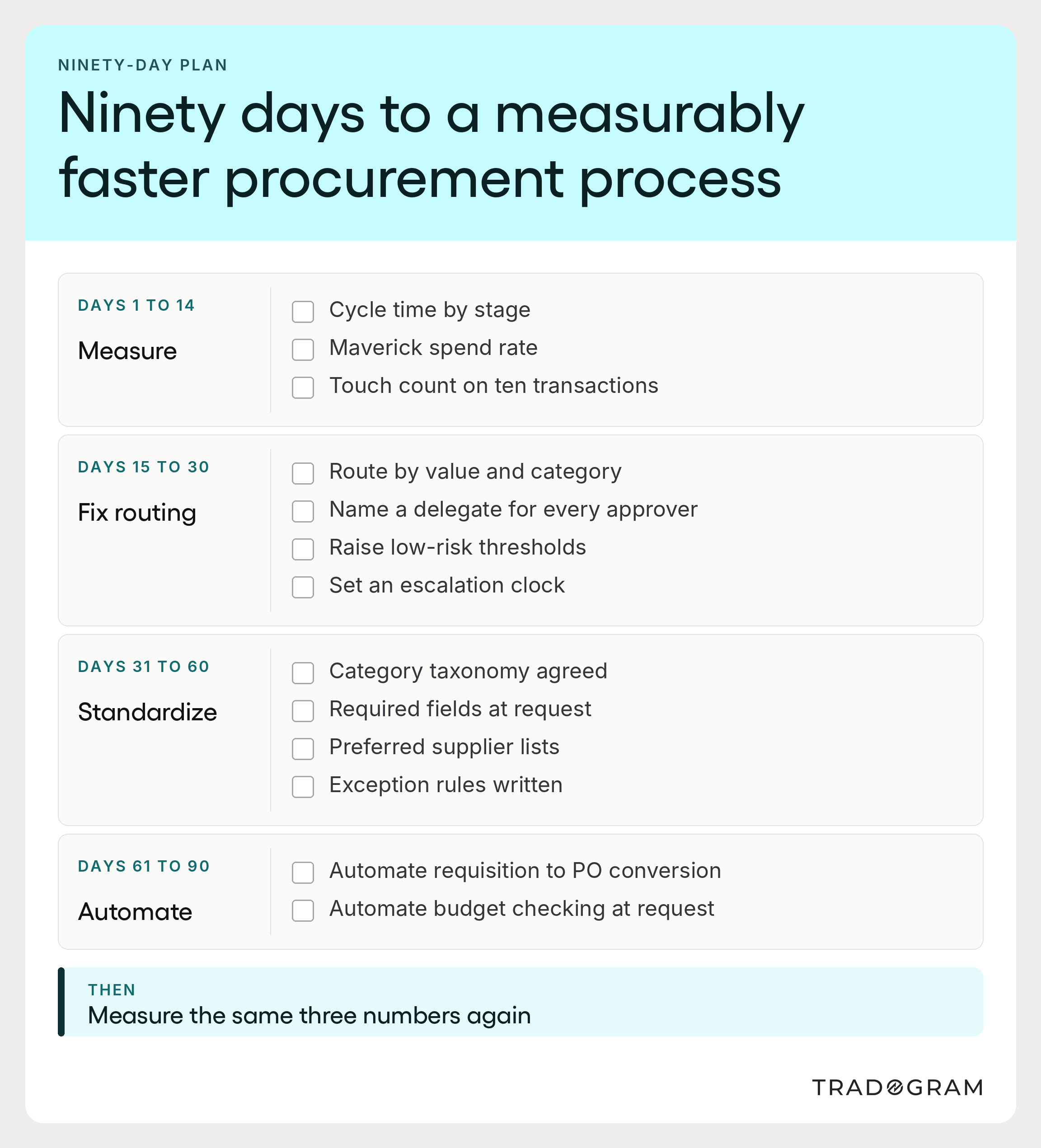
Procurement process improvement fails most often through scope. A program that sets out to transform everything delivers a roadmap. A program that sets out to fix one measured thing delivers a result, and the result buys permission for the next one.
Days 1 to 14: measure. Run the three diagnostics. Cycle time by stage, maverick spend rate, touch count on ten typical transactions. Do not change anything yet. This fortnight is what prevents the next eleven weeks from being spent in the wrong place.
Days 15 to 30: fix the routing. Whatever the diagnosis, approval routing is almost certainly part of it. Route by value and category, name a delegate for every approver, raise the threshold on low-risk categories, and set an escalation clock. These are configuration changes, not projects, and they drive efficiency faster than anything else available to you.
Days 31 to 60: standardize. Agree on the category taxonomy, the required fields at request, the preferred supplier lists, and the exception rules. Write the standards down as simple process maps so the agreed version is the one people can see. Get the affected category managers and business units to agree, because a standard nobody agreed to is a standard people will work around.
Days 61 to 90: automate the top two. With routing fixed and standards agreed, pick the two highest-return automations from your diagnosis. For most organizations, that is requisition-to-PO conversion and budget checking at request. Automate routine tasks in that order and leave the rest for the next cycle.
Then measure again. The same three numbers. This is what makes it continuous improvement, and it is also what gives you the evidence for the next round of investment.
Procurement teams that work this way tend to find something counterintuitive. The efficiency gains are real, but the more valuable outcome is capacity. Removing the administrative load creates room for strategic tasks, category work, and the supplier relationships that reduce costs and win better deals. Strategic improvements of that kind are what enhance efficiency permanently, and that capacity is the strategic value procurement is measured on over time. It is what turns efficiency into a strategic advantage instead of a one-off saving. Change management matters as much as configuration here, because long-term success depends on people using the process you built.
How procurement software helps improve procurement processes
Software alone will not fix a broken process, and the data is pretty blunt about it. PwC's Global Digital Procurement Survey, covering 1,000 companies across roughly 60 countries, found that 94% already use a source-to-pay platform while only 37% of transactional procurement processes are digitalized.
Almost everyone owns the tool. Most have not moved the work. PwC names user take-up as one of the limiting factors, which is the same finding this guide is built around: routing and standards first, because automation applied to a process nobody agreed on encodes the disagreement and runs it faster.
What software does do, once the sequence above is followed, is make four things structurally possible that are difficult to sustain by hand.
It replaces named approvers with rules. Automated approval workflows remove bottlenecks by routing on value and category instead of on a person. A request sent to an individual waits for that individual. A request sent to a rule clears the moment it meets the criteria and stops only when something genuinely needs judgment. This is the single change that returns the most time in most organizations, and it is configuration, not a project.
It makes spend visible at the category level, not the invoice level. Centralizing vendor data is what turns a pile of transactions into a picture. When supplier records, contract terms, and purchase history sit in one place, you can see that four business units buy from the same supplier on three different rate cards. Spread across systems, that costs you a negotiation you never knew was available.
It makes policy checkable. Compliance failures are usually visibility failures. When purchase requests, approvals, orders, and invoices share one record, off-contract buying shows up while it is happening instead of at quarter end, and contract terms are in front of the requester at the moment they raise a request. Centralized data does not enforce policy by itself. It makes policy checkable, and enforcement is not possible without that.
It shows total cost, not unit price. Unit price is the most visible cost of a purchase and rarely the largest. Total cost of ownership adds delivery performance, quality failures, the administrative effort of managing the relationship, and what it takes to exit it. Two suppliers separated by 4% on price routinely differ by far more once returns, expediting, and rework are counted, and that difference only becomes visible when the purchase order history and the receiving record live together.
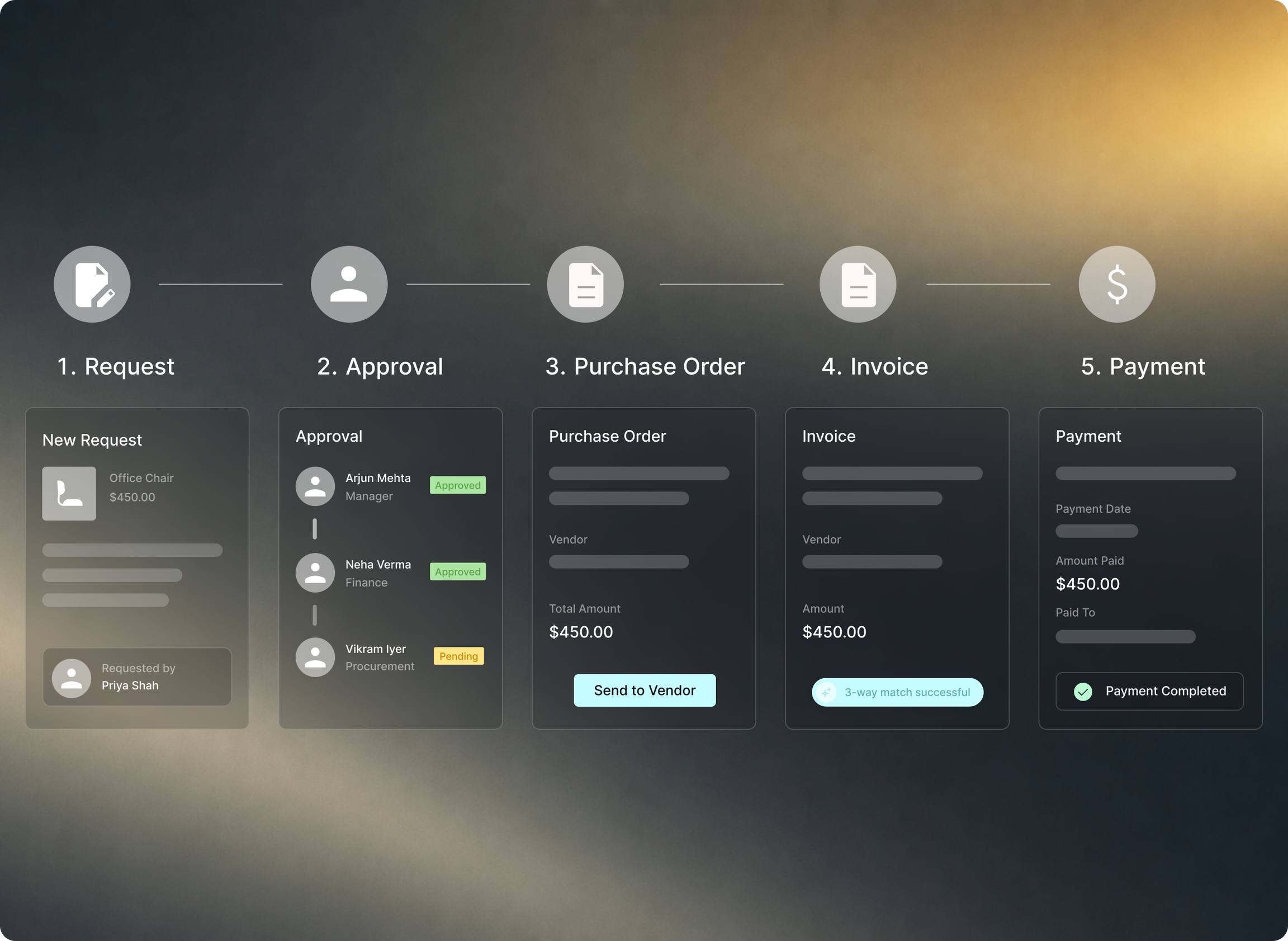
Procurement functions that run this way stop being a queue and start contributing business value to wider business operations. Connected records are what make data-driven operations possible, enabling procurement to answer questions while they still matter, turning reporting into actionable insights and data-driven insights into decisions someone acts on. This is the process redesign that moves a team from tactical purchasing toward work that changes what the organization pays.
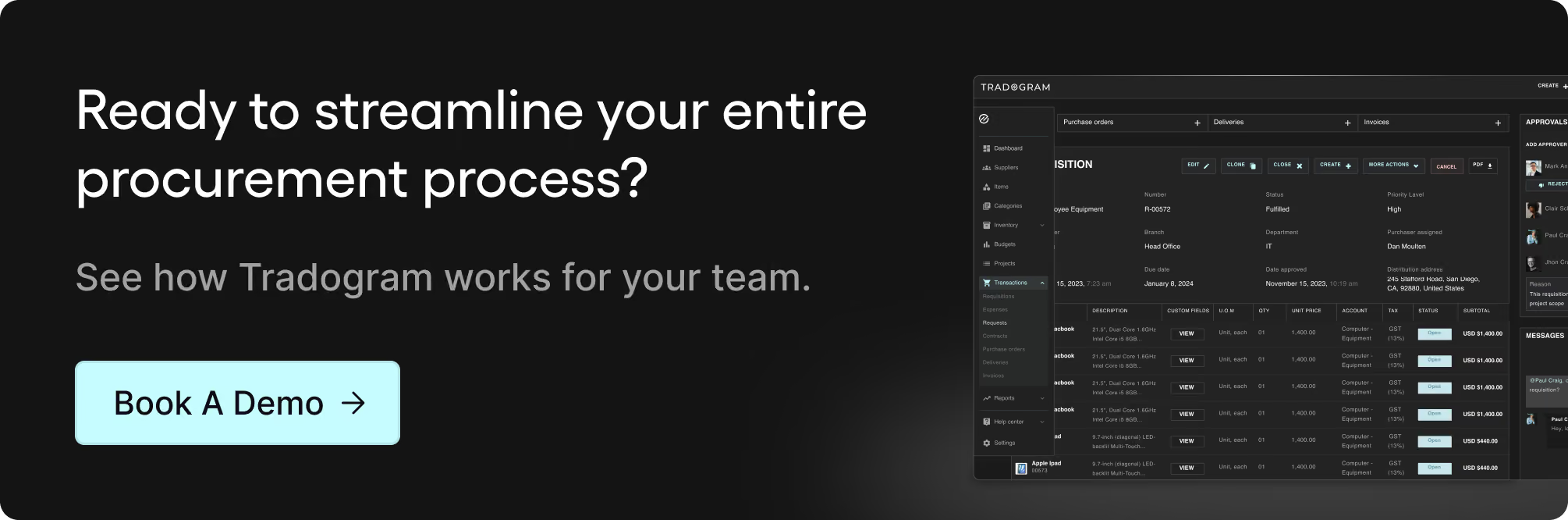
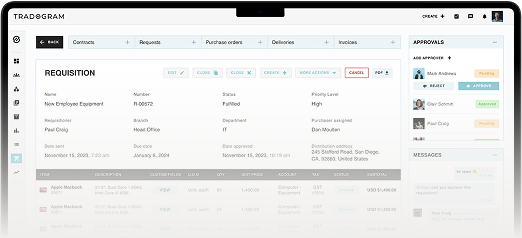
Tradogram connects purchase requests, approvals, purchase orders, receiving, invoice matching, and supplier records in one system, which is why the measurements in the first section of this guide are reports instead of projects for teams already running it. The order still matters. Teams that fix routing and agree their standards before configuring anything get the returns described here. Teams that start with the software get a faster version of what they had.