.png)


Most organizations that buy procurement software get some of the value and leave the rest on the table. Approvals route correctly, orders get raised, invoices match. But spend data is still fragmented across departments, a third of the team still emails requests to whoever they think approves them, and nobody can say whether the process is actually faster than it was a year ago.
The gap is rarely the software. It's the configuration, and the practices built around it.
That's an uncomfortable finding because it means the value isn't in the purchase. Two companies can run the same platform and get very different results, and the difference comes down to whether approval thresholds were set sensibly, whether the request form collects what approvers need, whether the records connect, and whether the occasional requester finds the system easier than the workaround.
This guide covers the practices that separate the two outcomes: how to sequence automation instead of switching everything on at once, what total spend visibility actually requires beyond a dashboard, how to integrate without turning it into a data migration project, how to manage suppliers under genuine compliance pressure, and why user experience decides whether any of it holds.
It starts with the question most teams ask first.
How does a procurement software system improve business efficiency?
Procurement software improves efficiency by removing waiting, not by making people work faster. That distinction determines whether an implementation delivers or disappoints.
In a manual process, the actual work is quick. Raising a request takes minutes. Choosing a supplier takes minutes. Issuing an order takes minutes. What consumes days is the gaps between those steps: a request sitting with an approver who is traveling, a quote nobody chased, an order waiting on a signature from someone who doesn't know it's waiting.
Software closes those gaps in five specific ways.
Requests arrive complete. A structured form collects specification, quantity, date, and budget code before submission, so approvers decide immediately rather than sending it back for basic information. Each round trip in a manual process costs days.
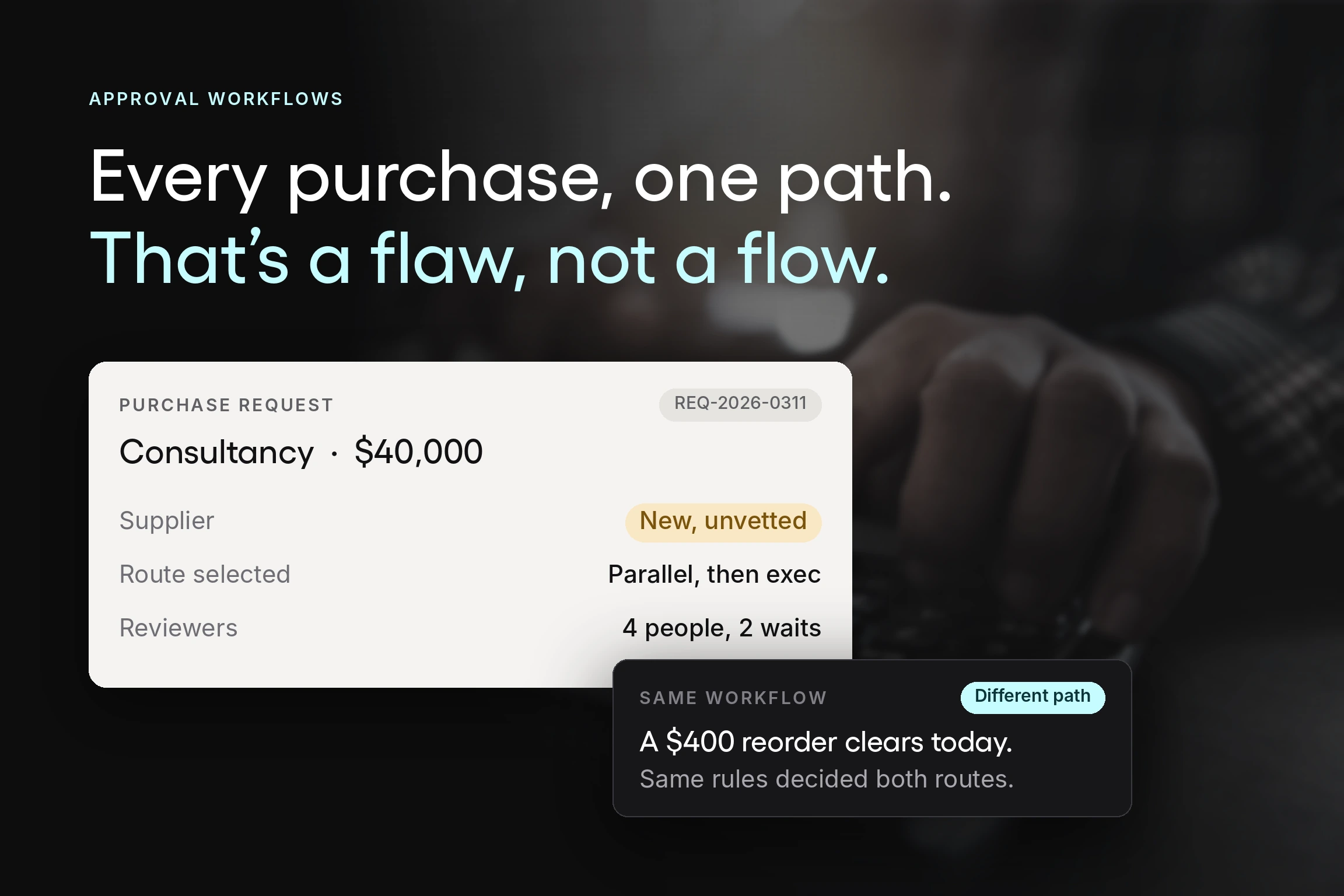
Approvals route themselves. Rules based on amount, department, location, or category send each request to the right person every time, with a named deputy covering absences. This is where most organizations see the largest single improvement, because approval waiting was where most of the delay lived.
Information carries forward. An approved request becomes a purchase order without anyone retyping it. That removes the transcription errors that would otherwise surface at invoice matching weeks later, when the original context has faded and resolving them costs far more than preventing them.
Matching becomes exception handling. Clean three-way matches process without intervention. Accounts payable sees only the invoices that genuinely need a decision, rather than working through every one to find the few that don't reconcile.
Reporting comes from the work. Cycle time, spend by category, and supplier performance read from records the team created while processing orders, instead of being assembled by hand each quarter.
The scale of the gain depends on where you start. Organizations moving from spreadsheets and email report the largest changes, with Tradogram customers commonly describing purchase order processing dropping from days to hours and cost savings averaging around 20%.
But none of that is automatic. Thresholds set too low produce three approvals on a routine purchase and the process gets slower, not faster. A request form that collects nothing useful still generates round trips. Records that don't reference each other still make every question an afternoon of reconstruction. The practices below are what turn the capability into the result.
1. Strategic AI and Automation Adoption
Effective procurement software practices begin with the strategic integration of AI and automation. Organizations that methodically embrace these technologies gain a sustainable competitive edge in a complex procurement environment.
Intelligent process automation presents immediate opportunities for impact. Successful organizations target high-volume, rule-based tasks such as:
- invoice processing
- vendor onboarding
- purchase order matching.
Trends in procurement automation show companies automating 40% or more of processes enjoy improved cycle times and reduced costs.
Key to success is contextual implementation. AI-driven spend analysis reveals patterns unseen by human analysts, while predictive analytics forecasts demand and supply risks. Gradual deployment with clear metrics at each phase ensures effective adoption.
Start by automating routine tasks while retaining human oversight for strategic decisions. This balance builds confidence in AI capabilities and preserves critical thinking and relationship skills essential for procurement value.
Implementing these technologies lays the groundwork for comprehensive spend visibility initiatives.
2. Achieving Total Spend Visibility
Comprehensive spend visibility is essential for effective 2026 procurement strategy, yet many organizations lack cohesive financial insights. Modern procurement software must offer real-time visibility into all spending, from strategic sourcing to tail-spend management.
Successful implementations establish unified spend analytics that consolidate data from various channels into a single dashboard. This consolidated view helps identify spending patterns, curb maverick purchasing, and uncover hidden cost-saving opportunities.
Advanced platforms use predictive analytics to forecast spending trends and alert teams to potential budget overruns. According to experts, organizations with comprehensive spend visibility can cut procurement costs by 8-15% within the first year.
True spend visibility demands more than data aggregation; it requires clean data governance and standardized categorization across procurement activities. Without these, even the best analytics tools can produce misleading insights.
Such visibility is crucial when integrating procurement software with broader enterprise systems.
3. Seamless Ecosystem Integration
Success with modern e-procurement software relies on seamless integration with existing business systems. Leading organizations prioritize platforms that connect effortlessly with ERP systems, financial tools, and supplier databases, creating a unified digital ecosystem.
API-first architecture is now the standard, enabling real-time data synchronization across departments and eliminating data silos. This ensures purchasing decisions are based on accurate inventory, budget, and supplier metrics.
Cloud-native solutions excel in this area, offering pre-built connectors for popular enterprise software and accommodating custom integrations. Organizations report efficiency gains when procurement workflows automatically update accounting and inventory systems.
Effective implementations focus on bi-directional data flow, where information moves between systems without manual intervention. This connectivity is increasingly important for advanced supplier management and compliance monitoring.
4. Sustainable and Compliant Supplier Management
Procurement organizations must navigate complex regulations while maintaining ethical supplier relationships. A comprehensive source-to-pay platform provides the transparency and control needed for sustainable operations.
Environmental compliance monitoring is crucial, with organizations needing real-time visibility into supplier sustainability metrics. Advanced procurement software tracks carbon footprints, waste reduction, and ethical sourcing certifications, helping avoid penalties and build stakeholder trust.
Risk mitigation extends to social responsibility. Modern platforms include supplier diversity tracking, labor practice monitoring, and conflict mineral reporting to ensure compliance and support corporate social responsibility.
Sustainable supplier management requires more than technology; it demands clear performance standards and regular audits. The best approaches combine automated monitoring with human oversight, balancing efficiency with accountability.
This approach naturally leads to creating intuitive user experiences that drive widespread adoption.
5. Prioritizing User Experience
The success of procurement software hinges on user adoption, making user experience design vital. Modern professionals expect intuitive interfaces that streamline workflows, not add complexity.
Simplified navigation is key. When users can easily find requisition forms, supplier catalogs, and approval workflows with minimal training, adoption rates soar. This is crucial in comprehensive procure-to-pay (P2P) systems where users interact with multiple modules.
Mobile accessibility is now essential. Procurement professionals need to approve requests on the go, making responsive design and mobile optimization vital for efficiency.
Self-service capabilities allow users to handle routine tasks independently, reducing administrative burdens. When employees can create requests, track orders, and access analytics through user-friendly dashboards, the organization benefits from increased transparency and efficiency.
Even well-designed interfaces need thoughtful implementation strategies for widespread adoption and maximal impact.
Limitations and Considerations in Procurement Software Adoption
While procurement software offers many benefits, organizations must recognize limitations affecting success. Understanding these challenges upfront aids in better planning and realistic expectations.
Budget and Resource Constraints are a primary barrier. Enterprise-grade spend management software requires significant investment, licensing fees, and IT resources. Smaller organizations may find comprehensive solutions financially prohibitive, forcing trade-offs between functionality and cost.
Integration complexity is another challenge, especially for those with legacy systems. Data migration can be time-consuming and error-prone, requiring careful coordination between IT and procurement teams.
Change management resistance can undermine even well-planned implementations. Procurement professionals must adapt to automated processes, while suppliers may resist new portals that disrupt workflows.
Vendor dependency poses strategic risks. Software providers may change pricing, discontinue features, or merge with competitors, leaving buyers with limited options once integrated.
These considerations highlight the importance of thorough planning and realistic expectations before major software investments, setting the stage for examining real-world successes.
Example Scenarios: Successful Procurement Software Implementation
Manufacturing Company Transformation
A mid-sized manufacturer streamlined procurement by implementing comprehensive supplier management and automated purchase order processing. Cycle times dropped by 40% through digital workflows automatically routing approvals based on spending thresholds. A three-phase implementation—starting with core purchasing, then contract management, and finally analytics—minimized disruption while maximizing adoption.
Healthcare System Integration
A regional healthcare network consolidated procurement across twelve facilities with cloud-based software featuring robust reporting. The centralized supplier database eliminated duplicate vendors, while automated compliance tracking ensured regulatory adherence. Real-time spend visibility revealed $2.3 million in annual savings, according to IT procurement best practices.
Service Industry Efficiency
A professional services firm used mobile procurement to enable field teams to make instant purchases. Integration with ERP systems ensured seamless data flow, while customizable approval workflows maintained spending controls. This demonstrates how modern software adapts to diverse requirements while preserving oversight.
These scenarios show that successful implementations share common elements: phased rollouts, strong change management, and alignment with existing processes.
Future Implications: What's Next in Procurement Software
The procurement software landscape is rapidly evolving to meet new challenges and opportunities.
AI integration is a major advancement, with predictive analytics becoming standard for forecasting demand and assessing supplier risk. Machine learning will automate routine decisions, flagging unusual patterns for review.
Sustainability tracking is increasingly important, with platforms incorporating carbon footprint monitoring and ESG compliance reporting. Organizations demand real-time visibility into environmental impacts to meet regulations and stakeholder expectations.
Hyper-automation will extend beyond purchase orders to complex negotiations and contract analysis. Experts anticipate that intelligent automation will handle up to 70% of routine tasks by 2026, freeing teams to focus on strategic relationships and innovation.
Cloud-native architectures will become the norm, offering enhanced scalability and integration. These developments suggest a future where technology amplifies human expertise, setting the stage for strategic outcomes.
Key Takeaways
Strategic Implementation Drives Success
Transforming procurement software requires a strategic, phased approach. Organizations investing in change management and training see adoption rates rise by up to 40% compared to those without structured support.
Data Integration Remains Critical
Successful platforms depend on seamless integration with enterprise systems. Many underestimate integration complexity, leading to data silos and inefficiency. Prioritizing API compatibility and data standardization early yields better results.
Future-Ready Features Matter
Effective solutions include AI-driven analytics, automated compliance monitoring, and real-time visibility. However, organizations must balance advanced capabilities with user experience to avoid adoption barriers.
ROI Measurement Validates Investment
Clear metrics and KPIs demonstrate software value. Tracking supplier performance, cost savings, and cycle time reductions shows measurable impact within the first year.
Understanding these principles helps organizations navigate the evolving procurement technology landscape as we move toward 2026.
Understanding Procurement Software in 2026
Modern procurement software has evolved into platforms integrating AI, predictive analytics, and real-time collaboration. These solutions manage the end-to-end procurement lifecycle from sourcing to supplier optimization.
Today's cloud-native architectures enable seamless integration with enterprise systems. Advanced platforms use machine learning to analyze spending, identify savings, and flag compliance issues early.
Smart procurement platforms transform reactive purchasing into strategic planning. They provide:
- real-time supply chain visibility
- enabling informed decisions based on market intelligence
- supplier performance metrics.
Key capabilities include:
- automated workflows
- dynamic approval routing
- intelligent supplier matching.
Modern solutions prioritize user experience with intuitive interfaces that reduce training needs and boost adoption. As we prepare for 2026, understanding these elements is crucial for implementing strategies that drive business value.
2. Automate Procurement Processes
Process automation transforms manual workflows into streamlined, error-free operations that deliver efficiency gains. Modern platforms automate requisition approvals, purchase order generation, and invoice processing without losing control or compliance.
Key automation opportunities include:
- Purchase requisition workflows - Automated routing based on spend thresholds, department codes, and compliance checkpoints.
Organizations implementing comprehensive automation see 40-60% reductions in processing times while improving accuracy rates.
Successful automation requires careful workflow mapping. Identify processes that benefit from automation versus those needing human judgment. Start with high-volume, standardized transactions before advancing to complex sourcing activities.
This approach lays the foundation for broader procurement best practices.
How Do You Ensure Procurement Best Practices?
Ensuring procurement best practices involves a systematic approach combining technology with continuous process refinement. Success comes from clear governance, team development, and regular performance assessments.
Start by defining measurable objectives aligned with business strategy, including:
- cost savings
- supplier performance
- process efficiency.
Regular audits ensure software and processes align with standards and regulations.
Continuous training and skill development are critical for modern procurement teams. As roles evolve through 2026, professionals need ongoing education in technologies, analytics, and sourcing methodologies.
Effective organizations implement feedback loops to capture insights from stakeholders. This includes:
- supplier performance reviews
- user experience assessments
- process optimization sessions.
Success depends on viewing procurement best practices as an ongoing journey. By embracing continuous improvement and leveraging software capabilities, organizations maximize value and competitive advantage in a complex marketplace.