.png)


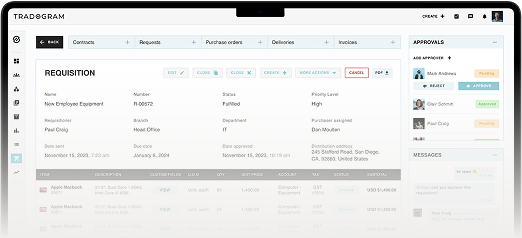
Procurement has evolved beyond its traditional back-office role, becoming a strategic asset by 2026. Interestingly, it’s not the Fortune 500 companies with extensive analyst teams that are capitalizing on this asset most effectively. Instead, agile small and mid-sized businesses (SMBs) are emerging as formidable players.
In 2026, a significant development is underway: a transition from AI that assists procurement teams to AI that orchestrates entire procurement operations autonomously. This shift is pivotal. We're moving from systems that merely respond when prompted to those that act, adapt, and execute independently.
Agentic AI is at the heart of this evolution. Unlike conventional automation or generative tools, agentic systems achieve goals through multi-step processes, autonomously making decisions. SupplyChainBrain points out that 2026 marks the transition of AI agents from pilot programs to full-scale production in procurement — and SMBs are particularly well-positioned to benefit. Why? They experience less technical debt, have streamlined approval chains, and can implement new systems without dismantling outdated infrastructure.
The central theme is a shift from doing to orchestrating — transitioning from manually managing purchase orders to overseeing an intelligent system that seamlessly handles sourcing, negotiation, compliance, and supplier communication. For more information on efficient purchase order management, explore Tradogram's purchase order management system.
Before exploring how SMBs can seize this opportunity, it’s crucial to understand what distinguishes agentic AI from the generative tools most teams already use — and why this difference is transformative.
Defining the Agent: GenAI vs. Agentic AI in the Supply Chain
Not all AI is created equal — and in procurement, this distinction is vital. Many organizations spent 2023 and 2024 experimenting with generative AI tools: using chatbots to summarize contracts, draft RFPs, or pull spend reports. Useful? Yes. Transformative? Not quite. This reactive AI still relies on humans asking the right questions at the right time.
Agentic AI operates on a different logic. Rather than awaiting a prompt, an agent receives a goal — like "ensure component X never falls below 30-day inventory" — and independently determines the steps to achieve it. It plans, prioritizes, and executes without needing constant oversight.
Reasoning and Planning: The Core Differentiator
What separates agents from conventional AI tools is their capability for multi-step reasoning. An agent doesn't just retrieve information; it evaluates options, anticipates downstream consequences, and selects a course of action. According to Google Cloud's 2026 agentic AI analysis, this planning capability allows agents to manage complex, dynamic tasks that previously required experienced human judgment.
Consider this: GenAI answers questions. Agentic AI solves problems.
Connecting to Your Existing Stack
Integration is a practical concern for any SMB. Agentic systems are designed to work within existing infrastructure — connecting to ERPs, source-to-pay (S2P) platforms, and supplier databases through APIs. Effective procurement automation in 2026 isn't about replacing legacy systems; it's about layering intelligent orchestration on top of existing frameworks.
Multi-Step Execution Without Supervision
Perhaps the most significant capability is autonomous workflow execution. An agent can identify a supply shortfall, shortlist pre-approved vendors, generate a purchase order, route it for approval, and log the transaction — all without human intervention at each step. The Camunda State of Agentic Orchestration report confirms this end-to-end autonomy is moving into production across industries in 2026.
Of course, "autonomous" doesn't mean "unsupervised forever" — a nuance particularly important for smaller teams. The next section discusses what's realistic for SMBs now versus what's still aspirational.
The SMB Reality Check: Cutting Through the 2026 Hype
Every major technology wave comes with inflated promises — and agentic procurement is no exception. For SMB procurement teams already stretched thin, the critical question isn't whether agentic AI is impressive. It's whether it's actually usable now, with limited resources and IT support.
The honest answer: meaningful capabilities are available today, but the landscape is uneven.
What's Real vs. What's Still Roadmap
Not every vendor demo reflects production-ready software. In practice, the most mature agentic tools for SMBs focus on narrow, high-frequency tasks — purchase order routing, supplier data enrichment, spend categorization — rather than complete autonomous workflows. The biggest early wins come from automating repetitive decision-making, not reinventing the entire procurement function overnight.
This distinction is crucial for smaller teams.
Simplification Is the Real Value Proposition
Agentic procurement doesn't need to be complex to be powerful. For a three-person procurement team, the most impactful outcome isn't a fully autonomous supply chain — it's eliminating the 40% of the workday spent on manual data gathering, status chasing, and low-value approvals.
Think of agentic tools as noise filters. They highlight decisions that require human judgment while quietly managing the operational background. The buyer's role doesn't disappear; it elevates. Instead of processing routine renewals, a procurement manager can focus on strategic vendor relationships and risk mitigation.
The successful deployment of AI agents relies heavily on matching tool complexity to team capacity — a principle SMBs should consider essential.
The true promise of agentic procurement isn't replacement — it's amplification. Knowing where that amplification delivers the fastest returns is what the next section explores.
Where AI Agents Will Add the Most Value for SMBs
Understanding the difference between generative and agentic AI — and navigating the noise of inflated expectations — sets the stage. But the more pressing question for SMB procurement leaders is concrete: where will agentic AI procurement actually deliver measurable results in daily operations? The answer lies in four high-impact areas where autonomous agents are already showing real potential.
Supplier Evaluation and Vetting
Qualifying a new supplier traditionally involves hours of manual research, reference checks, and cross-referencing compliance databases. Agentic systems can dramatically streamline this process. A task-specific agent can autonomously gather financial stability data, regulatory certifications, geographic risk profiles, and historical performance indicators — synthesizing them into a structured scorecard before a human buyer even opens their inbox. For SMBs without a dedicated vendor management team, this levels the playing field against larger competitors.
Real-Time Supply Chain Risk Monitoring
Static risk assessments conducted quarterly are increasingly inadequate. Global supply chains change rapidly — a port disruption, a sanctions update, or a supplier's sudden financial distress can surface within hours. Agents configured for continuous monitoring can track these signals in real time and trigger escalation workflows, ensuring SMB teams aren't caught reacting to problems that a larger enterprise would have spotted days earlier.
Agents that continuously monitor don't just reduce risk — they transform procurement from a reactive function into a proactive one.
Automated Contract Review and Compliance
Contract review is another workflow ripe for agentic orchestration. Instead of routing every new vendor agreement through costly legal resources, agents can flag non-standard clauses, verify terms against an organization's policy library, and confirm regulatory compliance — surfacing only the exceptions that genuinely require human judgment. For SMBs managing numerous supplier contracts simultaneously, this creates significant capacity.
Rapid Scaling With Task-Specific Agents
One of the most practical advantages for smaller organizations is the ability to deploy narrow, task-specific agents without overhauling existing systems. Rather than committing to a single monolithic platform, SMBs can layer agents into specific workflow bottlenecks — a sourcing agent here, a compliance checker there — and scale incrementally as confidence builds.
Of course, none of these capabilities deliver value if the underlying data is fragmented or unreliable. That's precisely why the preparation work — organizing data and redesigning workflows — becomes the critical next step.
The Roadmap to 2026: Preparing Your Data and Workflows
Knowing where agentic AI delivers value is only half the battle. The harder work is ensuring your organization is ready to capture it. For SMBs serious about agentic procurement, preparation starts well before any software purchase.
Start With Your Data Foundation
Agents are only as good as the data they act on — and this is where many SMBs may falter. Fragmented supplier records, inconsistent purchase order formats, and spend data scattered across spreadsheets and inboxes will hinder even the most sophisticated agent. Before evaluating agentic tools, prioritize consolidating procurement data into a single, structured source of truth. Clean vendor master data, standardized category codes, and documented approval hierarchies aren't glamorous work, but they're essential for agentic procurement for SMBs in 2026.
Map Your Bottlenecks Before You Automate
In practice, the SMBs that see the fastest returns don't try to automate everything at once. Instead, they audit their procurement workflows to identify high-friction, repetitive tasks — such as three-way matching, routine reorder approvals, or contract renewal reminders — and target those first. A focused bottleneck audit surfaces the processes where agent orchestration creates immediate, measurable relief.
Evaluate Vendors on Their Agentic Roadmap
Not all procurement platforms are evolving at the same pace. When reviewing your current software stack, ask vendors directly about their 2026 agentic capabilities and integration plans. A vendor without a credible roadmap is a liability as autonomy becomes a baseline expectation.
Build a Digital-First Culture
Technology alone won't close the gap. Procurement teams that embrace process documentation, digital approvals, and data discipline now will adapt to agentic workflows far more smoothly — setting the stage for the kind of strategic transformation the next section will explore.
Key Takeaways
- The central theme is a shift from doing to orchestrating
- Agentic AI operates on an entirely different logic.
- Agentic procurement doesn't need to be complex to be powerful.
- Agents that continuously monitor don't just reduce risk — they transform procurement from a reactive function into a proactive one.
- Agents are only as good as the data they act on
Conclusion: From Manual Entry to Strategic Orchestration
The common thread throughout this article is simple: agentic AI is the great equalizer. It provides lean SMB procurement teams with capabilities previously reserved for enterprises with dedicated analyst pools and custom-built systems. The playing field is shifting.
Imagine the 2026 SMB procurement team — not bogged down with purchase order approvals, but focused on supplier relationships, risk strategy, and growth decisions. Routine tasks run autonomously. Exceptions surface proactively. AI in procurement 2026 isn't a distant ambition — it's an operational reality for businesses willing to prepare now.
The groundwork matters. Clean data, documented workflows, and clear governance aren't prerequisites to delay action — they're the investment that makes autonomous orchestration possible.
Start your evaluation today. Identify one high-volume, low-complexity procurement workflow and ask: could an agent handle this? That single question is where the transformation begins.