
Published
December 4, 2023
| Updated
August 10, 2026

E-procurement's top 5 New Year's resolutions

E-Procurement's Top 5 New Year's Resolutions

Most procurement resolutions fail for the same reason personal ones do: they are goals without a process behind them. This article covers five e-procurement changes worth committing to, and the practical first step for each one.

Majdi Sleimen, COO of Tradogram
E-Procurement's Top 5 New Year's Resolutions
Take control of your procurement
Book A Demo

New Year's is the most popular time to transform a current reality into the promise of something better, and this is typically kicked off with an avalanche of resolutions. E-procurement is eager to join in the 2016 festivities with a list of resolutions that will likely last longer than your own - unless you too have the strength and determination of multi-talented cloud-based software. Listed in approximate order of priority, here are e-Procurement's top 5 resolutions for the New Year and beyond.

‍Note: 2016 is the year of the Monkey in the Chinese Zodiac. Resolutions have been titled accordingly.

  1. No Monkey Business: Reduce Purchasing Costs. Accomplish this by eliminating yearly maintenance fees, hidden fees, and per-module pricing. Banish useless features that serve no practical purpose in the procurement process, apart from making the application appear superficially glittery and as a result, unnecessarily expensive. Streamline and shape-up where it counts the most.
  2. Monkey See, Monkey Do: Recognize Patterns. Enable users to track trends and correlations across their data. Performance metrics do more than help e-Procurement stay competitive with the other software "apes"; they provide info on the effectiveness of the purchasing function andthe organization as a whole. This ensures optimal spend management and promotes decisive budgeting.
  3. Avoid Going Bananas: Supplier Relationship Management (SRM). This will provide a holistic approach to the supply chain by encouraging collaboration and forward planning. Flexibility is key: suppliers may choose to sign-up on the software, however this should be entirely optional - transactions can be completed with unregistered suppliers. The element of choice accelerates the speed at which suppliers adapt to the e-Procurement application, and relationships will be easier to maintain long-term.
  4. Chimp Off The Ol' Block: Simplify Navigation. Non-procurement professionals should be able to use all the tools on the platform. No training and/or elaborate user manual is required - that level of complexity impedes progress. When purchasing software is easy to implement and use, more time is available for value-added strategizing and various professional pursuits (that may or may not be related to these New Year's resolutions, no shame). Most importantly, non-procurement professionals are free to fulfill their real job description without getting tangled up in purchasing.
  5. King Kong in The Middle: Centralize Purchasing. The requisition collection process doesn't have to be stressful, disorganized, and detrimental to the bottom line (which is the case in most decentralized networks). E-purchasing resolves to make the gathering of requisitions a hassle-free activity: establish approval routes, and source from product catalogues, supplier websites, & additional external sources.

Warning: It may be hazardous for a subpar procurement solution to attempt fulfilling these resolutions. We recommended that you observe Tradogram's style and (carefully) follow suit. Wishing all readers a safe, healthy, and happy New Year. Control your purchasing, you monkeys.

Frequently Asked Questions

Which e-procurement changes are worth committing to?
The changes with durable value are reducing what purchasing actually costs to operate, making spend patterns visible enough to act on, removing manual steps that add time without adding control, tightening supplier information so it can be relied upon, and establishing measurement so improvement can be demonstrated. Each is unglamorous and each compounds. The changes that tend not to stick are those framed as targets without an accompanying process change, since a goal to reduce spend with no mechanism behind it is an intention rather than a plan.
How do you avoid paying for procurement features you will not use?

Establish what your process actually requires before looking at products, then treat anything beyond that as optional rather than valuable by default. Pay attention to pricing structure, specifically what is charged per module, per user or per transaction, since costs that look modest at evaluation scale differently once the system is in wide use. Ask which features are included at your tier rather than assuming what was demonstrated is what you are buying. Unused capability is not free: it carries configuration effort and complexity that discourages occasional users.

What patterns should you look for in procurement data?

Look for concentration and fragmentation first: which suppliers hold most of your spend, and where the same category is split across several vendors. Then look at price movement over time for repeat purchases, since drift is easier to see in a series than in a single invoice. Purchase frequency reveals items that should be on agreements or catalogs. Approval and cycle times show where the process slows. Off-process spend, meaning purchases with no requisition or order, is usually the most actionable finding of all.

Why do procurement improvement goals usually fail?

They fail for the same reason personal resolutions do: the goal is stated without changing the process that produces the current result. Committing to reduce costs, improve compliance or strengthen supplier relationships describes an outcome, not a mechanism. Goals that hold are attached to a specific change with an owner and a date, such as moving a named category onto a catalog or introducing approval routing for a department. The other frequent cause is having no baseline, which means nobody can tell whether the goal was met.

Written by:

Majdi Sleimen, COO of Tradogram
Co-Founder & COO, Tradogram

Majdi Sleimen is the Co-Founder of Tradogram and a procurement expert with deep experience in source-to-pay processes and procurement optimization. He focuses on helping organizations streamline purchasing workflows, improve control over spend, and adopt more efficient procurement systems through technology-driven solutions.

Take control of your procurement with Tradogram

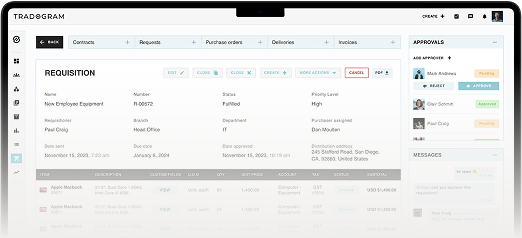
Tradogram requisition dashboard showing an approval workflow Book A Demo