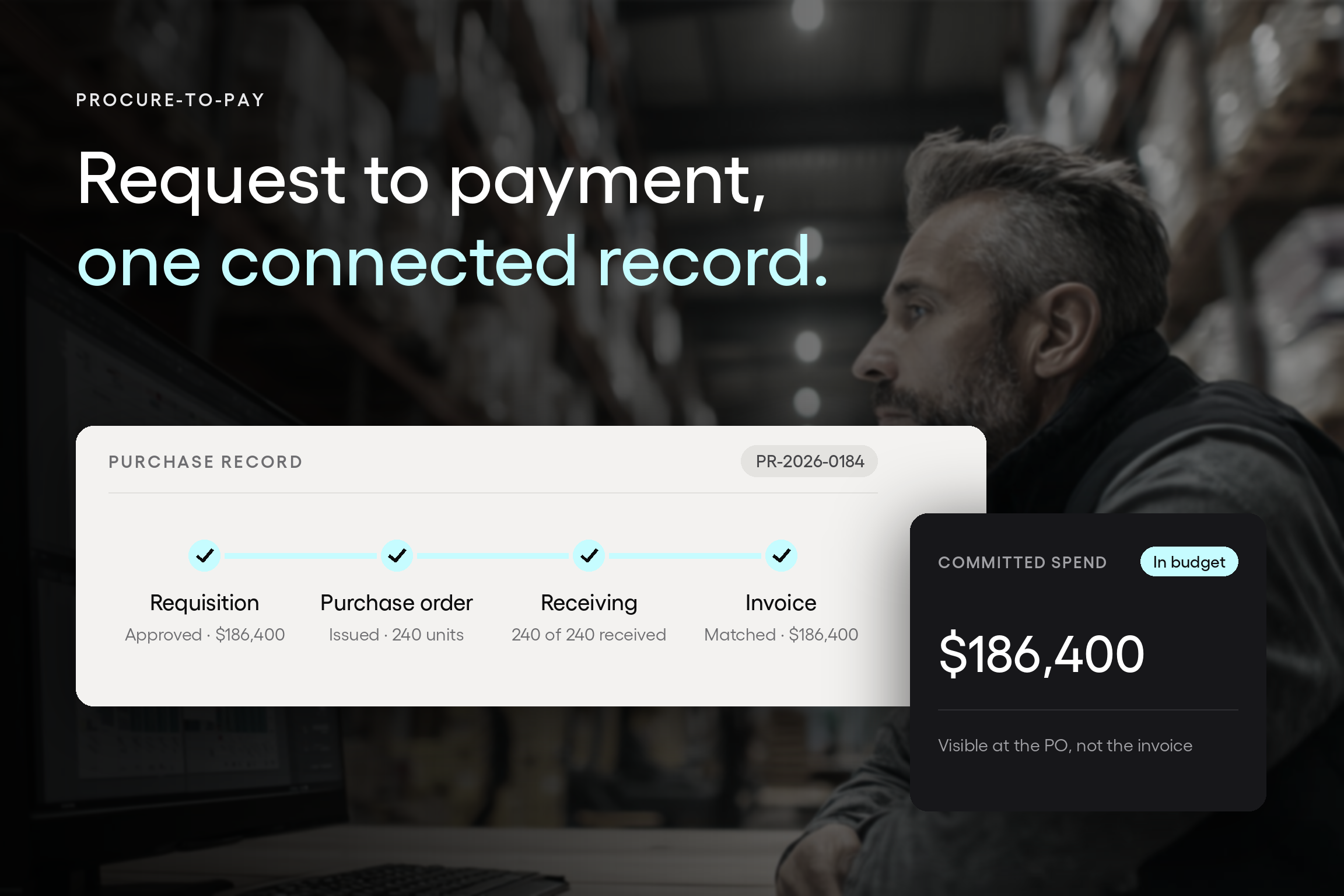


A department shows $40,000 left in its quarterly budget, so Finance signs off on a new equipment request. Three weeks later, two invoices arrive for orders placed a month ago that nobody recorded, and the department is $12,000 over budget.
No one broke a rule here. Someone approved the purchases, someone received the goods, and the invoices were legitimate. The request, approval, order, delivery, and invoice each lived in a different place, so procurement and finance teams had no single view of what had already been committed.
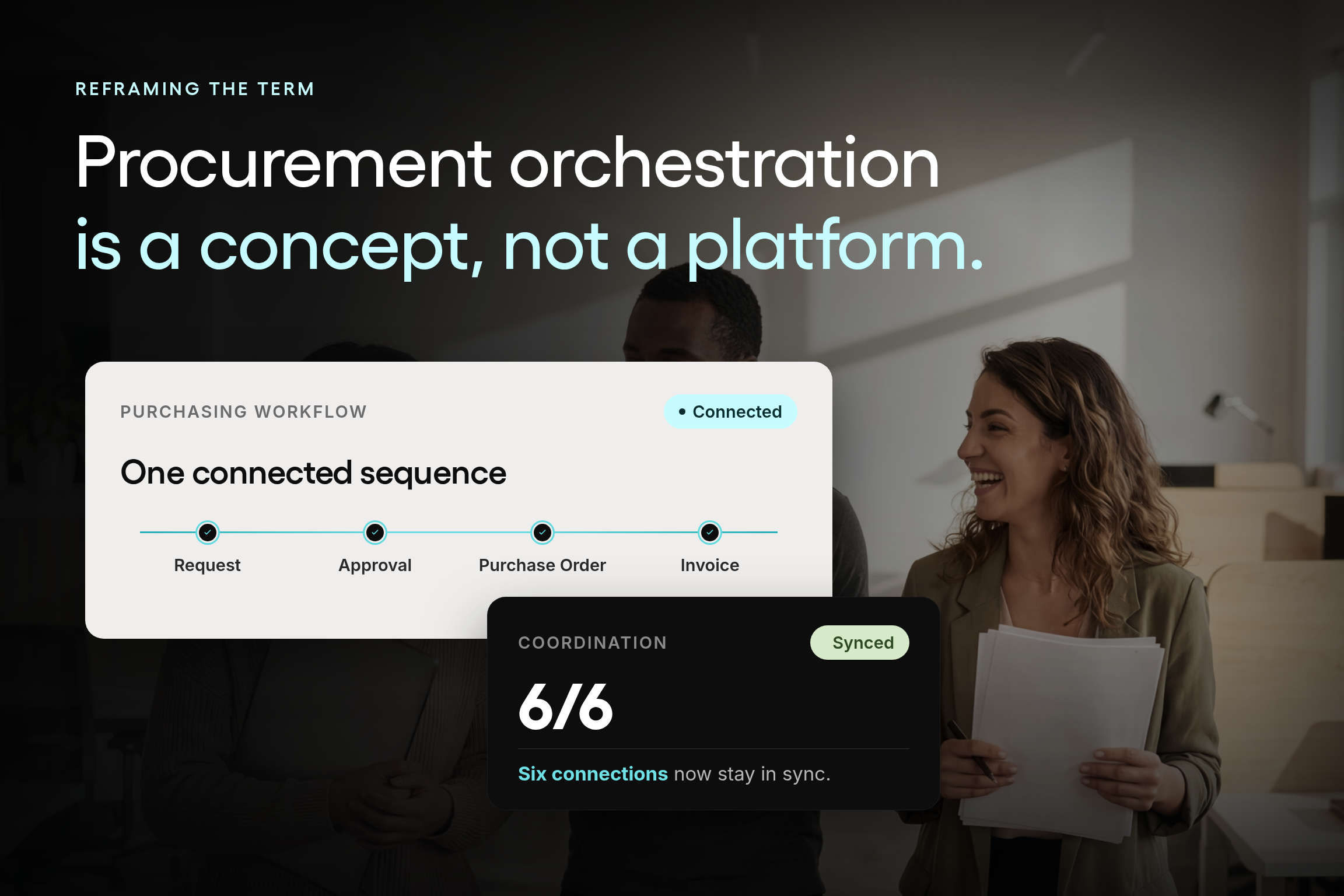
That gap is what the procure-to-pay process is designed to close. Done well, it gives you one connected record from request to payment and keeps procurement and financial operations working from the same information. Done badly, it becomes six separate processes that happen to share a purchase order number.
At Tradogram, we have helped hundreds of organizations digitize their procurement processes, and the same few breakpoints show up again and again. Here is what the cycle includes, where each stage fails, the best practices that hold up outside a textbook, and how to measure whether any of it is working.
What is the procure-to-pay process?
The procure-to-pay (P2P) process is the end-to-end workflow an organization uses to request, approve, order, receive, verify, and pay for goods and services.
It begins with a formal purchase requisition and ends with payment to the supplier, linking procurement and finance teams around a shared record for each purchase. Covering the entire purchase lifecycle in one workflow separates it from a set of loosely related purchasing tasks.
“Purchase to pay” describes the same workflow. The two phrases are used interchangeably, with purchase-to-pay process more common among procurement teams in the UK and Europe and procure-to-pay process more common in North America. If you see a purchase-to-pay system, a purchase-to-pay cycle, or a P2P process referenced in a vendor’s documentation, assume it means the same set of stages described below.
What separates procure-to-pay from general purchasing is the connection between the stages in the procurement process, and the spend visibility that connection produces across the entire procurement cycle.
A purchasing process can consist of buying things. A procure-to-pay process requires each stage to produce evidence the next stage checks against. The requisition justifies the order, the order defines what the delivery should contain, the receiving record confirms what arrived, and the invoice gets compared against both before accounts payable moves any money.
That chain of evidence is what makes the entire process auditable rather than merely recorded.
The procure-to-pay cycle: six stages from request to payment
The procure-to-pay cycle has six stages. Organizations name them differently, and larger procurement teams often split sourcing into its own set of activities, but the sequence and the dependencies stay the same.
1. Purchase requisition
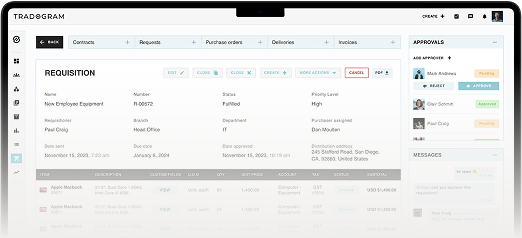
An employee identifies a need and submits a formal purchase requisition describing what they need, why, how much it will cost, when it is required, and which budget it should draw from.
This stage sets the ceiling on how well the rest of the cycle runs. A requisition with a rough description and no cost estimate forces every downstream approver to guess or ask. Purchase requisition software with required fields is the cheapest improvement available in most procurement processes.
2. Approval
The request is routed to the people whose authority covers it, based on rules such as amount, department, project, GL code, location, or supplier. Consistent routing applies procurement policies in practice, not in a document nobody opens.
Approval is where most cycle time disappears, and the delay is rarely the review itself. It is the interval between the request landing in someone’s inbox and that person noticing it. Purchase approval software that routes by rule and sends reminders removes the follow-up work without removing the review.
3. Sourcing and supplier selection
For purchases above a threshold, or in categories without a preferred supplier, the procurement team collects quotes, compares responses, negotiates terms, and selects a supplier. This is where sourcing hands off to supplier management, because the supplier chosen here becomes a record the rest of the organization depends on.
Not every requisition needs this stage. Repeat purchases from contracted suppliers should skip it, and forcing a competitive process on a $200 reorder wastes more than it saves. What matters is that the threshold is defined, applied consistently, and that responses are compared on the same criteria. Sourcing management software keeps requests for quotation and supplier responses side by side rather than scattered across email.
4. Purchase order
An approved requisition becomes a purchase order and goes to the supplier. The purchase order records what is being bought, at what price, in what quantity, on what terms, and when it should arrive.
This document makes the rest of the cycle verifiable. Without it, receiving has nothing to check a delivery against and accounts payable has nothing to check an invoice against. Organizations that create purchase orders after the invoice arrives have a records process, not a control process.
Moving from spreadsheet templates to purchase order management software is usually where committed spend becomes visible.
5. Receiving
Whoever takes delivery records what actually arrived, in what quantity, and in what condition, and links that record to the purchase order.
Receiving is the stage most often skipped, and skipping it turns invoice verification into guesswork. If nobody recorded that 8 of 10 units arrived, accounts payable has no basis for questioning an invoice for 10.
Receiving management software that supports partial deliveries and flags shortages gives the invoice stage something concrete to check.
6. Invoice processing and payment
The supplier invoice is captured, compared against the purchase order and the receiving record, routed for invoice approval, and paid according to the agreed terms.
Invoice management and payment processing are usually handled in accounts payable systems, so the quality of the data arriving from earlier stages determines how much manual work lands there.
The comparison step is three-way matching in accounts payable, which catches price differences, quantity differences, and duplicate invoices before payment, not after.
When the three records agree, the invoice moves through with minimal review, and the vendor payment can be released on time. When they disagree, the difference is visible and specific, which beats discovering a variance during month-end close.

Where the procure-to-pay workflow usually breaks down
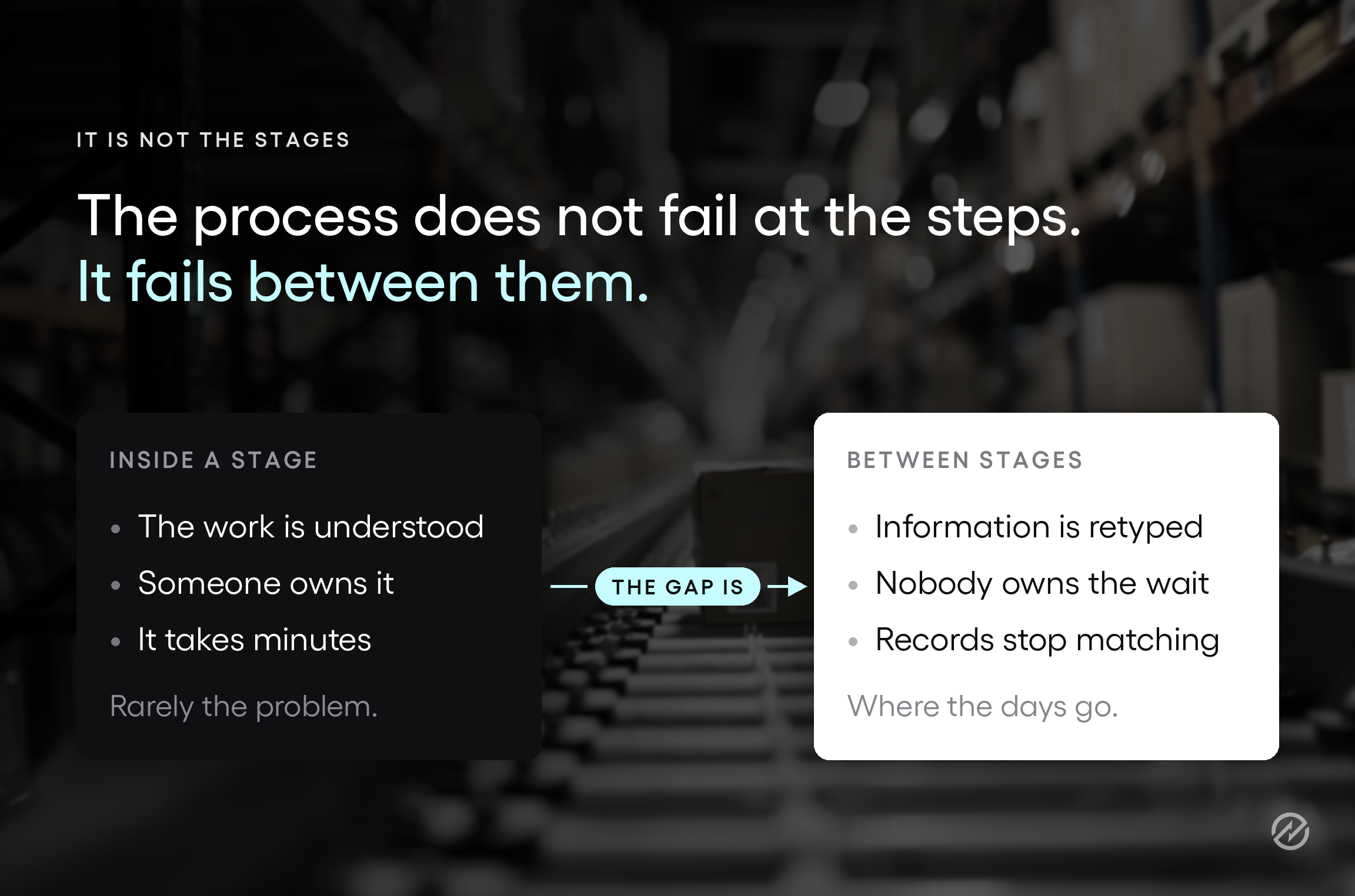
The procure-to-pay workflow rarely fails at a single stage. It fails at the handoffs between stages, where information has to move from one person, form, or system to another.
These are the patterns we see most often when procurement professionals describe their current process to us. Two show up in almost every conversation: requests that arrive too incomplete to approve, and approval authority that three managers in the same company would describe three different ways.
Purchase orders created after the fact. Someone calls a supplier, the goods arrive, the invoice follows, and a purchase order is generated afterward to close the loop for the accounting system. Every control in the cycle depends on the purchase order existing first.
Receiving that happens without a record. The delivery is accepted at a loading dock or a front desk, the packing slip goes in a drawer, and the only evidence of what arrived is someone’s memory three weeks later.
Committed spend that is invisible until invoiced. This is the scenario at the top of this article, and the single most common complaint we hear from finance teams. Budget reports show actual spend, but approved purchase orders that have not been invoiced are a real commitment against the same budget. If the system does not track them, the budget number is wrong. Procurement spend management software that shows committed spend alongside actual spend closes this gap.
Supplier information is spread across systems. Contract terms in a shared drive, tax documents in email, pricing in a spreadsheet, and performance notes in someone’s head. Each renewal decision then starts with a search, not a review. Centralizing records in supplier management software makes the review possible.
None of these are the result of careless work. They are what happens when procurement operations grow past the point where informal coordination can hold them together, which goes hand-in-hand with more departments, more approvers, and more volume rather than with any single decision.

8 procure-to-pay best practices that hold up in practice
Most published procure-to-pay best practices are accurate but too general to act on. These are narrower, and each one changes something specific about how the workflow runs.
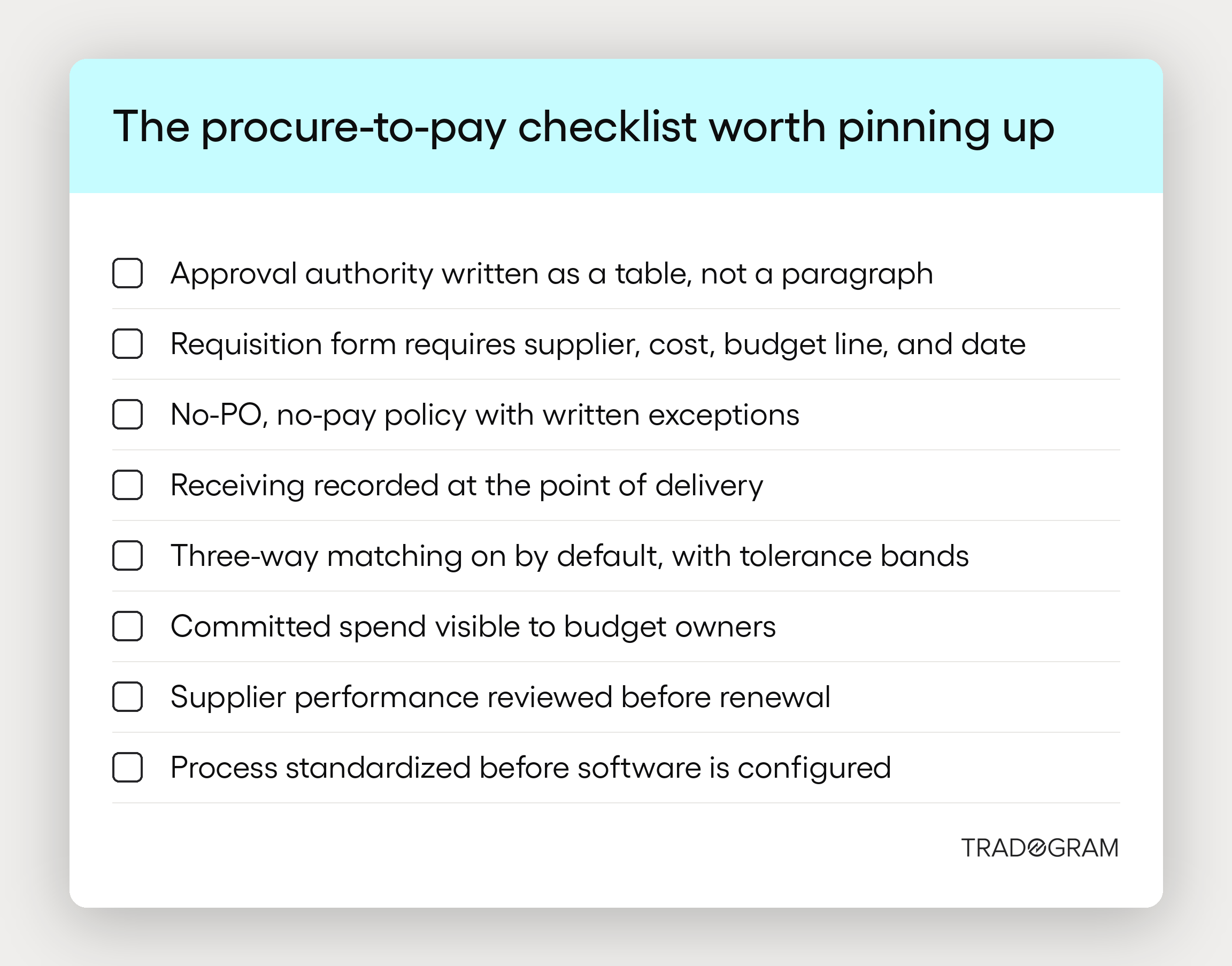
Define approval authority as a table, not a policy paragraph. Write out the thresholds: who approves up to $5,000, who approves up to $25,000, what requires two approvers, and what always routes to finance regardless of amount. Municipal buyers often work this way already, because purchasing authority is capped before a purchase needs council approval. Private organizations benefit from the same clarity.
Make the requisition form do the work. Every required field is a question an approver doesn't have to ask. Supplier, cost estimate, budget line, delivery date, and justification cover most of it. Add a field for anything your approvers ask for twice.
Adopt a no-PO, no-pay rule, with defined exceptions. A no-PO, no-pay policy means you don't process invoices without a matching purchase order. It works only if you also document the exceptions, since utilities, rent, and some professional services legitimately arrive without one. Written exceptions also help you ensure compliance without creating a rule your team has to break weekly.
Record receiving at the point of delivery. Not at the end of the week, and not by the person who placed the order once they get around to it. Partial deliveries especially need to be captured as partial, because a shortage recorded three weeks late looks identical to a billing error.
Use three-way matching as the default, with tolerance bands. Set an acceptable variance, in percent or dollars, below which a small price difference passes without review. Matching every invoice to the cent creates exception queues people learn to clear rather than investigate.
Track committed spend, not just actual spend. Budget owners need to see approved purchase orders that have not been invoiced yet. That is the difference between a budget report that reflects reality and one that reflects last month, and it is where most practical cost control in procurement actually happens.
Treat supplier relationship management as a data problem, not a relationship problem. On-time delivery, quality issues, and purchase price variance against agreed pricing make a renewal conversation different from a rubber stamp, and collecting them requires receiving and invoice data to sit on the supplier record. Timely payments build stronger supplier relationships more than any negotiation tactic, and a maintained list of preferred suppliers with agreed pricing saves time on routine purchases.
Standardize before you automate. Automating a process nobody agrees on encodes the disagreement into the software. Decide the thresholds, the required fields, and the sourcing rules first, then configure the system to enforce them.
Automating the procure-to-pay process
Procure-to-pay automation means using software to connect the stages of the cycle so the output of one becomes the input of the next without anyone retyping it, emailing it, or waiting for it.
The value is in removing handoffs, where the delay and the errors live, rather than removing the judgment at each stage. It is the most reliable way to streamline procurement without asking anyone to work faster.
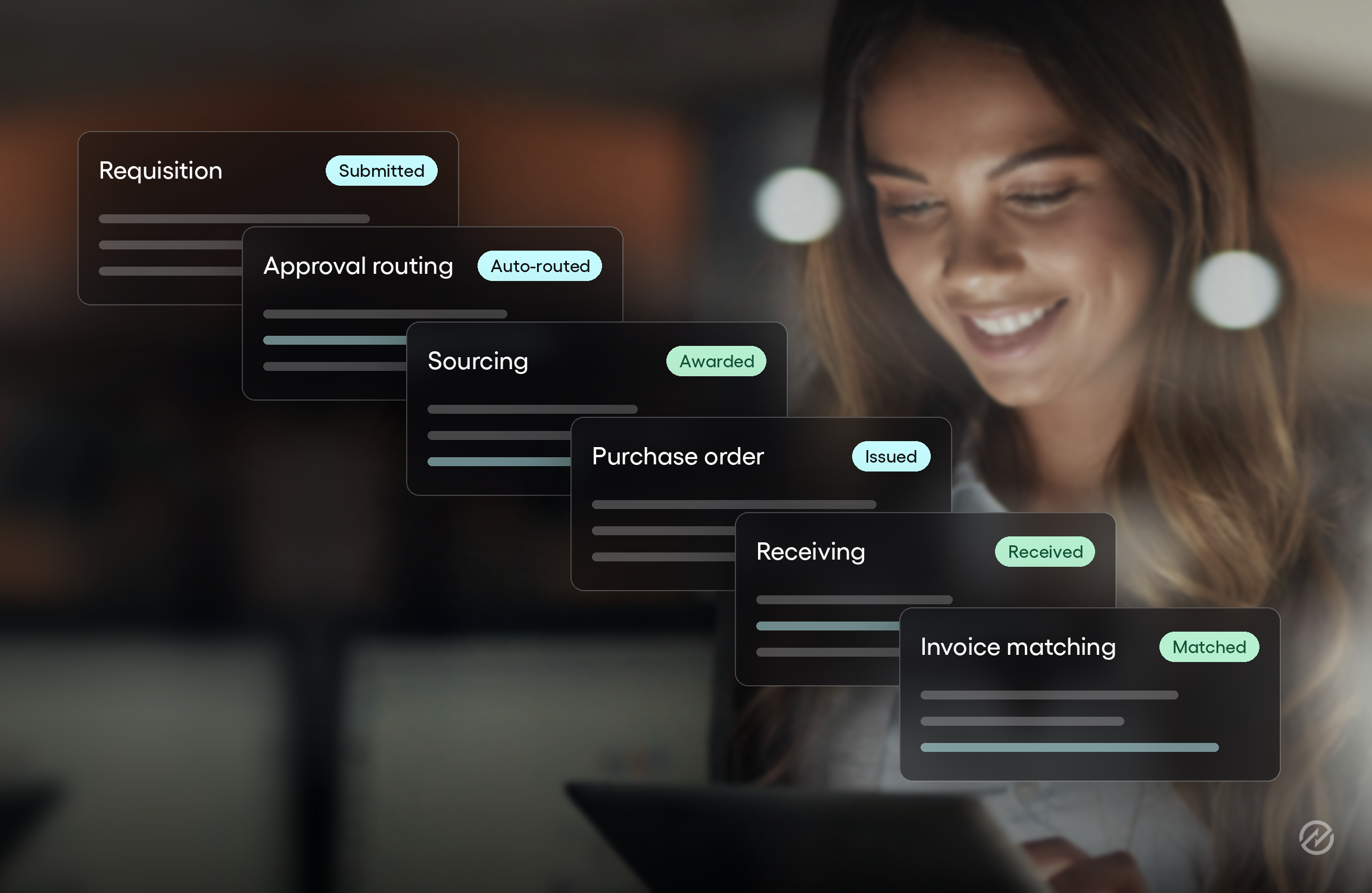
Here is how procure-to-pay process automation changes at each point.
Requests become structured and routed by rule. A configurable form with required fields replaces free-text email, and the workflow routes each request by amount, department, project, location, or GL code, sending reminders when it sits. The system automatically records a formal request with approval history, which is what auditors most often ask for.
The system generates purchase orders from approved requisitions. The approved request becomes a purchase order with the same line items, prices, and terms. That removes transcription errors and ensures the purchase order exists before the goods do.
Budget checks happen before commitment, not after invoicing. The system compares the request against the relevant budget and shows the remaining balance, including approved but uninvoiced orders, so the budget owner sees potential overspending at the approval screen.
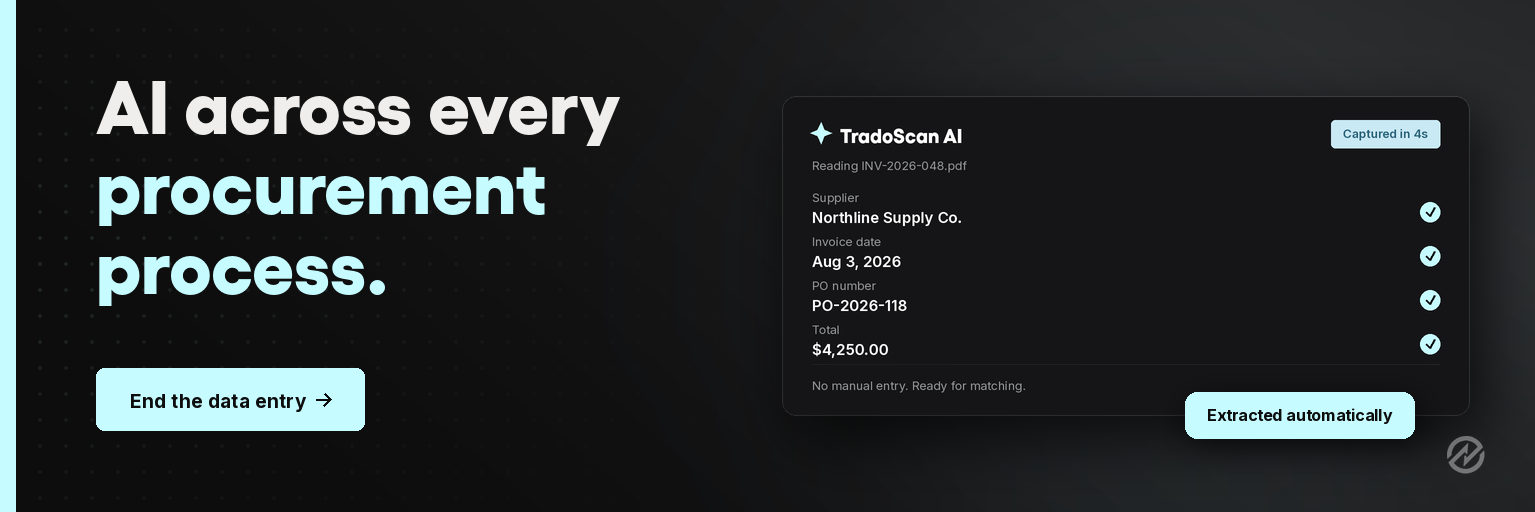
Invoices are captured and matched automatically. Automated invoice processing reads invoice data rather than requiring manual entry, and invoice matching software compares each invoice against the purchase order and receiving record. Matched invoices move through. Mismatches are flagged with the specific difference identified, reducing errors without adding a second reviewer.
Spend data becomes queryable. Because the entire lifecycle writes to the same data set, procurement reporting can answer which suppliers account for the most spend in a category, which departments are trending over budget, and which orders are approved but not yet received. That is the difference between a procurement function that reacts and one that supports strategic decision-making.
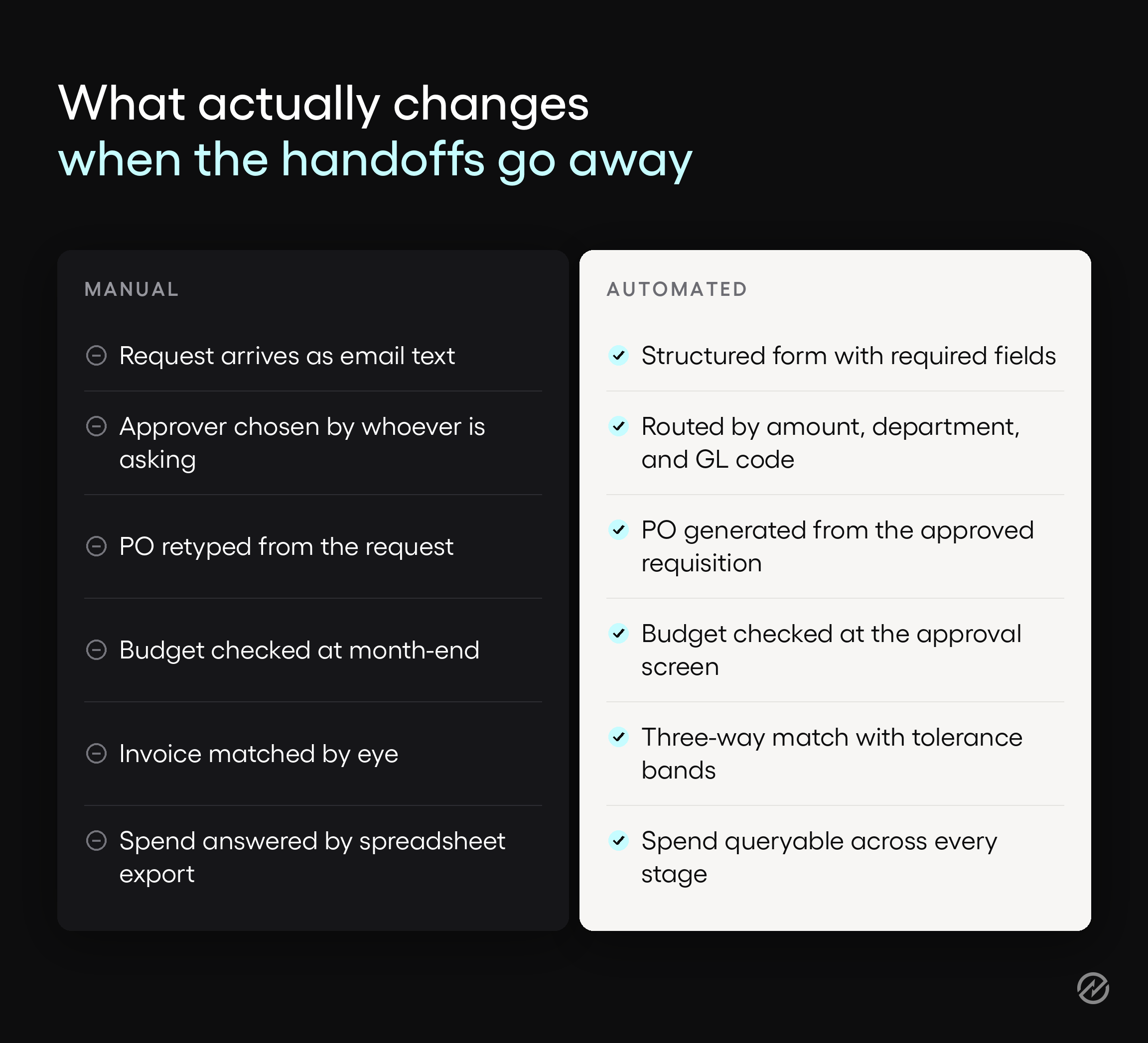
Taken together, these changes streamline operations in a specific way: the same purchasing volume moves through with fewer people touching each transaction.
Eliminating manual tasks drives operational efficiency and helps reduce labor costs, and it is a more honest claim than a blanket promise to improve efficiency.
The teams that cut the most labor cost were usually the ones spending the most time on invoice exceptions and approval follow-up. Automating that work freed capacity to identify cost-saving opportunities that were previously invisible: duplicate suppliers in one category, contract pricing that was never applied, and savings buried in tail spend nobody had time to analyze.
Three honest caveats.
- Automation doesn't fix an undefined process, so standardization must come first.
- Adoption, not capability, is the real constraint: employees will work around a system they find harder than emailing their manager.
- Implementing one department or one purchase category first consistently outperforms an organization-wide launch.
What a procure-to-pay system should connect
A procure-to-pay system is software that manages the full cycle from requisition to payment in one connected data set. That last part matters, and it is where many decisions about procurement systems go wrong.
Buying a requisition tool, a purchase order tool, and an AP tool separately reproduces the original problem in software form.
Each is accurate about its own stage and blind to the others, so the budget owner still cannot see committed spend. Procure-to-pay software is only worth the change management if the stages share data.
Use these as evaluation criteria rather than a feature checklist.
- Can a budget owner see committed spend before the invoice arrives? If not, the system is recording purchases rather than controlling them.
- Can approval rules be configured to match your actual authority table, including multi-step routing and rules by department, project, and GL code?
- Does it write to your accounting system? Procurement integrations with QuickBooks, Xero, NetSuite, Sage, and Dynamics 365 Business Central determine whether procurement data reaches finance without export files.
- Does it connect to your ERP? Integrations with JD Edwards, Oracle, Microsoft Dynamics, and other enterprise resource planning (ERP) systems determine whether procurement data reaches financial reporting without a monthly export.
- Does it fit alongside the systems you already run? Most organizations are not replacing their financial systems, so the question is how cleanly procurement data lands in them.
- Does three-way matching run automatically, with configurable tolerances?
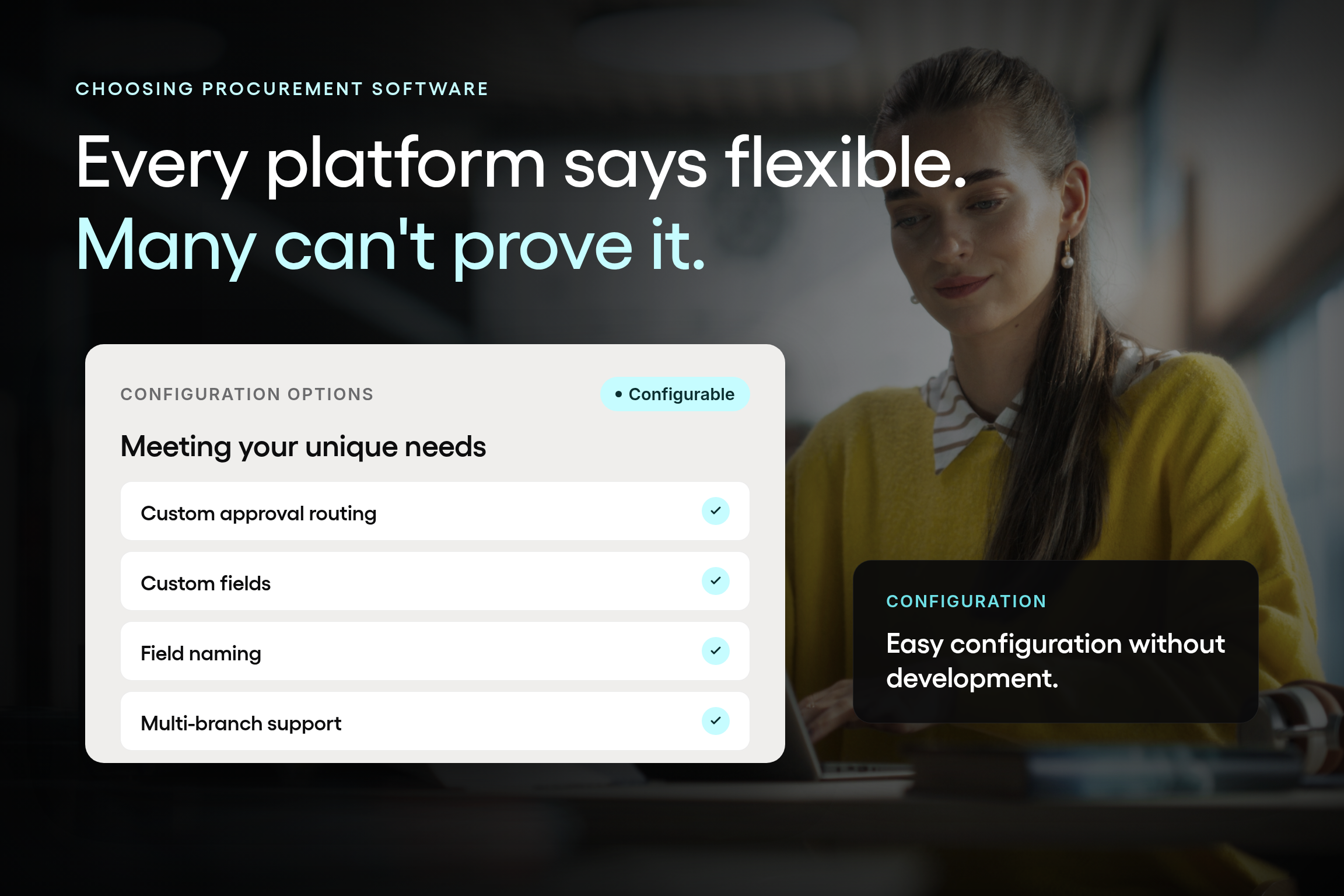
- Can it be configured to your process rather than the other way around? Purchasing practices vary widely between organizations, even within the same industry, and a system that assumes one workflow will fight you at every threshold that does not match. Submitters are the largest user group and the least invested in procurement controls, so their experience decides adoption.
The organizations that get the most out of a procure-to-pay system are past the point where spreadsheets and email work, but not large enough to want an enterprise implementation.
Integrating procurement with the financial systems you already run usually matters more than replacing them, since the goal is to get purchasing data to financial management cleanly and to run a workflow alongside your other business processes rather than apart from them.
Getting it right is as much about procurement management and process design as it is about software, because a connected system built on undefined business processes just moves the confusion somewhere new.
Procure-to-pay KPIs: how to measure the P2P process
Four key performance indicators tell you whether the process is working, and together they give you the relevant management reporting a finance lead will actually ask for. Track them for a quarter before making changes so you have a baseline to compare against.
Procure-to-pay cycle time. Days from requisition submission to supplier payment. Break it into stage-level intervals, because the total tells you there is a delay and the stage-level numbers tell you where. Approval to purchase order is usually the largest and most fixable segment, and it is the clearest single measure of process efficiency in the cycle.
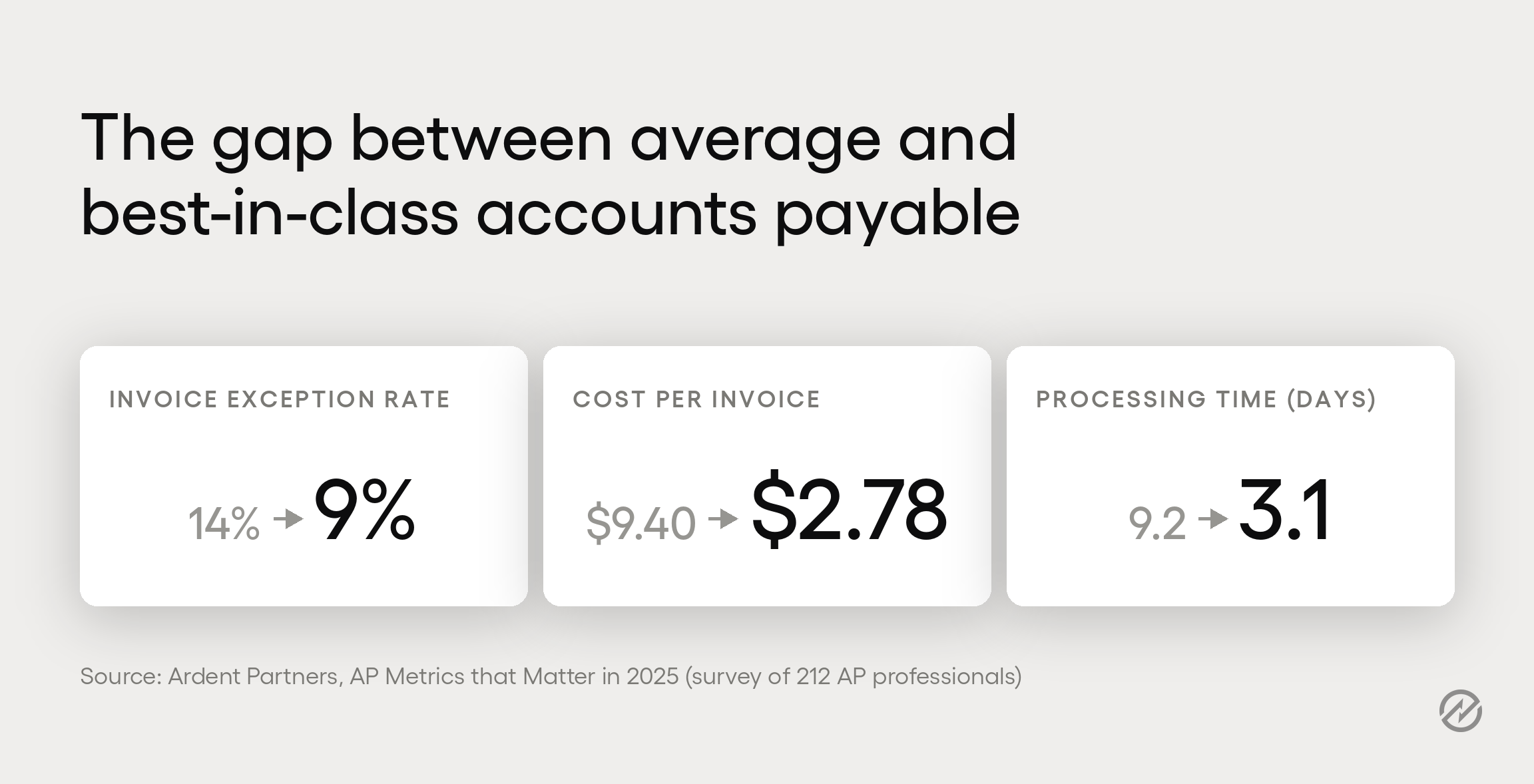
Invoice exception rate. The share of invoices that need manual intervention before payment. This is the most diagnostic number in the cycle, because exceptions are almost always caused by something missing upstream: no purchase order, no receiving record, or a price that was never confirmed. Ardent Partners’ AP Metrics that Matter in 2025, based on a survey of 212 accounts payable professionals, reported an average exception rate of 14% against 9% for best-in-class performers, and an average cost per invoice of $9.40 against $2.78.
Percentage of spend under purchase order. What share of purchasing volume ran through an approved purchase order before the money was committed. This measures how much of your spend the process actually governs, and it improves most visibly when you enforce no-PO, no-pay.
Budget variance at close, and how much of it was known in advance. The second half is the point. Variance is not automatically a problem. Variance that surprises the budget owner is, and unplanned commitments are where most avoidable financial risks in purchasing actually originate. Reported cost savings are worth tracking alongside it, but only against a documented baseline, since savings claimed without one rarely survive contact with financial reporting.
Our guide to procurement KPIs covers supplier performance, savings, and compliance measures alongside these, and invoice cycle time is worth isolating if payment speed is the immediate concern.
Procure-to-pay, purchase-to-pay, and source-to-pay: how do they differ?
These three terms describe overlapping scopes, and the distinction matters mainly when you are comparing software.
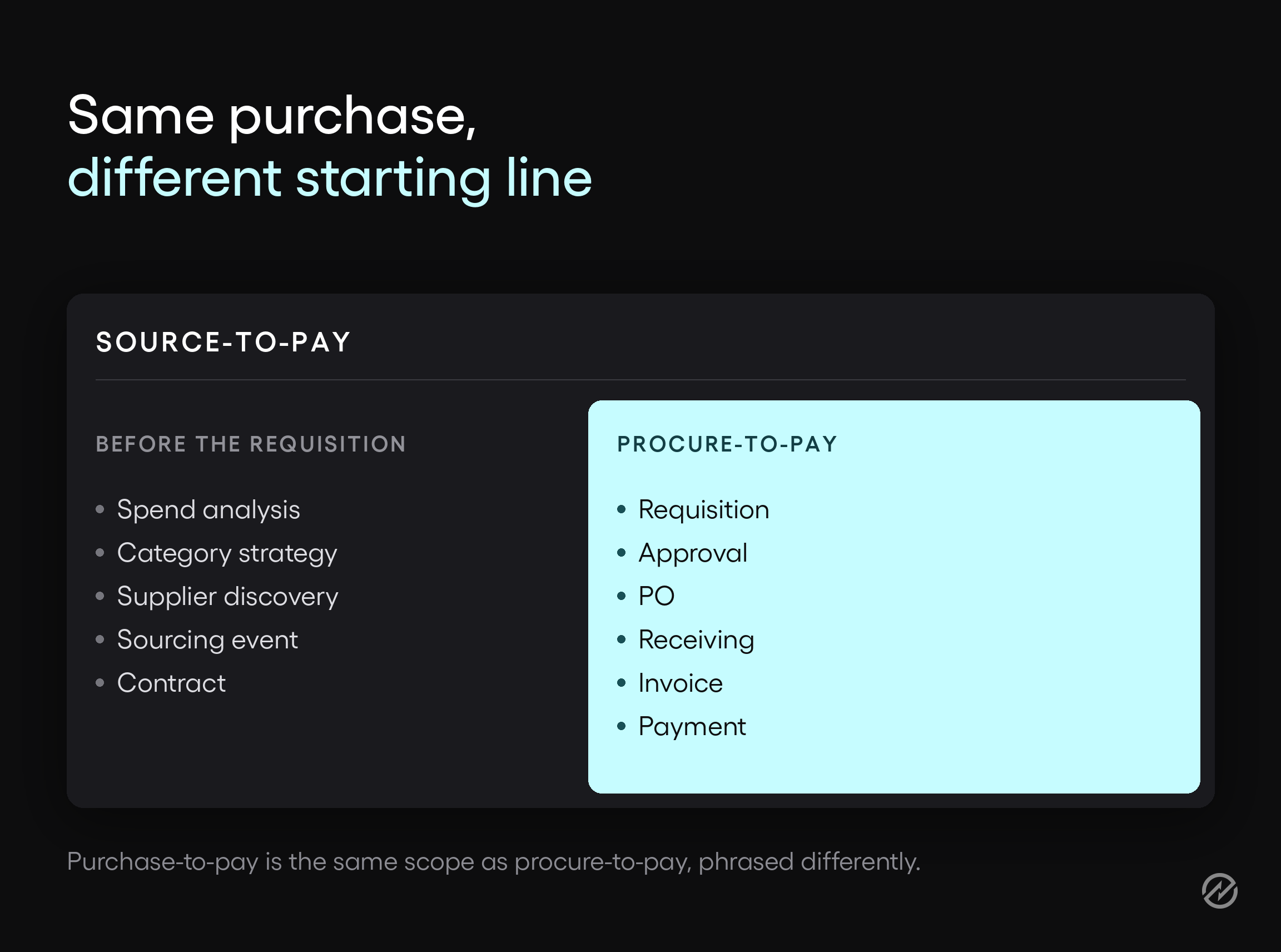
Procure-to-pay and purchase-to-pay are the same process. Both cover requisition through payment. The difference is regional phrasing, not scope.
Source-to-pay is broader. It includes everything in procure-to-pay plus the upstream work: spend analysis, category strategy, supplier discovery, strategic sourcing events, and contract management. Procure-to-pay begins when someone requests something; source-to-pay begins with the decision about what to buy, from which market, and under what agreement.
Requisition-to-pay is narrower, and it is the term used most loosely. Many vendors treat requisition-to-pay (R2P) as a straight synonym for procure-to-pay, so it is worth checking what a specific product means by it. When a genuine distinction is drawn, requisition-to-pay covers only the transactional cycle: request, approval, purchase order, receipt, invoice, and payment, with the supplier already selected. It leaves out sourcing and supplier selection, which is why teams buying mostly from contracted suppliers often describe their process this way.
Most organizations improving purchasing control should get procure-to-pay working first. Layering a sourcing strategy on a process that cannot confirm what was received produces savings on paper that never reach the accounts.
Where to start with procurement process automation
The sequence that tends to succeed is narrower than a full redesign. First, write down your approval authority table, including amounts, roles, and exceptions. Measure your invoice exception rate for one month, because it will tell you more reliably than any assessment where the upstream gaps are. Then fix your worst handoff, which for most organizations is either requisition completeness or receiving records. Standardize on paper before configuring software, and roll out to one department so you can learn what confuses people while the group is small enough to talk to individually.
The organizations that improve fastest do not redesign everything at once. They make committed spend visible, get purchase orders created before goods arrive, and let the rest follow from those two changes.
Tradogram connects purchase requests, approvals, purchase orders, receiving, invoice matching, budgets, and supplier records in one workflow, configured around how your organization already buys rather than a fixed process. If you want to see how that maps to your current approval structure, book a demo and we will walk through it with your own thresholds and departments.