

A purchase request gets approved over email. Someone builds the purchase order from scratch in a template, because that's faster than tracking down the last one. Three weeks later, an invoice shows up, and someone in finance has to work out whether the price is right, whether anyone actually approved it, and whether the order was ever delivered. Every one of those steps lives in its own inbox, template, or spreadsheet, and someone has to stitch them back together by hand, every time.
That stitching, more than any feature, is the gap "procurement orchestration" is trying to solve.
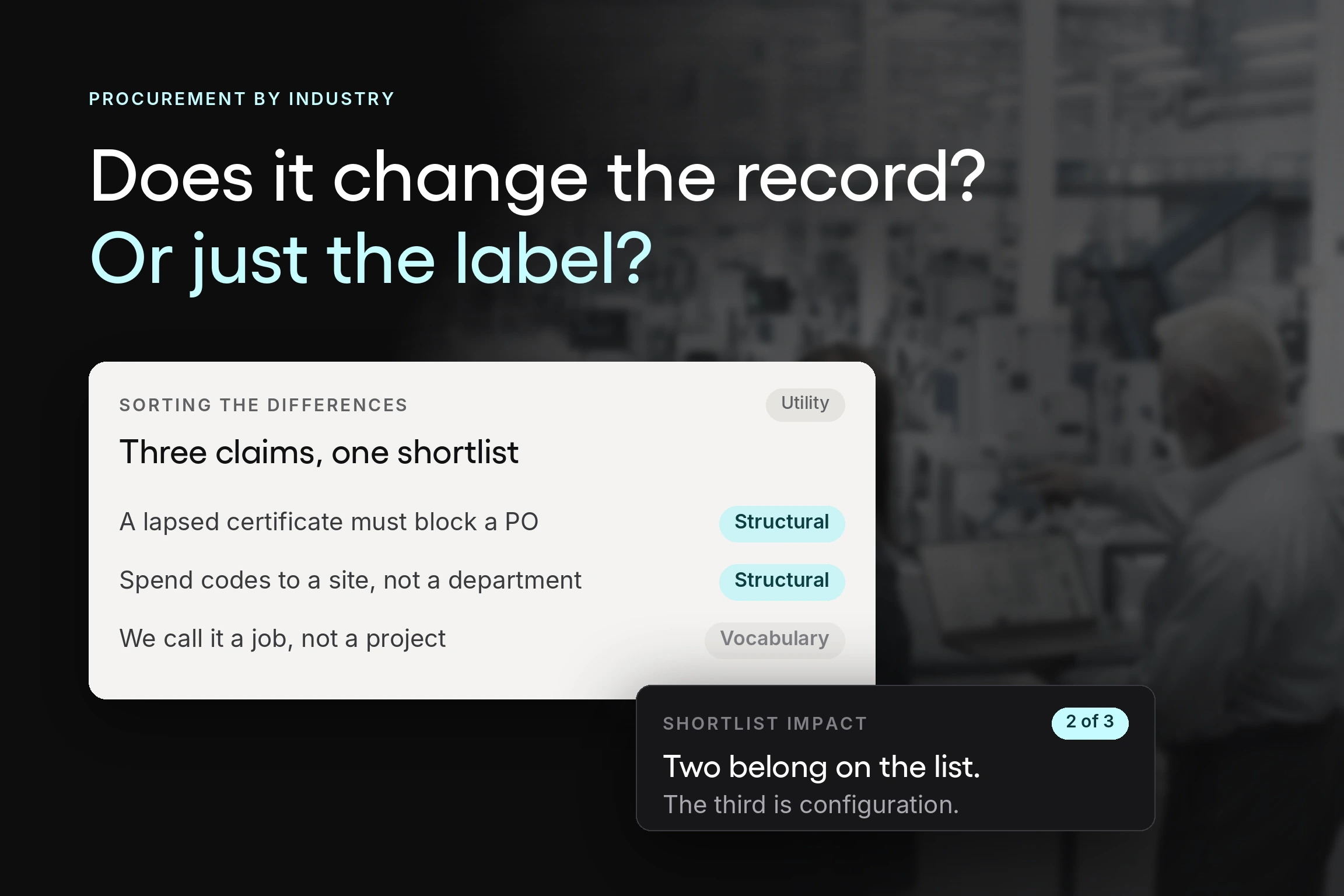
The term appears mostly in comparisons between enterprise platforms built for organizations that run a dozen ERP systems across multiple countries. If your procurement team is a handful of people keeping purchasing under control across a few departments or sites, it's fair to wonder whether this is a real operational fix or a more expensive way of describing automation you already have.
It's a real fix, and it doesn't require that scope. Procurement orchestration is a coordination principle: it describes whether your requests, approvals, purchase orders, receiving records, and invoices are actually connected, not which pricing tier or AI feature you've bought. This article breaks down what orchestration actually requires, the signs that your organization needs it, and how a mid-market team builds toward it without adopting the complexity of an enterprise suite.
Key Takeaways
- Procurement orchestration represents the coordination of people, processes, systems, and data across the purchasing lifecycle, not a specific product category or pricing tier. A team either has that coordination, or it doesn't, regardless of company size, which means the outcome is achievable well below enterprise scale.
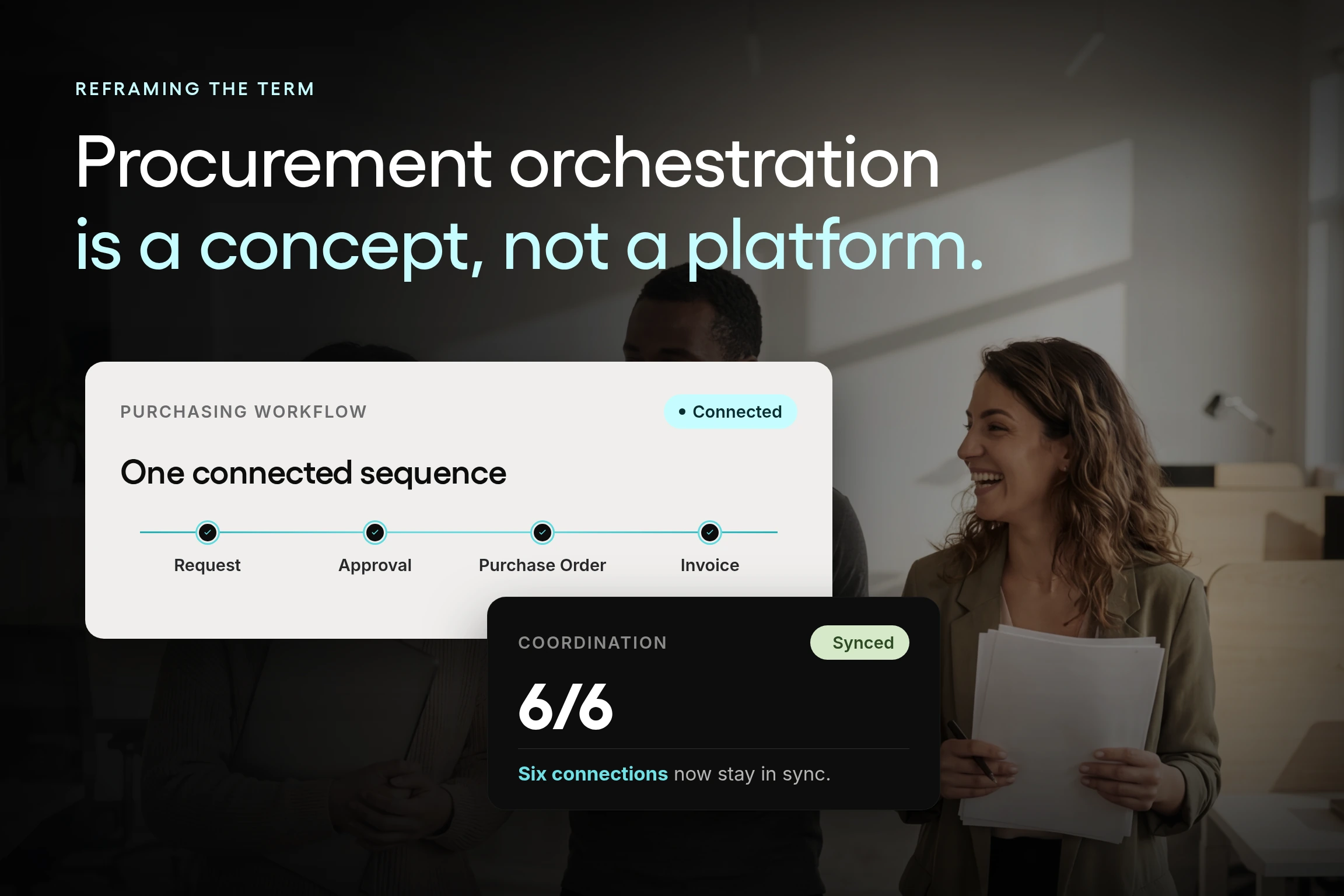
- A working orchestration layer depends on six specific connections, including centralized supplier information such as performance history and pricing. Intake, approval routing, linked purchase orders and invoices, synced accounting systems, and visibility into committed spend complete the list; missing any one of them breaks the coordination at that exact point.
- Automation, AI, and orchestration solve different problems, and procurement orchestration acts as the connective layer between the other two rather than replacing them. Automation removes manual work from a single step, AI reduces manual effort on specific tasks such as invoice matching, and orchestration connects both across the full purchase lifecycle.
- Achieving procurement orchestration doesn't require an enterprise platform built for global operations or large enterprise organizations. A configurable mid-market platform, integrated with existing ERP and accounting systems, delivers the same coordination outcome without the added scope offered by larger platforms.
- A recent trigger event predicts the need for procurement orchestration more reliably than a generic checklist of fragmented systems and manual processes. A new site, a new procurement or finance hire, an audit finding, or rising purchase order volume each turns a tolerable coordination gap into an urgent one that’s worth solving.
What is procurement orchestration?
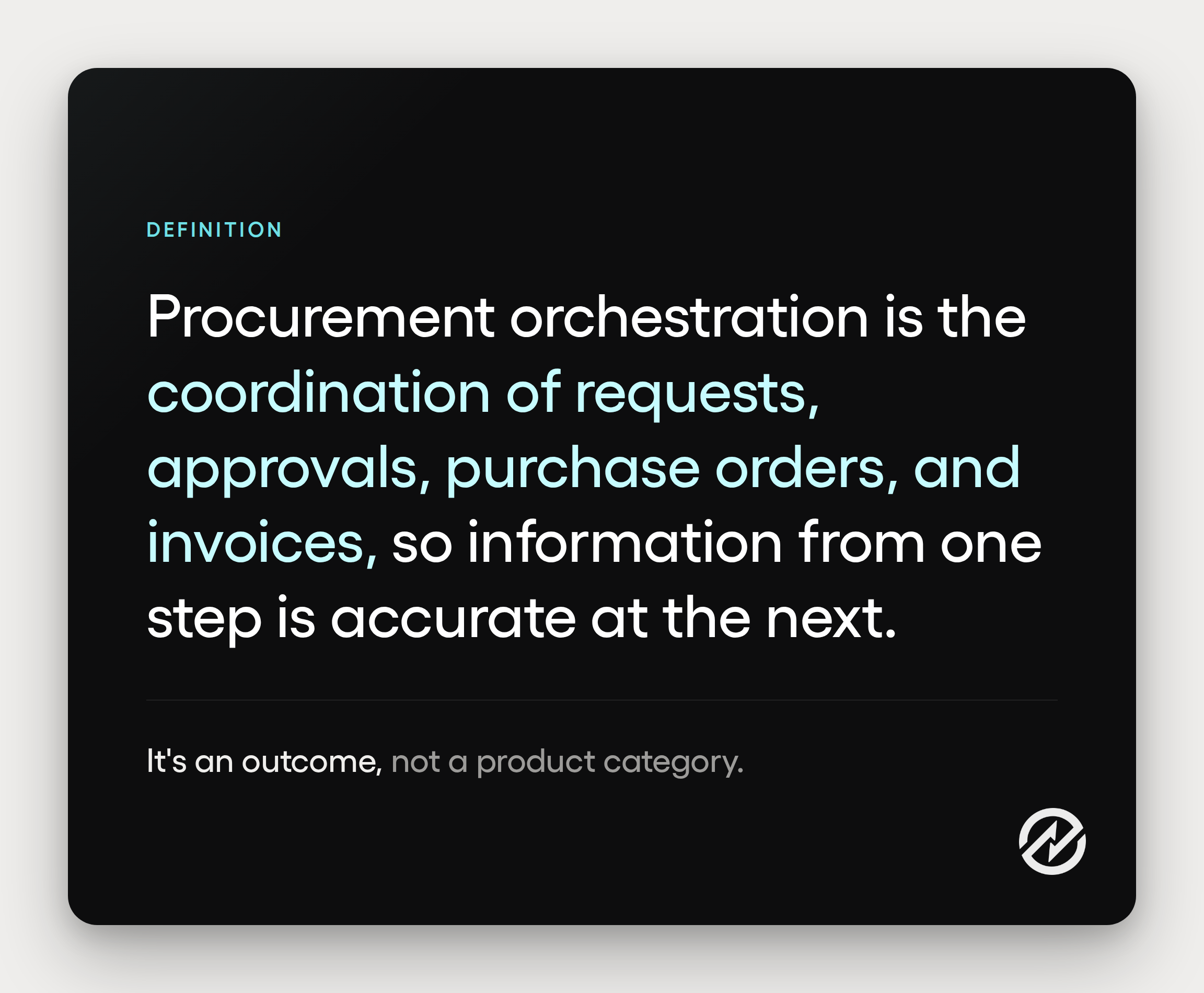
Procurement orchestration is the coordination of people, processes, systems, and data across the full purchasing lifecycle: the request, the approval, the purchase order, receiving, the invoice, and the payment, so the information created at one step is available and accurate at the next. It describes an outcome, not a product category.
That distinction matters because most procurement teams already run something close to a full procurement process. A request gets submitted somewhere. Someone approves it, one way or another. A purchase order eventually exists. Goods or services show up. An invoice arrives and gets paid.
The process is there. What's often missing is the connective tissue between those steps: whether the approval that happened in an email thread ever makes it onto the purchase order, whether the purchase order gets checked against what was actually received, whether finance sees any of this before the invoice lands.
Some procurement platforms have started calling that connective tissue the procurement orchestration layer, the piece that sits across the systems you already run and keeps the intake-to-pay sequence connected end to end instead of scattered across five places.
It's worth looking at how a few of the platforms that popularized the term define it, because the definitions converge more than you'd expect.
Zip describes orchestration as the coordination of the systems and stakeholders involved in a purchase. Ivalua frames it around connecting procurement to the other systems, like ERP and contract management, that a purchase touches along the way.
Ramp ties it to the coordination between intake, approvals, and the tools that execute a purchase once it's approved. Strip away the vendor-specific language, and each definition describes the same thing: whether the steps in your process, and the systems that run them, are actually talking to each other.
That's a useful reframe. It turns orchestration from a category you shop for into a property your existing process either has or lacks. The next question isn't which orchestration platform to buy. It's what has to be true, structurally, for that coordination to exist at all, and that's worth breaking down before asking whether your organization needs to change anything.
Orchestration vs. procure-to-pay vs. automation
These three terms get used almost interchangeably. They describe different things, and mixing them up can lead to misdiagnosis.
How procurement orchestration differs from procure-to-pay
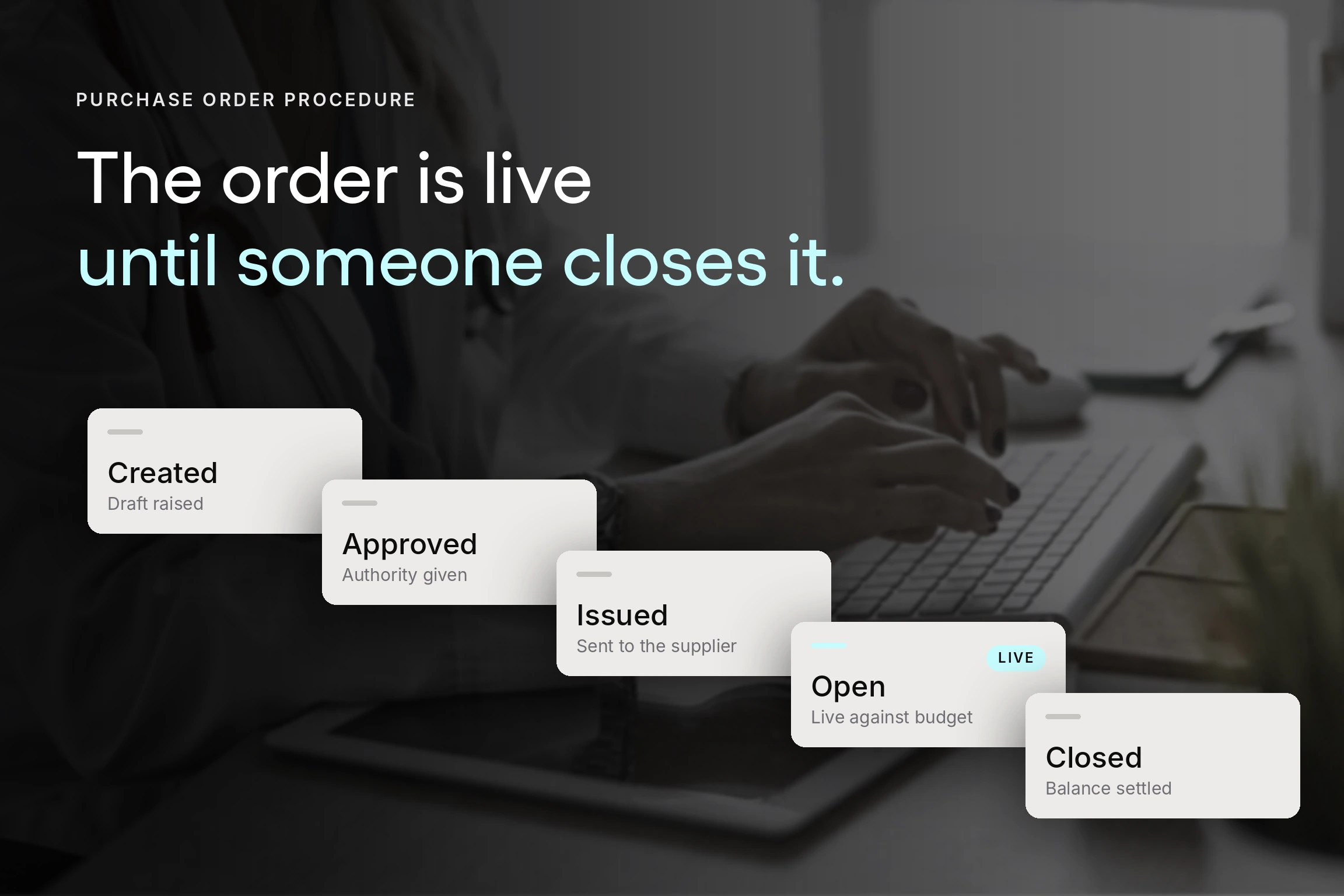
Procure-to-pay is the sequence of steps a purchase moves through: request, approval, purchase order, receiving, invoice, payment. It's a process, not a measure of how connected that process is.
Orchestration asks a different question. It asks whether the steps in that sequence, and the systems that run them, are actually connected to each other.
How procurement orchestration differs from simple automation
Automation removes manual work from one step in that sequence. An approval that routes itself rather than waiting for someone to forward an email is an example of automation. So is a purchase order that's generated from an approved request instead of being typed from scratch.
You can automate several individual steps and still lack orchestration if the systems behind those steps don't share information with each other.
| Term | What it describes |
|---|---|
| Procure-to-pay | The sequence of steps a purchase moves through, from request to payment |
| Automation | Removing manual work from a single step in that sequence |
| Orchestration | Whether the steps, and the systems that run them, are connected to each other |
Here's what that gap looks like in practice. A company can have a well-documented procure-to-pay policy: every request needs a manager's approval, every purchase over a set amount requires a purchase order, and every invoice is checked against that order before payment. On paper, the process is airtight.
But if someone still has to retype the approved purchase order into the accounting system by hand because the purchasing tool and the accounting software were never connected, that company has a procure-to-pay process without orchestration. The steps exist. The policy exists. The connection between the systems that run those steps doesn't.
That gap, between having a process and having a connected process, is what the rest of this article is about. It's also the gap spend visibility alone doesn't close, a distinction worth understanding before looking at what actually closes it.
What procurement orchestration systems actually require
Coordination isn't abstract. It comes down to a specific set of connections, and if any of them are missing, the process breaks down at exactly that point.
Key components of an orchestration layer
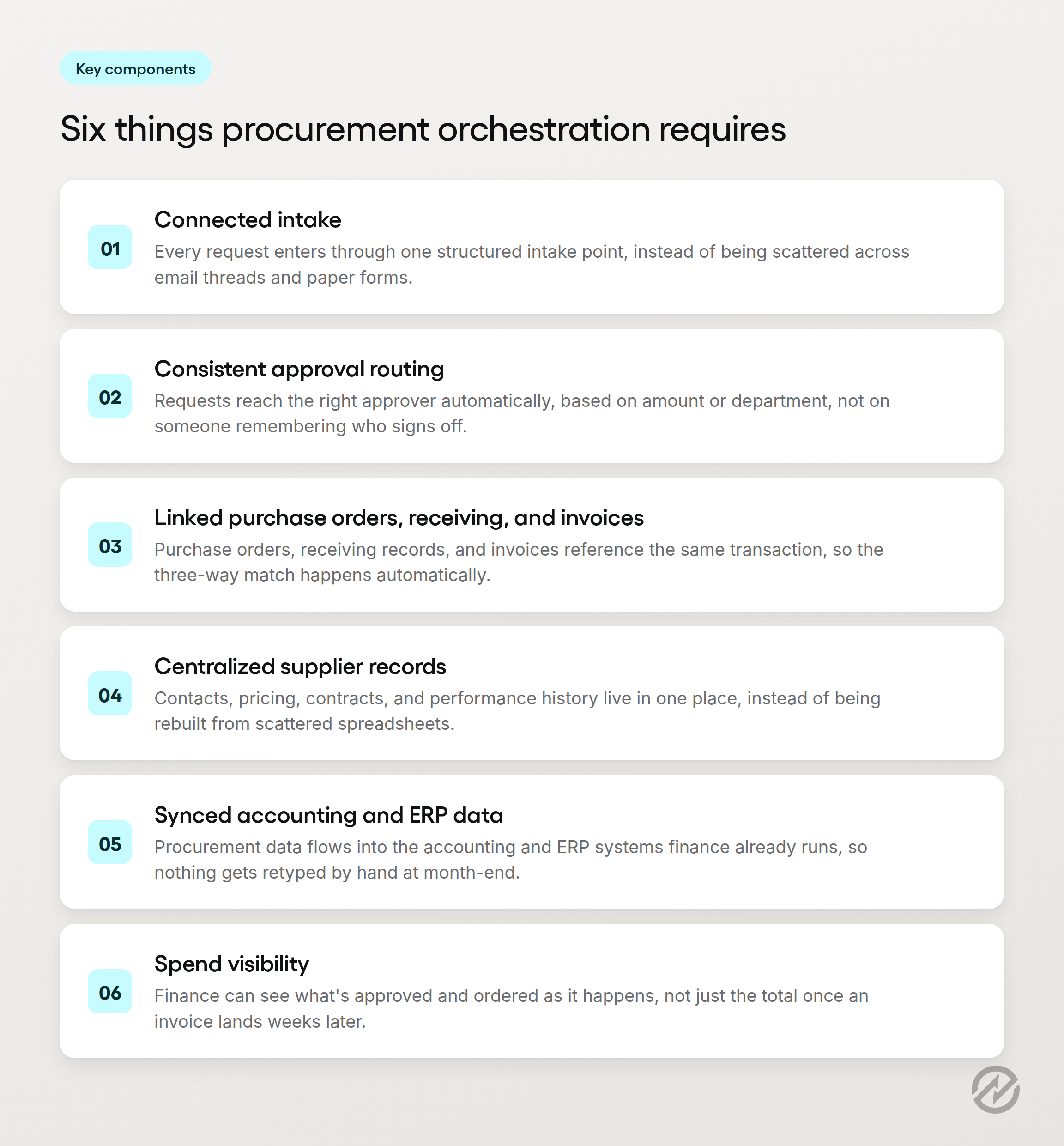
Six things have to be true for orchestration to actually exist:
- Intake is connected, not scattered across email, chat, and paper forms. A request enters the system in a structured, trackable way, no matter who submits it or which department they belong to.
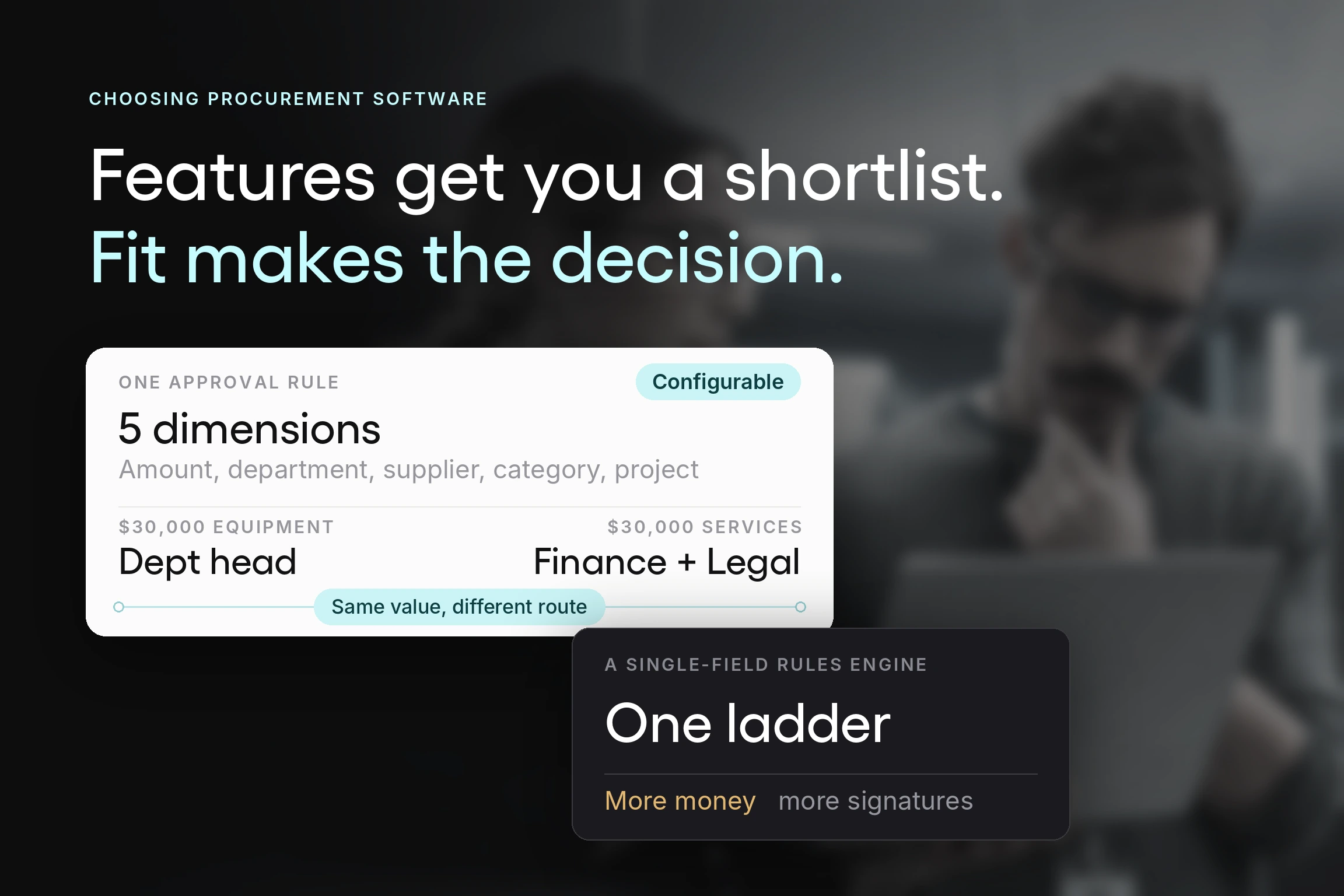
- Approval workflows are consistent. Requests reach the right approver based on rules such as amount, department, or category, rather than relying on someone to remember who signs off on what.
- Purchase orders, receiving, and invoices are linked, so a three-way match between what was ordered, what arrived, and what was billed occurs automatically rather than being pieced together by hand.
- Supplier data lives in one place, a single source of truth for contacts, pricing, contracts, and supplier performance history, instead of being reconstructed from five different spreadsheets every time someone needs it.
- Systems sync with accounting and ERP systems. Procurement data doesn't have to be manually re-entered into the systems finance already relies on.
- Committed spend is visible before the invoice arrives. Finance can see what's been approved and ordered, not just what's already been paid.
None of that requires one monolithic system that does everything. It requires the systems your team already uses or could reasonably use to actually share information, rather than each holding its own separate version.
Here's what it looks like end-to-end. A department manager submits a software purchase request. The system automatically checks it against the department's budget. The request routes to the right approver based on the dollar amount. Once approved, a purchase order is generated from the same information, without anyone retyping it. When the purchase syncs with accounting, there's no separate data-entry step waiting on someone's afternoon. Every part of that sequence points back to the same transaction.
That's the practical shape of what Tradogram’s procurement software is built to support: connected requests, configurable approval workflows, linked purchase orders and receiving, and native accounting integrations, rather than a single feature promising to solve coordination on its own.
The remaining question is whether getting there requires the kind of platform built for organizations that run a dozen ERP systems across multiple countries, or whether a mid-market team can build toward it with what's already configurable in the tools they'd actually use.
Procurement orchestration without enterprise complexity
Closing that gap doesn't require an enterprise platform. Procurement orchestration is a coordination outcome, and that outcome is achievable at a much smaller scale than the term usually implies.
Enterprise orchestration platforms are built to solve a specific scale of complexity: a dozen ERP systems, IT service management intake, legal contract workflows, procurement spanning entities across several countries. That's a real problem for the organizations that have it.
Most mid-market teams don't have it. A 150-person company running purchasing across three departments and two locations has a coordination problem, but it isn't the same problem an enterprise platform was built to solve.
The coordination outcome is the same either way: connected requests, consistent approval rules, linked purchase orders and invoices, and data that syncs with the systems finance already uses. What changes is the scope required to get there.
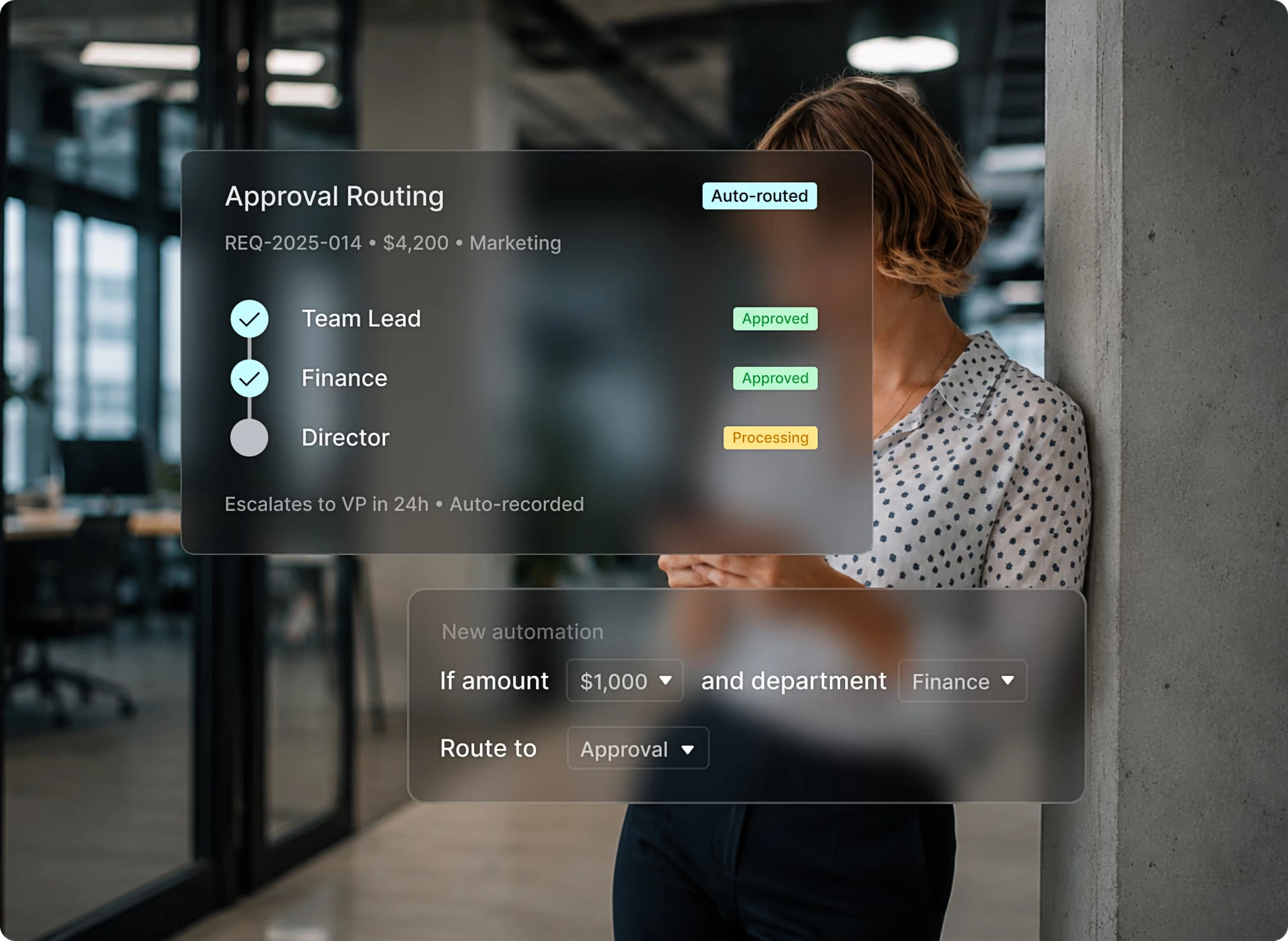
A configurable approval workflow that routes requests by department, location, or dollar amount delivers that outcome without requiring legal intake, IT service management, or the multi-entity governance an enterprise suite is built to carry. Different departments or branches can follow different approval rules within a single shared structure, rather than needing separate systems or a platform scoped for problems your organization doesn't have.
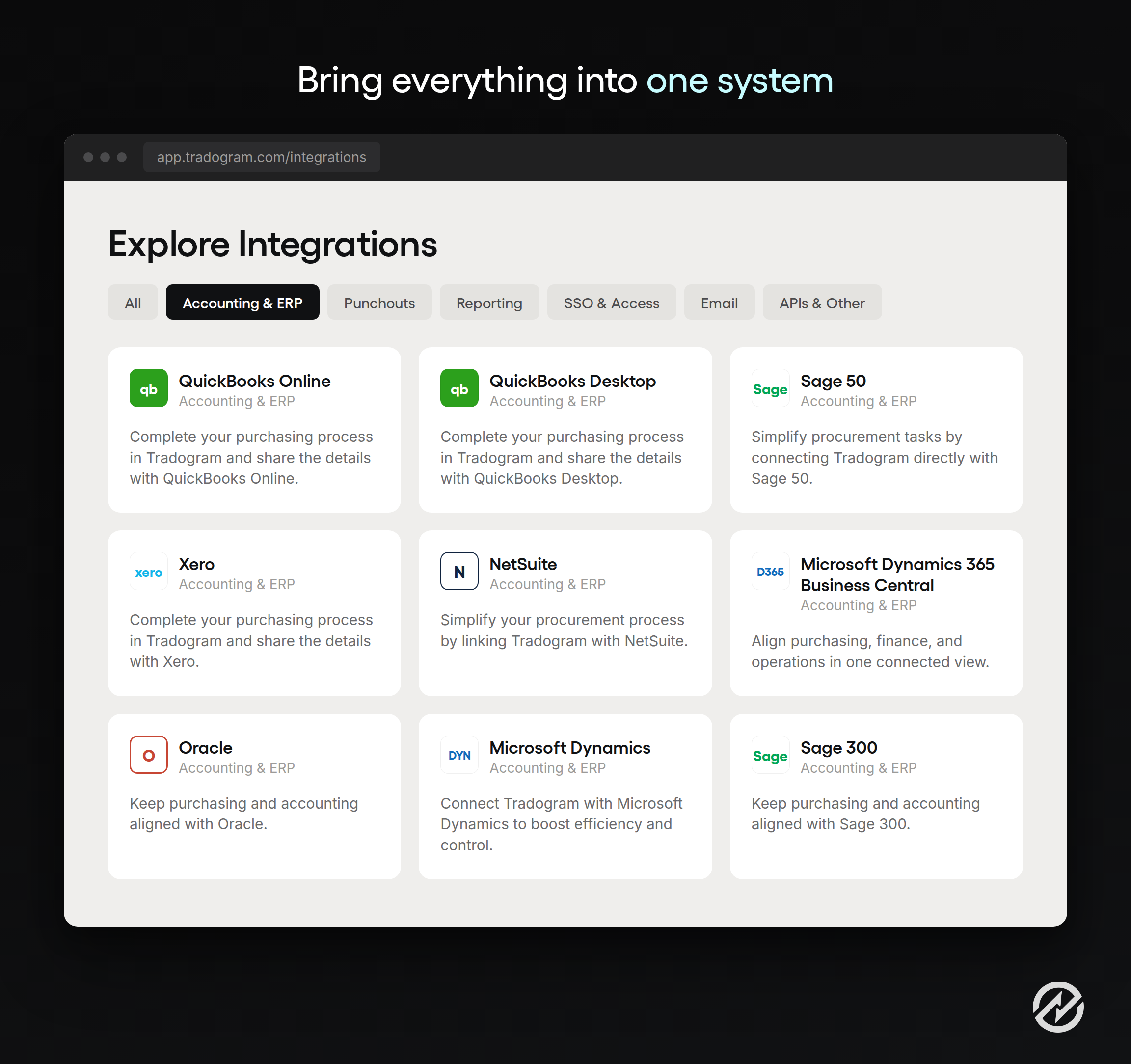
Connect that to the accounting or ERP system your finance team already runs via native ERP and accounting procurement integrations, and purchasing data no longer needs to be re-entered by hand. That's the same connective tissue described earlier: purchase orders, receiving records, and invoices referencing the same transaction instead of getting reconciled by hand at month-end.
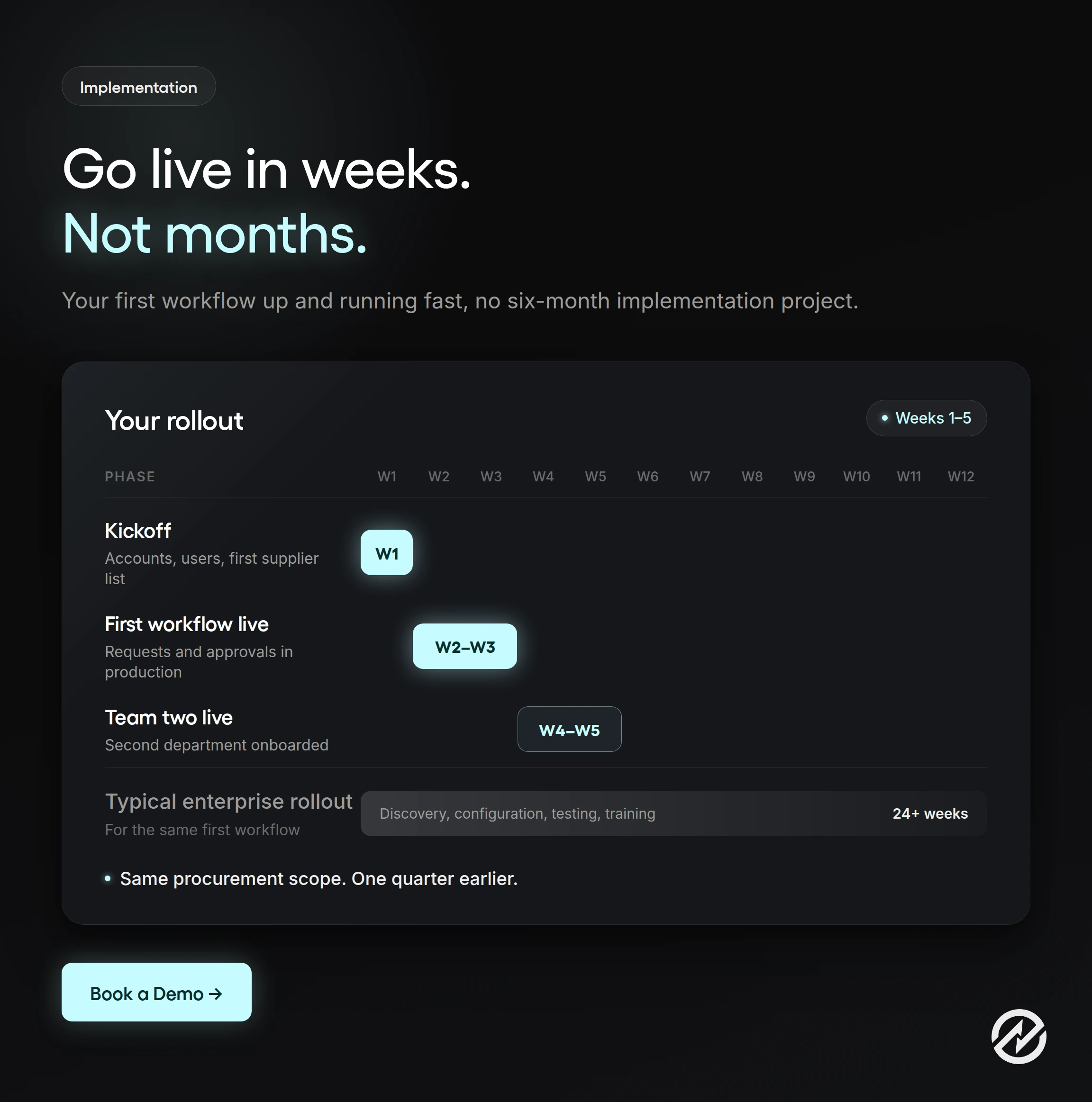
None of this is zero effort. Configuring approval rules, thresholds, and integrations to match how your organization actually operates takes real setup time, even on a platform built to make configuration easy. Be wary of anyone who tells you otherwise, whether they're selling an enterprise suite or a mid-market one.
What it doesn't take is an enterprise implementation, a dedicated IT project, or a platform priced and scoped for problems your organization doesn't have.
The next question is how to tell whether your organization has actually reached the point where that gap matters.
Signs your organization needs procurement orchestration
Most "signs you need this" lists in procurement content describe a company much bigger than yours. Here's a version grounded in what actually triggers searches for most mid-market teams, drawn from patterns across Tradogram's customer base.
You're a strong candidate for procurement orchestration if several of these are true:
- Purchasing spans more than one department or site, and each has drifted toward its own version of the process.
- Purchases are sometimes committed before formal approval because the approval step is a courtesy, not a control.
- Finance has no reliable view of committed spend. They see the number once the invoice arrives, not before.
- Reconciling purchase orders, receipts, and invoices is a manual, recurring task because the systems that record them are disconnected.
- A recent trigger event has raised the stakes. A new site opened. A new Procurement Manager or Controller started. An audit turned up missing approvals or documentation. Purchase order volume has climbed faster than the process built to handle it.
That last point matters more than the others individually. Structural complexity, on its own, is tolerable for years. What turns a tolerable coordination gap into an urgent one is almost always a specific event that exposes it: a new location where approval rules haven't been decided yet, an audit finding that names a specific missing document, a new hire who inherits a process nobody can fully explain.
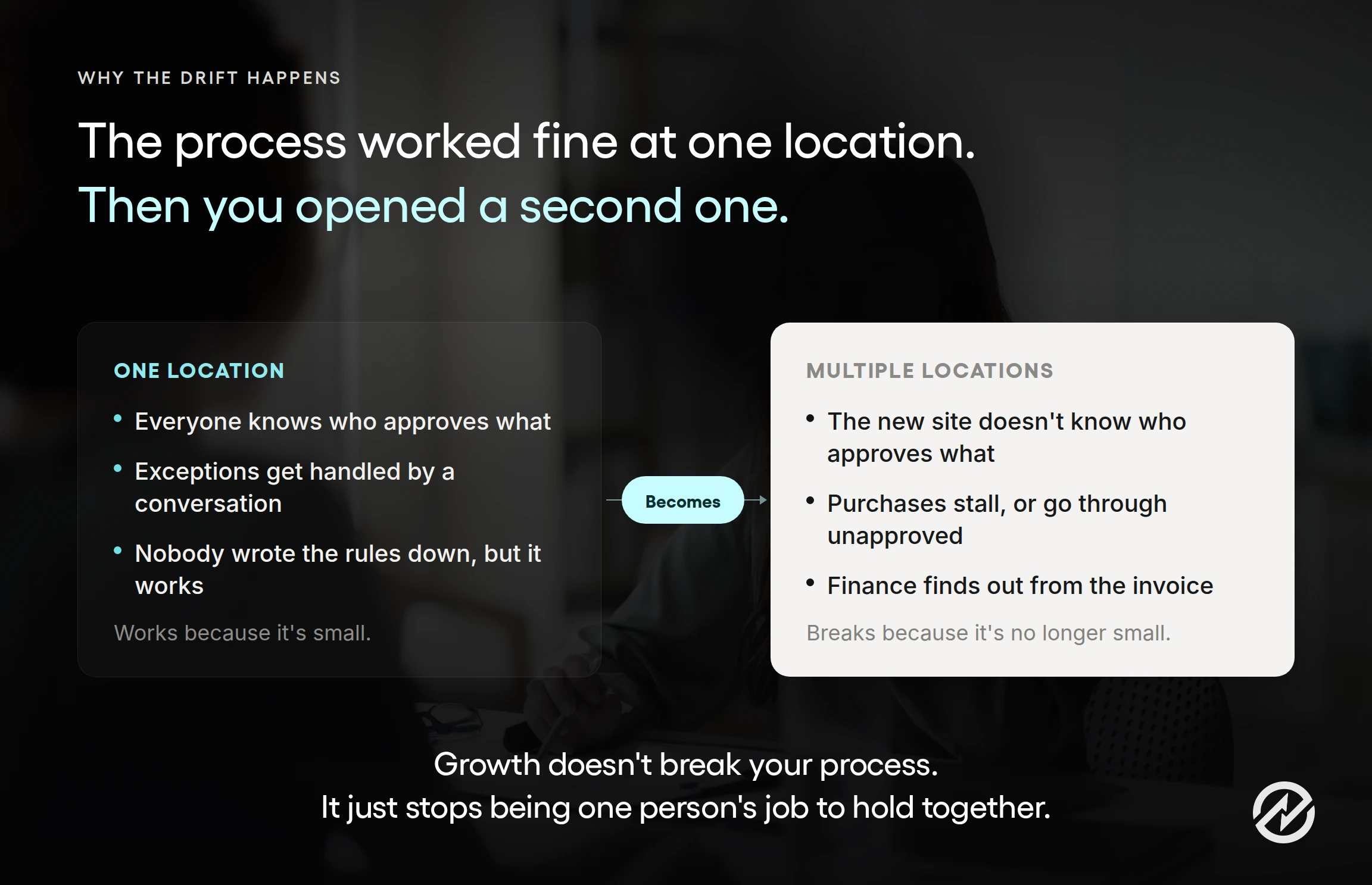
Here's what that looks like in practice. A company opens a second location. The original approval rules were built around a single office and a single set of approvers. The new site's manager isn't sure who's supposed to sign off on what, so purchases either stall waiting for an answer or go through without one. Neither outcome is really a choice. It's just what happens when a process built for one context gets stretched to cover a second one without anyone redesigning it.
If two or three of the signs above sound familiar, manual processes are already costing your team time, and it's worth understanding what actually controls that spend before the next trigger event makes the decision for you.
Where AI actually fits into procurement orchestration
AI's most credible role in procurement orchestration today is to reduce manual work on specific, well-defined tasks, not to run the purchasing process on its own.
That distinction matters, because "AI-powered" gets used to describe two very different things. One is a system that extracts data from a document, checks it against related records, and flags items that need a second look. The other is a system that makes purchasing decisions and takes action without anyone reviewing them. Only the first kind exists in credible production use today.
Tradogram's own AI capability, TradoScan, does the first kind of work. It reads an invoice and extracts the line items, quantities, and pricing, rather than having someone retype that information by hand. It checks the extracted data against the related purchase order and receiving record, the same three-way match described earlier in this article. When something doesn't line up, including a price that’s higher than what was quoted or a quantity that doesn't match what was received, it gets flagged for a person to review before payment goes out.
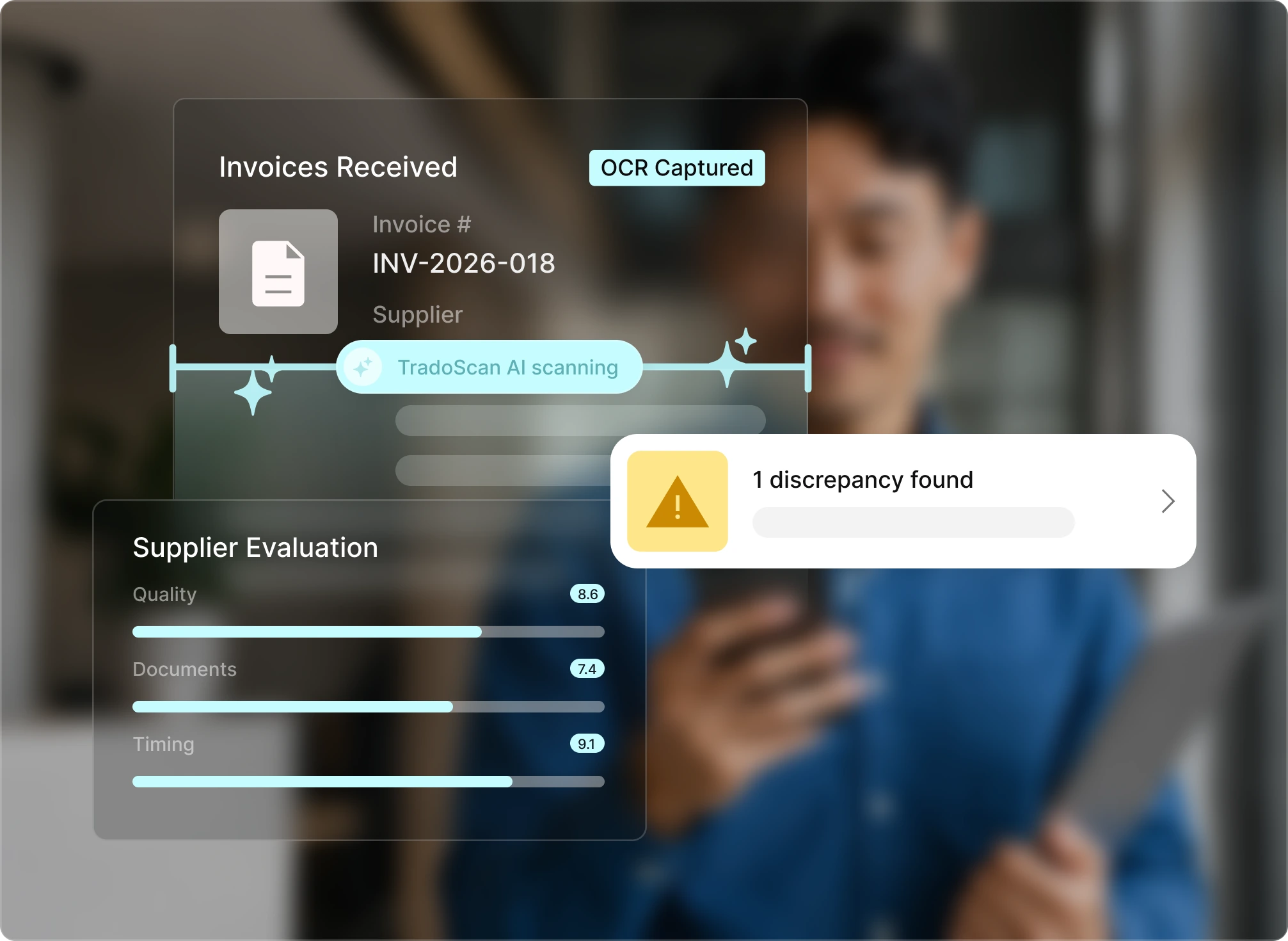
That's different from workflow automation, which routes a request or generates a purchase order without anyone having to touch it. Document extraction and matching still end with a person. They remove manual data entry and manual review for the mechanical part of the task, while the judgment call about whether this discrepancy is a mistake or a legitimate exception remains with your team.
If a platform describes its AI capability without naming the specific task it performs, that's worth asking about directly. "AI-powered" isn't a feature on its own. Extracting invoice data, matching it against a purchase order and receipt, and flagging discrepancies is a feature, and it's worth knowing exactly where human judgment still comes into play before you build a workflow around it.
TradoScan's invoice data extraction and matching is one piece of the orchestration layer described earlier, not a replacement for the coordination itself. The connections between systems still have to exist for TradoScan, or any AI feature, to have accurate data to work with in the first place.
Implementing procurement orchestration at a mid-market scale
Start with the single connection point causing the most friction today, not a full rollout across multiple systems at once.
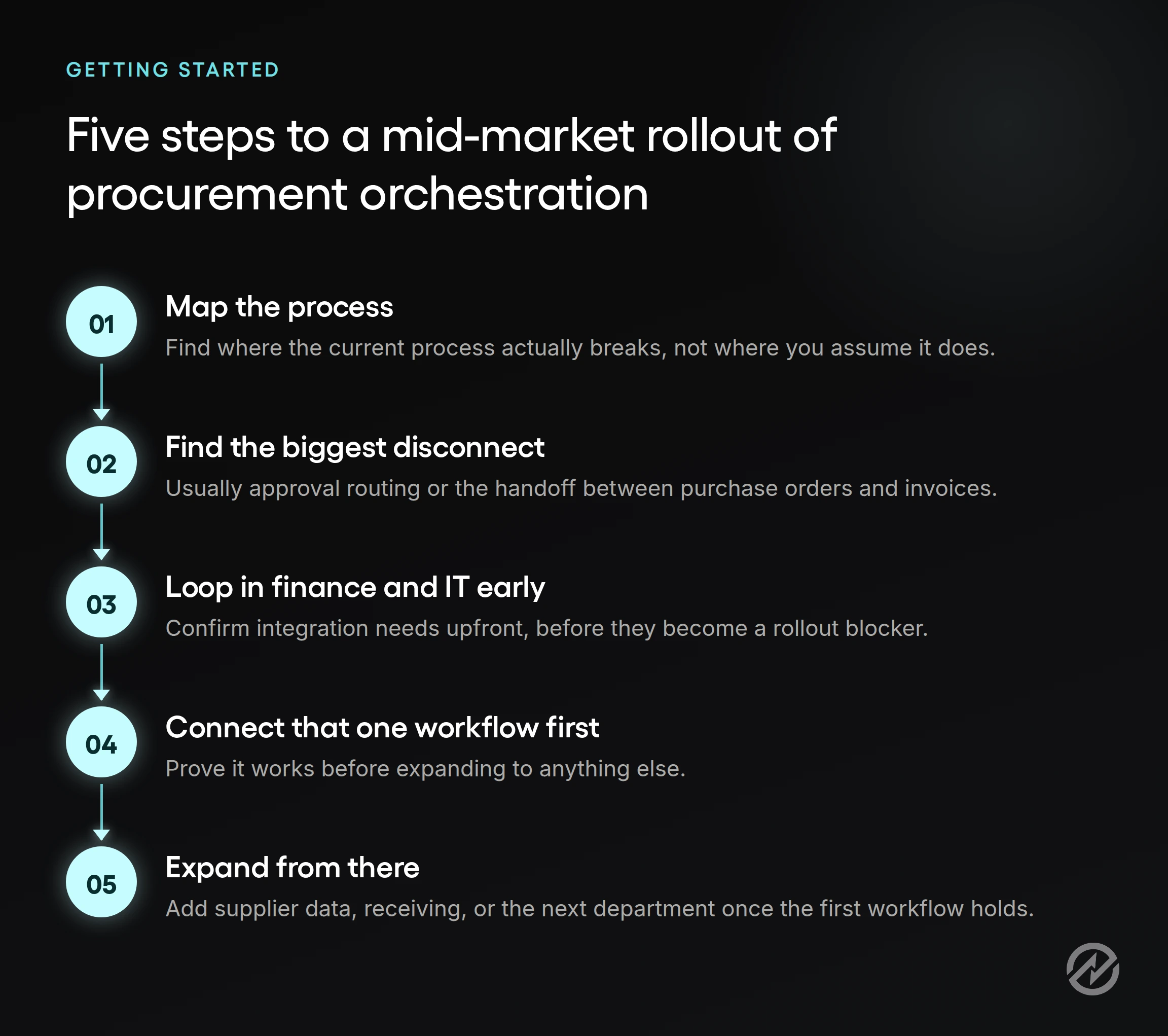
For most mid-market teams, that means untangling approval routing or the purchase-order-to-invoice handoff first, because those are usually where the most manual work and the most risk are concentrated. A five-step approach keeps the project scoped to something a lean team can actually execute:
- Map your current procurement processes, step by step, including where they break: where requests actually originate, who approves what, where purchase orders get created, and where data gets re-entered instead of passed along.
- Identify the single biggest disconnect. For most teams, that's either approval routing, which depends on someone remembering the rules, or the purchase-order-to-invoice handoff, which usually means manual reconciliation.
- Bring finance and IT into the conversation early enough to confirm integration needs, not after the fact. They'll know which ERP or accounting connections matter most and where existing systems already do part of the job.
- Connect that one workflow first, rather than trying to unify fragmented processes across the whole organization simultaneously. A working approval workflow, live and in use, is worth more than a half-configured plan to fix everything.
- Expand from there, connecting the next highest-friction point, such as supplier data, receiving, or a second department, once the first workflow is proven.
The constraint here isn't effort. It's discipline. Connecting one purchase requisition workflow can take weeks, not months, because you're integrating a single process rather than migrating every disparate tool your organization relies on at once.
Teams that stay disciplined about that sequence move fast. Teams that try to fix every disconnected system simultaneously are usually the ones still stuck at the mapping stage six months later.
Coordination, not complexity
Go back to the scenario this article opened with: a request approved over email, a purchase order built from scratch, an invoice that shows up weeks later with no clear record of what was approved or delivered. That's what happens when a real process runs through disconnected tools.
Now run the same purchase through a coordinated one, like Tradogram. The request enters a structured system instead of an inbox. It's checked against budget and routed to the right approver automatically, based on rules that don't depend on anyone remembering them. The purchase order is generated from the same approved information rather than being retyped. When the invoice arrives, it's checked against what was ordered and what was received before anyone approves payment, and the accounting system records the transaction.
Nothing in that sequence requires an enterprise platform, a dedicated IT project, or an AI system to run the process unsupervised. It requires the coordination principle this article has been describing throughout: connected intake, consistent approval workflows, linked purchase orders and invoices, and systems that share information with the people who need it in real time, rather than holding on to their own separate versions.
That's the core promise of procurement orchestration, and it's achievable at whatever scale your organization operates. The operational efficiency gains, real-time visibility into committed spend, and reduced manual reconciliation aren't exclusive to enterprises. They're what happens when the systems your team already uses are finally talking to each other.
If your team is already fielding purchase requests across departments or sites, you don't need to solve every coordination gap in this article at once. Start with the connection causing the most pain today, prove it works, and expand from there. See how Tradogram routes purchase requests to the right approver automatically, and keeps purchase orders, receiving records, and invoices connected, without an enterprise implementation.
If you're still mapping out where your own process breaks down, the complete guide to digital procurement transformation is a good next stop.