
The Invisible Drain: The True Cost of a Fragmented Supplier Base
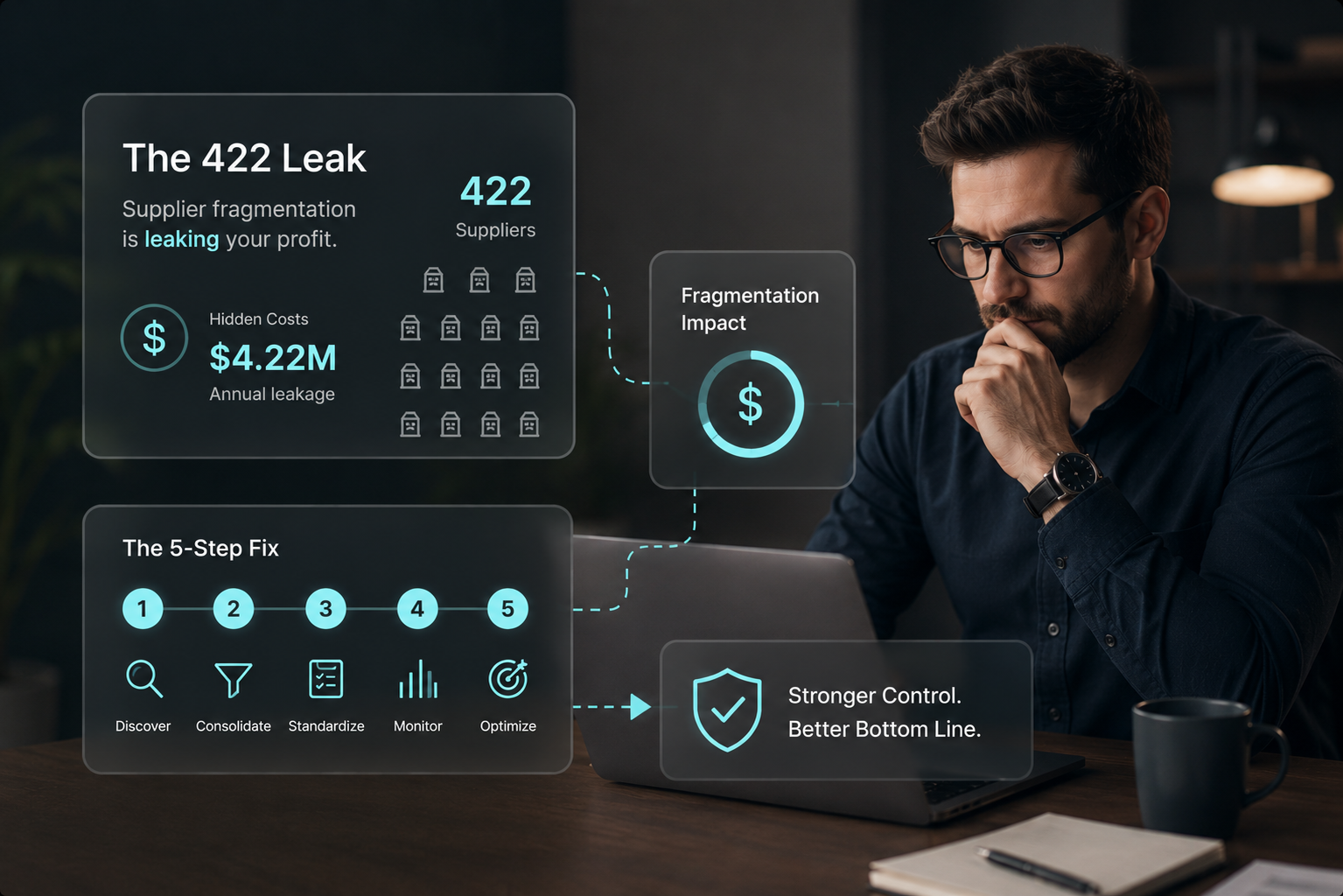
While a larger number of suppliers might suggest more choices, better prices, and increased flexibility, the reality often proves otherwise. It can lead to excessive overhead, duplicated efforts, and a bottom line that silently loses money never reflected on any invoice.
Supplier fragmentation — the unchecked spread of redundant, unmanaged vendors within your procurement system — ranks among the most costly issues in business operations. Its expenses are so widespread across various processes that most companies fail to recognize the total impact until it's substantial.
Consider this: Organizations managing over 100 active suppliers can incur up to 35% more on procurement activities compared to those with a streamlined base, according to Deloitte.
Inadequate Supplier relationship management turns what seems like strategic diversification into a visibility and margin drain. Every untracked vendor is a blind spot, and every redundant contract is a resource burden. The illusion of "having options" veils a significant financial leak.
The upside? This issue is fixable. The sections that follow explain how fragmentation inflates your cost-per-transaction and outline a practical 5-step solution to consolidate, streamline, and reclaim that margin. Before that, it's crucial to understand just how costly fragmentation can become.
The $527 Problem: Quantifying the Administrative Burden
Each purchase order tells its own tale — and in fragmented procurement settings, it's an expensive one. Based on CAPS Research, manually processing a single PO costs about $527. Automated systems can reduce this figure to around $105 — an 80% cut in administrative costs. Multiply this difference across numerous vendors, and it transforms from inefficiency to liability.
Manual vs. Automated PO Processing: A Direct Comparison
- Cost per PO: Manual processing costs around $527, while automated processing costs approximately $105.
- Processing time: Manual processing takes hours to days, whereas automated processing takes minutes.
- Error rate: Manual entry results in high errors, significantly reduced through automation.
- Vendor touchpoints: Manual involves multiple, uncoordinated touchpoints, while automated is centralized.
- Audit readiness: Manual processes are labor-intensive, while automated processes are real-time.
The cost-per-PO metric is perhaps the clearest indicator of how fragmentation burdens procurement teams. More vendors equate to more transactions, more approvals, and more reconciliation cycles — each adding to the overhead.
The Data Entry Trap
In fragmented environments, procurement staff often spend excessive time re-entering the same information across disconnected systems. A vendor invoice arrives, is manually matched to a PO, cross-referenced with a contract stored elsewhere, and routed for approval via a different tool. Each step poses an error risk — and an avoidable labor cost.
The Touchpoint Multiplier
Every new vendor adds unique touchpoints: onboarding, compliance checks, invoicing cycles, and relationship management. Effective tail spend management necessitates disciplined vendor consolidation because low-value, high-volume transactions with fringe suppliers disproportionately consume administrative resources compared to their actual spend value.
Why Reconciliation Costs Compound
When data is siloed in separate systems, month-end reconciliation becomes a forensic exercise rather than a routine task. Teams chase mismatched invoices, duplicate payments, and unapproved vendors — none of which adds strategic value.
This wasted effort is only part of the issue. When data is fragmented, processing costs rise, and it becomes nearly impossible to see. This visibility gap presents its own serious risks.
The Visibility Vacuum: Why Fragmented Data is Your Biggest Risk
When your vendor data is scattered across spreadsheets, inboxes, and disconnected systems, you don't have a supplier network — you have a blindspot. And blindspots are costly.
The administrative costs discussed earlier are just one layer of the problem. Beneath them lies a more insidious risk: the complete absence of a single source of truth for supplier and contract data. Without consolidated visibility, procurement decisions are made on incomplete information — and that's where the real money walks out the door.
"Better visibility would be amazing. We have more than 12,000 contracts, and their data is not sorted." — Gaia Olcese, Procurement Manager at Satispay
This isn't an isolated case. According to a recent industry survey by Concord, 100% of respondents cited the lack of real-time visibility into contract data as a major issue. When an entire industry operates blindly, the consequences are predictable — and costly.
''A fragmented supplier base doesn't just create operational noise. It creates structural blind spots that compound over time.''
Here's where that lack of visibility does the most tangible damage:
- Compliance failures: Without centralized contract tracking, renewal deadlines and regulatory milestones are missed. Auto-renewals trigger on unfavorable terms, and audit exposure silently increases.
- Lost volume pricing: When spending on similar goods is spread across 15 or 20 vendors, no single supplier sees enough volume to justify a discount. Consolidation that could unlock 10–15% savings never occurs because no one has the full picture.
- Broken forecasting: Siloed spend data makes accurate demand planning nearly impossible. Teams end up over-ordering, under-ordering, or duplicating purchases — all symptoms of the same root cause.
Maverick spending thrives in this environment. When employees can't easily find approved vendors or verify contract status, they default to whoever is quickest — often outside any negotiated agreement. The visibility vacuum doesn't just fail to prevent this behavior; it actively enables it.
This pattern — high-frequency, low-visibility purchases slipping through the cracks — highlights a broader structural issue in how organizations manage their spend portfolio. It's where fragmentation tends to concentrate most heavily.
The 80/20 Tail Spend Trap: Where Fragmentation Hides
Supplier fragmentation doesn't hit hardest where you're watching. It hides in the purchases nobody's managing closely — office supplies, one-off service contracts, emergency vendor orders that bypass your approved list entirely. This is tail spend, and it's where supplier fragmentation costs quietly compound into a systemic problem.
According to GEP, tail spend typically accounts for 80% of all procurement transactions but only 20% of total spend. That ratio sounds manageable — until you realize the sheer volume of those transactions makes them impossible to control without the right systems in place.
Key Insight: The 80/20 Rule in Action Tail spend is high in transaction volume, low in individual value — which is precisely why it attracts the least oversight and the most maverick behavior. What seems like "small" spending adds up to massive, untracked leakage across hundreds of vendors.
The Maverick Spend Problem
Maverick spending — purchases made outside approved vendor channels — naturally arises from a fragmented tail. When employees need something quickly and the approved process feels slow or unclear, they source it themselves. Each workaround adds another vendor to the network, another invoice format to reconcile, and another gap in your spend visibility. Typically, this results in a gradual accumulation of unauthorized relationships that no single team is responsible for managing.
The Scalability Wall
Manual processes simply cannot keep pace with tail spend volume. A procurement team can rigorously manage 50 strategic suppliers. Managing 500 — many of them transactional, low-touch vendors — requires infrastructure that spreadsheets and email chains cannot provide.
In practice, the administrative overhead of chasing down invoices, onboarding micro-vendors, and reconciling duplicate orders grows faster than the value those vendors deliver. That's the scalability wall: the point where fragmentation stops being an inconvenience and becomes a structural drag on your operation.
And the cost isn't only financial. The operational consequences — inconsistent quality, strained relationships, supply instability — run even deeper.
Operational Fallout: Quality, Stability, and Relationships
The hidden costs of managing multiple vendors extend far beyond processing fees and administrative overhead. When your procurement team is divided among many supplier relationships, no single relationship receives the attention it deserves. Depth matters in vendor partnerships — preferred buyers gain priority production slots, faster issue resolution, and early access to innovations. Spread too thin, you're just another account number in someone's CRM, and your ability to enforce quality standards erodes as a result.
Consistency suffers most visibly at the SKU level. When multiple vendors supply the same component or product category, identical quality is rare — even when specs say otherwise. Tolerances vary. Materials differ. What appears to be a standardized input can perform differently depending on the source, creating downstream quality control headaches that cost time and credibility. The more vendors you manage, the harder it becomes to hold any single one accountable to a consistent standard.
Stability complicates the problem further. Organizations with consolidated supplier bases report higher supply chain stability and better strategic focus from their procurement teams, according to BusinessAge Research. The second benefit — strategic focus — is easy to underestimate. When your team is constantly managing supplier disputes, chasing late shipments, and onboarding replacements, they're not building category expertise or negotiating better long-term agreements. Fragmentation doesn't just strain operations; it consumes the human capital that should be driving your procurement strategy forward. Fortunately, this problem has a clear, structured solution.
The Maverick Spend Problem
Maverick spending — purchases made outside approved vendor channels — naturally arises from a fragmented tail. When employees need something quickly and the approved process feels slow or unclear, they source it themselves. Each workaround adds another vendor to the network, another invoice format to reconcile, and another gap in your spend visibility. Typically, this results in a gradual accumulation of unauthorized relationships that no single team is responsible for managing.
The Scalability Wall
Manual processes simply cannot keep pace with tail spend volume. A procurement team can rigorously manage 50 strategic suppliers. Managing 500 — many of them transactional, low-touch vendors — requires infrastructure that spreadsheets and email chains cannot provide.
In practice, the administrative overhead of chasing down invoices, onboarding micro-vendors, and reconciling duplicate orders grows faster than the value those vendors deliver. That's the scalability wall: the point where fragmentation stops being an inconvenience and becomes a structural drag on your operation.
And the cost isn't only financial. The operational consequences — inconsistent quality, strained relationships, supply instability — run even deeper.
Operational Fallout: Quality, Stability, and Relationships
The hidden costs of managing multiple vendors extend far beyond processing fees and administrative overhead. When your procurement team is divided among many supplier relationships, no single relationship receives the attention it deserves. Depth matters in vendor partnerships — preferred buyers gain priority production slots, faster issue resolution, and early access to innovations. Spread too thin, you're just another account number in someone's CRM, and your ability to enforce quality standards erodes as a result.
Consistency suffers most visibly at the SKU level. When multiple vendors supply the same component or product category, identical quality is rare — even when specs say otherwise. Tolerances vary. Materials differ. What appears to be a standardized input can perform differently depending on the source, creating downstream quality control headaches that cost time and credibility. The more vendors you manage, the harder it becomes to hold any single one accountable to a consistent standard.
Stability complicates the problem further. Organizations with consolidated supplier bases report higher supply chain stability and better strategic focus from their procurement teams, according to BusinessAge Research. The second benefit — strategic focus — is easy to underestimate. When your team is constantly managing supplier disputes, chasing late shipments, and onboarding replacements, they're not building category expertise or negotiating better long-term agreements. Fragmentation doesn't just strain operations; it consumes the human capital that should be driving your procurement strategy forward. Fortunately, this problem has a clear, structured solution.
The Fix: A 5-Step Roadmap to Supplier Consolidation
Supplier fragmentation is a solvable problem. According to Deloitte, consolidating your supplier base is the most direct way to eliminate the 35% procurement cost premium that fragmented organizations routinely absorb. Here's how to do it.
The $527-per-transaction leak isn't inevitable — it's a structural problem with a structural solution. Start with the audit, and build from there.
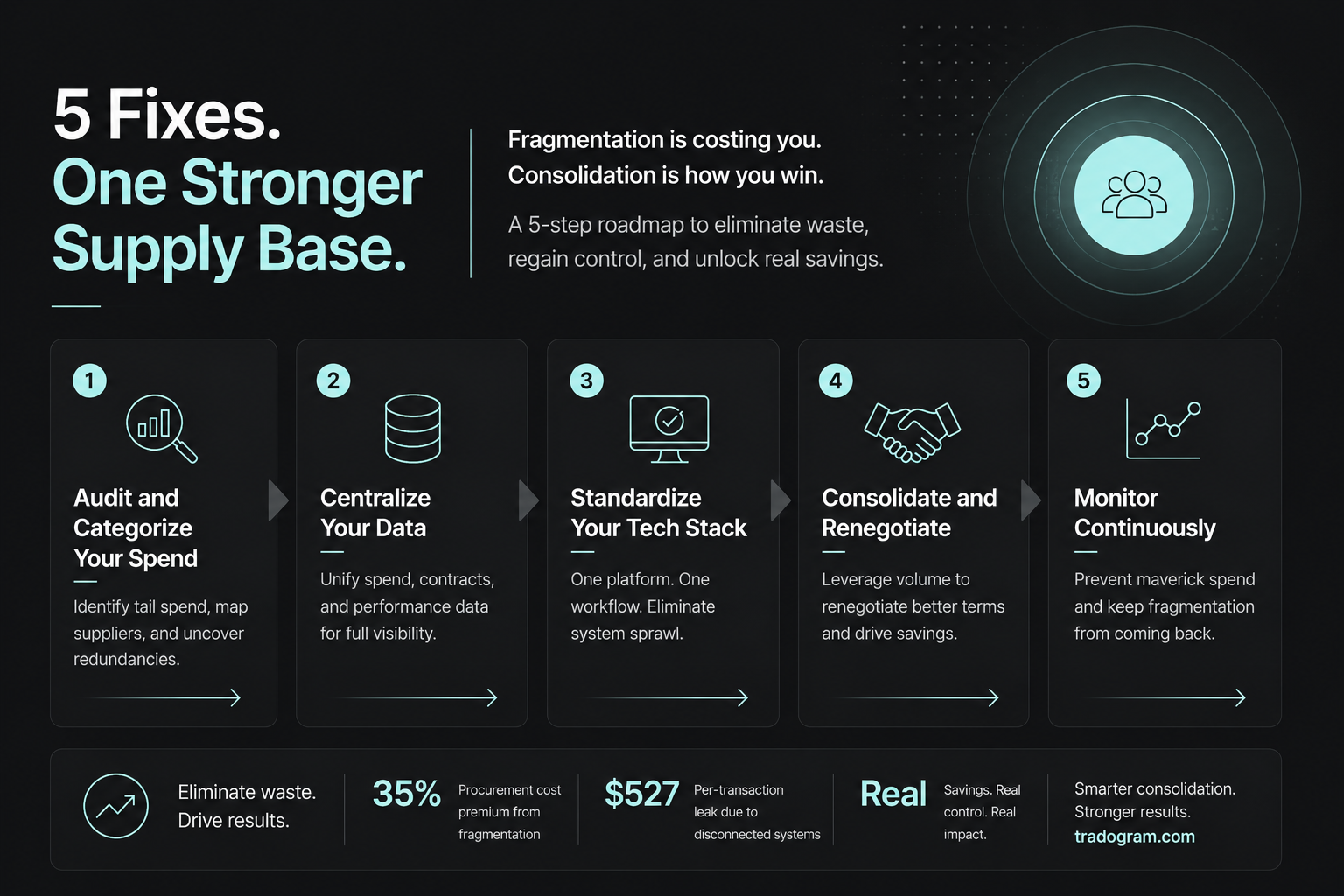
- Audit and Categorize Your Spend. Begin by identifying your tail spend — the 80% of transactions consuming 20% of the budget but generating disproportionate administrative drag. Map every active supplier, categorize by spend volume, and flag redundant vendors serving identical needs.
- Centralize Your Data. Fragmented supplier data leads to fragmented decisions. Consolidate spend records, contracts, and performance metrics into a single source of truth. Research confirms that poor information-sharing costs firms billions annually — visibility is essential.
- Standardize Your Tech Stack. Disconnected systems keep your per-PO cost around $527. Migrating to a unified procurement platform can reduce that figure to approximately $105. One system. One workflow. One point of accountability.
- Consolidate and Renegotiate. With consolidated volume data, approach preferred suppliers for renegotiated terms. Volume leverage is your strongest bargaining tool — use it strategically.
- Monitor Continuously. Maverick spend doesn't disappear; it waits for the moment your controls relax. Implement ongoing spend monitoring with automated alerts for off-contract purchases to prevent fragmentation from quietly rebuilding.
Conclusion: Bringing Procurement Back Under Control With Tradogram
Supplier fragmentation often develops slowly, but over time it creates significant hidden costs — from rising administrative overhead and maverick spending to poor visibility, duplicate vendors, and lost negotiating power.
With Tradogram, organizations can centralize purchasing, supplier management, approvals, contracts, and spend tracking into one unified procurement platform. Features like automated purchase orders, approval workflows, supplier management, spend analytics, contract tracking, and three-way matching help reduce manual work, improve visibility, and keep procurement operations under control.
By consolidating procurement data into a single system, businesses can identify redundant suppliers, strengthen compliance, improve forecasting, and negotiate better supplier agreements with greater confidence.
Explore Tradogram’s features here: Procurement Features
Key Takeaways
- Compliance failures: Without centralized contract tracking, renewal deadlines and regulatory milestones are missed. Auto-renewals trigger on unfavorable terms, and audit exposure silently increases.
- Broken forecasting: Siloed spend data makes accurate demand planning nearly impossible. Teams end up over-ordering, under-ordering, or duplicating purchases — all symptoms of the same root cause.
- Consolidate and Renegotiate. With consolidated volume data, approach preferred suppliers for renegotiated terms. Volume leverage is your strongest bargaining tool — use it strategically.
Ready to reduce procurement inefficiencies and gain full visibility into your supplier network? Book a Demo