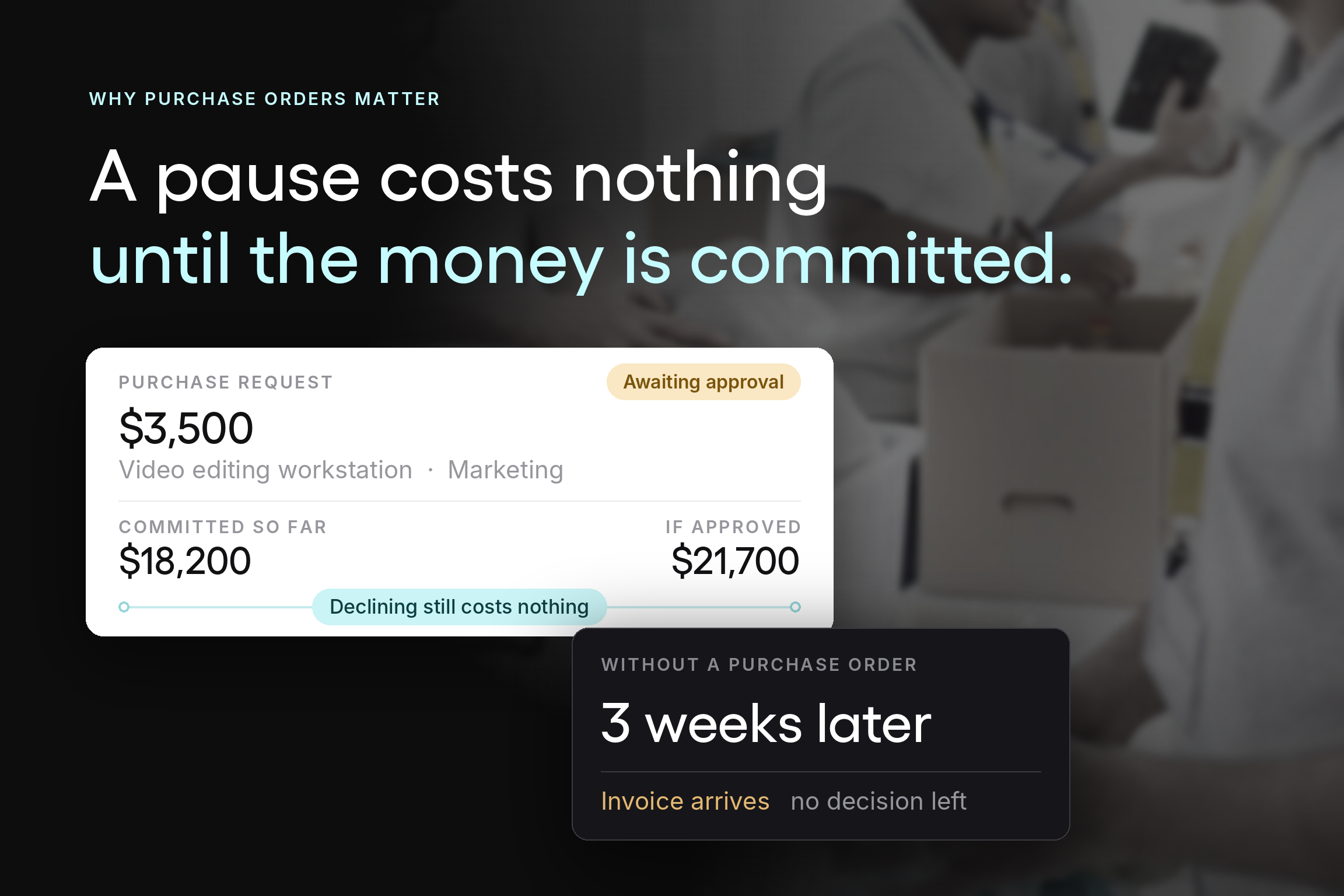


A marketing lead's computer dies on Tuesday. She has a campaign shipping Friday and needs a machine that can handle video editing, so she only wants to know how fast she can get a new one.
Down the hall, the co-owner who runs the books sees the same $3,500 purchase from the other end. She's looking at an account balance, a payroll run, and a supplier invoice she knows is coming, and she wants that $3,500 in view before it shows up on a statement.
Both concerns are reasonable, and a typical purchasing policy addresses neither. "Get approval for large purchases" doesn't tell the marketing lead who approves or how long it takes. It doesn't tell the co-owner what's been committed since she last checked.
So the computer goes on a company card. The invoice arrives three weeks later, and by then the only decision left is who signs off on paying it.
A purchase order solves both problems in one document, because it puts the commitment on record the day it's made. The marketing lead can see where her request stands, and the co-owner sees the spend before the bill arrives.
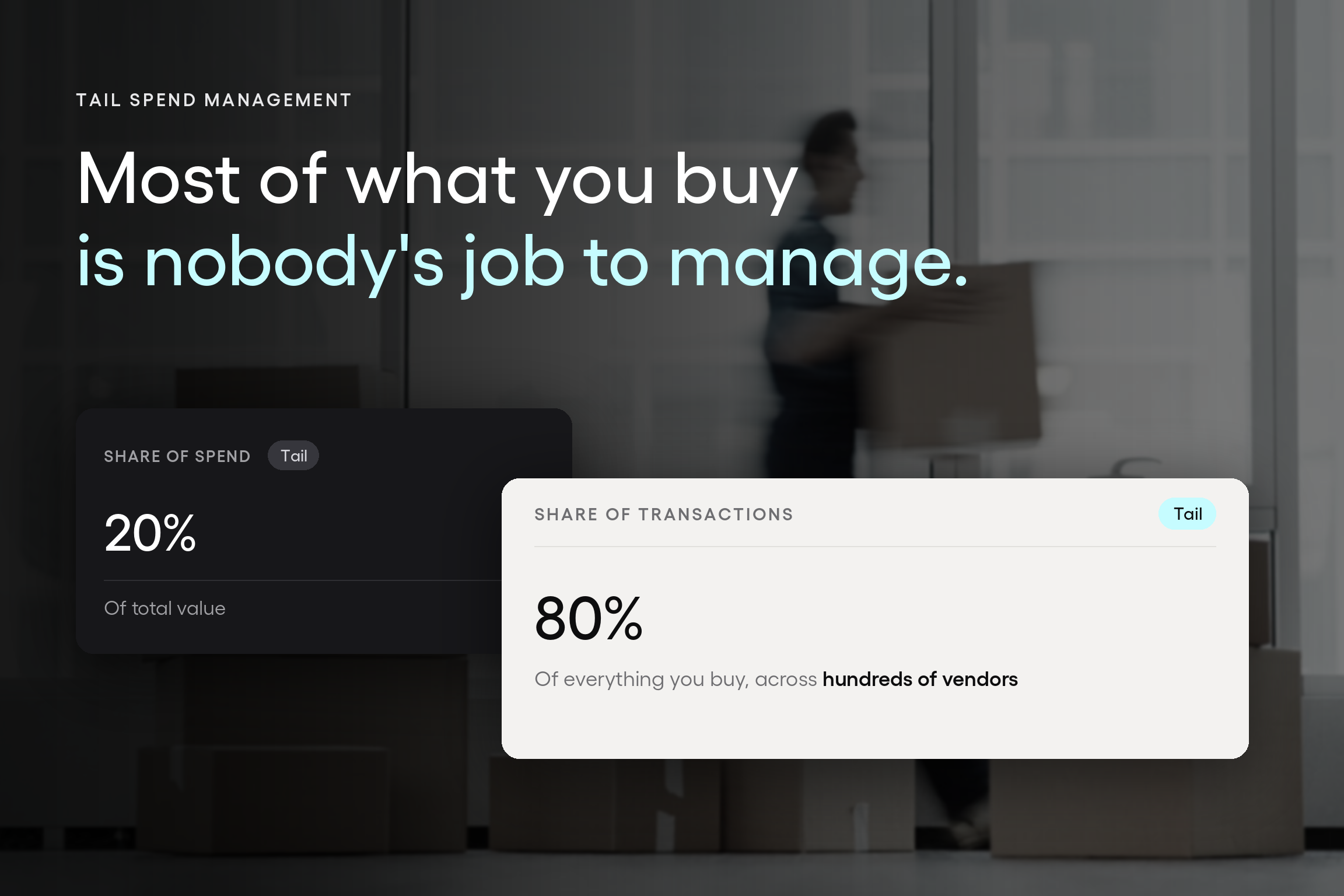
Since 2014, Tradogram has helped thousands of organizations digitize their procurement processes. In smaller companies, the pattern we see most often is a threshold problem. These businesses use purchase orders for large purchases but never define what counts as large, so the process covers the spending they were already careful with and leaves everything else unchecked.
This guide covers what a purchase order commits you to, which details give it legal weight, when raising one is worth the effort, and how it connects to the invoices and inventory records that depend on it.
Why purchase orders matter when the margin for error is thin
Purchase orders matter because they move the decision to spend money ahead of the moment the money is committed. For a small business, that sequence is the difference between a manageable surprise and a real problem.
The pressure on that timing is not theoretical. The Federal Reserve Banks' 2026 Report on Employer Firms surveyed 6,525 firms with one to 499 employees and found that 77% reported rising costs, tariff costs, or both as a financial challenge.
Cost pressure of that kind rarely arrives as a single shock. It arrives as a run of ordinary purchases, each defensible on its own, none of them visible together until the invoices land in the same month.
A purchase order closes that gap. It is a formal request to buy specific goods or services at an agreed price, issued by the buyer before anything is ordered, and it creates a record of the commitment on the day the commitment is made. That timing is the whole value. Everything else a purchase order does, and it does a lot, follows from putting the decision and the documentation in the same moment.
What a purchase order commits you to, and when it becomes binding
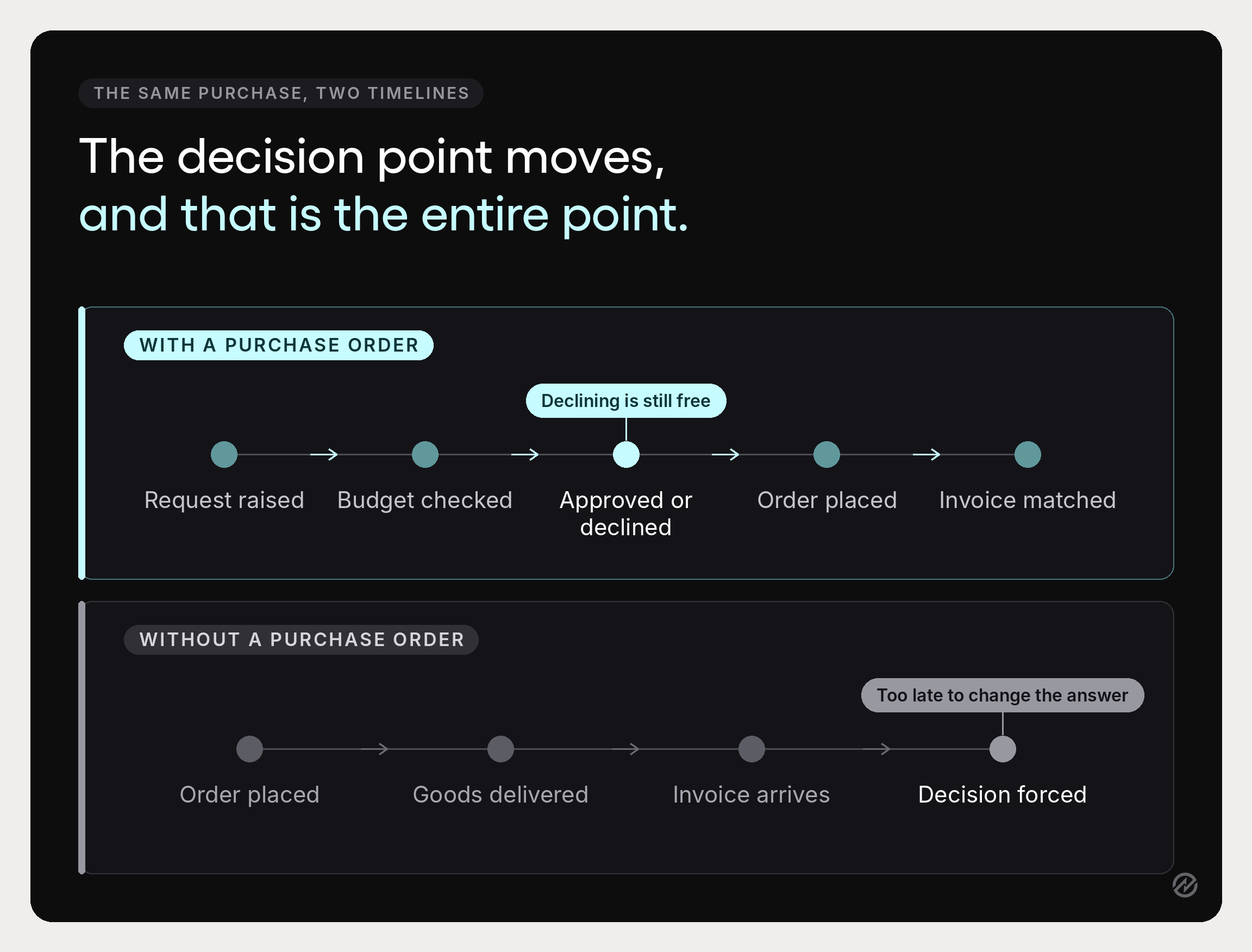
A purchase order is the buyer's offer, and it becomes a legally binding contract when the seller accepts it. That distinction matters more than most business owners realize, because it defines the window in which you can generally still change your mind for free. The purpose of a purchase order is to make that window exist at all.
When you issue a purchase order, you are making an offer: these items, this quantity, this price, delivered here by this date, paid on these terms. Until the vendor accepts, it is an offer and nothing more. Once the vendor accepts, whether by signing, by confirming in writing, or in many cases by shipping the goods, the purchase order becomes a legally binding contract covering both the buyer and the seller. Your obligation to pay and their obligation to deliver on those terms now exist in a document you both agreed to.
Acceptance rules vary by jurisdiction and by the order's terms, so check with a legal advisor before relying on them for a high-value purchase.
That is the legal protection people mean when they talk about purchase orders. The value of the document is that a dispute about what was ordered, what it cost, or when it was due becomes a question of reading. We have seen small businesses lose weeks to a disagreement a two-page purchase order would have settled in a minute.
The details that turn a purchase order into legal protection
A purchase order only protects you to the extent it is specific. These are the key components worth treating as mandatory rather than optional:
Each field is easy to include and expensive to omit. The relevant details are not paperwork for its own sake. Each one is a question someone will eventually ask, answered in advance.
Why do companies use purchase orders?
Companies use purchase orders because the document does six jobs at once, and doing any one of them another way costs more. The benefits of using purchase orders are usually listed as abstractions, so it's easier to judge each one when stated as the specific problem it prevents.
It controls spending before the money is gone. A purchase order sits in front of an approval process, so someone with budget responsibility sees the cost while declining it is still an option. Budget control that happens after the fact is not control. It is reporting.
It creates an audit trail without anyone having to maintain it. Every purchase order is a dated record of what was requested, who approved it, and what was agreed. When your accountant, your bank, or an auditor asks how a cost was authorized, the answer already exists.
It stops duplicate invoices from being paid twice. When invoices reference a purchase order number, a second invoice for the same PO is visible immediately. Without that reference, duplicate payments are found by accident or not at all.
It makes cash flow predictable. Open purchase orders are committed spend that has not been invoiced yet. A business that can track cash flow against its open POs knows what is coming. A business working from paper invoices finds out on arrival.
It replaces verbal agreements with written parameters. "We agreed on 200 units at the old price" is a memory. A purchase order is a record. Moving from an ambiguous conversation to specific written terms removes most of the friction between buyers and vendors.
It enforces policy across departments. Routing a purchase request through the same approval workflow, whether it comes from operations, the marketing team, or the shop floor, makes policy real. Policies that depend on people remembering them do not survive a busy quarter.
Are purchase orders necessary for every purchase?
No, and treating them as universal is the fastest way to get your team to stop using them. Every purchase order takes staff time to raise, approve, and match, and for small transactions, that cost can exceed what you are buying. If it adds up to $30 in staff time, applying it to a $22 box of printer paper costs more than it protects.
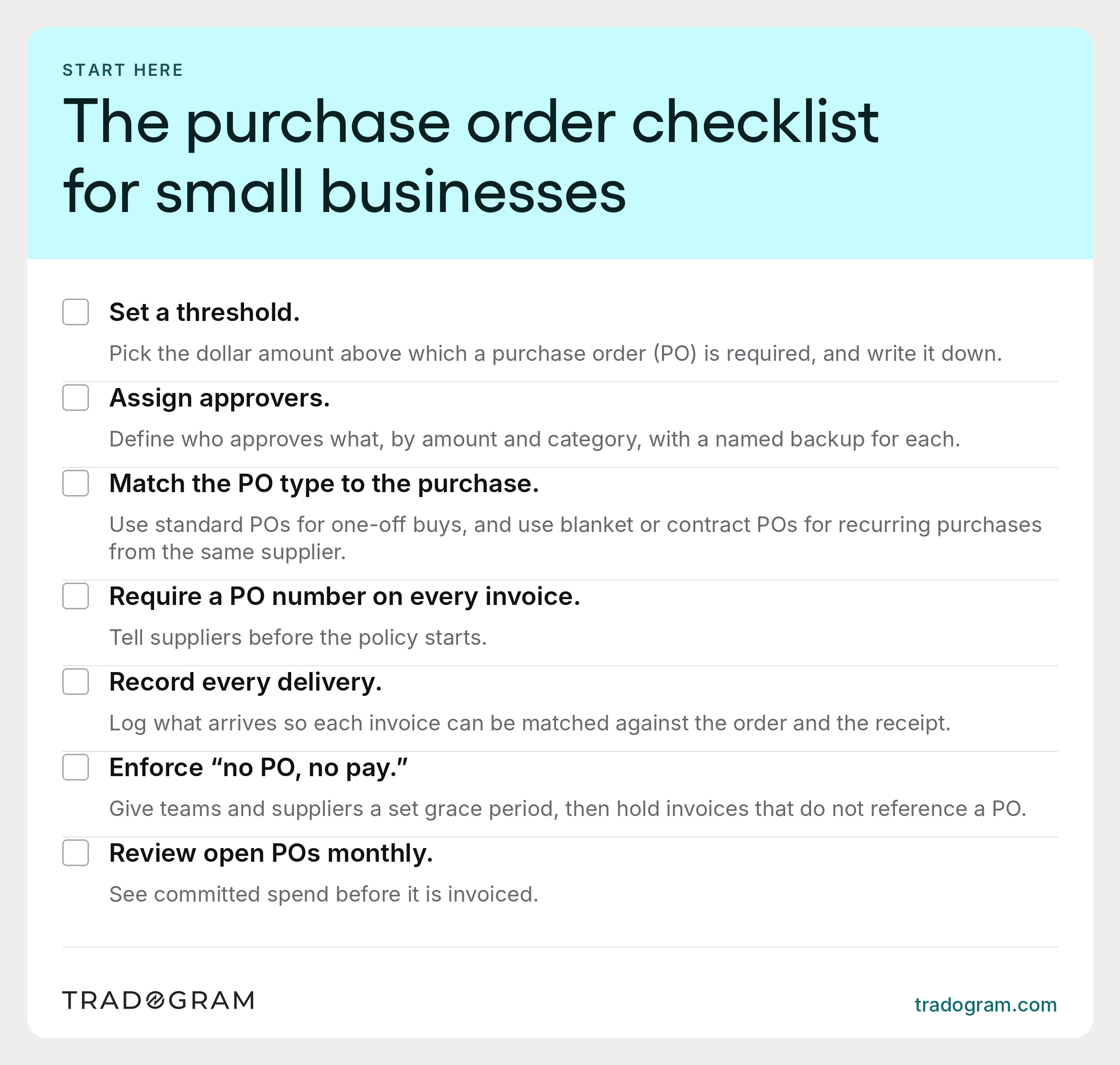
The businesses that get this right set a threshold and write it down. Below the threshold, use a simpler instrument. Above it, no PO means no pay. The instruments worth knowing:
- Purchase requisitions. An internal request to buy something, raised before a purchase order exists. Requisitions are where the "do we need this" conversation belongs, and for businesses that want approval without vendor-facing paperwork, a purchase requisition is often enough by itself.
- Blanket and standing arrangements. For recurring purchases from a known supplier, one agreement covering a period beats a stack of near-identical documents.
- Expense records and receipts. For small, one-off costs where the approval overhead exceeds the risk.
- Contracts. For services with ongoing scope, the contract carries the terms and the purchase order handles the release of funds against it.
What are the advantages and disadvantages of purchase orders?
Purchase orders have six advantages, all covered above: spending control, an audit trail, protection against duplicate invoices, predictable cash flow, written terms, and a policy that holds across departments.
The drawbacks matter too, because they're usually what stalls adoption. A purchase order adds a step between wanting something and having it. It takes staff time to raise, and it creates a document someone has to maintain. Applied without a threshold, it makes small purchases slower without making them safer.
Those drawbacks are manageable, but only if you acknowledge them while designing the process. Deciding the threshold deliberately separates a purchasing process people follow from one they work around. A threshold no one sets becomes a threshold everyone invents.
Standard, planned, blanket, and contract purchase orders
There are four types, and choosing correctly saves more time than any other single decision in purchase order creation.
A blanket purchase order is usually the one small businesses are missing. If you are raising multiple purchase orders a month to the same supplier for the same category, you are paying the processing cost repeatedly for a decision you already made.
Our guide to blanket purchase orders covers the mechanics, and the full breakdown of purchase order types covers the edge cases. A contract purchase order and a planned purchase order look similar on paper and behave differently in practice, so read both before you commit to one.
How a purchase order moves through a small business
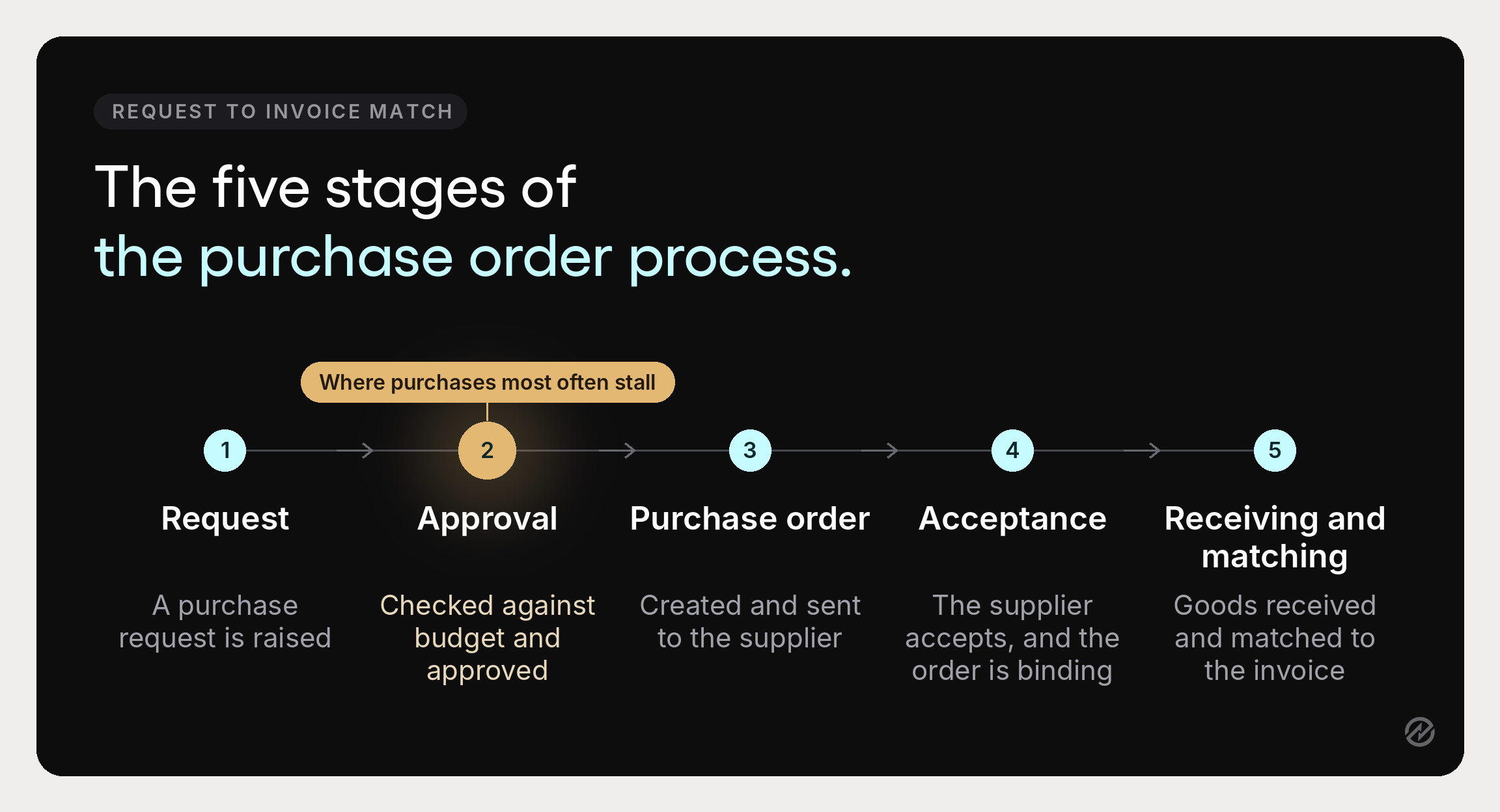
The typical purchase order process has five stages, and approval is the one where it most often stalls.
1. Purchase request. Someone identifies a need. In a business with a defined process, this arrives as a purchase requisition with a supplier, an estimated cost, and the budget line it belongs to. Without one, it arrives as a message asking whether it is okay to buy something.
2. Internal approval. The request goes to whoever owns that budget. This is the stage where the process either works or does not. Approval workflows that depend on a specific person being at their desk create a queue, and queues push people to buy first and ask later.
3. PO creation. The approved request becomes a purchase order with a PO number, supplier details, line items, delivery date, and payment terms, then goes to the vendor.
4. Acceptance and fulfillment. The vendor accepts, and the purchase order becomes binding. From here, you track order status against what was promised.
5. Receiving and invoice matching. Goods arrive, you record the receipt, and you match the invoice against both the purchase order and the receiving record before releasing payment.
Stage two is often where a manual purchase order process breaks. APQC's cross-industry benchmarks put the median time from requisition to purchase order at 2.0 days for goods, across 1,181 organizations. If your figure runs well past that, start with approvals.
We see the same thing across the businesses we work with: the purchase order process is sound, the approval process is a bottleneck, and the workaround people invent to get around the bottleneck reintroduces the exact problem that made purchase orders necessary.
If your approval step routinely takes longer than the thing being purchased is urgent, the problem is not that your team dislikes process. The process is asking them to choose between following it and doing their job.
The fix is structural. Route approvals by amount and category instead of by person, give every approver a delegate, and set the threshold high enough that routine purchases do not consume the same attention as the ones that need a second opinion. The purchase order approval workflow piece goes deeper on how to structure the routing itself.
Where purchase orders meet your invoices
The purchase order earns most of its value at the moment an invoice arrives, because it gives your finance team something to check the invoice against. Without it, approving an invoice means asking someone whether they remember agreeing to this.
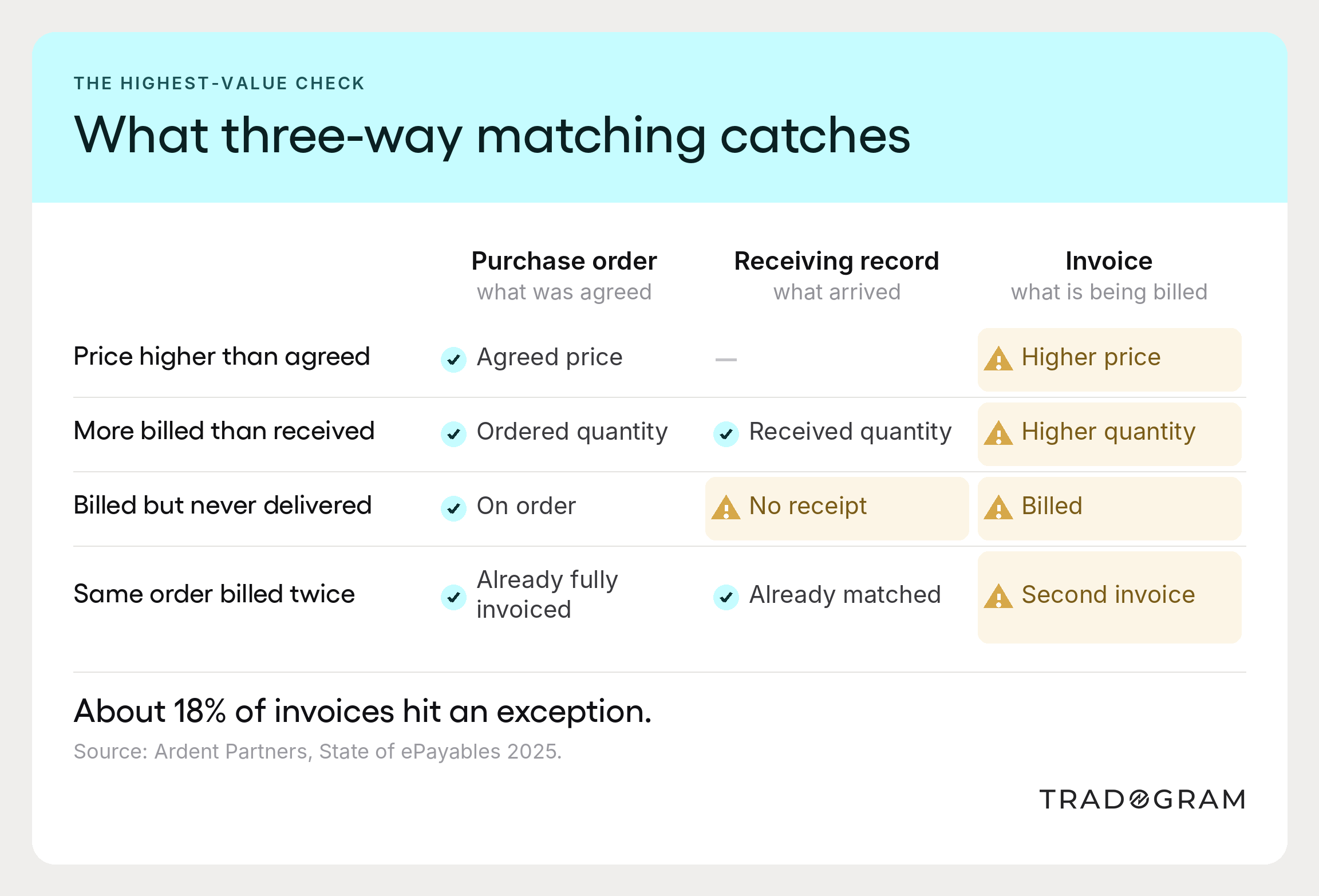
Three-way matching is the mechanism. The invoice is compared against the purchase order, which states what was agreed, and the receiving record, which states what showed up. When the invoice matches both, you release payment. When it does not, you have caught a problem before paying for it. It is the highest-value control in the procure-to-pay process, and it is unavailable to a business that never raised the purchase order.
The numbers on invoice processing make the case better than any argument. Ardent Partners' State of ePayables 2025 puts the average invoice at $9.84 and 8.2 days, with 18.4% raising an exception that a person has to resolve. An exception costs more than a clean invoice because it stops moving and becomes an investigation. The purchase order is what most of those investigations are looking for.
Exceptions are the point. An exception is an invoice that does not reconcile, and many exceptions trace back to a purchase order that was vague, late, or never raised. Fewer exceptions mean faster processing, because the expensive part of processing invoices is the investigation.
Practically, this means:
Put the PO number on every invoice. Make it a vendor requirement, not a request. Invoice matching without a reference number is a search.
Record receiving. Two-way matching catches price errors. Three-way matching catches the goods that were invoiced and never delivered.
Connect to your accounting software. When purchase orders, receipts, and invoices live in one place and sync to the system your finance team already uses, invoice reconciliation stops being a monthly project.
Track invoice status against open POs. Knowing which purchase orders have been invoiced, which are outstanding, and which are disputed is ordinary financial management, and it is unavailable without POs.
What purchase orders tell you about inventory and suppliers
Purchase orders are a planning record as much as a control, and small businesses often discover this late.
Every open purchase order is a statement about stock that is coming but has not arrived. For inventory management, that forward view beats a count of what is on the shelf, because it tells you whether the shortage in front of you is a real problem or a delivery that lands Thursday. Businesses running without POs have to manage inventory from current stock alone, so they reorder things already in transit and run out of things no one realized they hadn't ordered.
Over time, the same records answer questions you could not otherwise ask. Which supplier hits their delivery timelines and which one quietly runs a week late. Which category has crept up in price while no one was comparing. How much was spent on a category last year, compared to what was budgeted.
That history is the raw material for demand forecasting and for the next negotiation, and it accumulates as a byproduct of raising purchase orders. Supplier performance you can prove is supplier performance you can negotiate against, so vendor management and purchase order discipline tend to improve together.
Managing purchase orders without hiring someone to manage them
The objection we hear most is that a small business cannot spare a person to run this. It is a fair objection, and it is also the reason the manual version fails. Managing purchase orders on spreadsheets and email works until volume rises, at which point the administrative overhead grows faster than the business does.
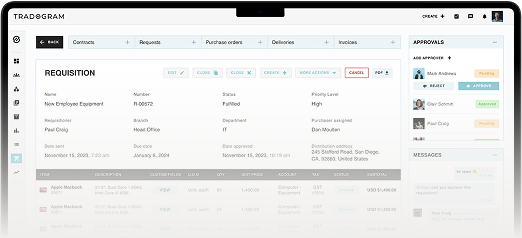
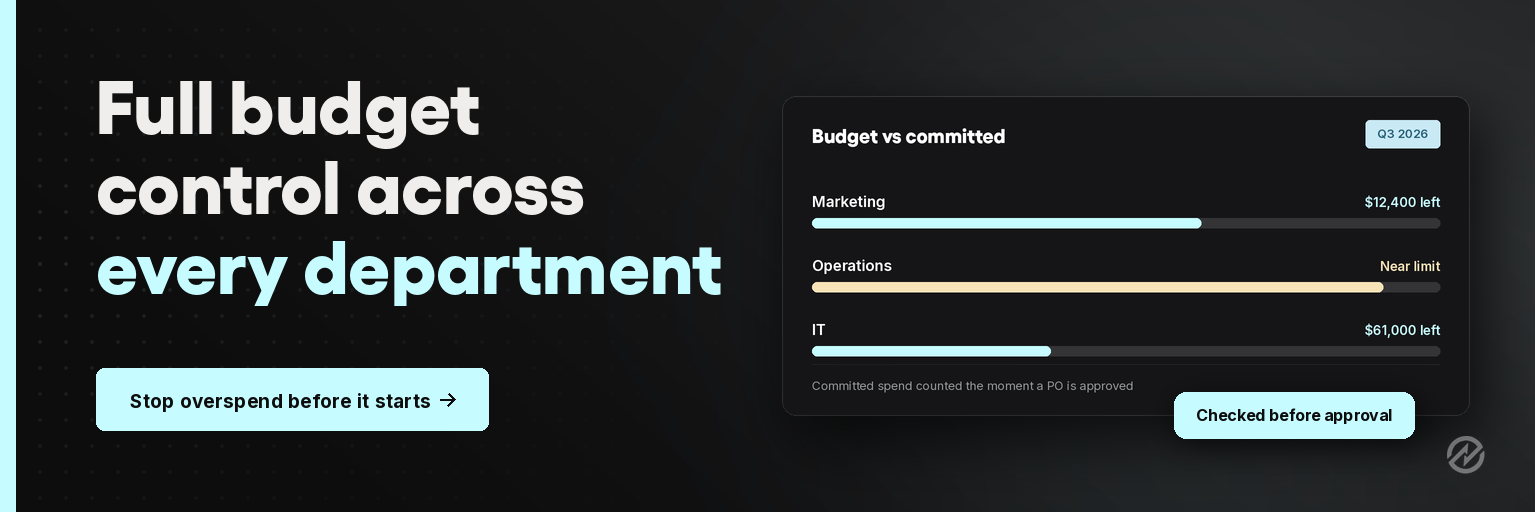
A purchase order system changes the economics by removing the work, not by redistributing it. Electronic purchase orders route themselves to the right approver, check the request against the budget before it moves, and update order status without anyone chasing it.
Approval workflows that automate approvals by amount and category mean routine purchases clear in minutes, and only exceptions reach a human. Purchase order software absorbs the matching, reminders, and record-keeping that otherwise consume someone's afternoon.
The size of that gap is measurable at the top end. The Hackett Group's 2025 digital world-class research found that top-performing procurement organizations run requisition-to-PO cycles 58% shorter than their peers and operate with 31% fewer staff at 19% lower cost. Those are large organizations, and a five-person company won't see gains at that scale. But the 58% sits in the requisition-to-PO cycle, where approval happens, and that's the same place small businesses lose time.
The benefits of a purchase order system, as distinct from the benefits of purchase orders themselves, come down to four things you cannot get on paper.
- Requests route by rule instead of by memory, so nothing waits on one person.
- Budgets are checked at the point of request, before the money is committed.
- Order status updates itself, so no one spends a morning asking suppliers where things are.
- Every purchase order, receipt, and invoice sits in one searchable record, so nothing has to be reassembled from three inboxes.
Those four are worth paying for. Most of what a vendor shows you beyond them is a feature list.
This is also where purchase order management stops being a finance project and becomes something procurement teams, operations, and the finance team share. When the system holds the full PO process, from purchase request through payment, finance and procurement teams stop reconciling two versions of the same month.
That single record is what procure-to-pay software is for, and it turns purchase orders from paperwork into a process that doesn't depend on someone chasing it.
In Tradogram, approval rules are set by amount and category, so each request goes to the right approver without anyone having to forward it. Budgets are checked at the point of request, before an order is placed. When an invoice arrives, TradoScan extracts the invoice data and flags discrepancies against the purchase order and receiving record before payment. The records connect to the accounting or ERP system your finance team already uses.
Karthik Rama, CEO and principal consultant at Procurement Doctors, has nearly two decades of procurement experience, and his advice to procurement managers evaluating procurement software is blunt about where they go wrong:
"User experience and integration are the most important aspects to me. If the user experience is bad, teams won't adopt the software, and then there's no point using the system."
Before selecting anything, he recommends a discovery session that maps your current processes, policies, and audit gaps with every affected stakeholder in the room, rather than starting with a feature list.
It is good advice for any procurement department, and especially for a small business, where the person who abandons a badly designed tool is usually the same person who chose it.
The practical test is simpler than a feature comparison. Can somebody in your business currently raise a purchase request, get it approved, and send a purchase order to a supplier without asking anyone how? If the answer is no, procurement software won't fix the problem until you fix the process.
Back to the marketing lead and the co-owner
No policy document would have put that machine in front of the co-owner before the card was charged. The business had a purchasing policy. What it did not have was a moment, before the money moved, when the person holding the balance saw the number and could ask a question, or a path the marketing lead could follow that was faster than buying it herself.
That is all a purchase order is: a forced pause at the only point where a pause is still free. Everything else in this guide, the legal protection, the audit trail, the ability to match invoices against what was agreed, follows from that one property.
If you are putting the purchase order process in place, three decisions determine whether it survives contact with a busy month:
Set the threshold, and write it down. Decide the amount above which a purchase order is mandatory and below which it is not. Getting the number slightly wrong matters far less than leaving it undefined, because every employee sets an undefined threshold for themselves.
Make approval fast enough to be worth following. If the approved path is slower than the unapproved one, people take the unapproved one, and you have built a rule, not a process. Route by amount, give every approver a backup, and let the routine purchases clear without a debate.
Commit to no PO, no pay. The policy only works if finance will hold an invoice that has no purchase order behind it. Announce it, give people a month, then enforce it. Softening this once teaches everyone that it is optional.
When these three decisions hold, spending becomes visible before it happens, invoice disputes get easier to settle, and the finance team spends less time on reconciliation. Purchase orders control spending and save time, and they do both by asking one question at the right moment instead of a dozen at the wrong one.