

There’s an abundant online sea of practical ideas for cutting costs in business:
- For administrative cost reductions, there are “13 ways to cut administrative overhead in business”.
- An in-depth article by Harvard Business Review is packed with ideas for large companies.
- For SMBs, there’s a list of “101 ways to reduce expenses” and “79 cost-cutting ideas”.
- There’s even a list of “29 sustainable cost-saving ideas” for companies that want to go green.
But how do companies go about practically implementing these different techniques?
As an administrator, when your attention turns to reducing expenses in the office, there’s more involved than simply declaring an update to existing methodologies.
Especially in larger companies, the process used to revise and adjust the current standard operating procedures which are already in place can prove to be cumbersome and challenging.
In an audio interview focused on procurement cost reduction strategies, a framework is outlined for enhancing purchasing procedures to improve operational cost efficiency in business. While the idea for this framework is focused on cutting costs through enhancing purchasing procedures, the same practice can be used to initiate other elements of a cost reduction strategy.
Download a free white paper containing our top 7 cost control techniques
To start cutting costs, make adjustments at the company policy level first
Policies control everything in a business - including the potential effectiveness of a newly devised cost control strategy.
There are two questions to ask when updating cost control policies:
- Are current business policies empowering or hindering expense reduction opportunities?
- Do new policies need to be created to support the initiative?
By assessing current policies from a cost reduction standpoint, administrative stakeholders can evaluate and plan policy changes prior to making impactful operational adjustments.
Some ideas for updating existing policies with the potential to optimize cost control include:
- Empower employees to source alternative cost-effective SaaS tool subscription options
- Increase the frequency at which established contract agreements are renegotiated
- Assess and consolidate the methods used to report spending to accounts payable
Examples of new policies to support office expense control:
- Implement full or partial telecommuting/remote-working flexibility where viable
- Transition from paper-based workflows to digital transfers and record-keeping
- Require all high-level expenses to be accompanied by an RFQ and CBA analysis
Embed updated cost control policies into standard business operating procedures
Adjusting standard operating procedures can significantly reduce costs. By first planning policy updates, workflow transitions can occur more smoothly by causing less unanticipated disruption.
Examples and ideas for procedure updates that could cut operating costs:
- Mandate an approval workflow for all business expenses to increase spend visibility
- Establish the use of purchase requisition forms for bulk ordering
- Designate a purchasing manager to ensure all costs remain on-contract
Because every business operates differently, innovative ideas for which operational procedures should be added or removed will need to be developed on a case-by-case basis.
Support policies and procedures with a standardized spend management system
Once policies and procedures for a cost reduction strategy have been established, they can be reinforced through the deployment of a spend management system.Spend management systems are designed to control costs by ensuring all financial activity is initiated and streamlined through a single, standardized point of entry.

Consider the following ideas to get the most value out of a new system:
- Source and evaluate systems that are simple and not too time-consuming to implement
- Ensure provided feature flexibility meets the requirements of all policies and procedures
- Find an affordable solution that will pay for itself by cutting costs, not adding to them
- Select a system that integrates with other platforms and tools being used
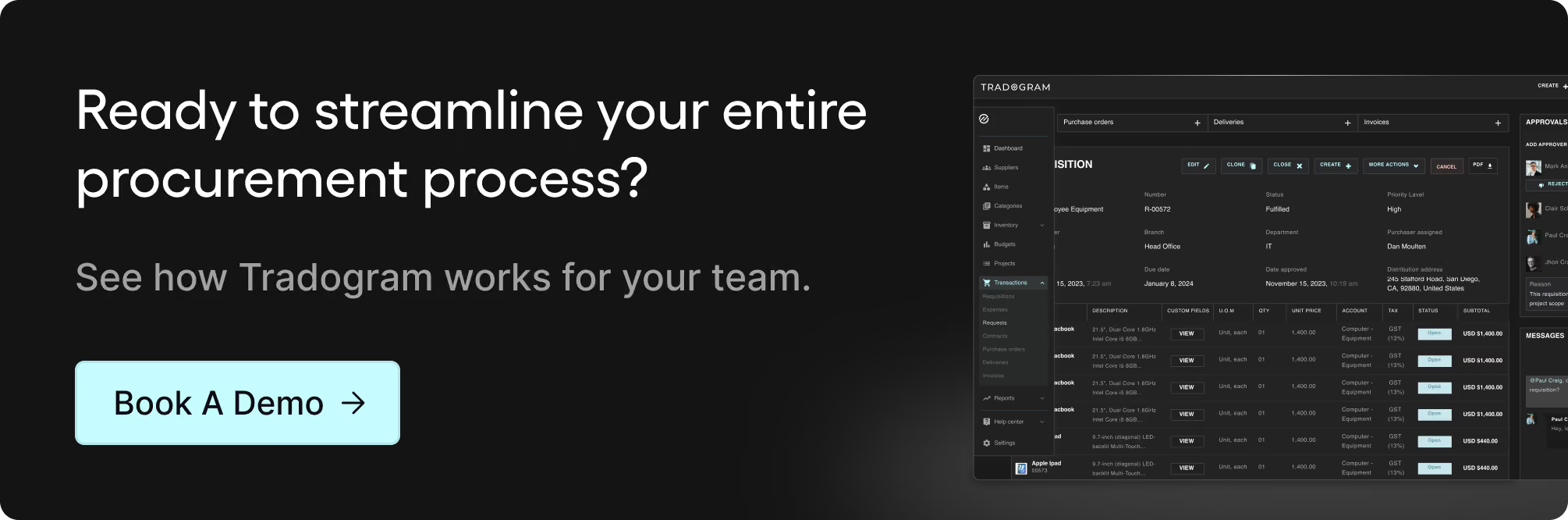
During the evaluation process, consider learning more about Tradogram - a simple, flexible, and affordable spend management system that was designed to support cost reduction initiatives in mid to large-sized businesses.