
The High Cost of Silence: Why Compliance Monitoring is a Financial Imperative
Every dollar your organization spends outside a negotiated contract is effectively working against you. In most procurement operations, these dollars accumulate faster than anyone cares to admit.
Compliance monitoring — the ongoing, real-time scrutiny of purchasing behaviour against approved policies, contracts, and vendor agreements — is not a luxury reserved only for large enterprises. It acts as the financial immune system for any procurement function. Yet many teams still view compliance as a retrospective task: conduct an audit, find gaps, patch them up, and repeat.
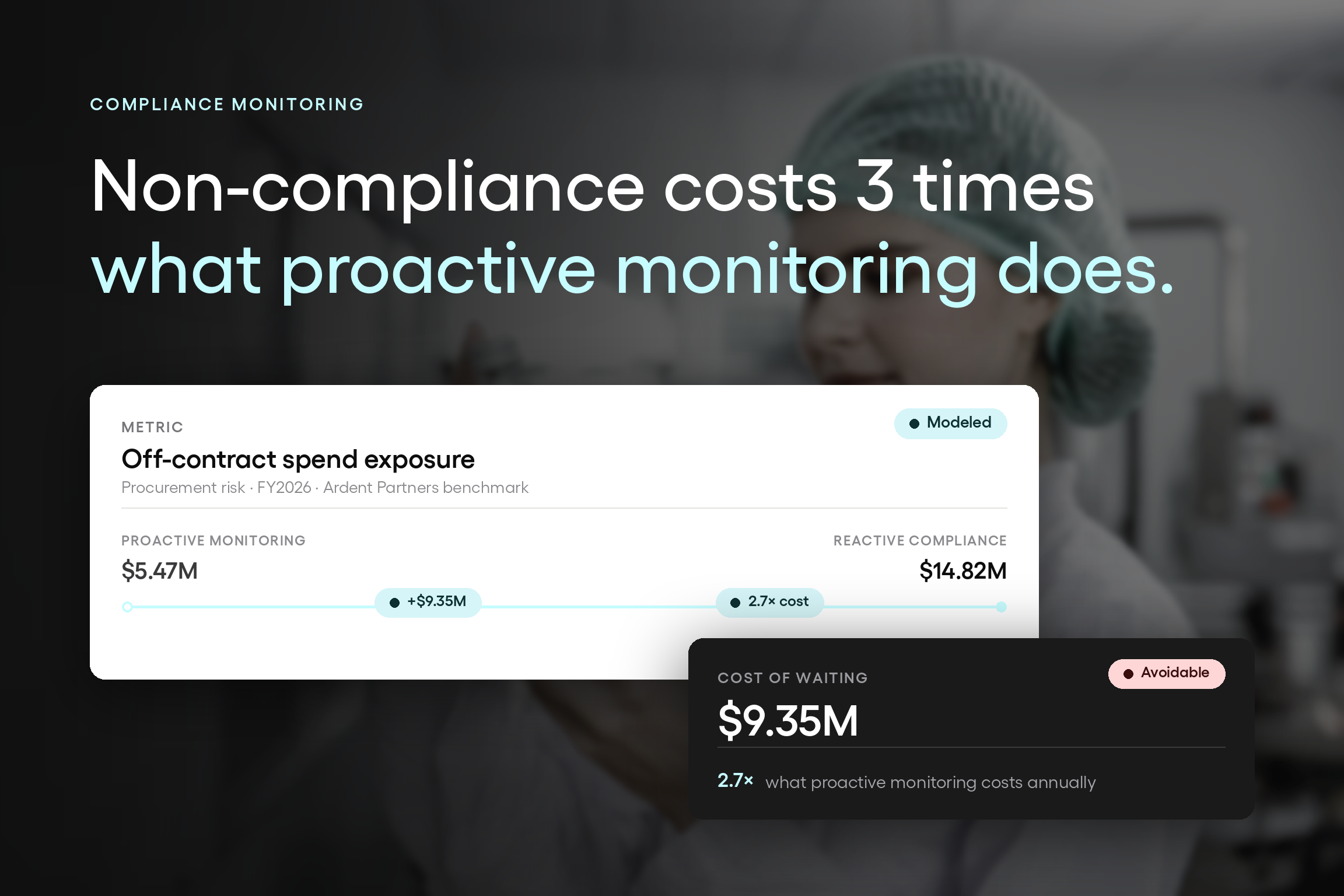
This reactive cycle is costly. According to research cited by Ardent Partners, organizations lose an average of 12% to 18% in savings leakage for every dollar spent off-contract. When scaled across a mid-sized company's annual procurement budget, this becomes a figure that is hard to overlook.
The cost of silence is even greater. The Ponemon Institute found the average total cost of non-compliance reaches $14.82 million — nearly three times the $5.47 million cost of proactively maintaining compliance.
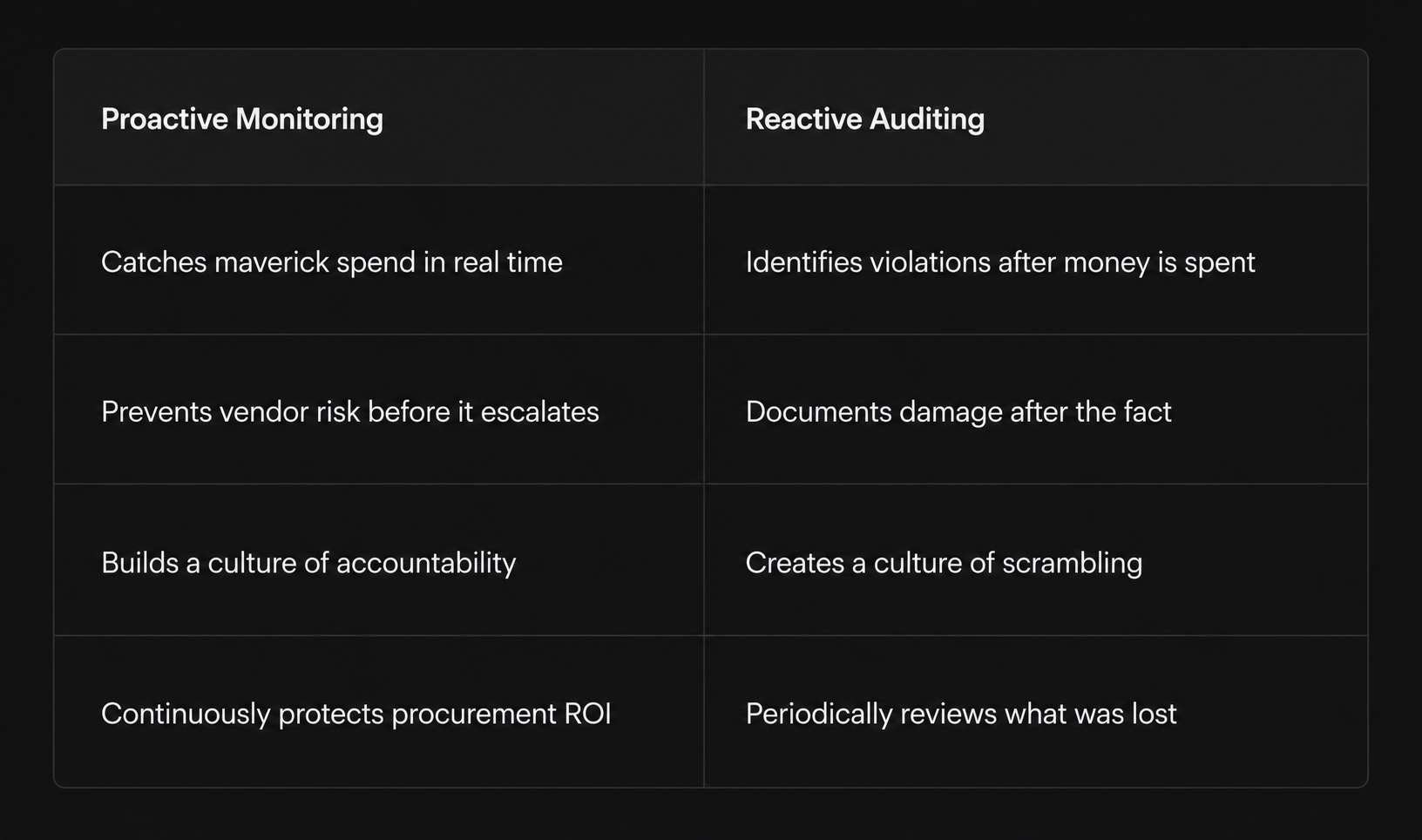
Compliance monitoring serves as the vigilant eyes and ears of your procurement department — constantly observing, continually comparing actual spend against what was agreed. The next section examines what this looks like in practice.
What is Compliance Monitoring? Definitions and Real-World Examples
Compliance monitoring is the ongoing evaluation of business processes to ensure adherence to both internal policies and external regulations, distinct from a one-time audit, which only provides a historical snapshot.
This distinction is crucial in procurement. An audit reveals what went wrong last quarter. Monitoring shows you what's going wrong right now, allowing you to address issues promptly. Continuous compliance research shows that organizations that transition from periodic reviews to ongoing oversight consistently recover more value from their contracts. The right compliance monitoring tools turn this shift from aspiration to operational reality.
Here's how it plays out across three critical procurement scenarios.
Automated PO-to-Invoice Matching
How it works:
- Every invoice is automatically cross-referenced with its corresponding purchase order and receiving record.
- Price variances, duplicate submissions, and quantity discrepancies trigger immediate alerts.
- Payments are held for human review rather than processed by default.
This eliminates overpayment risk at the source — without waiting for a quarterly reconciliation to catch the error.
Real-Time Vendor Risk and Certification Tracking
How it works:
- Supplier certifications (ISO, WSIB, insurance) are tracked against expiry dates.
- Automated flags are raised when a vendor's risk profile changes.
- New suppliers are screened before onboarding, not afterward.
Third-party risk management solutions increasingly depend on continuous data feeds rather than static questionnaires for this reason.
Cybersecurity Monitoring for Third-Party Data Access
How it works:
- Vendor access to internal systems is logged and continuously reviewed.
- Unusual access patterns trigger security alerts in real time.
- Compliance with data-handling policies is verified against actual behaviour, not self-reported assessments.
Undetected third-party access gaps remain one of the fastest-growing sources of enterprise data liability — a risk that point-in-time audits simply cannot address. Understanding the full architecture of a monitoring programme requires examining the foundational pillars that make these examples possible.
The 7 Pillars of an Effective Compliance Monitoring Framework
Understanding what compliance monitoring is only takes you so far. The real value comes from knowing how to integrate it into your procurement operations effectively. As Jason Busch of SpendMatters aptly put it, "the gains from better information far outweigh the costs of investment in specific technologies." The following five pillars provide a practical framework to evaluate where your programme currently stands.
1. Risk Assessment
Before effective monitoring can occur, it's essential to identify vulnerabilities. Map your highest-value vendor relationships, single-source contracts, and departments with historically low approval rates.
Action Item: Rank your supplier categories by spend volume and flag any contracts where maverick buying has occurred in the past 12 months.
2. Policy Integration
Rules hidden in a PDF that no one reads aren't rules — they're merely decorative. Policy integration involves embedding approval thresholds, preferred-vendor requirements, and spending limits directly into your procurement software, making violations structurally difficult rather than just discouraged.
Action Item: Audit your current procurement software configuration to ensure purchasing policies are enforced at the point of transaction, not reviewed after the fact.
3. Continuous Data Collection
Manual spreadsheets create gaps. Compliance monitoring tools close these gaps by automatically capturing purchase orders, invoices, and contract milestones in real time, eliminating the lag that makes periodic audits so costly.
Action Item: Identify every data source currently feeding your spend reports and determine which still require manual input.
4. Reporting and Communication
Data that remains in a dashboard benefits no one. Stakeholders — from finance to department heads — need scheduled, digestible reports that highlight exceptions and trends without requiring them to log in and dig.
Action Item: Establish a reporting cadence (weekly summaries, monthly deep-dives) and assign ownership for each report's distribution and follow-up.
5. Corrective Action
Detection without response is ineffective. A robust framework defines exactly what happens when a violation is flagged: who is notified, what the escalation path looks like, and how remediation is documented for audit purposes.
Action Item: Document a corrective action workflow and ensure it's accessible to every procurement team member before the next review cycle.
These five pillars form a foundation — but maintaining that foundation over time introduces its own set of challenges, especially as cybersecurity threats increasingly intersect with procurement data. That overlap warrants close examination.
Best Practices for Cybersecurity Compliance Monitoring
With a solid framework established, as discussed in the previous section, there's one area that procurement teams often underestimate: cybersecurity. Procurement systems handle sensitive financial data, vendor contracts, and payment information — making them prime targets. Effective compliance and monitoring must extend beyond policy checklists to include your digital security posture.
Focus on the following:
- Apply the principle of least privilege. Restrict access to your procurement software based on role. Not every team member needs visibility into payment terms or vendor banking details. Limiting access significantly reduces your internal attack surface. When evaluating procurement software, granular permission controls should be non-negotiable.
- Continuously monitor third-party vendor security postures. A vendor's security gap is your liability. HITRUST research indicates that traditional security questionnaires are increasingly inadequate on their own — ongoing assessment is the benchmark that matters.
- Automate anomalous spending detection. Unusual purchase patterns — duplicate payments, off-hours approvals, sudden vendor changes — can indicate either fraud or a breach. Automated alerts catch these faster than any manual review cycle.
- Keep privacy protocols current. GDPR and CCPA requirements evolve. As TrustArc notes, treating privacy as genuine risk management rather than a one-time checkbox protects your organization from regulatory exposure. Continuous compliance monitoring in the cloud is especially crucial for identifying misconfigurations before they're exploited.
Pro-Tip: Before onboarding any new vendor, require documented evidence of their data security controls — not just a self-reported questionnaire. Integrate this step directly into your procurement workflow to ensure consistent enforcement, not left to individual discretion.
Identifying these risks is only half the challenge. The tools you use to detect and respond to them determine whether your compliance programme keeps pace — which leads us to the critical question of automation versus manual effort.
Choosing the Right Compliance Monitoring Tools: Automation vs. Manual Effort
The frameworks and cybersecurity practices covered earlier are only as effective as the tools you use to enforce them. In terms of compliance and monitoring, the gap between manual effort and automated systems isn't merely a matter of convenience — it's a matter of dollars, accuracy, and response time.
Manual tracking has a ceiling. Spreadsheets and email threads can't flag a contract breach the moment it occurs, and human reviewers working through static reports will always react to problems rather than prevent them. In practice, the larger your supplier network grows, the faster that ceiling drops.
The ROI case for automation is compelling: automated procurement systems reduce manual touchpoints, cutting human error rates by 25% to 45%. This isn't a marginal improvement — it's a structural shift in how risk is managed.

What to Look For in a Monitoring Tool
When evaluating procurement management platforms, prioritize these features:
- Real-time alerts triggered by threshold breaches or policy violations
- Automated workflows that immediately route issues to the right stakeholder
- Immutable audit trails that document every action for regulatory review
- Native integration within your procurement platform — not a bolted-on add-on
The best monitoring tool is one your team will actually use — meaning it needs to reside where procurement decisions are already being made, not in a separate system that creates yet another data silo.
Choosing the right tools lays the foundation for everything that follows — including how you integrate compliance monitoring into a cohesive, ROI-positive procurement strategy.
Conclusion: Securing Your Procurement Future with Tradogram
Real-time compliance monitoring isn't a cost centre — it's one of the most effective profit-protection strategies available to modern procurement teams. Throughout this article, the path has been clear: visibility leads to control, control reduces risk, and reduced risk directly defends your bottom line.
The journey from scattered supplier data to total spend control requires intentional steps — adopting the right frameworks, embedding best practices into daily workflows, and choosing tools that automate rather than add burden. Compliance monitoring done well means fewer surprises, stronger vendor relationships, and procurement decisions grounded in real data rather than assumptions.
Tradogram unites these pillars in one platform, offering spend visibility and automated purchasing workflows that ensure every dollar is accounted for — whether managing a growing team or overseeing complex, multi-vendor operations. From construction projects to corporate supply chains, end-to-end procurement oversight is no longer reserved for enterprises with dedicated compliance departments.
Your next steps toward smarter compliance monitoring:
- Audit your current visibility gaps across active vendor contracts
- Identify which manual monitoring tasks are candidates for automation
- Establish a continuous review cadence rather than relying on periodic audits
- Align procurement metrics with broader organizational risk thresholds
Don't let checkbox compliance erode your procurement ROI. Start your free Tradogram trial today and take control of compliance monitoring before the next risk finds you first.
Key Takeaways
- Proactive compliance monitoring is essential for reducing financial leakage and enhancing procurement efficiency.
- Reactive auditing is costly and less effective in preventing violations before they occur.
- Continuous compliance monitoring is crucial for real-time risk management, particularly in procurement and cybersecurity.
- Automation in compliance monitoring significantly reduces human error and enhances scalability.
- Effective tools and frameworks are essential for integrating compliance monitoring into procurement operations.
- Tradogram offers a comprehensive solution to unify spend visibility and procurement workflows, promoting better control and risk management.
.png)
.png)

.png)
.webp)