

Ask a procurement team to cut costs, and they'll find something. Ask them twelve months later what those savings were actually worth, and the conversation gets uncomfortable.
That gap is the real problem with cost reduction in purchasing and procurement. Finding savings is rarely the hard part. Most organizations have obvious money sitting in duplicate suppliers, off-contract purchases, and orders nobody questioned. The hard part is making those reductions permanent, or keeping them from quietly reappearing under a different budget line.
In more than thirty years of procurement work, I've watched far more cost-reduction efforts fail in the second half than in the first.
So this article covers both. You'll get 10 cost-saving strategies for purchasing and procurement, grouped by how quickly they pay back and what must be true for each one to work. Then you'll get the part most guides skip: how to separate real cost savings from cost avoidance, defend your baseline, and report a savings number your CFO won't rip apart.
What cost reduction in purchasing & procurement actually means
Cost reduction in procurement is the practice of lowering what an organization pays to acquire the goods and services it needs, without giving up the quality, reliability, or delivery performance it depends on. It covers the price paid to suppliers, the administrative costs of running the purchasing process, and the costs of errors, delays, and rework caused by a weak process.
Why unit price is the wrong place to start
The most common mistake in procurement cost reduction is optimizing the number on the invoice.
Total cost of ownership accounts for everything a purchase costs over its useful life: the purchase price, shipping and expedited fees, storage, installation, maintenance, downtime when it fails, and the cost of replacing it sooner than planned. A cheaper item that fails twice as often, arrives late, or requires three follow-up calls to a supplier who doesn't answer the phone is not a saving. It's a cost that's moved somewhere your procurement reporting can't see.
I've watched teams book a genuinely favorable price on a volume discount, hit the pricing tier, and write off four months of stock that expired in the warehouse. Every number in that decision was defensible. The outcome was a loss.
So the practical test for any cost reduction opportunity is whether the total cost went down, not whether the unit price did. That test is also what protects quality. When the comparison includes failure rates, delivery performance, and rework, the cheap-and-unreliable option stops looking attractive on its own terms, and you don't need a separate quality policy to rule it out.
Cost reduction benefits: what reducing procurement costs frees up
The obvious benefit is margin. Every dollar removed from procurement costs directly reaches the bottom line.
Savings released from procurement become available for hiring, equipment, or program delivery without increasing the total budget. Committed spend, made visible before invoices arrive, makes cash flow predictable. And lower input costs create a competitive advantage.
But the reason to run a cost reduction program is usually broader than profitability, and it looks different depending on the organization. In the private sector, success is the gap between what you sell and what it costs you to procure. In the public sector, in education, and in the nonprofit world, the budget is fixed, and success is measured by how much the organization delivers within it. Procurement savings in a school district or a health service don't improve a margin. They fund more of the actual work.

Why most procurement cost reduction efforts don't hold
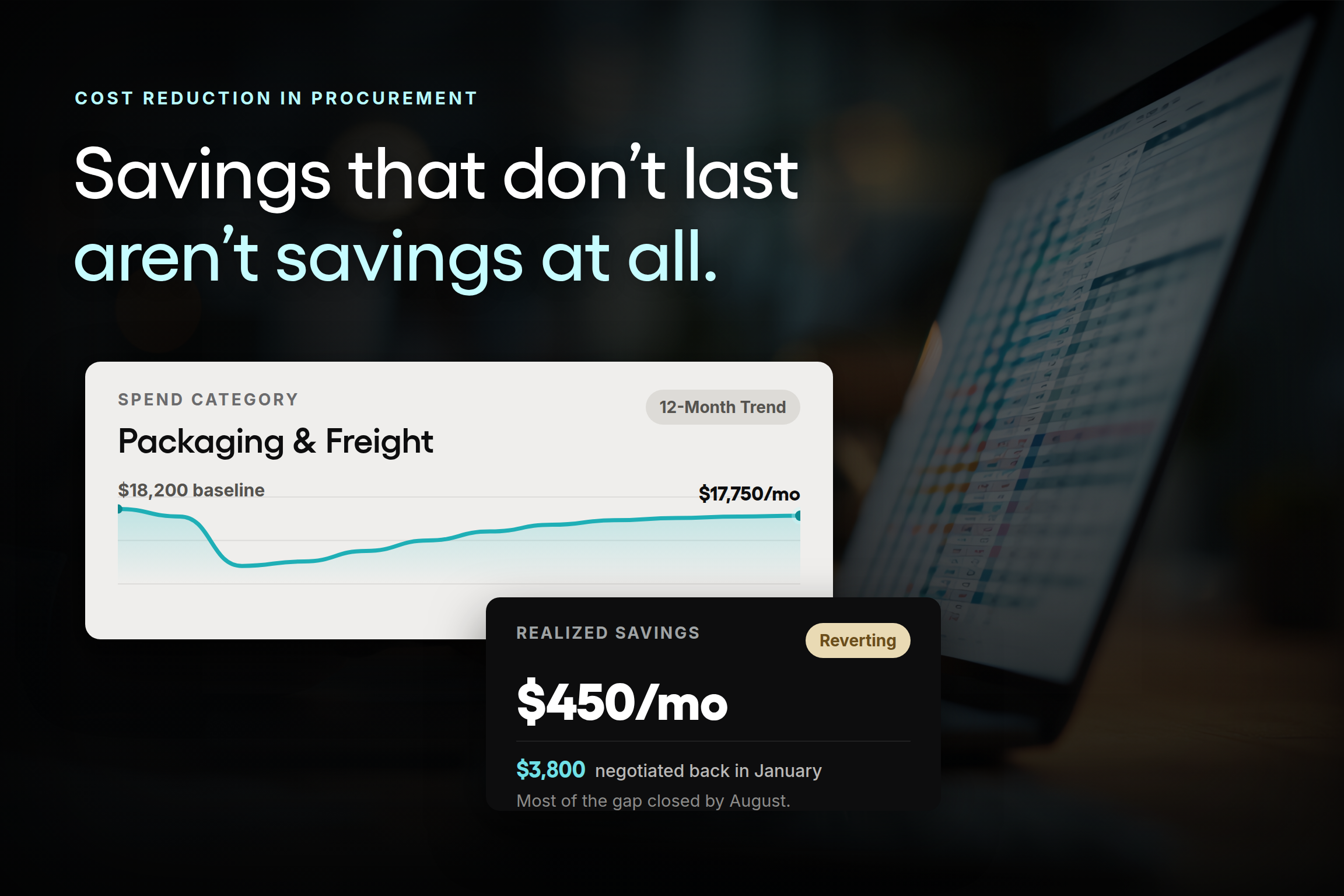
Most organizations can find cost-saving opportunities. Far fewer can still point to them a year later.
The pattern is consistent enough to be predictable. A team runs a sourcing exercise, negotiates a better rate, reports the number, and moves on.
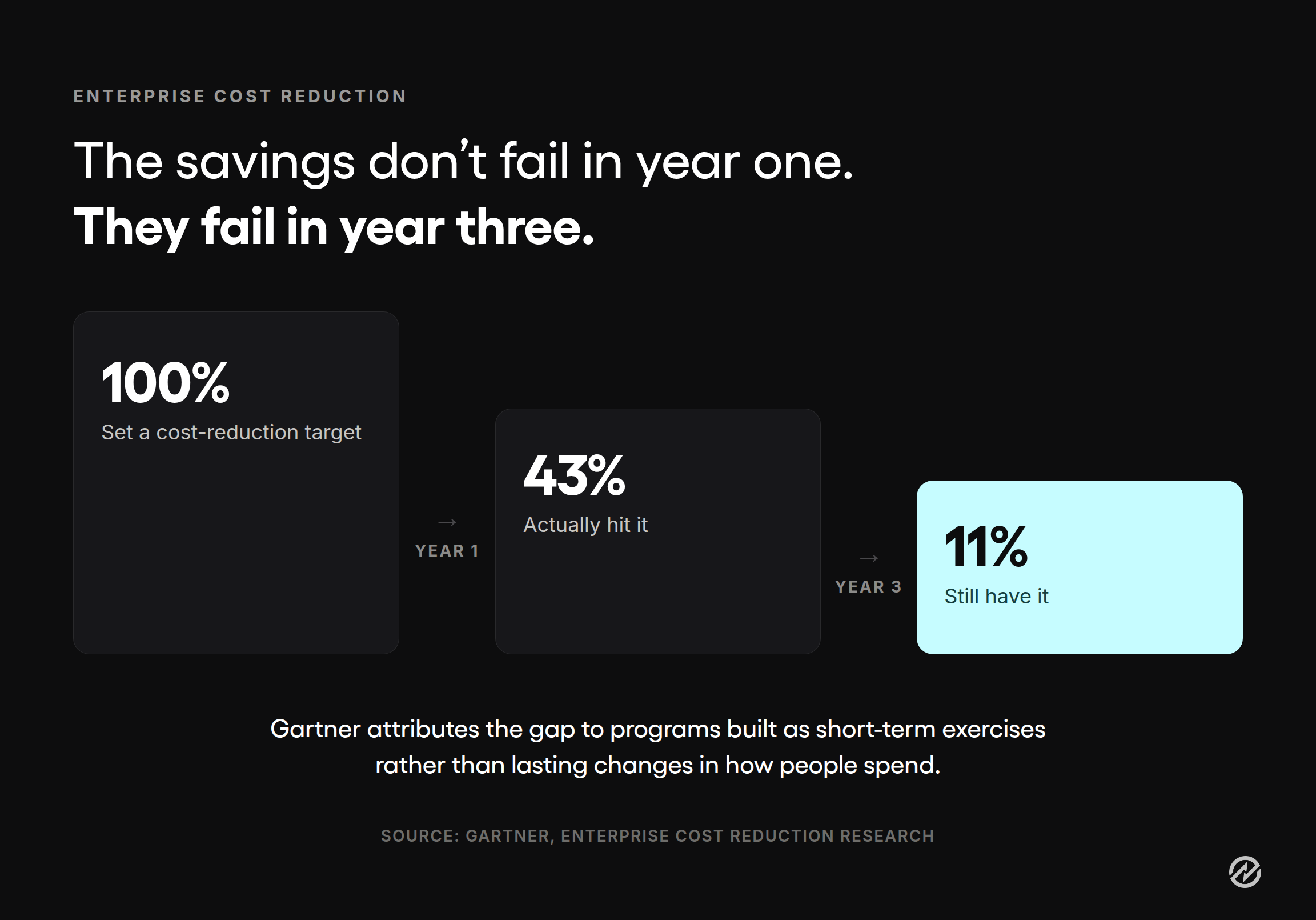
Gartner's research on enterprise cost reduction puts a number on it. Only 43% of leaders hit their cost-saving target in the first year, and just 11% sustain those savings across three consecutive years. Gartner attributes the gap to programs built as short-term exercises focused on immediate savings rather than lasting changes in how people spend, which is why removed costs creep back once the pressure lifts.
Three failure modes account for most of that.
- The savings depended on negotiation rather than change. A supplier agrees to a lower rate. Nothing else about the purchase changes: the same volume, the same specification, the same ordering pattern, the same people buying outside the contract when it's inconvenient. That rate holds until the supplier's next increase, and then you're negotiating the same category again.
- Nobody agreed on the baseline. The savings figure gets calculated against whatever comparison makes it look best: last year's price, the first quote received, the budgeted amount, the supplier's opening offer. Finance calculates it differently, arrives at a smaller number, and the credibility of the whole program takes the hit.
- The control lived in policy but not in the workflow. A purchasing policy says orders above a threshold require approval and must go to an approved supplier. The policy is correct, communicated, and largely ignored.
That third one deserves a longer look, because it's gotten worse rather than better.
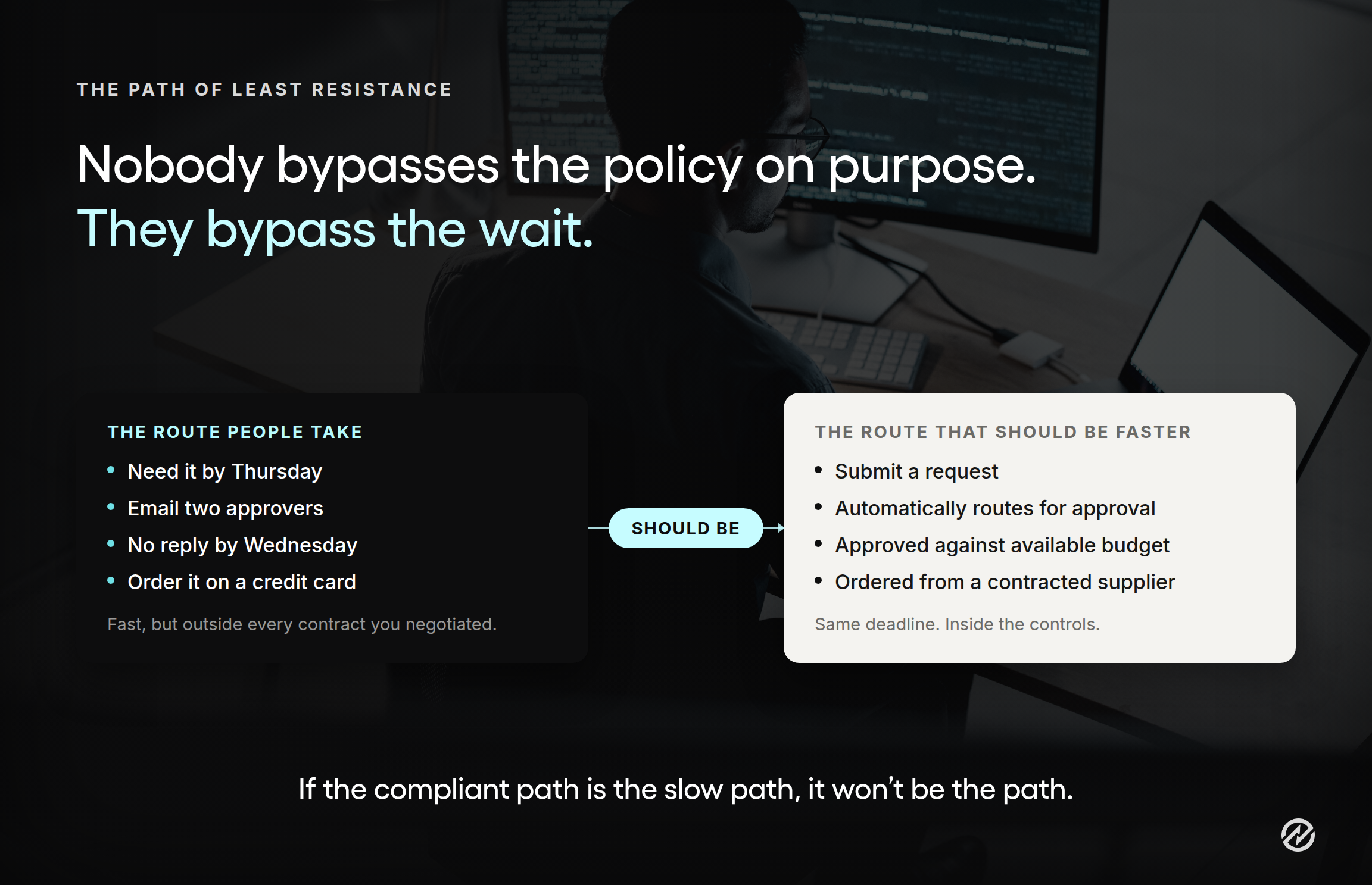
Purchasing expectations have compressed. A transaction that used to take a week is now expected to close in a day. What hasn't compressed is the approval process, which in many organizations still depends on people forwarding messages and waiting for replies. When the control is slower than the need, people route around it. That isn't a discipline problem, and treating it as one yields training sessions rather than results. It's a design problem: the compliant path has to be the fast path, or it won't be the path.
Where to look first: sequencing your cost reduction efforts
Before you negotiate anything, get the spending picture in front of you.
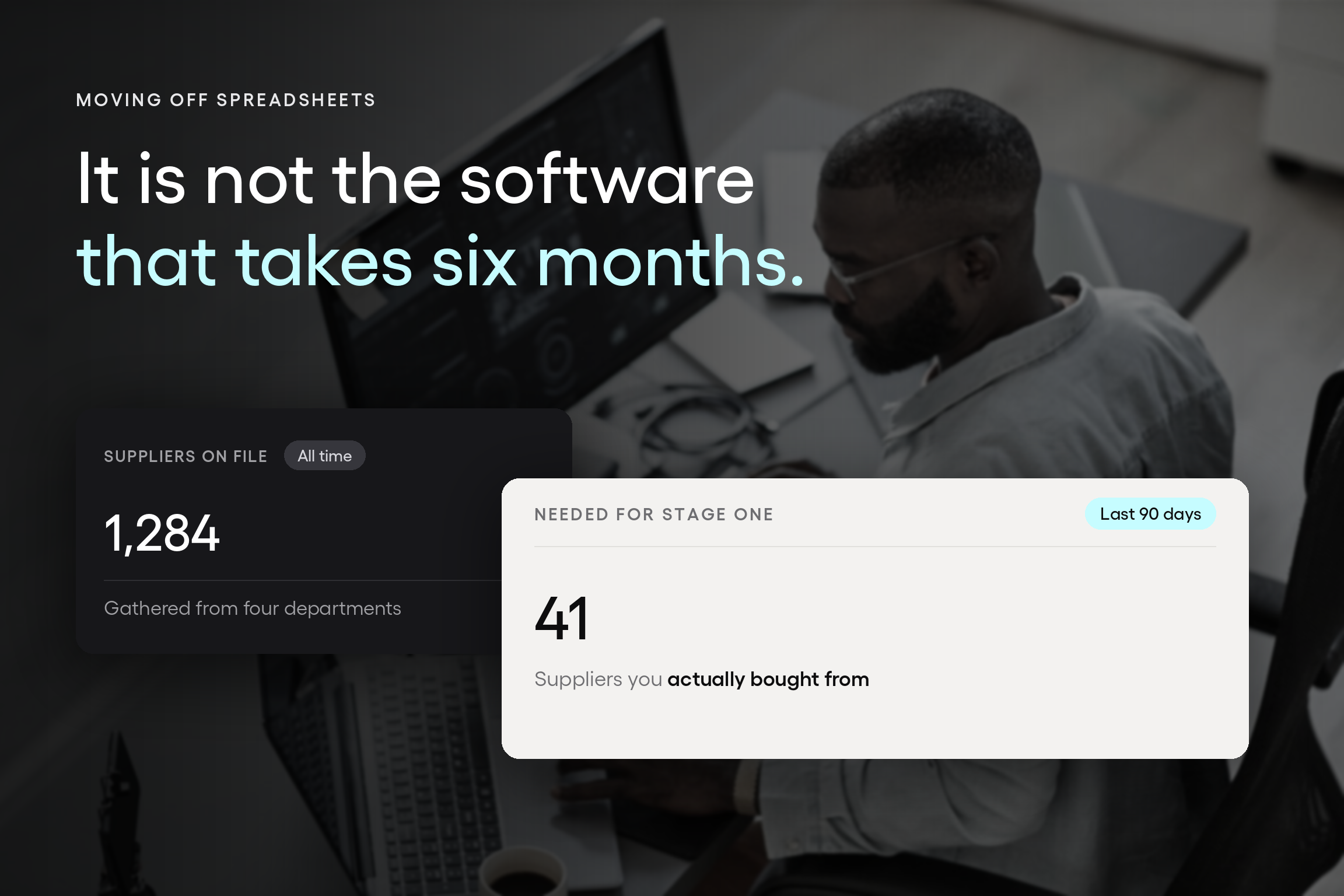
A procurement spend analysis pulls purchasing data from across departments, locations, and systems, then groups it so patterns become visible: what you buy, from whom, how often, at what price, and how much of it runs outside your contracts.
Most organizations doing this for the first time find the same three things. Spending is more concentrated than anyone assumed, a handful of categories account for most of the value, and a surprising share of purchases went to suppliers nobody formally selected.
That last discovery is usually where the hidden costs live.
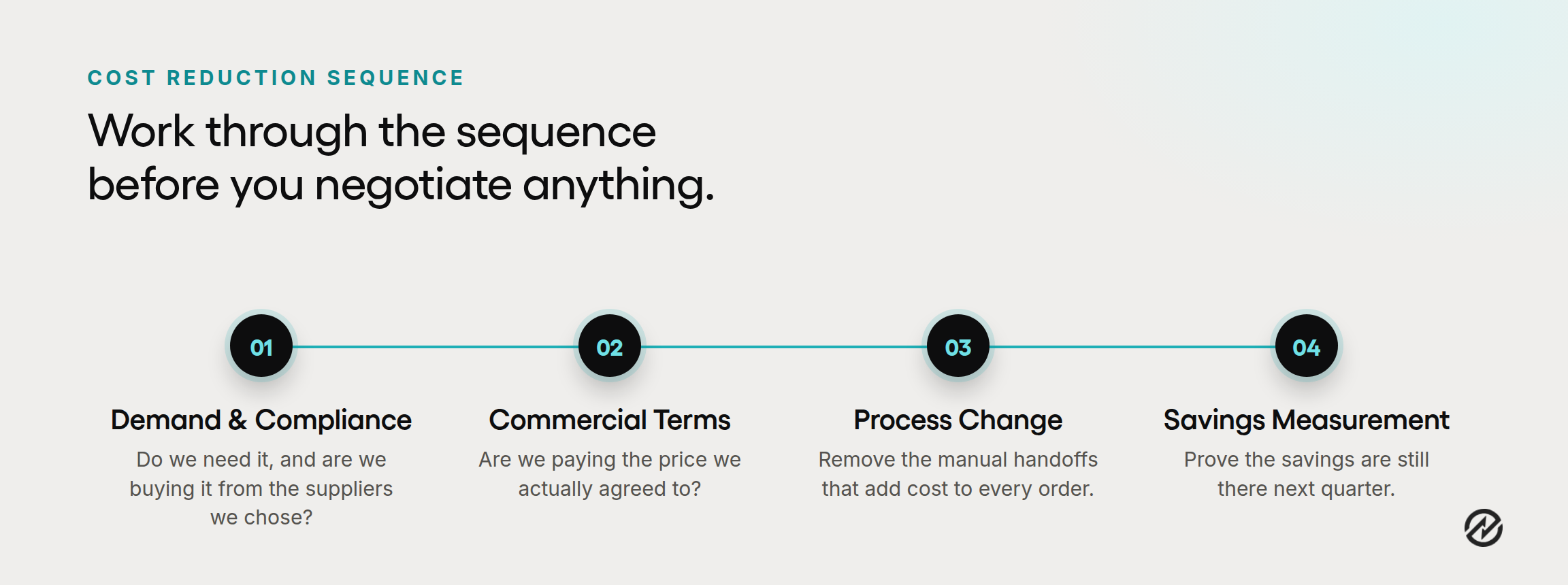
Once you can see the spending patterns, work through every significant category in this order. The order of these diagnostic questions matters, because each question makes the next one cheaper to answer.
- Do we need this at all? The cheapest purchase is the one that doesn't happen. Subscriptions nobody uses, standing orders that outlived their reason, safety stock covering a risk that no longer exists.
- Do we need this much, this often? Order frequency and quantity are usually set by habit. Reviewing demand routinely finds more money than renegotiating price, and it costs nothing to look.
- Are we buying from the right suppliers? Off-contract purchasing quietly reverses savings you already earned. You don't need a new negotiation to capture this, only enforcement of a decision already made.
- Are we paying the price we agreed to? Contracted rates and invoiced amounts drift apart more often than most teams expect.
Once you’ve run your initial diagnosis, set your cost-reduction goals against the complete sequence rather than a single percentage target, and tie them to business priorities.
A savings goal that ignores which categories the organization actually depends on produces reductions that get reversed the first time something breaks.
10 procurement cost reduction strategies that hold up
These are grouped by how quickly they pay back and what must be true for each to work. Run them roughly in this order. The early ones cost little and make the later ones more effective, but not vice versa.
1. Run a spend analysis before you negotiate anything
Pull twelve months of procurement data and group it by category, supplier, department, and location. You're looking for concentration, duplication, and leakage: the same item bought from four suppliers at four prices, categories nobody owns, and spend sitting outside every contract you've signed.
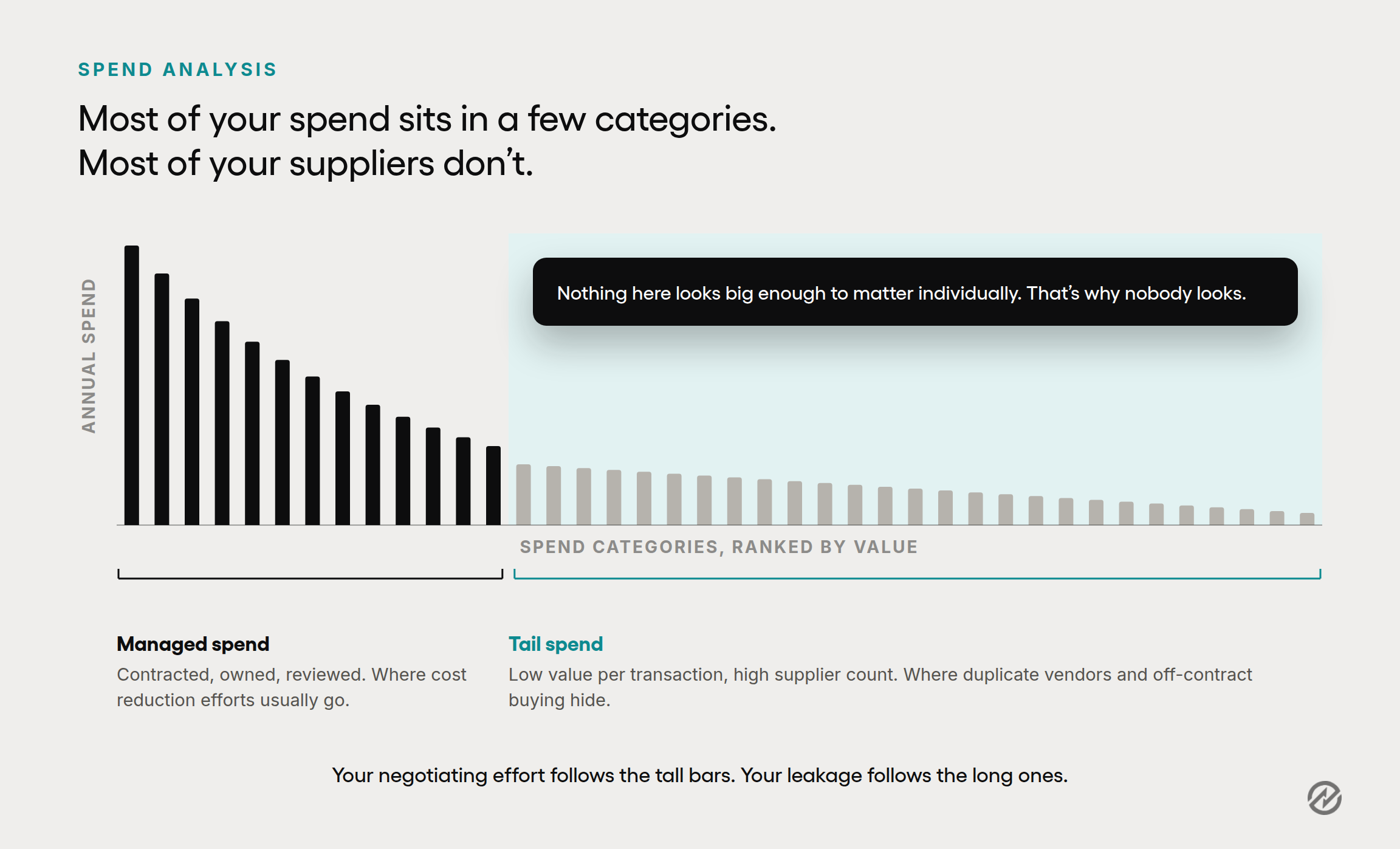
The pattern is consistent: a small number of categories carry most of the value, and a long tail of low-value, unmanaged purchases carries most of the suppliers. That tail is usually where duplicate vendors and off-contract buying hide, and it rarely gets attention because no single transaction looks big enough to matter.
2. Eliminate maverick spending by making the compliant path the fastest one
Maverick spending is any purchase made outside your approved suppliers, contracts, or approval rules. It's rarely deliberate. It happens because someone needs something, and the official route is slower than the deadline allows.
Publishing the policy again won't fix it. Two things do: make approved suppliers easy to find and order from, and route approvals automatically so requests reach the right person without anyone forwarding an email.
Track unauthorized spending as a percentage of total spend. If it's falling, your controls are working. If it's flat while your policy documentation grows, they aren't. APQC maintains this as a standard procurement benchmark, so you're measuring the same thing as your peers.
3. Review demand before you review price
Most organizations buy on autopilot. Order quantities, reorder points, and standing subscriptions get set once and then inherited by people who never question them.
Ask three questions of any recurring purchase.
- Is anyone still using this?
- Are we ordering more than we consume before it expires or becomes obsolete?
- Could a different specification do the same job for less?
Demand reductions are the most durable way to reduce costs, because they don't depend on a supplier agreeing to anything. Nobody can raise the price of something you don’t buy.
4. Consolidate suppliers where the volume justifies it
Fragmented purchasing splits your leverage. Three suppliers, each getting a third of a category, means you don’t get competitive pricing from any of them, plus three onboarding processes, and three sets of invoices to process.
Supplier consolidation aggregates volume to reach better pricing tiers and reduces the administrative and operational processes associated with each additional vendor record.
The caution: consolidation raises concentration risk. Before awarding a category to one supplier, know how quickly you could replace them. For anything the organization can't operate without, keep a qualified alternative even if it costs slightly more.
5. Review supplier contracts on a schedule, not at renewal
Most contracts auto-renew because nobody diaried the date. By the time anyone looks, the leverage is gone, and the choice is accept or scramble.
Build a contract management calendar that includes each agreement, its value, renewal date, notice period, and a review trigger set 90 to 120 days ahead. That window is when you still have options.
Check three things at each review: whether contract terms still match how you actually buy, whether invoiced prices match agreed rates, and whether market conditions have moved since signing. Rate drift between contracted and invoiced pricing is common and almost always in the supplier's favor.
6. Use competitive bidding where the market is genuinely competitive
Running a structured sourcing event, comparing supplier proposals against the same criteria, reliably produces better pricing than a single-supplier conversation. That's the core of strategic sourcing, and it works best when it's scheduled against your cost-reduction aims rather than triggered by a renewal you almost missed.
Before running a strategic sourcing event, confirm the market is real: are there three or more suppliers who can meet the specification and would compete for this volume?
Score bids on total cost, delivery performance, and capability, not price alone. A bid comparison that only ranks price will pick the supplier you replace next year.
7. Negotiate payment terms and total cost, not just unit price
Suppliers protect headline price harder than anything else, because it's what their own reporting measures. There's usually more room elsewhere.
Extended payment terms improve cash flow without changing what you pay. Consolidated delivery schedules cut freight. Removing expedite fees, minimum order charges, and small-order surcharges can be worth more than the discount you were fighting for.
Ask suppliers what would make your account cheaper for them to serve. Fewer, larger, more predictable orders usually cost them less, and that's a saving they can share rather than absorb.
8. Implement category management
Category management assigns ownership of a spend category to someone accountable for its cost, suppliers, and performance over time, rather than handling each purchase as it appears.
That ownership is what turns one-off savings into an ongoing position. The category owner knows the supply market, tracks price movements, plans sourcing ahead of renewals, and spots consolidation opportunities that a transactional buyer never sees.
Start with two or three high-value categories rather than the whole spend map, and see our guide to procurement category management for guidance on structuring ownership. A decentralized procurement structure makes this harder, but not impossible: the owner sets the strategy centrally, while sites execute it.
9. Cut the cost of running the process
Every purchase consumes staff time across requesting, approving, ordering, receiving, matching, and paying. Those labor costs scale with purchasing volume and almost never appear in a savings report, because no invoice records them.
APQC benchmarking data published in 2026 puts the cost of processing a single purchase order anywhere from about $14.00 to more than $54.00, and attributes most of that spread to how the work is structured rather than to industry or volume. At tens of thousands of orders a year, the gap between those two figures is a line item.
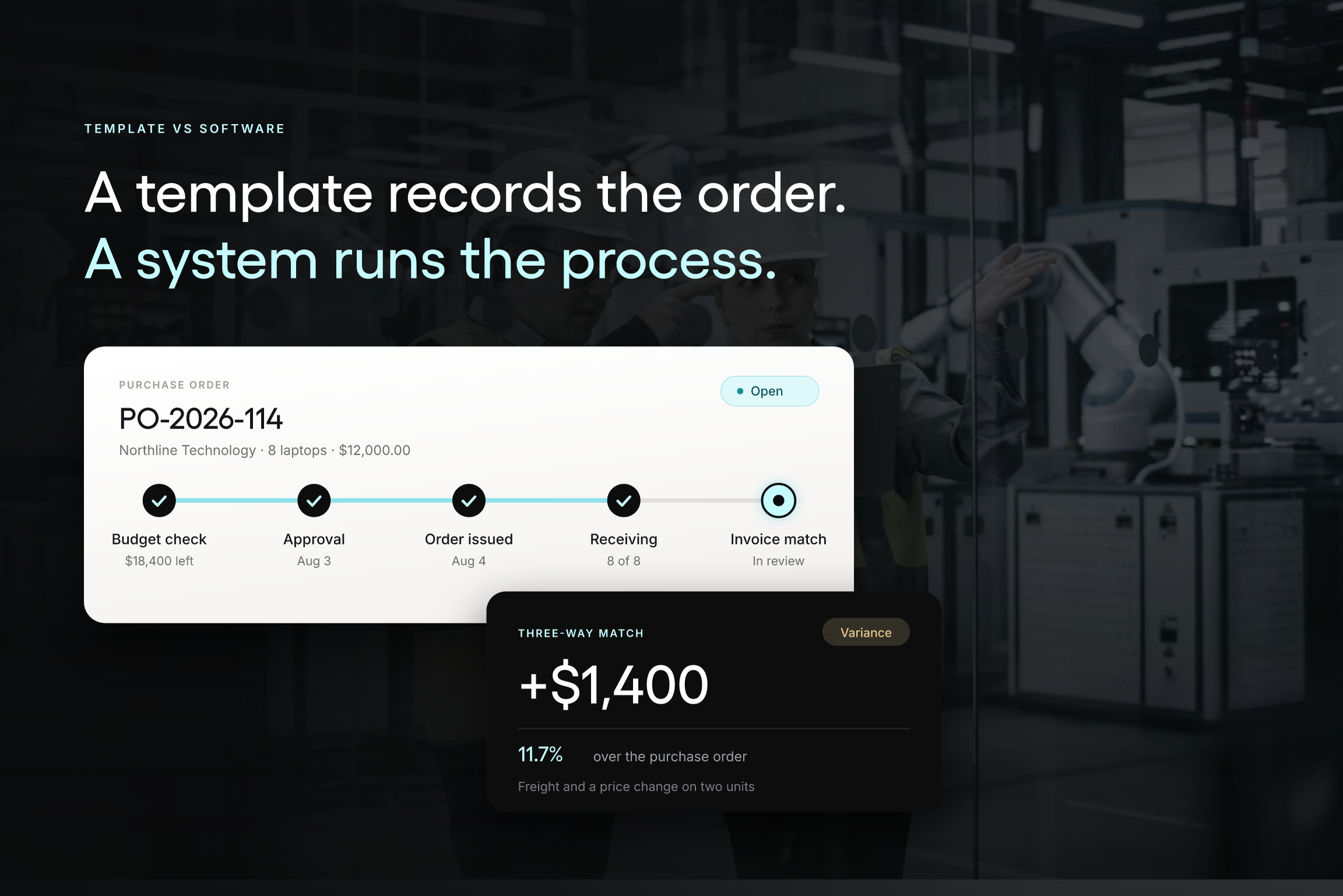
Process efficiency improvements come from removing handoffs, not from working faster. Approval routing that doesn't require chasing. Requests that arrive complete the first time. Invoices are matched against orders and receipts automatically rather than line by line.
This is where the largest reductions usually sit in growing organizations, and where the savings are hardest to reverse, because you'd have to deliberately reinstate the manual steps.
10. Manage supplier performance and reduce procurement risk
Supplier management is where cost reduction stops being a negotiation and becomes a relationship.
A supplier who delivers late, ships the wrong quantity, or fails quality checks costs you more than their price suggests. Expedited replacements, production delays, and staff time spent resolving problems are real procurement costs that land in someone else's budget line.
Supplier performance management makes those costs visible. Track on-time delivery, quality acceptance, and pricing accuracy for your top suppliers, review the results with them on a set cadence, and use the record in renewal decisions.
The same information supports risk mitigation. Knowing which suppliers you depend on and how exposed you'd be if one failed turns supplier relationships into a source of business value rather than a source of surprises.
How to measure and prove procurement savings
This is where cost reduction programs live or die politically, and it has almost nothing to do with procurement skill.
Finance will ask three questions about any savings figure you report.
- What did you compare it to?
- Will it still be there next year?
- Can I see it in the accounts?
A savings number that can't answer all three gets challenged, and after that happens twice, the procurement team stops being invited to the conversation early enough to matter.
Agree the baseline before you start, not after
Every savings figure is a comparison, and the comparison is a choice. The same purchase produces wildly different results depending on which baseline you pick.
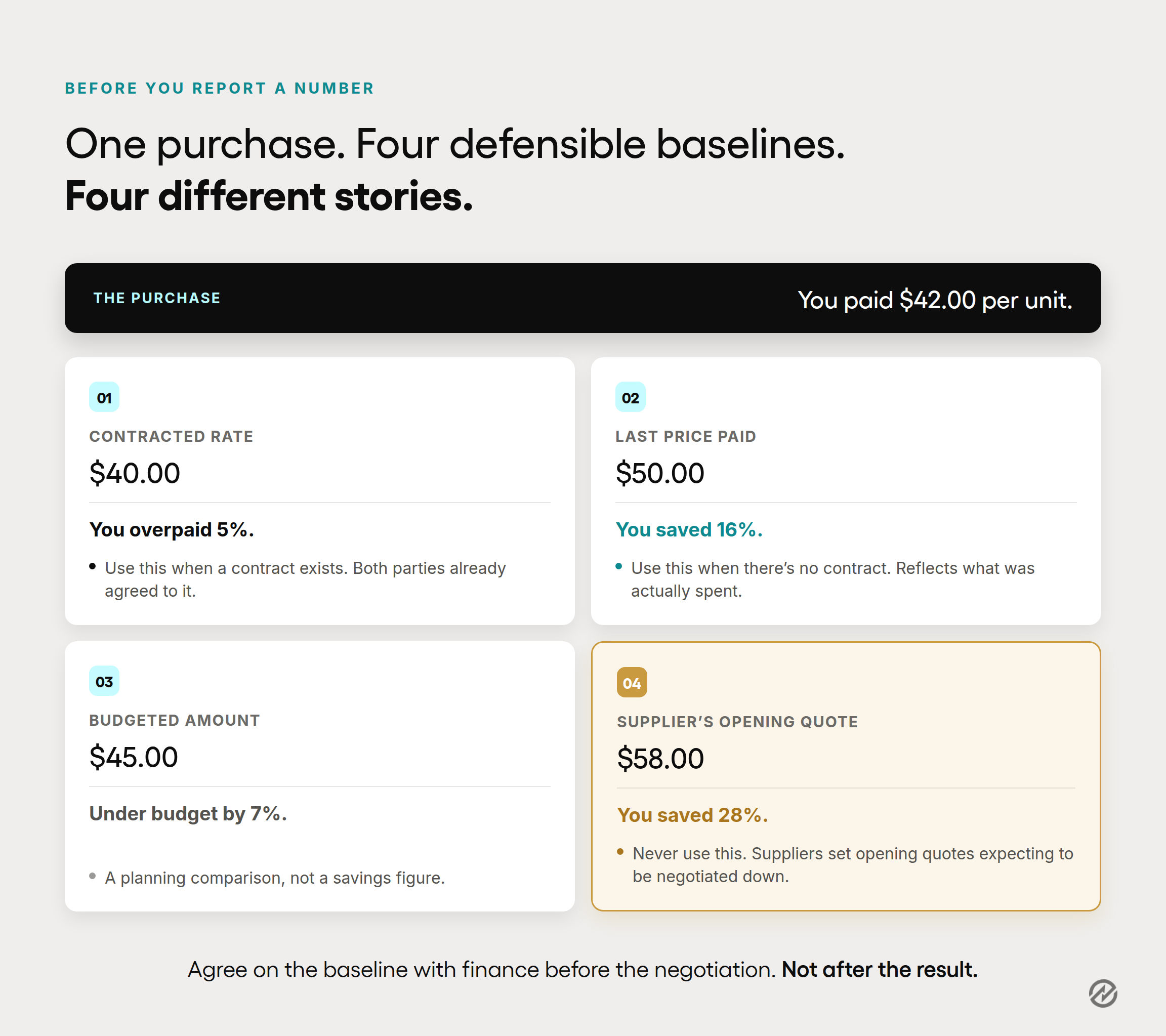
Say you buy an item at $42.00 per unit. Against last year's price of $50.00, you saved 16%. Against the contracted rate of $40.00, you overpaid. Against the supplier's opening quote of $58.00, you saved 28%. Against a $45.00 budget, you came in under.
Four defensible baselines, four different stories, one purchase.
Pick the baseline before the negotiation and write it down. Three rules make it hold up:
- Use the contracted rate when one exists. It's the number both parties already agreed to, which makes it the hardest to argue with.
- Use last price paid when there's no contract. It reflects what the organization actually spent rather than what someone hoped to spend.
- Never use the supplier's opening offer. Suppliers set opening quotes knowing they'll be negotiated down. Measuring against them manufactures savings that never existed, and finance knows it.
Report savings, avoidance, and realized savings separately
Combining these into one number is the fastest way to lose credibility, because the three behave differently and finance treats them differently.
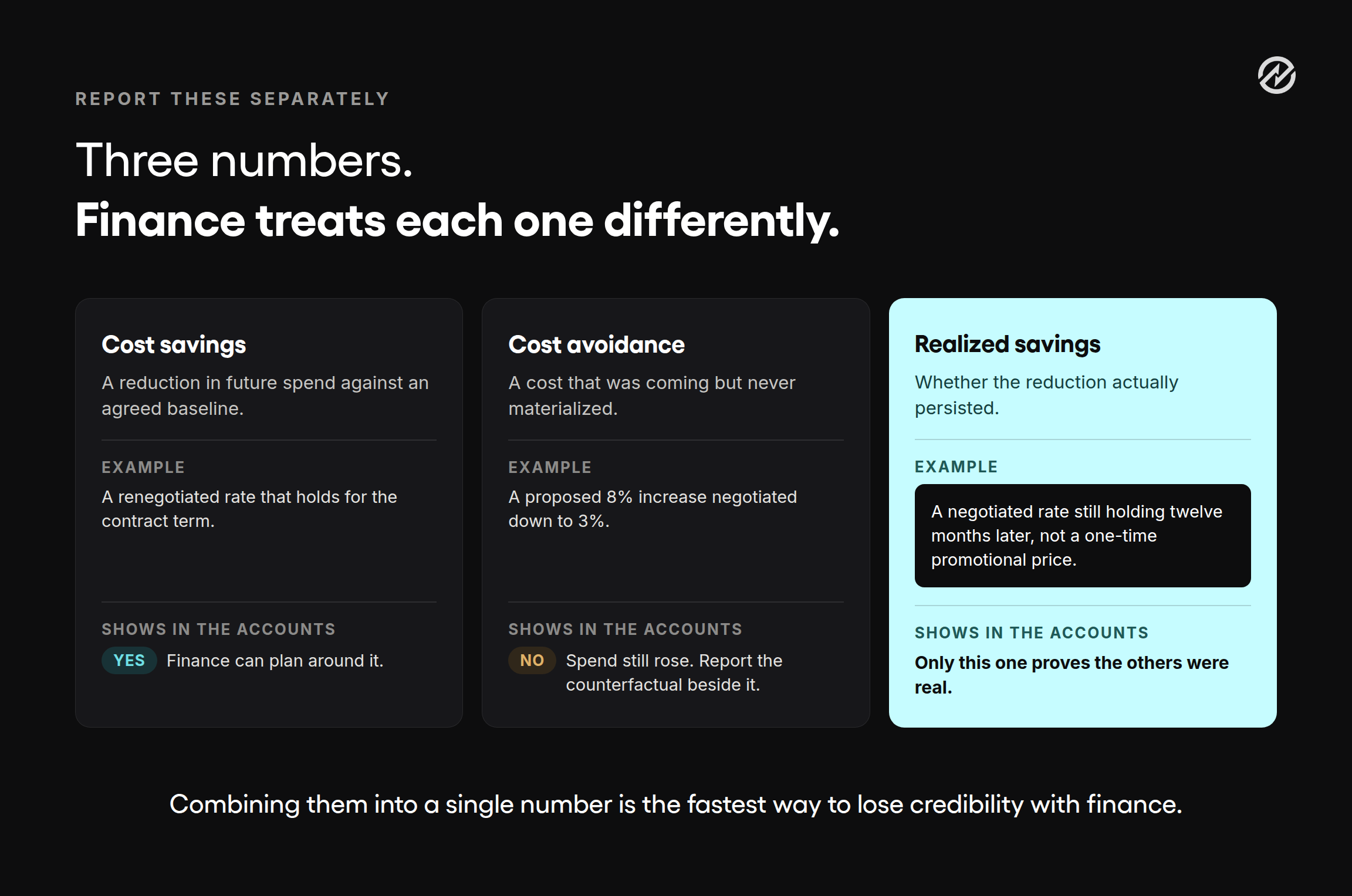
Cost savings reduce future spend against an agreed baseline. A renegotiated rate that holds for the contract term. These appear in the budget, and finance can plan around them.
Cost avoidance is a cost that didn't materialize. You negotiated a proposed 8% increase down to 3%. Your spend went up, so this will never show as a reduction in the accounts, but the organization is 5% better off than it would have been. Report it in its own line, and write the counterfactual next to it: what the cost would have been, and why.
This isn't just internal hygiene. APQC, which maintains one of the largest process benchmarking databases in the world, tracks cost takeout and cost avoidance as two separate measures, each with a different definition. Cost takeout is measured as the year-over-year difference on the same recurring purchases. Cost avoidance is classified as intangible savings. If the benchmarking standard keeps them apart, your reporting should too.
Realized savings ask whether the reduction actually persisted. A negotiated rate that held for twelve months is realized. A one-time promotional price that produced the same number last quarter is not. Tag every saving as either repeatable or one-time when you record it, and report them separately.
Measurable savings that persist come from the demand, compliance, and process changes covered earlier, which is why sequence matters as much as tactics.
Track a small number of things, consistently
Procurement performance improves when the same short set of measures gets reviewed on a set cadence. Four are usually enough:
- Realized savings against baseline, split into repeatable and one-time
- Spend under management, meaning the share of total spend running through approved suppliers, contracts, and approval workflows
- Purchase price variance, comparing what you paid against what you expected to pay, item by item
- Procurement cycle time, from request to purchase order, since it's the clearest proxy for what the process costs to run
Review them monthly rather than quarterly. A variance figure produced once for a board meeting tells you almost nothing. The same figure produced every month shows you where the process leaks, which turns cost reduction from an annual project into continuous improvement.
None of this works if the underlying purchase data is stored in separate spreadsheets. Consistent measurement depends on requests, approvals, orders, receipts, and invoices being recorded in the same place, which is the practical argument for procurement reporting and analytics.
What procurement management software changes about cost reduction
Procurement management software doesn't produce savings. It makes the decisions you've already made enforceable and the results sufficiently visible to defend.
That distinction is worth stating plainly, because this category gets sold as a savings engine and then judged against a promise no software can keep. What it actually does is close the gap between the procurement processes written in your policy and the ones people follow when they're busy.
Four connections matter specifically for cost reduction.
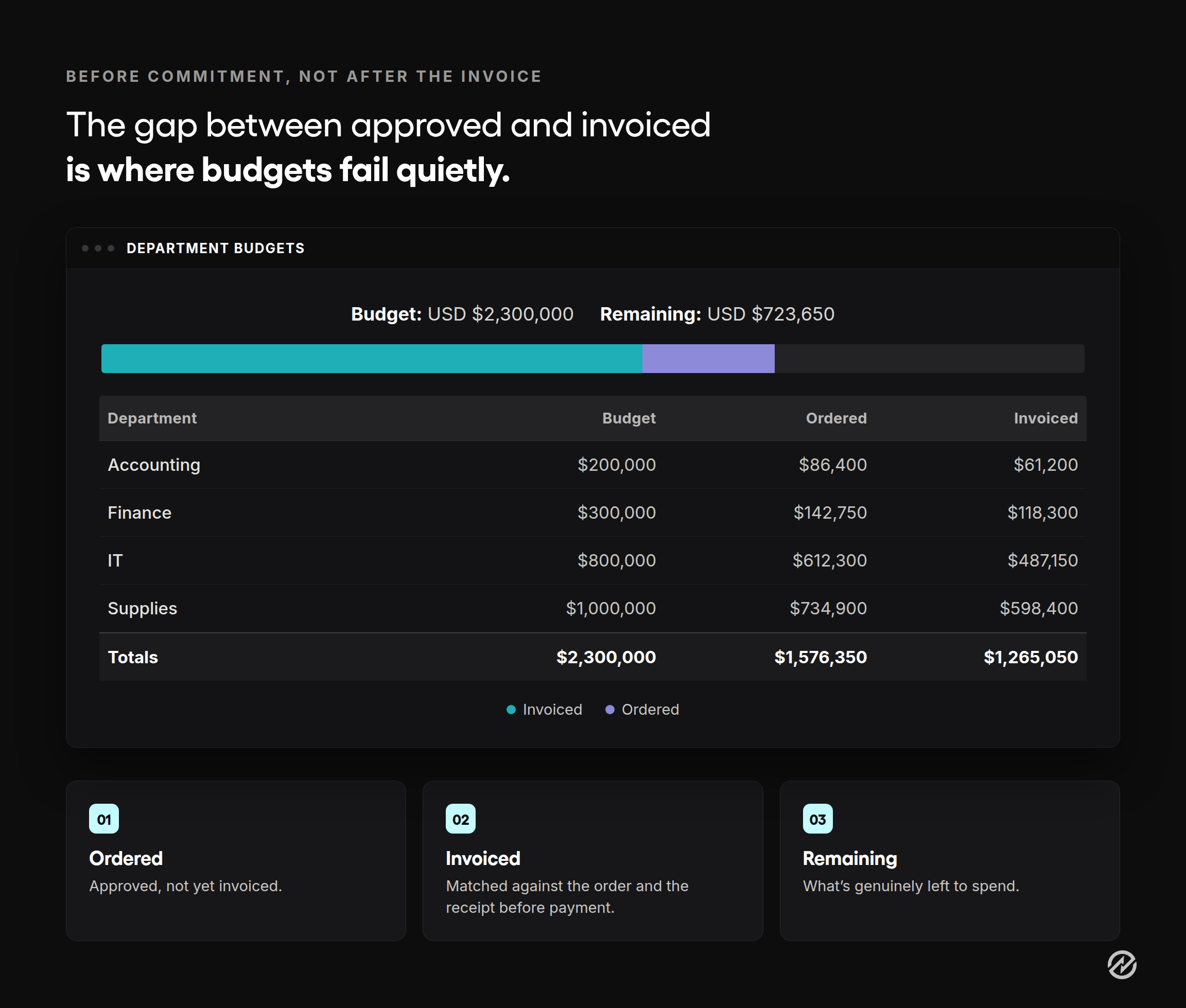
Budget and spend controls. Budgets are set by category, department, project, or location, and requests are checked against available budget before approval rather than after the invoice lands. Finance sees committed spend alongside paid spend, which is the difference between managing costs and reporting them.
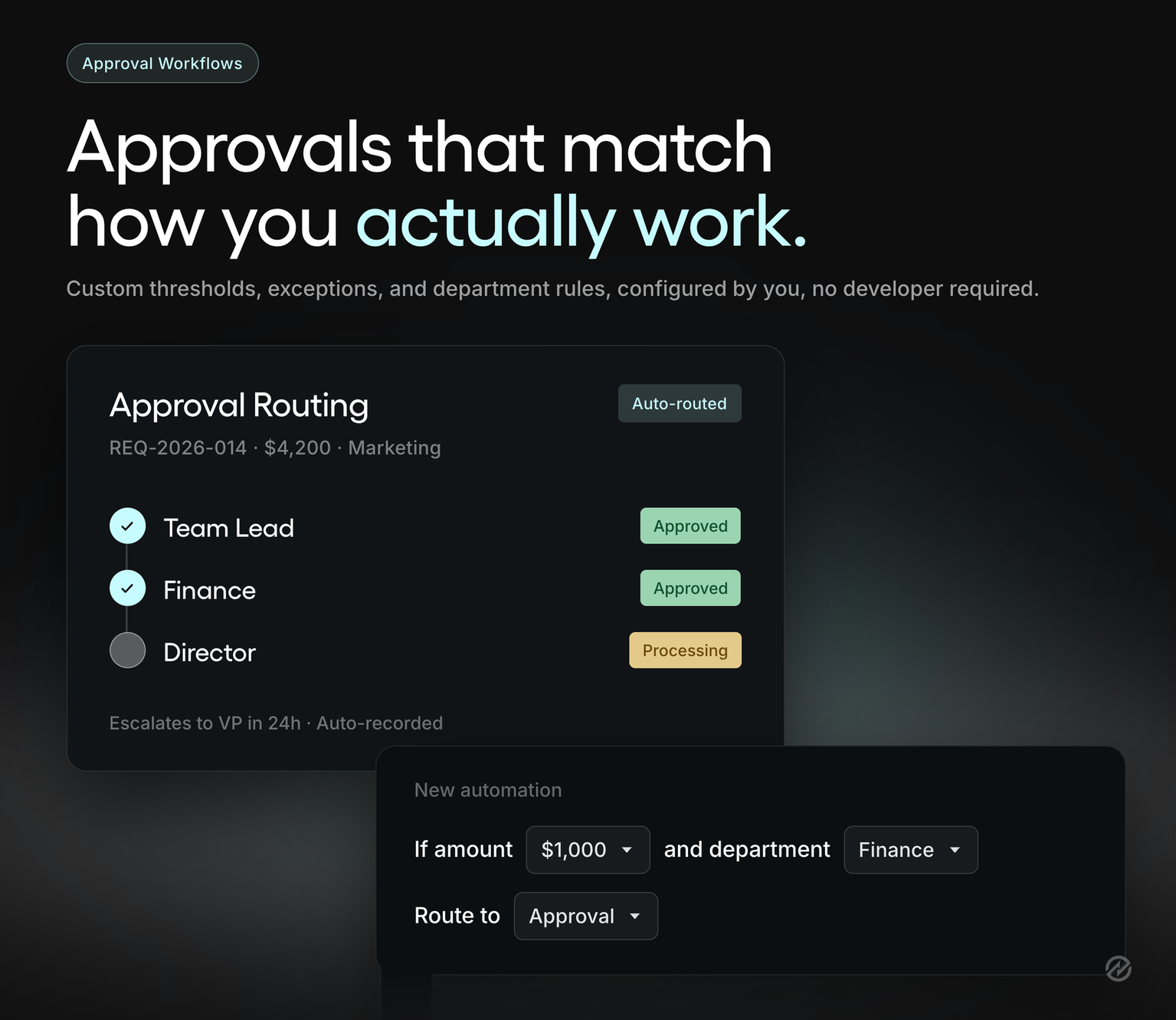
Configurable approval workflows. Requests route automatically based on amount, department, location, or supplier, so the compliant path becomes the fast path. That's what reduces maverick spending in practice, rather than another policy reminder.
Connected records across the entire procurement lifecycle. Requests, approvals, purchase orders, receipts, and invoices remain linked to one another. Invoice matching compares all three before payment, so price and quantity differences surface while the money is still yours. A centralized purchase-to-pay process also means your procurement data lives in one place, which makes the measurement discipline above possible.
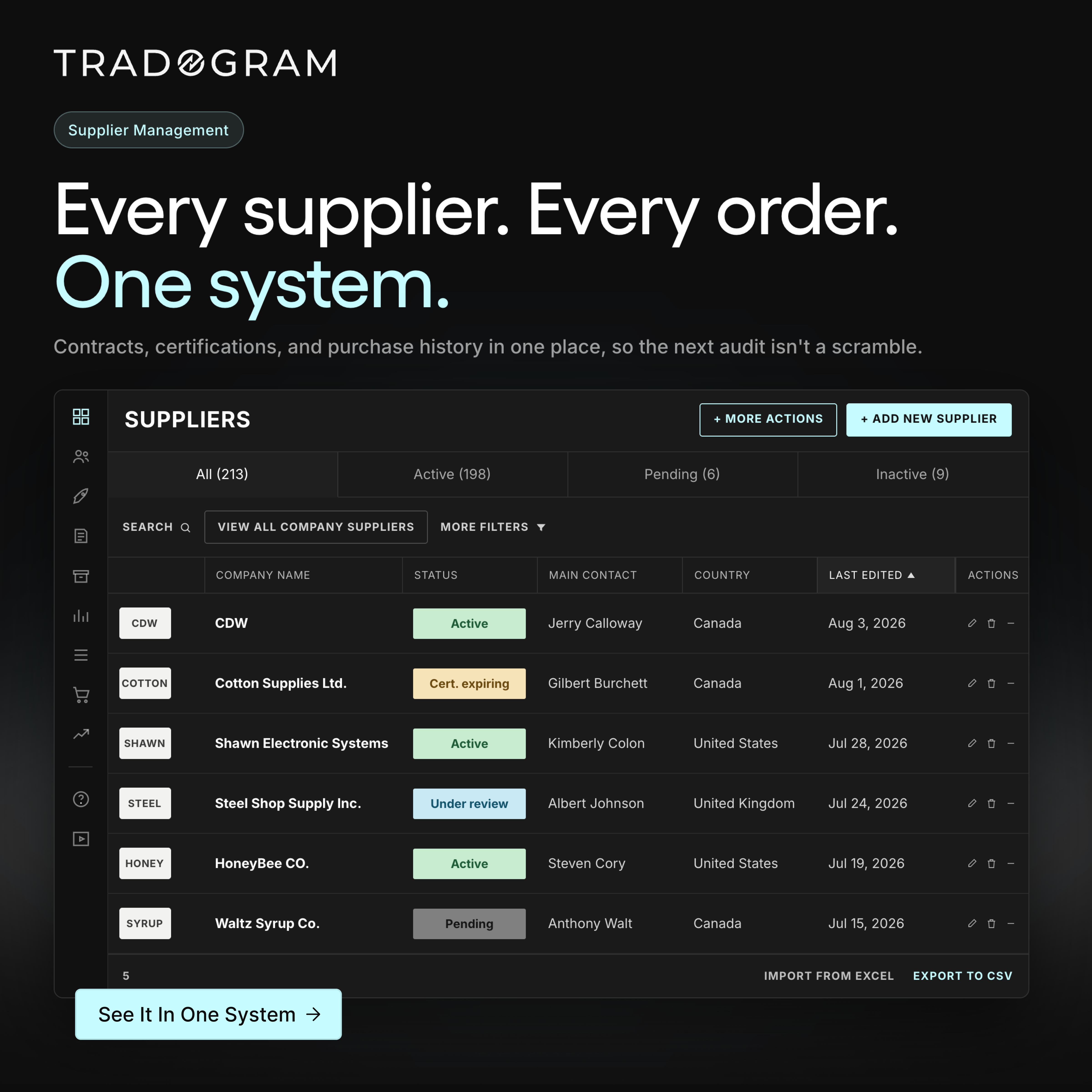
Supplier management and contract management in one record. Supplier performance management, pricing history, documents, and renewal dates sit together. Supplier relationship management stops being a quarterly scramble through folders, and risk management becomes something you can act on before a contract auto-renews.
The operational efficiency gains show up fastest in cycle time. Ashesi University reduced purchase order processing time from 2 to 3 business days to under 2 hours and reported a 15% cost reduction. Ohio Hills Health Services went from more than five business days to a few minutes, with procurement-related costs down more than 10%. Technical America reported purchasing cost savings of around 25%.
Those are the strong results. It's fair to show the other end too: Leafline Labs and the National Security Institute each reported operational savings in the 1% to 5% range. What separates them isn't the software. It's how much unmanaged spend existed before it.
If your entire procurement lifecycle is already centralized, contracts are up to date, and compliance is high, software will streamline processes and save administrative time rather than transform your cost base. If requests arrive by email and nobody can say what's been committed this month, the savings available are considerably larger.
Start with one category, not the whole spend map
The fastest way to derail a procurement cost-reduction program is to try to fix everything at once. A program that tackles every category at the same time creates plenty of activity, but very little that survives the year.
Pick one category instead. Something meaningful in value, messy enough to have real savings opportunities, and small enough that you can finish.
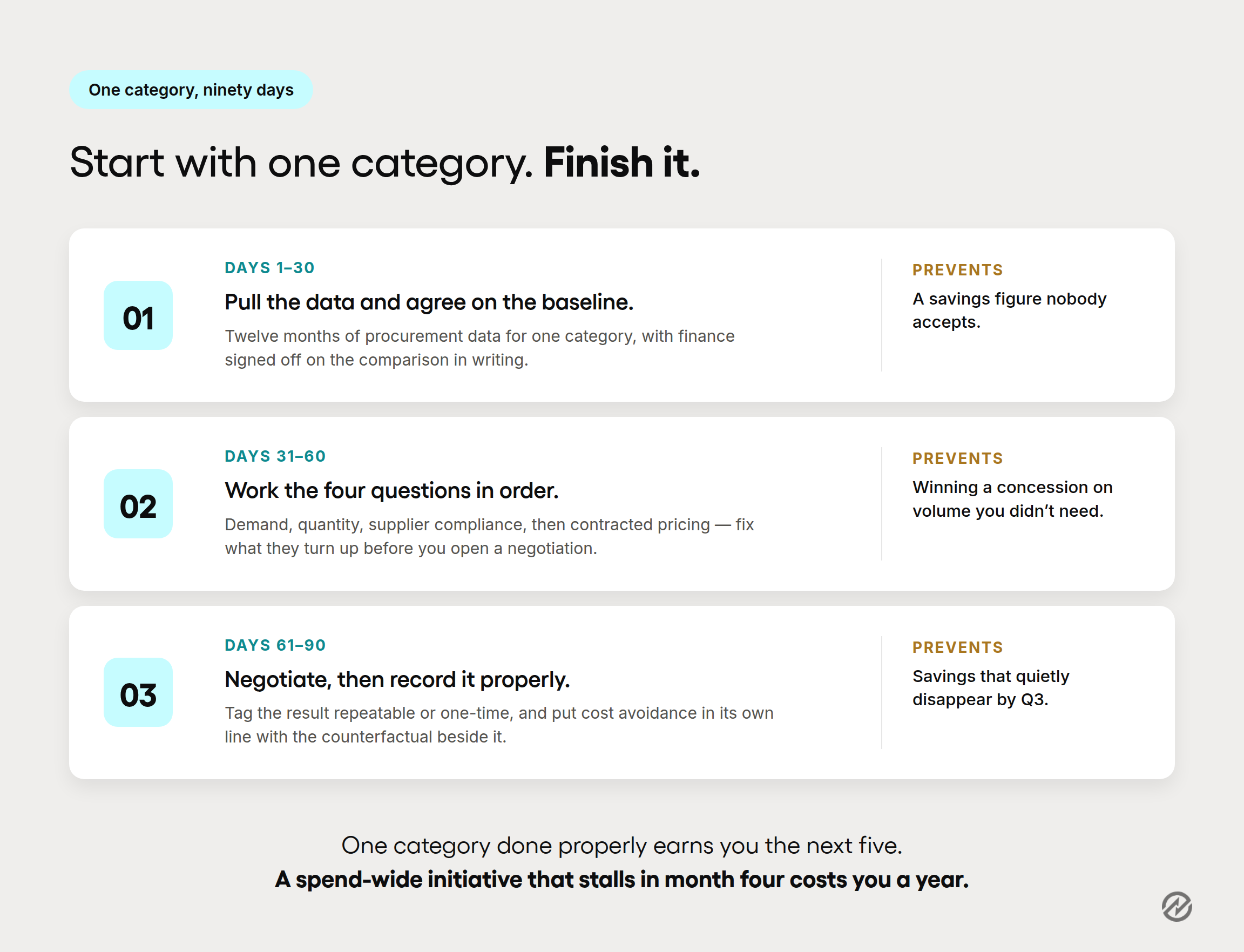
In the first month, pull twelve months of procurement data for that category and agree the baseline with finance before you touch anything. Write down which comparison you'll use and get someone in finance to say yes to it.
In the second month, work the four questions in order. Do we need it? Do we need this much? Are we buying it from the suppliers we chose? Are we paying the price we agreed to? Fix what those turn up before opening a negotiation.
In the third month, take what's left to the supplier, then record the result properly. Tag it repeatable or one-time, separate any cost avoidance into its own line with the counterfactual written beside it, and report it.
One category done properly earns you the credibility to run the next five.
A spend-wide initiative that stalls in month four costs you that credibility for a year.
If your purchasing runs on spreadsheets and email today, the constraint won't be finding savings. It'll be proving them and keeping them. That's what a connected purchasing process is for.