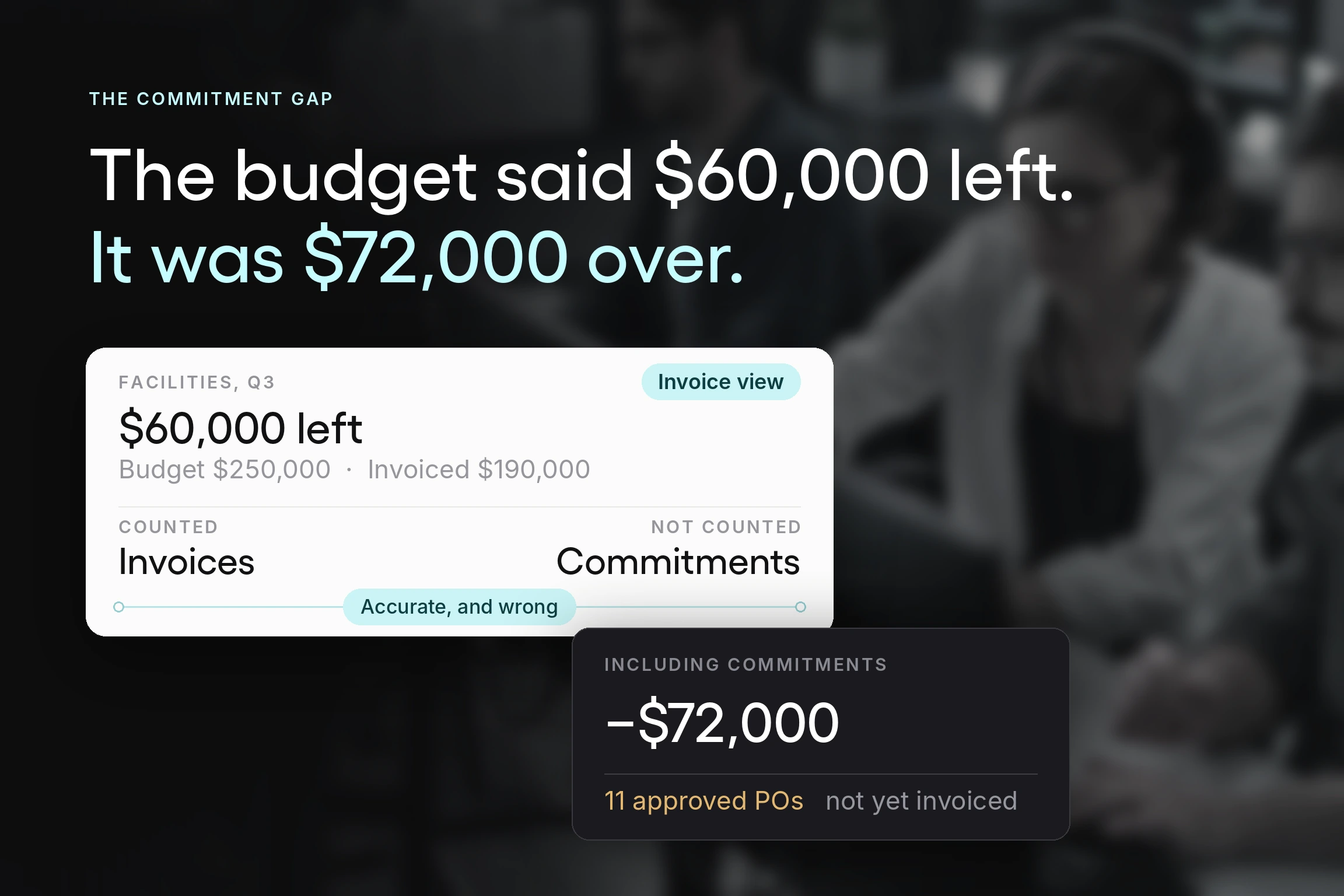


Every month, someone in your organization reports a budget remaining figure. Facilities has $60,000 left. It goes into the deck, finance accepts it, and the department keeps buying against it.
But that number counts invoices. It does not count commitments.
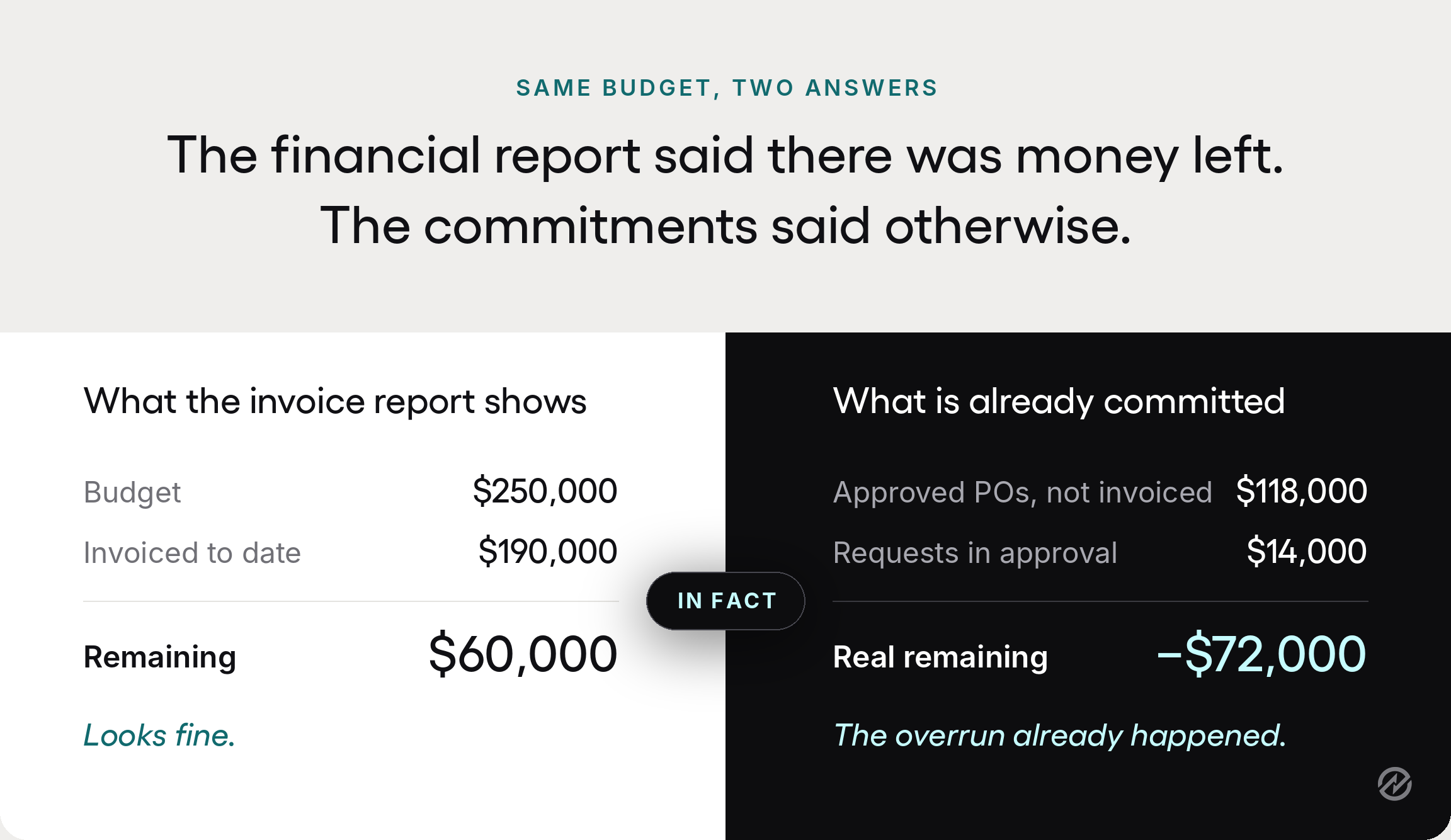
Behind the $60,000 sit eleven purchases approved over four months that have not yet been invoiced. Each was defensible on its own. None of them appeared as a running total to the person who approved the eleventh.
Add them up, and the real position is $72,000 in the red, and has been for weeks. The report was accurate about what had been paid and silent about what had been promised.
That gap between when money is committed and when anyone can see it shapes most cost overruns in organizations that have outgrown their current purchasing process.
At Tradogram, we have helped thousands of organizations digitize their procurement processes, and this gap is the single most common one we find. It also explains why the two things procurement software is best at, controlling overruns and preventing unauthorized purchases, are usually described as separate benefits when they are really the same capability applied at two different moments.
This guide covers how procurement software saves money in practice: where the savings opportunities come from, how the controls prevent unauthorized spend without slowing legitimate purchases, and how to track cost savings so finance credits them.
Key Takeaways
- Most cost overruns are a visibility problem, not a spending problem. Money is committed when a purchase is approved, but in manual processes it stays invisible until the invoice arrives weeks later. Budget owners approving against an invoice-only view are working from a number that is already wrong.
- Preventing unauthorized purchases is primarily an internal controls problem. In ACFE's 2026 Report to the Nations, more than half of occupational fraud cases involved either a lack of internal controls or an override of existing ones, and the typical case ran 12 months before detection. Controls applied at the request stage cost far less than after-the-fact detection.
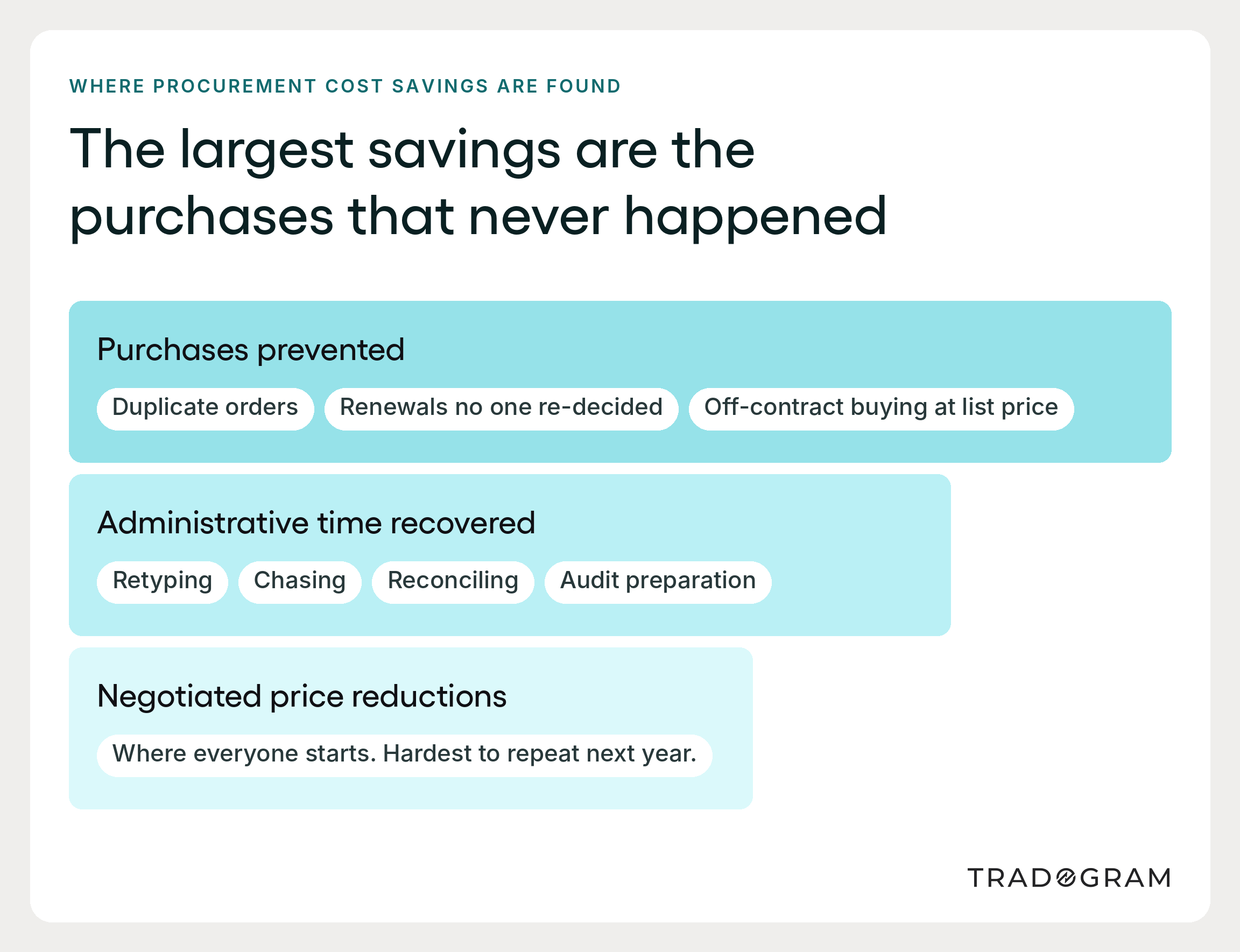
- The largest procurement cost savings come from purchases that never happen. Duplicate orders, renewals no one re-decided, and off-contract buying at list price are cheaper to prevent than to renegotiate. Prevention happens at the request, the last point where the purchase is still free to stop.
- Savings that were never baselined rarely survive contact with finance. Bain found that 7 out of 10 procurement teams lost at least 25% of the savings yield from their initiatives. Tracking cost savings against a documented starting position turns a procurement claim into a credited number.
- Supplier payment fraud has changed shape, and controls have to change with it. The current pattern is a request to change the banking details of a real supplier you use every month. Verified banking details captured at onboarding turn that request from a judgment call into a comparison.
The three places that procurement cost savings come from, and negotiation is the smallest
Negotiation is the first answer most teams give when asked where procurement software saves money: better prices from better-informed buying. That is real, and it is rarely the largest line.
The bigger savings come from three less visible places.
Purchases that do not happen. A duplicate order caught before it is placed, a subscription renewal that finally gets re-decided, a request routed to a contracted supplier instead of a new one at list price. None of these show up as a negotiated saving. All of them reduce procurement costs more reliably than a discount, and procurement teams often overlook them because nothing visible happens when they work.
Administrative time that no longer gets spent on manual grunt work. Retyping a request into a purchase order, chasing approvers, assembling an audit trail, reconciling invoices against orders by hand. Automating routine tasks reduces labor costs and frees procurement teams to focus on work that drives savings. Streamlining procurement processes this way improves procurement efficiency without adding headcount, which is usually the only option on the table.
Errors that never reach a supplier or a payment run. A price that does not match the contract, a quantity that does not match what arrived, an invoice paid twice. Each seems small, but across a year of purchasing volume, they can add up.
Procurement cost reduction is mostly the sum of these three, and all three depend on the same thing: the purchase being visible and checkable before the money is committed. That is also why spend visibility is the precondition for every other saving on the list. You cannot identify cost-saving opportunities in spending patterns you cannot see.
Anatomy of the commitment gap
Here is the mechanism behind that $72,000 overrun, because the sequence matters.
Many companies use spreadsheets to track procurement, especially when they are small enough to manage it that way. In a manual process like this, a purchase passes through four states: requested, approved, ordered, invoiced. Accounting systems generally see the fourth. Everything before it exists in email, chat messages, the spreadsheet, or someone's memory.
So a budget report in a manual process answers the question "what have we paid?" when the budget owner needs to know "what have we already promised to pay?"
Between those two numbers sits every approved purchase order that has not yet been invoiced, and in a department with a long-lead-time category, that gap can run to weeks or months of spending. These are the hidden costs that make a total cost picture impossible to assemble until it is too late to act on.
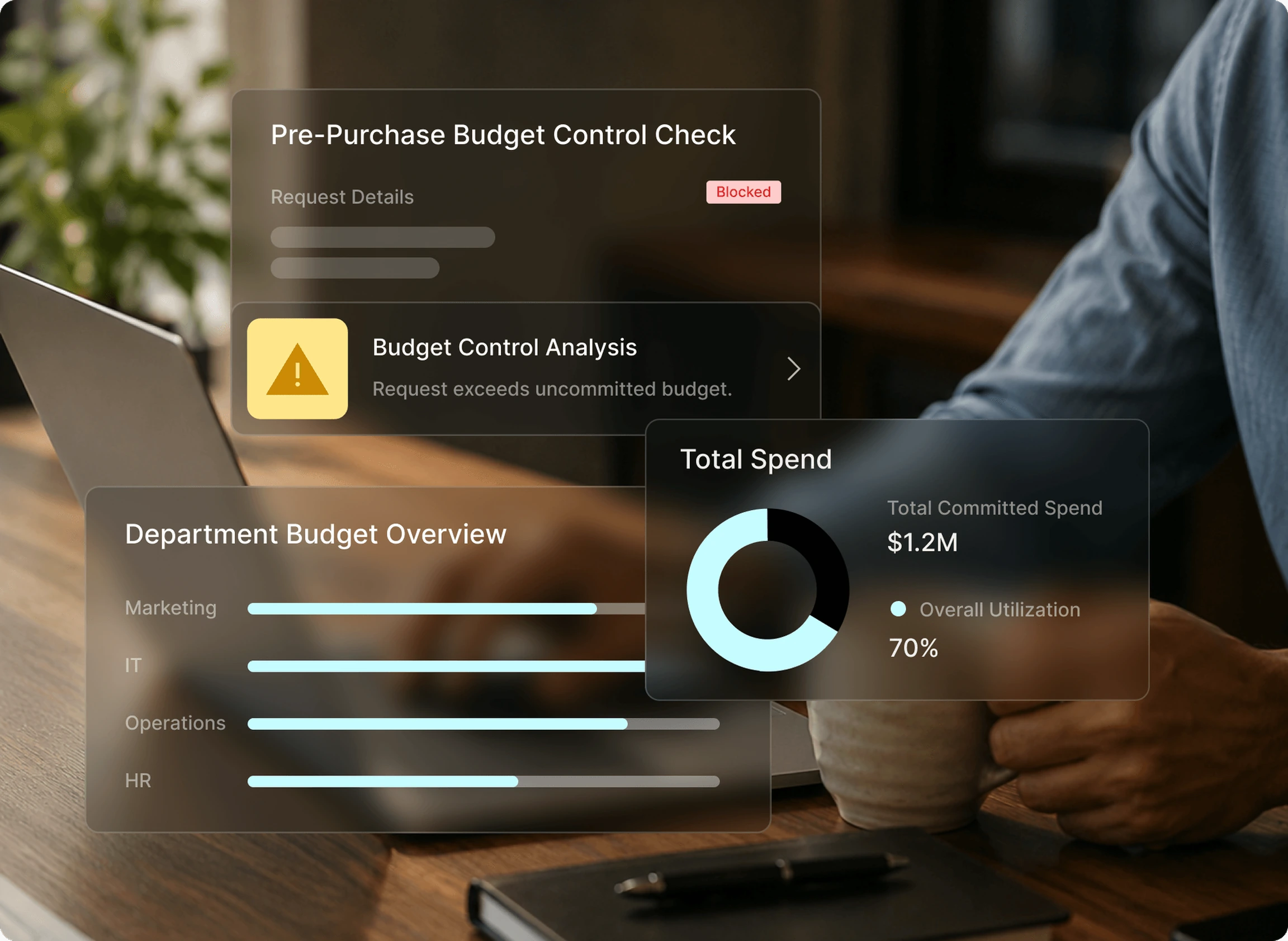
Procurement software closes it by recording the commitment at approval, not at invoice. Budget and spend control checks a request against the relevant budget line, including approved but uninvoiced commitments, so the budget owner sees the real position at the moment of decision. Overrun discovery moves from month-end to the moment of the request, the last moment it can still be prevented.
Four controls that stop a purchase before it exists
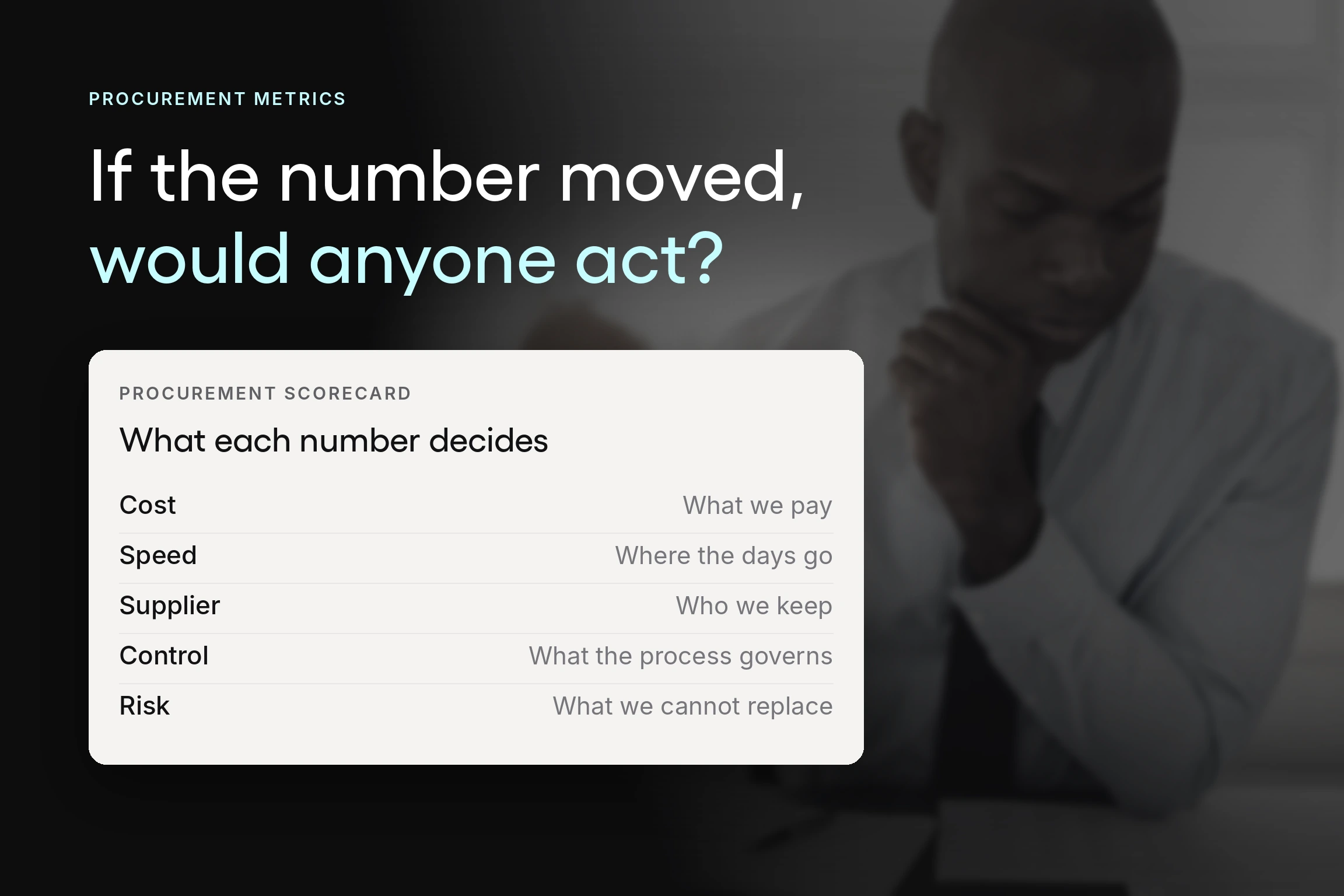
Unauthorized spending covers a wide range, from an employee ordering something without asking to deliberate fraud, and the same controls address most of it.
Controls beat vigilance because of timing, and the evidence is clear. In ACFE's 2026 Report to the Nations, which examined 2,402 cases, more than half of occupational fraud cases involved either a lack of internal controls or an override of existing ones.
The median loss per case was $104,000, and a typical case ran 12 months before anyone detected it. ACFE estimates organizations lose around 5% of revenue to fraud annually, though that figure is an estimate derived from examiner judgment, not a measured sample.
Twelve months is the number that matters for procurement. Detection after the fact is not a control. It is bookkeeping on damage already done.
Four mechanisms prevent unauthorized purchases before they exist.
Approval required before commitment. A purchase request is internal and reversible at no cost. A purchase order is a commitment. Putting the approval between those two states is the cheapest financial control available, and it is the one manual process most often gets the other way around, when a purchase order gets raised after the invoice arrives.
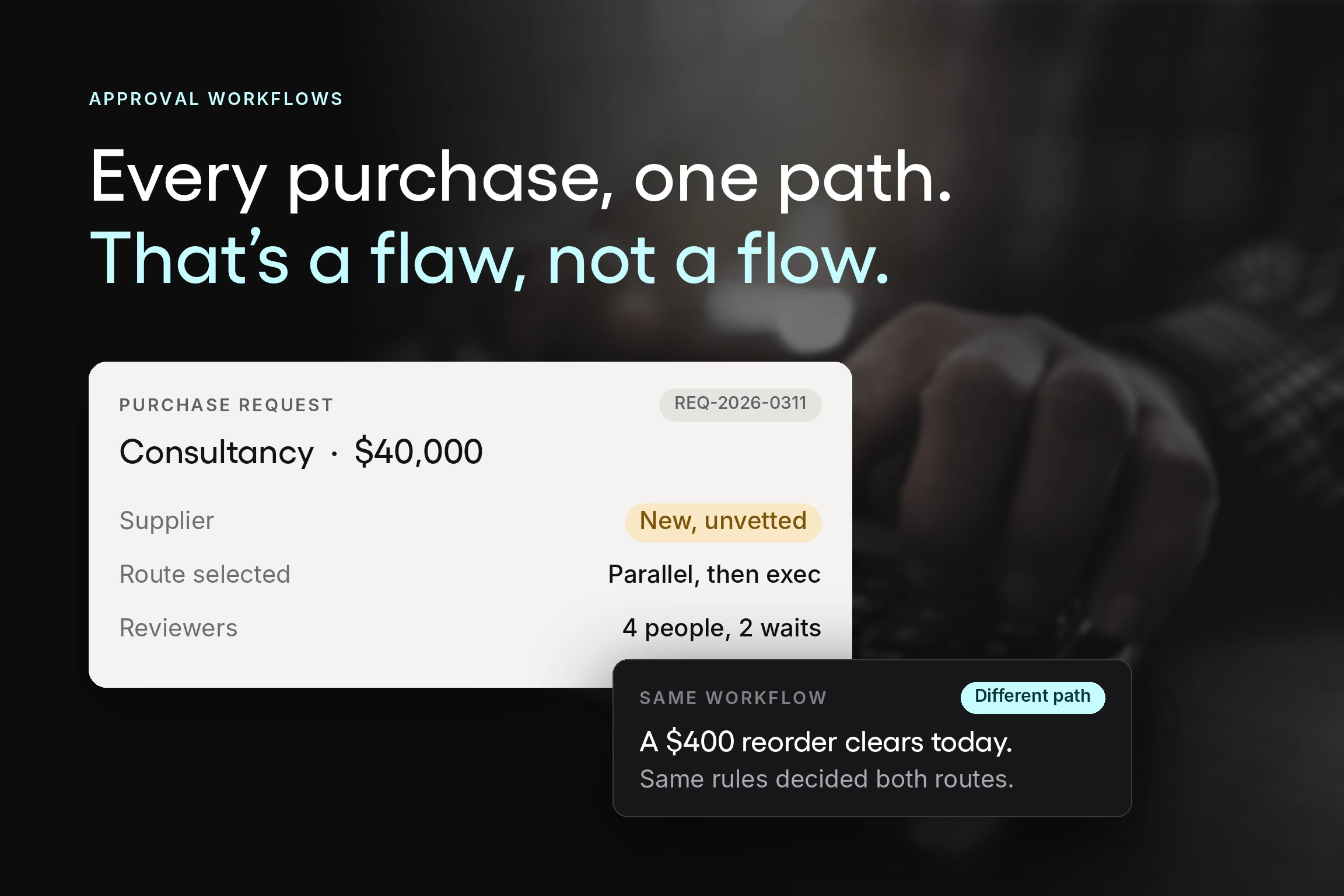
Spending limits applied by rule. Thresholds and approval workflows route requests by amount, department, category, supplier, or project. Policy stops depending on whether an individual remembered it, which also means the rule applies the same way when the requester is senior.
Approved supplier lists enforced at the request. A request naming a supplier outside the agreed arrangement can route to procurement for review before it proceeds. This is where off-contract buying at list price gets caught, and it is the control that protects negotiated pricing without anyone noticing.
Segregation of duties. The person who requests a purchase should not approve it, and they should not approve the invoice either. It is one of the oldest controls in procurement and still one of the strongest, because it requires collusion, not just opportunity.
Taken together, these are risk mitigation measures as much as cost controls, and most cloud-based procurement software applies them as configuration.
The banking-detail switch that catches experienced teams
One specific fraud risk deserves special attention, because the mechanism has shifted and the old controls no longer cover it.
The classic version of supplier payment fraud was a fabricated invoice from a company that does not exist. The current version is a request to change the banking details of a supplier you use every month, sent by email and sometimes even referencing a real order. It is harder to spot precisely because the relationship is real and the invoice is expected.
The scale is not small. The FBI's Internet Crime Complaint Center recorded 24,768 business email compromise complaints in 2025 with $3.05 billion in reported losses, and defines BEC as targeting businesses "working with suppliers," including the redirection of legitimate vendor invoices. Those are self-reported complaints, so the figure is a floor, not a total. Separately, the Association for Financial Professionals reported that 76% of US organizations experienced attempted or actual payments fraud in 2025, with 74% hit by business email compromise, from a survey of 465 treasury practitioners.
The control is unglamorous and close to free: capture and verify supplier banking details at onboarding, hold them on the supplier record, and require a change request to be checked against them through a channel that is not the email that requested the change. That turns a judgment call into a comparison.
Do this one even if you do nothing else on this list.
The running cost of the purchasing function itself
Beyond preventing overruns and unauthorized spend, procurement automation cuts the operational costs of running the purchasing function itself.
This is the least discussed source of procurement cost reduction and often the easiest to measure.
Requests arrive complete. A structured form with required fields replaces free-text email. Many returned requests aren't rejected on merit; they bounce because an estimated cost or budget line is missing. Fixing the form lifts first-pass approval rates without touching the approval rules, and it removes one of the most repetitive manual tasks in the entire purchasing process.
Routing happens by rule. No one has to know the approval hierarchy to use it, and no one chases. Chasing is a hidden operational cost that shows up as approver time, never as a line item.
Approved requests become purchase orders directly. No rekeying between approval and purchase order creation, which removes a whole category of errors before they reach a supplier.
Invoices are checked automatically against the order and receipt. Three-way matching compares the invoice, the purchase order, and the receiving record, so price and quantity differences surface during invoice processing, before payment goes out. This control catches an overcharge that would otherwise go unquestioned.
The audit trail builds itself. Every approval, rejection, delegation, and escalation is recorded with actor and timestamp. Audit preparation stops being a project.
These administrative tasks consume a large share of procurement capacity. Removing them is not glamorous, and in our experience it is the change customers notice first.
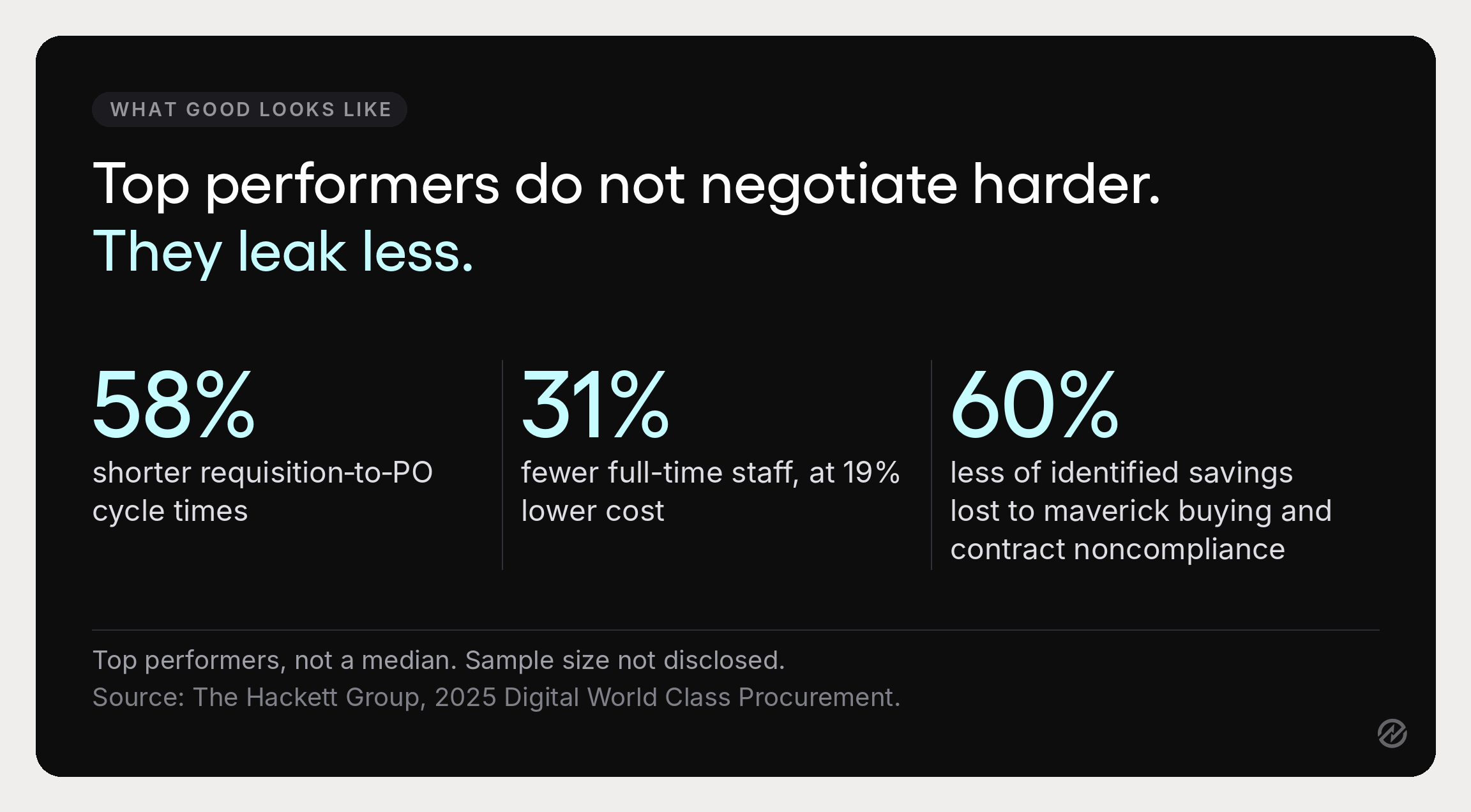
For a sense of what this is worth at the top end, The Hackett Group's 2025 Digital World Class Procurement research found top-performing procurement teams run 58% shorter requisition-to-purchase-order cycle times with 31% fewer full-time staff at 19% lower cost, and lose 60% less of their identified savings to maverick buying and contract noncompliance. Hackett does not disclose the sample size, and these figures describe top performers. Treat them as a ceiling, not an expectation.
Reed Global eliminated 100% of manual accounts payable data entry and doubled its procure-to-pay cycle speed after connecting purchasing and AP in one system.
Sourcing decisions improve once the data stops being scattered
Competitive bidding and stronger supplier management produce savings too, and they depend on data that manual processes scatter.
Competitive bidding becomes practical. When requests for quotation and supplier responses sit side by side in sourcing management software, scored against criteria you published in advance, like-for-like comparison holds. Spread across email threads, it stops happening, and the incumbent wins by default.
Spend analysis reveals consolidation opportunities. The same category bought from eleven suppliers across four departments is invisible on any single requisition and obvious in a spend report. Consolidating low-value purchases is where volume discounts come from, and where a surprising amount of administrative cost sits.
Contract management protects negotiated pricing. Agreements that lapse without review either roll over on terms no one examined or leave purchasing happening with no contract at all. Contract management software that keeps agreements and their renewal dates visible turns a renewal into a decision. Invoices that are never checked against contracted pricing are where a meaningful amount of value leaks back out. Most teams assume the rate card is being applied.
Strategic supplier relationships improve terms beyond price. Payment terms, delivery commitments, and price-review mechanics all carry value, and some are easier to win than a discount. Suppliers who receive predictable orders and reliable payment negotiate differently from those who do not. Supplier relationship management works better when you can track supplier performance over time instead of recalling it at renewal, and consistent supplier performance data makes a switch to cheaper suppliers defensible.
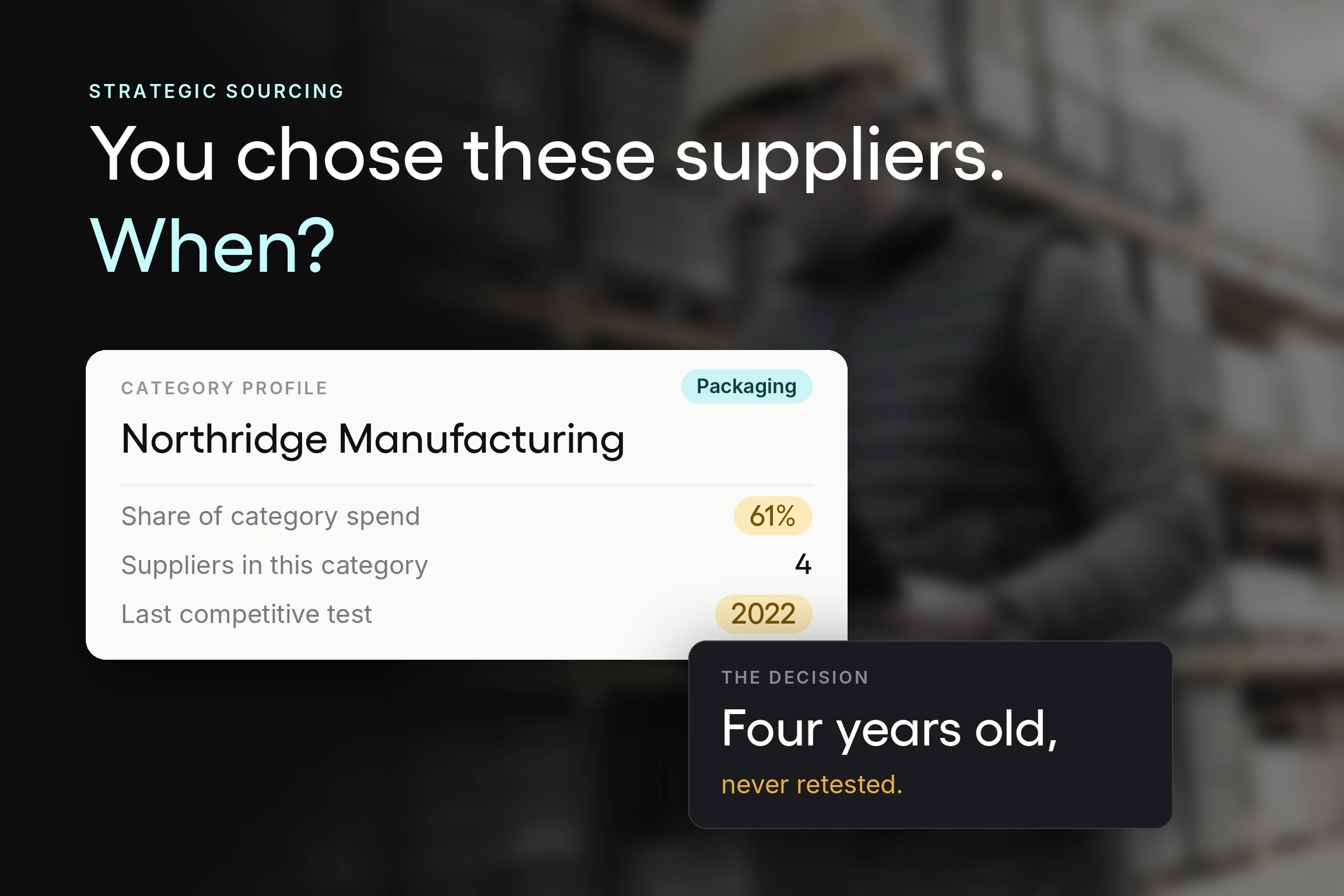
Strategic sourcing extends the same logic backward. A proper sourcing cycle on a category is where the largest single cost-reduction opportunities usually sit. It applies across the entire procurement lifecycle.
A note on demand forecasting and inventory: where an organization holds stock, visibility into purchasing patterns supports better reorder timing, and real-time inventory management reduces both carrying costs and the excess inventory that ties up cash. It also reduces emergency purchases after a stockout, which are rarely bought at a good price. This matters far more in manufacturing and distribution, where supply chain timing drives cost, than in a services business, so weight it accordingly.
Making savings survive the conversation with finance
This is the part most procurement teams underinvest in, and it is why savings claims so often get discounted.
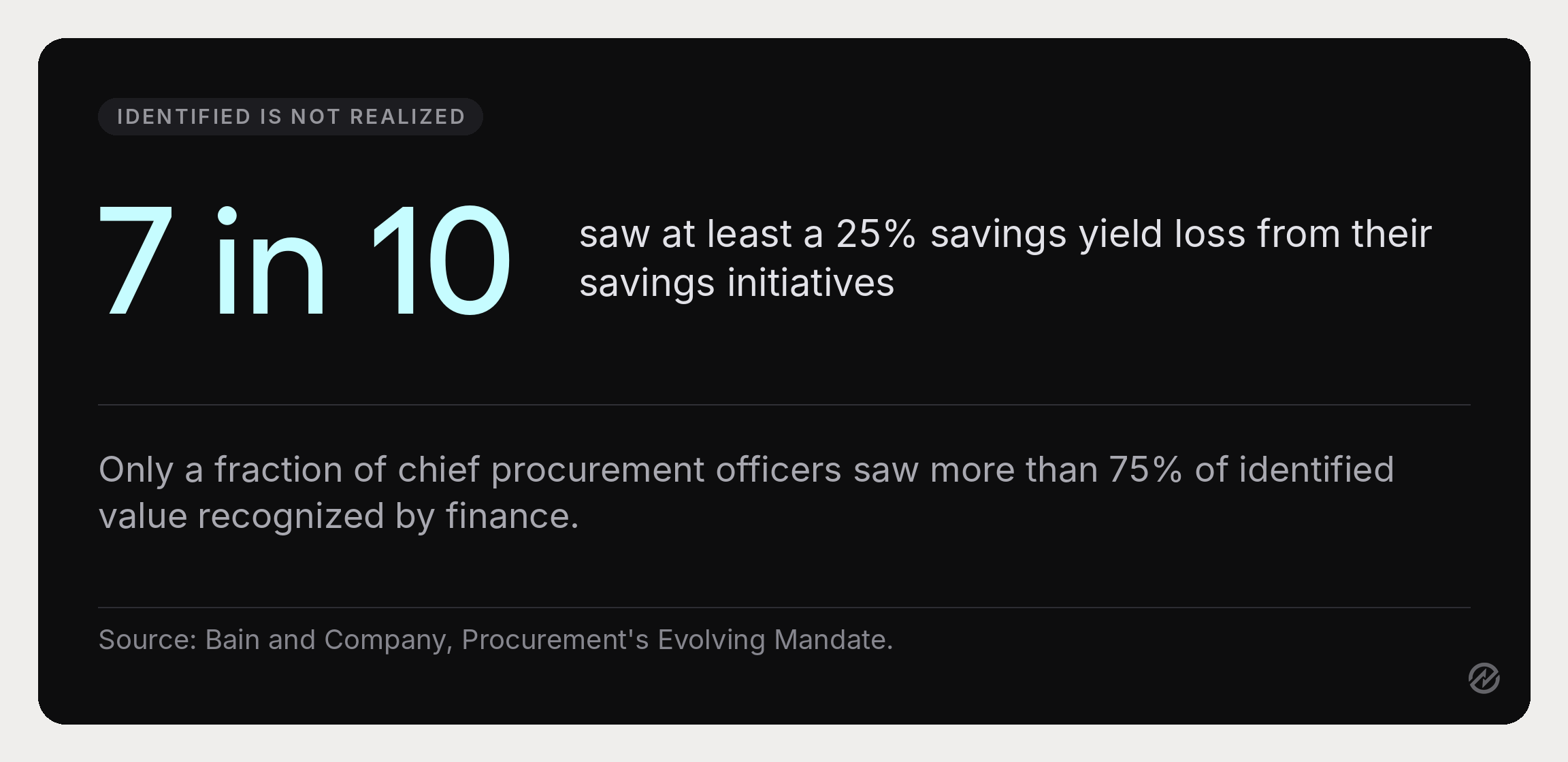
The evidence that this is a widespread problem is unusually clear. Bain & Company found that 7 out of 10 procurement teams saw at least a 25% savings yield loss from their savings initiatives, with only a fraction of chief procurement officers seeing more than 75% of identified value recognized by finance. The savings were identified. They were not realized, or they were not credited, which (from a budget perspective) amounts to the same thing.
Four procurement best practices close much of that gap.
- Document the baseline before you start. What the category cost before, at what volume, on what terms. Savings claimed without a documented starting position are an assertion, and finance will treat them as one. This is the single highest-value habit on the list, and it costs nothing but discipline.
- Adjust for volume. A category that got cheaper because you bought less of it did not produce a procurement saving. Separating price effects from volume effects makes a savings number defensible in a room with a CFO in it.
- Distinguish cost reduction from cost avoidance. Cost reduction lowers a number that appears in the accounts. Cost avoidance prevents an increase that would otherwise have happened, such as holding pricing flat in a rising market. Both are real, but they land differently on a budget, and conflating them is the fastest way to lose finance's trust.
- Track spend under contract as a leading indicator. The share of spend flowing through negotiated agreements tells you whether sourcing decisions are reaching daily purchasing. It is a more reliable measure of whether savings will materialize than the savings forecast is, because it measures behavior instead of intent.
Savings tracking software is really just procurement reporting pointed at a specific question: what did this cost before, what does it cost now, and did the change survive? Treat it as cost management. Our guide to procurement KPIs covers the wider measurement set.
Bonus: the early payment discount finance can see
Early payment discounts are one of the few procurement savings that land directly in the accounts, and teams routinely miss them for a simple reason: the invoice isn't approved in time.
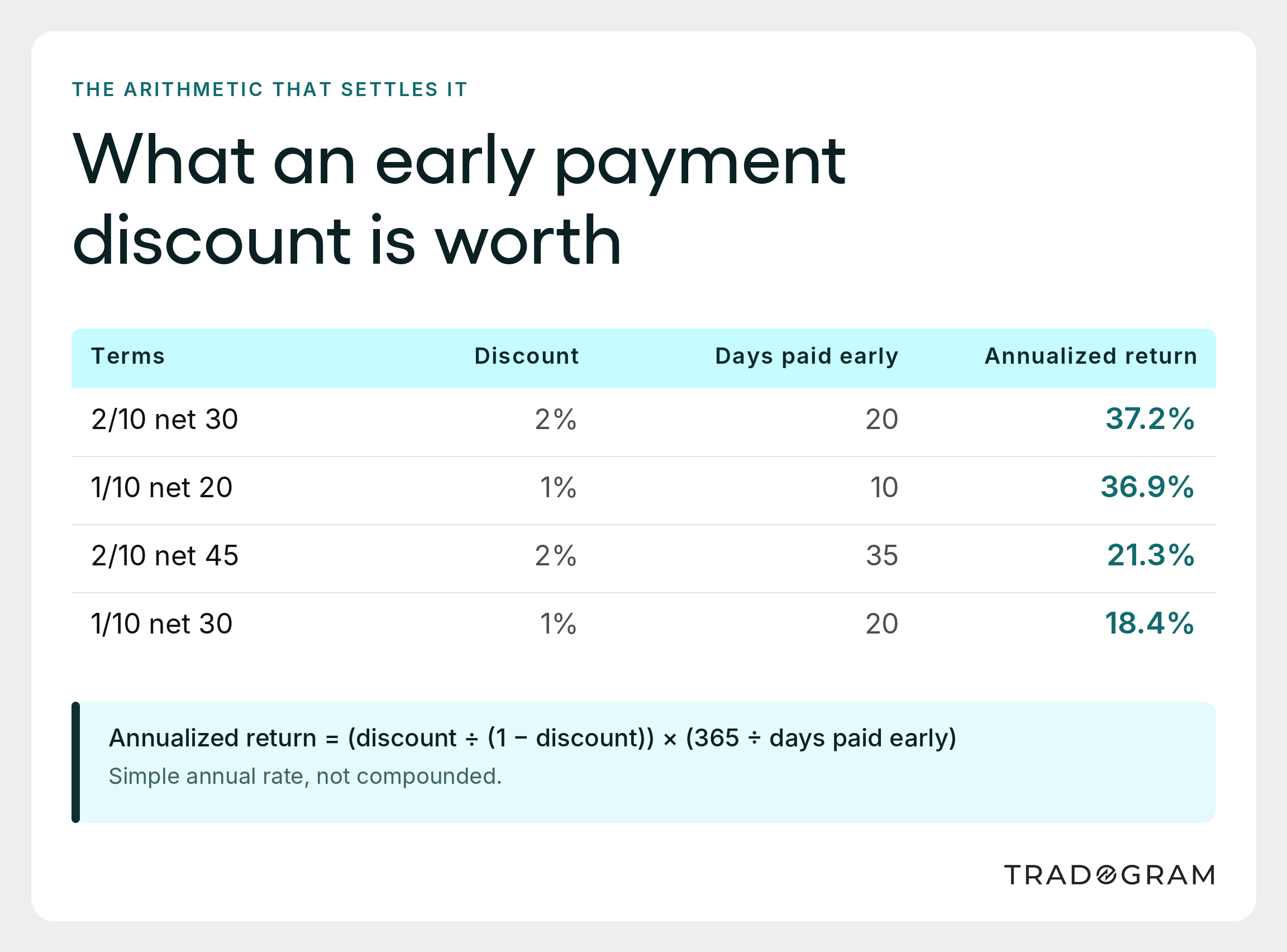
The math is better than most teams realize. Terms of 2/10 net 30 mean a 2% discount for paying within 10 days instead of 30. Annualized, that 20-day acceleration is worth about 37%.
As long as the cash is available without borrowing at a higher rate, few uses of short-term cash pay as well. The catch is the 10-day window. An invoice that waits on a missing purchase order, an unmatched receipt, or a traveling approver misses it, and the discount reverts to full price.
That is where the controls in this guide pay off a second time. When the purchase order already exists, and the receipt is recorded against it, the invoice can be matched and approved inside the discount window. Visibility into committed spend also improves cash flow forecasting, so finance knows the cash will be there before the invoice arrives.
Two habits keep this credible with finance. Track discounts captured against discounts offered, since the gap between them is the measurable cost of a slow approval process. And book captured discounts as cost reduction, because they lower a number that appears in the accounts.
Paying on time matters even when no discount is on offer. Suppliers who are paid reliably negotiate differently, and that shows up later as better terms.
How this looks in Tradogram
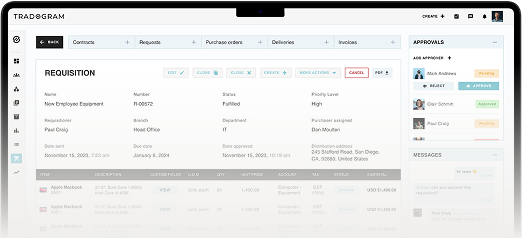
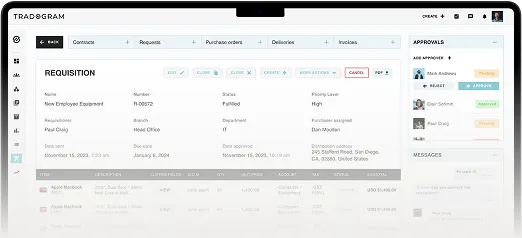
Tradogram connects purchase requests, configurable approval workflows, budget checks, purchase orders, receiving, and invoice matching in one system. That is how committed spend becomes visible before the invoice lands.
The specific workflow change is small and the effect is not, because it applies across the entire procurement process. A requester raises a request against a budget line. The system checks the line including approved but uninvoiced commitments and shows the real remaining balance to the approver. The rules route it by amount, department, supplier, and category. Once approved, it becomes a purchase order without retyping, receiving is recorded against it, and the invoice is matched against both before payment is released.
River Edge Behavioral Health reported a 20 to 25% cost reduction and a 40 to 50% reduction in approval time. A nonprofit cut its purchasing costs in half.
Worth a quick caveat: procurement management software enforces the policy you write. It does not write it, and it will not settle an argument about who owns a budget. What it does is make the answer visible at the moment somebody needs it.
On implementation: most procurement systems connect to the accounting or enterprise resource planning software finance already uses, so approved spend reaches them without an export file. A successful implementation usually depends less on the technical setup than on settling the thresholds and budget ownership first, so implementing procurement software one department at a time tends to work better than switching everything at once.
The three-step audit you can run this week
Three steps, in order, and none of them require software. That is the point: you can reduce costs meaningfully before you buy anything.
Find out what your committed spend really is. Pick one department and add up every purchase that has been approved but not yet invoiced. If that number is uncomfortable to produce, you have found the gap, and you have also found the argument for closing it.
List every renewal due in the next 90 days. Include subscriptions, service contracts, and annual licenses that will renew automatically unless someone stops them. Next to each one, name the person who will decide whether it continues. A renewal no one re-decides is a default purchase, and it is one of the easiest savings to recover.
Baseline one category before you try to save anything in it. Document what it costs today at current volume. Then, whatever you change, you can prove what happened. That is the difference between a procurement solution that saves money and one that says it did.
After that, software makes the pattern durable instead of dependent on memory. The organizations that save money consistently are the ones that made these three habits routine, not the ones that bought the most capable system. Those three steps cost nothing but a decision and an afternoon. If the numbers they produce make the case, book a demo and bring them with you.